
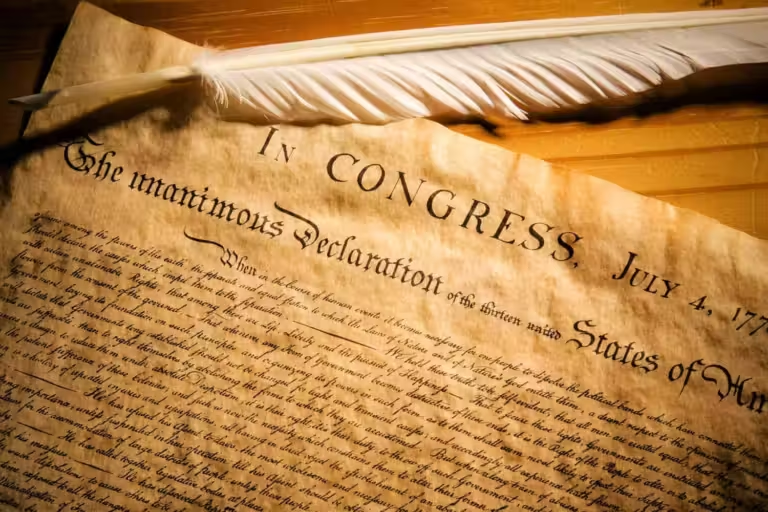
Declaration of Independence displayed beneath a quill, symbolising the political birth of the United States in 1776

USA: Birth of a Nation — From Independence to the Constitution

  1. The Reformation in the British Isles: Causes and Legacy
  2. English Expansionism: From the British Isles to the Atlantic Empire
  3. The Glorious Revolution of 1688: Causes and Legacy
  4. The American Colonies: Religion, Politics and Self-Government
  5. USA: Birth of a Nation — From Independence to the Constitution

The United States was not born in a single moment on 4 July 1776. The Declaration of Independence announced that the colonies considered themselves free states, but independence still required military victory, diplomatic recognition and a functioning political union. The Articles of Confederation created the first national government, while the Constitution of 1787 replaced that loose alliance with a stronger federal republic.

The creation of the United States began inside a crisis of the British Empire. War debt, western expansion, customs enforcement and parliamentary taxation had already transformed disagreement into organised colonial resistance.

When was the United States born?

Several dates can represent the birth of the United States. The Declaration of Independence announced separation from Britain in 1776, while the Treaty of Paris secured international recognition in 1783. The Constitution created the present federal system in 1787–1789, and the Bill of Rights added important protections in 1791.

Each date represents a different stage of nation-building. Independence was first a political claim, then a military achievement, then a diplomatic reality and finally a constitutional system. The new nation emerged through this cumulative process rather than through one ceremony or document.

The term “nation” also requires care. The thirteen colonies became thirteen states before they developed a powerful national government. Many inhabitants initially felt stronger loyalty towards their state, locality, religious community or region than towards an abstract American nation.

The Revolution nevertheless created new shared institutions, symbols and political language. Congress, the Continental Army, foreign diplomacy and common resistance encouraged people from separate colonies to imagine themselves as part of one political community.
Lire USA: Birth of a Nation — From Independence to the Constitution

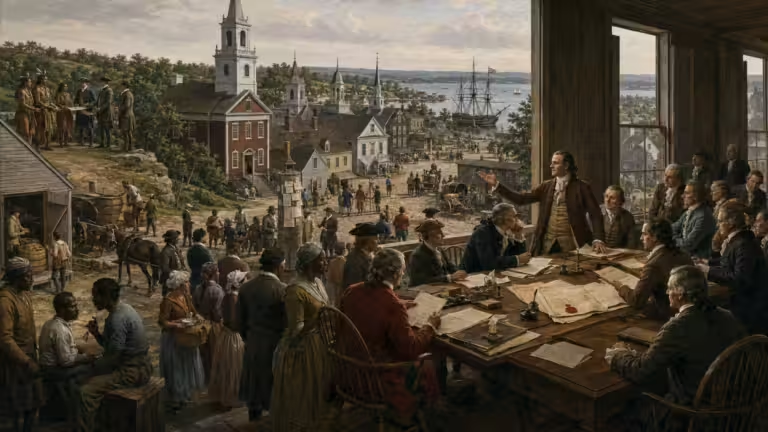
Colonial representatives debate laws and petitions in a British American town while religious communities, Indigenous diplomats, merchants and enslaved workers reveal the limits of colonial self-government

The American Colonies: Religion, Politics and Self-Government

  1. The Reformation in the British Isles: Causes and Legacy
  2. English Expansionism: From the British Isles to the Atlantic Empire
  3. The Glorious Revolution of 1688: Causes and Legacy
  4. The American Colonies: Religion, Politics and Self-Government
  5. USA: Birth of a Nation — From Independence to the Constitution

Religion and politics developed together throughout British colonial America. Congregationalists, Anglicans, Quakers, Catholics, Presbyterians, Baptists, Lutherans and other communities created sharply different colonial societies. Elected assemblies, town meetings and local courts encouraged habits of self-government, yet colonial liberty remained restricted by established churches, property qualifications, slavery, Indigenous dispossession and the continuing authority of the British Empire.

The colonies did not develop outside the Atlantic economy. British trade laws, protected markets, maritime commerce and enslaved labour shaped the societies whose religious and political institutions this article examines.

The American colonies were not one society

The thirteen colonies that later formed the United States did not share one religion, economy or political structure. They developed at different times under royal, proprietary and corporate charters. Their populations included English, Scottish, Irish, Welsh, Dutch, German, French, Swedish and African people, alongside Indigenous nations whose homelands long preceded European settlement.

New England contained compact towns, Congregational churches and maritime economies. The Chesapeake and Lower South relied increasingly on plantation agriculture and enslaved labour. The Middle Colonies developed commercially active ports and some of British North America’s most religiously diverse populations.

These distinctions influenced political institutions. Town meetings played an important role in parts of New England, whereas county courts, parish vestries and plantation elites exercised greater local authority in the South. Representative assemblies existed throughout the colonies, but their powers and electorates varied considerably.

The phrase “colonial America” can therefore conceal competing regional experiences. The colonies shared allegiance to the Crown and participation in the British Atlantic system, yet they remained strongly attached to their separate charters, assemblies, churches and local interests.

Lire The American Colonies: Religion, Politics and Self-Government

The Glorious Revolution of 1688

The Glorious Revolution of 1688: Causes and Legacy

  1. The Reformation in the British Isles: Causes and Legacy
  2. English Expansionism: From the British Isles to the Atlantic Empire
  3. The Glorious Revolution of 1688: Causes and Legacy
  4. The American Colonies: Religion, Politics and Self-Government
  5. USA: Birth of a Nation — From Independence to the Constitution

The Glorious Revolution of 1688 replaced James II with the joint monarchy of William III and Mary II after a large Dutch military intervention. The resulting settlement restricted several royal powers and strengthened Parliament in England. However, the revolution was neither bloodless nor identical across the three kingdoms: Scotland adopted its own Claim of Right, while Ireland endured a major Williamite-Jacobite war.

The crisis of 1688 emerged from the unresolved conflicts of the Restoration. James II had alienated Anglicans, Tories, dissenters and military officers through his use of royal prerogative, his standing army and his promotion of Catholic officeholders.

What was the Glorious Revolution?

The Glorious Revolution was the political and military crisis of 1688–1689 that removed the Catholic James II from the thrones of England, Scotland and Ireland. His Protestant daughter Mary and her Dutch husband William of Orange replaced him as joint monarchs.

The name “Glorious Revolution” became popular because later supporters portrayed the transfer of power as lawful, Protestant and comparatively peaceful. This interpretation emphasised parliamentary liberty and contrasted 1688 with the Civil Wars and regicide of the 1640s.

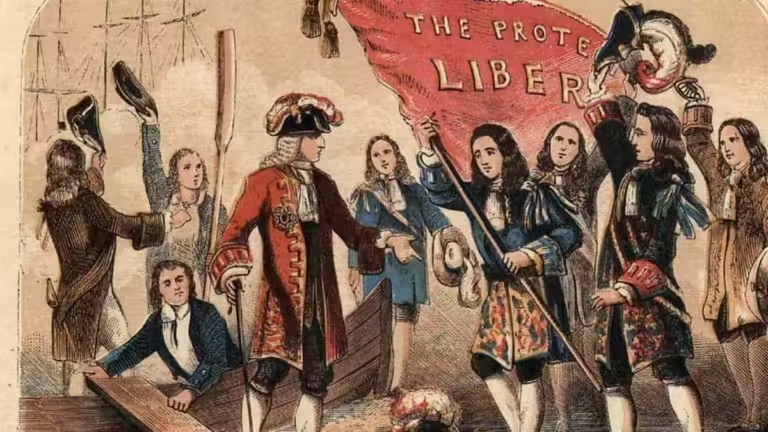
However, William did not simply accept an invitation and arrive as an unarmed mediator. He crossed the Channel with a Dutch fleet, professional soldiers, artillery and substantial financial support. His expedition constituted a foreign invasion, even though English political and military defections allowed it to succeed with limited fighting in England.

The revolution also developed differently across the Stuart kingdoms. England experienced a rapid collapse of royal authority. Scotland adopted a separate constitutional and religious settlement, while Ireland became the principal battlefield between Williamite and Jacobite forces.

Lire The Glorious Revolution of 1688: Causes and Legacy