
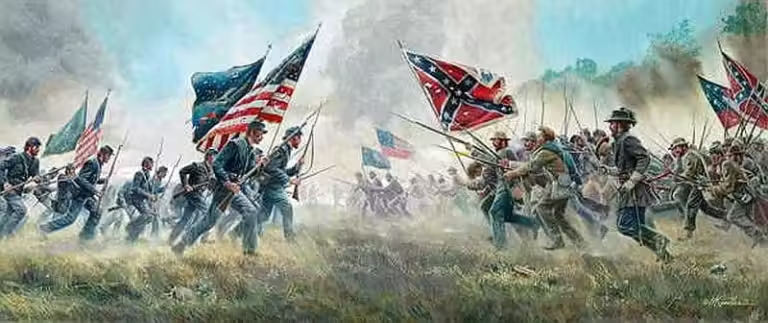
The American Civil War began in 1861 after eleven Southern states left the Union to protect a political order founded on slavery. What began as a war to preserve the United States became a struggle for emancipation. Union victory destroyed the Confederacy, abolished slavery and opened the contested era of Reconstruction.
The American Civil War was fought between the United States and the Confederate States of America from 1861 to 1865.
The conflict transformed the Constitution, destroyed legal slavery and established that individual states could not leave the Union by force.
It also caused destruction on an unprecedented scale. Millions of soldiers served, hundreds of thousands died and much of the fighting took place across the Southern states.
The war did not result from one isolated disagreement. Decades of political conflict, territorial expansion and sectional rivalry preceded it. However, slavery stood at the centre of those disputes.

What caused the American Civil War?
The immediate crisis began after Abraham Lincoln won the presidential election of 1860. However, the origins of the conflict extended much further back.
The Northern and Southern states developed different economic and political priorities during the first half of the nineteenth century.
The North industrialised and urbanised more rapidly. The South remained more dependent on commercial agriculture and enslaved labour.
These economies were not independent. Northern banks, merchants and textile mills profited from slave-grown cotton. Nevertheless, their political interests increasingly diverged.
The most divisive question concerned slavery’s expansion into western territories. Every new territory threatened to alter the balance between free and slave states.
For the political and economic background, read North and South Before the American Civil War.
Slavery and territorial expansion
Southern slaveholders wanted access to western land. They also feared that permanently restricting slavery would weaken their political influence and threaten the institution’s future.
Many Northerners opposed slavery’s expansion without demanding immediate abolition where it already existed. Republicans argued that western territories should remain available to free labour.
The Missouri Compromise, Compromise of 1850 and Kansas-Nebraska Act repeatedly attempted to manage the conflict. Each settlement delayed confrontation without resolving the underlying issue.
The Dred Scott decision of 1857 further intensified the crisis by declaring that Congress could not prohibit slavery in federal territories.
The wider social structure of the slaveholding states is examined in Antebellum South: Society, Slavery and Secession.
Was the war about states’ rights?
Secessionists frequently defended their actions through the language of state sovereignty and constitutional rights.
However, the essential question is which rights they sought to protect. The declarations issued by seceding states repeatedly identified slavery, opposition to slavery and resistance to the Fugitive Slave Act as central grievances.
Southern politicians defended state authority when it protected slavery. At the same time, they demanded federal intervention when Northern states resisted the capture and return of fugitives.
States’ rights formed part of the constitutional argument, but slavery gave that argument its political urgency.
The secession crisis
Abraham Lincoln won the presidential election on 6 November 1860. He opposed the extension of slavery into federal territories but did not campaign on immediate abolition within existing slave states.
Nevertheless, many Southern leaders considered his election a decisive threat. Lincoln had won without carrying a state in the Deep South, while the Republican Party possessed no meaningful Southern base.
South Carolina seceded on 20 December 1860. Mississippi, Florida, Alabama, Georgia, Louisiana and Texas followed during the next six weeks.
Delegates from these states organised the Confederate States of America at Montgomery, Alabama, on 4 February 1861.
They selected Jefferson Davis of Mississippi as provisional president. The Confederate Constitution resembled the United States Constitution but explicitly protected slavery.
Secession remained controversial within the South. Unionists opposed disunion in several states, particularly in mountainous and border regions.
The first seven seceding states nevertheless seized federal forts, arsenals and other property within their territory. Fort Sumter in Charleston Harbor remained under United States control.

Fort Sumter and the outbreak of war
Lincoln took office on 4 March 1861. In his inaugural address, he stated that he had no intention of interfering with slavery where it already existed.
He also rejected the legality of secession and insisted that the Union remained unbroken.
Fort Sumter was running short of supplies. Lincoln informed South Carolina that he intended to send provisions rather than reinforcements.
Confederate forces opened fire on the fort on 12 April 1861. Its garrison surrendered the following day.
Lincoln then called for 75,000 militia volunteers to suppress the rebellion. This decision forced the Upper South to choose between the Union and the Confederacy.
Virginia, Arkansas, North Carolina and Tennessee subsequently seceded. Richmond became the Confederate capital.
Delaware, Maryland, Kentucky and Missouri remained in the Union, although divided loyalties produced political conflict and military violence. The western counties of Virginia later separated and entered the Union as West Virginia in 1863.
The strengths of the Union and the Confederacy
The Union entered the war with major material advantages.
- It possessed a much larger free population.
- It controlled most of the country’s factories and industrial workers.
- It had more railway mileage and greater financial resources.
- It produced more food and manufactured weapons.
- It retained the existing navy and federal government.
The Confederacy had approximately 5.5 million free inhabitants and 3.5 million enslaved people. The Union and loyal border states possessed a much larger population from which to recruit soldiers and workers.
However, the Confederacy did not need to conquer the entire North. It needed to defend its territory long enough to exhaust Northern political support.
Southern armies also fought mainly on familiar ground and included experienced officers such as Robert E. Lee, Joseph E. Johnston and Thomas “Stonewall” Jackson.
The importance of military leadership should not be exaggerated. The Union also possessed capable commanders, particularly Ulysses S. Grant, William T. Sherman, George H. Thomas and Philip Sheridan.
Furthermore, Confederate reliance on enslaved labour created a profound vulnerability. Enslaved people could escape, withdraw their labour, provide intelligence and assist Union forces whenever federal armies approached.

The military strategies
The Union needed to restore federal authority across an enormous territory. Its broad strategy developed around several objectives.
- Blockade Confederate ports.
- Control the Mississippi River.
- Capture Richmond and destroy major Confederate armies.
- Cut railway and supply networks.
- Use the Union’s greater manpower and industrial capacity over time.
General-in-Chief Winfield Scott proposed a blockade and control of the Mississippi. Newspapers mockingly called this the Anaconda Plan because it appeared designed to squeeze the Confederacy gradually.
The Confederate strategy was primarily defensive, although its armies also invaded Northern territory.
Confederate leaders hoped battlefield victories would weaken Northern morale, encourage foreign recognition and produce a negotiated independence.
1861: expectations of a short war
Many people on both sides initially expected a short conflict. Volunteers enlisted enthusiastically, often believing that one decisive battle would settle the issue.
The First Battle of Bull Run, also called First Manassas, took place near Washington on 21 July 1861.
Union forces initially advanced, but Confederate reinforcements turned the battle. The disorganised Union retreat demonstrated that the rebellion would not end quickly.
The battle also gave Thomas Jackson the nickname “Stonewall”. According to the traditional account, another Confederate officer compared Jackson’s brigade to a stone wall during the fighting.
After Bull Run, both governments raised larger armies and prepared for a prolonged war.

The war in the West
Although public attention often focused on Virginia, the western theatre was strategically decisive.
Union forces sought to control rivers and penetrate the Confederate interior. Ulysses S. Grant won important victories at Fort Henry and Fort Donelson in February 1862.
These victories opened routes into Tennessee and earned Grant the nickname “Unconditional Surrender” Grant.
The Battle of Shiloh followed in April 1862. Two days of intense fighting produced heavy losses and ended hopes that the western campaign would be easy.
That same month, naval forces commanded by David Farragut captured New Orleans, the Confederacy’s largest city and most important port.
Union control of the Mississippi gradually tightened, although the Confederate fortress at Vicksburg continued to block complete navigation.
The Peninsula Campaign and Robert E. Lee
In spring 1862, Union General George B. McClellan transported the Army of the Potomac to the Virginia Peninsula.
He intended to approach Richmond from the southeast and avoid a direct overland campaign from Washington.
McClellan moved cautiously and repeatedly overestimated Confederate strength. After General Joseph E. Johnston was wounded, Robert E. Lee took command of the Army of Northern Virginia.
During the Seven Days Battles, Lee launched a series of costly attacks that forced McClellan away from Richmond.
Lee’s success protected the Confederate capital and established him as the South’s most prominent commander.
Antietam and the transformation of the war
After further Confederate victories in Virginia, Lee invaded Maryland in September 1862.
He hoped to obtain supplies, influence Northern opinion and perhaps encourage British or French recognition of the Confederacy.
Union and Confederate forces met near Sharpsburg, Maryland, on 17 September at the Battle of Antietam.
Approximately 22,700 soldiers were killed, wounded or reported missing. Antietam became the bloodiest single day in United States military history.
The battle was tactically inconclusive, but Lee withdrew to Virginia. Lincoln therefore treated it as a strategic Union success.
Five days later, he issued the Preliminary Emancipation Proclamation. Antietam consequently marked a major political turning point.
From preserving the Union to emancipation
Lincoln initially defined the war’s principal objective as preserving the Union.
He had constitutional, military and political reasons for proceeding cautiously. The loyal border states still permitted slavery, while many Northern voters did not support immediate abolition.
However, enslaved people transformed the situation from the beginning of the war. Thousands escaped to Union lines and refused to return to bondage.
Union officers initially adopted inconsistent policies. Congress later passed Confiscation Acts that authorised the seizure and eventual liberation of enslaved people used to support the rebellion.
Emancipation weakened the Confederate economy, deprived enslavers of labour and allowed formerly enslaved men to join the Union forces.
The Emancipation Proclamation
The final Emancipation Proclamation took effect on 1 January 1863.
It declared enslaved people free within states and designated areas still in rebellion against the United States.
The proclamation did not immediately abolish slavery throughout the country. It did not apply to loyal border states or to certain Confederate areas already under Union control.
Its importance was nevertheless immense.
- It made emancipation an explicit Union war aim.
- It authorised the recruitment of Black soldiers.
- It discouraged European powers from supporting the Confederacy.
- It turned Union military advance into an instrument of liberation.
- It made the restoration of the pre-war Union increasingly impossible.
The proclamation did not grant freedom as a gift independently of Black action. Enslaved people had already weakened slavery through escape, resistance and assistance to Union armies.
African American soldiers and sailors
More than 180,000 African American soldiers served in the Union Army. Thousands more served in the Navy.
Most served in segregated units known collectively as the United States Colored Troops. Their commissioned officers were generally white.
Black soldiers initially received lower pay and inferior equipment. They also faced the danger that Confederate forces might execute or re-enslave them if captured.
They fought in major operations at places such as Port Hudson, Fort Wagner, New Market Heights, Petersburg and Appomattox.
Their service strengthened the Union military effort and transformed the meaning of citizenship. Men previously excluded from national political life now fought directly for the survival and reconstruction of the republic.
1863: Gettysburg and Vicksburg
The summer of 1863 produced two of the most important Union victories of the war.
The Battle of Gettysburg
Lee invaded the North for a second time in June 1863. He hoped to gather supplies, threaten Northern cities and influence public opinion.
Union and Confederate forces met at Gettysburg, Pennsylvania, from 1 to 3 July.
The battle involved approximately 165,000 soldiers and produced around 51,000 casualties, including those killed, wounded, captured or missing.
On the third day, the failed Confederate assault commonly known as Pickett’s Charge ended Lee’s offensive.
Lee withdrew to Virginia. The defeat ended his strongest attempt to win a decisive victory on Northern soil.
Gettysburg did not make Confederate defeat immediate or inevitable. The Army of Northern Virginia remained dangerous for almost two more years.
The fall of Vicksburg
Meanwhile, Grant conducted a complex campaign against Vicksburg, Mississippi.
After crossing the Mississippi south of the city, his army defeated Confederate forces in several battles and surrounded Vicksburg.
The Confederate garrison surrendered on 4 July 1863.
Union control of the Mississippi divided the Confederacy geographically. Texas, Arkansas and most of Louisiana became increasingly isolated from the eastern Confederate states.
Gettysburg and Vicksburg together shifted the strategic balance towards the Union.
The Gettysburg Address
Lincoln delivered the Gettysburg Address on 19 November 1863 during the dedication of a national cemetery.
The speech lasted only a few minutes. Yet it redefined the war through the principles of the Declaration of Independence.
“That government of the people, by the people, for the people, shall not perish from the earth.”Abraham Lincoln, Gettysburg Address, 1863
Lincoln presented the conflict as a test of whether a nation founded on liberty and equality could survive.
His phrase “a new birth of freedom” connected preservation of the Union with emancipation and democratic renewal.
Life on the home front
The war transformed civilian life across both sections.
Governments introduced conscription, taxation and new financial systems. Families faced separation, bereavement and economic disruption.
The Northern home front
Northern industry expanded to supply uniforms, weapons, railways and food. The federal government introduced a national currency, income taxation and banking reforms.
However, the war also provoked political opposition. Peace Democrats criticised Lincoln’s policies, while disputes over conscription contributed to the New York City Draft Riots of July 1863.
The riots combined opposition to the draft with racist violence. Mobs attacked Black residents, homes and institutions.
The Confederate home front
The Southern economy suffered from blockade, military destruction, transport breakdown and the loss of enslaved labour.
Inflation made basic goods increasingly expensive. Food shortages led to unrest, including the Richmond Bread Riot of April 1863.
The Confederate government introduced conscription and taxation despite its commitment to states’ rights.
Policies that exempted some wealthy slaveholders from military service encouraged the complaint that it was “a rich man’s war and a poor man’s fight”.
Women and the war
Women managed farms, businesses and households while male relatives served in the armies.
Thousands worked as nurses, relief organisers, laundresses, cooks and government employees. Some served as spies, scouts or soldiers disguised as men.
Enslaved women faced displacement, violence and uncertainty, but they also escaped to Union lines and sought to reunite families.
The war expanded women’s public responsibilities without immediately granting equal political rights.
Grant takes command
Lincoln appointed Ulysses S. Grant commander of all Union armies in March 1864.
Grant developed coordinated campaigns intended to prevent Confederate armies from transferring troops between theatres.
He accompanied the Army of the Potomac in Virginia, where General George G. Meade retained direct command.
The Overland Campaign brought relentless fighting at the Wilderness, Spotsylvania and Cold Harbor.
Grant suffered severe casualties, but he continued moving south rather than retreating after each battle.
Union forces eventually crossed the James River and attacked Petersburg, a vital railway centre supplying Richmond.
The resulting siege lasted from June 1864 until April 1865.
Sherman, Atlanta and the March to the Sea
In the western theatre, William T. Sherman advanced towards Atlanta during summer 1864.
The city fell to Union forces on 2 September. Its capture strengthened Northern morale and helped Lincoln win re-election in November.
Sherman then marched from Atlanta to Savannah. His forces destroyed railway lines, military facilities, supplies and property that could support Confederate armies.
They also lived partly from the countryside, seizing food and livestock. Soldiers frequently looted or destroyed private property beyond formal orders.
Historians debate whether Sherman’s campaign should be labelled “total war”. His armies did not generally pursue the systematic killing of civilians.
However, they deliberately targeted the South’s economic capacity and civilian willingness to continue the conflict. The campaign represented a form of hard war directed against the material foundations of Confederate resistance.
Sherman captured Savannah on 21 December 1864 and then marched north through the Carolinas.
The election of 1864
Lincoln’s re-election was not guaranteed. Military losses and war weariness had weakened confidence in his administration.
The Democratic Party nominated former Union General George B. McClellan. Its platform called for negotiations, although McClellan personally supported continuing the war until the Union was restored.
The fall of Atlanta changed the political atmosphere. Lincoln won a clear victory in both the popular vote and Electoral College.
Union soldiers voted heavily for him. The result confirmed that the North would continue the war and the policy of emancipation.
The collapse of the Confederacy
By early 1865, Confederate armies faced manpower shortages, declining supplies and multiple Union offensives.
Union forces broke through the lines around Petersburg on 2 April. Lee evacuated Petersburg and Richmond, while the Confederate government fled.
Lee attempted to move west and join other Confederate forces. Union armies blocked his route and captured essential supplies.
On 9 April 1865, Lee surrendered the Army of Northern Virginia to Grant at Appomattox Court House.
Grant offered generous military terms. Confederate soldiers surrendered their weapons, received paroles and returned home. Officers could retain their sidearms, while soldiers who owned horses could take them for spring planting.
Appomattox symbolised the effective defeat of the Confederacy, but it did not end every military operation immediately.
Joseph E. Johnston surrendered a major Confederate force to Sherman in North Carolina later in April. Other commands surrendered during May and June.
The last significant land battle occurred at Palmito Ranch, Texas, in May 1865. The final Confederate land force under Stand Watie surrendered in June.
The assassination of Abraham Lincoln
On 14 April 1865, actor and Confederate sympathiser John Wilkes Booth shot Lincoln at Ford’s Theatre in Washington.
Lincoln died the following morning. Vice President Andrew Johnson became president.
Booth had participated in a wider conspiracy intended to attack several members of the federal government.
Lincoln’s assassination did not end the war. Nor did it cause the abolition of slavery. However, it profoundly affected the political atmosphere surrounding reunion and Reconstruction.
The abolition of slavery
The Emancipation Proclamation applied only to areas in rebellion. A constitutional amendment was therefore necessary to abolish slavery throughout the United States.
Congress approved the Thirteenth Amendment on 31 January 1865.
The required number of states ratified it on 6 December 1865.
The amendment prohibited slavery and involuntary servitude, except as punishment for a crime after conviction.
Its ratification legally abolished slavery across the country. However, freedom did not automatically provide land, economic independence, education, citizenship or protection from violence.
Those questions became central during Reconstruction after the American Civil War.
Why did the Union win?
No single factor explains the Union victory.
- The Union possessed greater population, industry, finance and transport capacity.
- The naval blockade restricted Confederate trade and imports.
- Control of the Mississippi divided the Confederacy.
- Grant coordinated sustained pressure across several theatres.
- Black military service added substantial manpower to Union forces.
- Enslaved people weakened the Confederate economy through escape and resistance.
- The Confederacy failed to secure formal European recognition.
- Lincoln maintained enough Northern political support to continue the war.
Confederate defeat was not predetermined in 1861. The South came close to exhausting Northern willingness to fight at several points.
However, it could not replace losses or match the Union’s long-term resources. Its commitment to slavery also undermined its labour system and international position.
How many people died in the Civil War?
Exact figures remain uncertain because Confederate records were incomplete and neither government systematically counted all civilian deaths.
The traditional estimate placed military deaths at approximately 620,000. Later demographic research has produced higher estimates, often around 750,000.
Any single figure should therefore be treated as an estimate rather than an exact count.
Disease killed more soldiers than battlefield wounds. Crowded camps, poor sanitation and limited medical knowledge allowed infections to spread rapidly.
Many survivors lived with amputations, chronic illness and psychological trauma. Civilian populations endured hunger, displacement, destruction and epidemic disease.
The consequences of the Civil War
The Civil War transformed the United States politically, socially and economically.
The Union survived
Confederate defeat established that secession could not be achieved through military force.
The United States increasingly came to be understood as one nation rather than a voluntary association from which states could withdraw unilaterally.
Slavery was abolished
Nearly four million formerly enslaved people emerged from bondage.
Emancipation represented an extraordinary transformation, but former enslavers and Southern governments soon attempted to limit Black freedom through restrictive laws and violence.
Federal power expanded
The federal government introduced taxation, national banking, conscription and large-scale mobilisation.
Its role in defining citizenship and protecting individual rights became a central issue during Reconstruction.
The Southern economy was devastated
Railways, farms, cities and infrastructure suffered extensive damage. Confederate currency and slave property lost their value.
The destruction of slavery forced a complete reorganisation of labour, although systems such as sharecropping later preserved substantial economic inequality.
The meaning of freedom remained contested
Formerly enslaved people sought family reunification, education, land, political participation and control over their labour.
White supremacist resistance attempted to restrict these gains. The end of warfare therefore opened another struggle over citizenship and equality.
The memory of the Civil War
Americans continued to debate the meaning of the war long after 1865.
The Lost Cause interpretation presented the Confederacy as a noble movement defending states’ rights. It minimised slavery and romanticised Confederate leaders.
Monuments, textbooks, veterans’ organisations and popular entertainment helped spread this narrative.
A historically accurate interpretation must distinguish between the motives of individual soldiers and the political purpose of Confederate secession.
Confederate soldiers enlisted for varied personal reasons, including community loyalty, coercion, honour and defence of their homes.
However, the Confederate government and seceding states created their new nation to protect a slaveholding social and political order.
Remembering the war therefore requires attention to military experience, slavery, emancipation and the unfinished struggle for civil rights.
Conclusion
The American Civil War began after eleven Southern states attempted to leave the Union and establish a Confederacy committed to protecting slavery.
The Union initially fought principally to restore federal authority. Enslaved people, congressional policy and military necessity progressively transformed emancipation into a central war aim.
The Union’s superior resources mattered, but victory also depended on strategy, political endurance, Black military service and the collapse of slavery behind Confederate lines.
Gettysburg and Vicksburg shifted the strategic balance in 1863. Atlanta strengthened Lincoln’s position in 1864, while Grant and Sherman applied relentless pressure until Confederate armies collapsed.
Lee’s surrender at Appomattox symbolised the beginning of the end rather than a single, precise conclusion to the war. Other Confederate forces surrendered during the following weeks.
Union victory preserved the United States and the Thirteenth Amendment abolished slavery. Yet the war did not settle the meaning of freedom or equality.
Those unresolved questions defined the next period of American history: Reconstruction.
Frequently asked questions
When did the American Civil War begin?
The war began when Confederate forces opened fire on Fort Sumter in Charleston Harbor on 12 April 1861. The secession crisis itself had begun after Lincoln’s election in November 1860.
What was the main cause of the Civil War?
Slavery stood at the centre of the crisis, especially the dispute over its expansion into western territories. Secessionists used constitutional arguments to defend a political and economic order based on slavery.
How many states joined the Confederacy?
Eleven states joined the Confederacy: South Carolina, Mississippi, Florida, Alabama, Georgia, Louisiana, Texas, Virginia, Arkansas, North Carolina and Tennessee.
Did the Emancipation Proclamation free every enslaved person?
No. It applied to enslaved people in areas still rebelling against the United States. It did not apply to loyal border states or every Confederate area already under Union control.
How many African American soldiers served in the Union Army?
More than 180,000 African American soldiers served in the Union Army. Thousands of Black sailors also served in the United States Navy.
Was Gettysburg the end of the war?
No. Gettysburg was a major turning point in July 1863, but the war continued for almost two more years. Confederate armies remained capable of sustained resistance until 1865.
When did the Civil War end?
Lee surrendered the Army of Northern Virginia on 9 April 1865, but other Confederate forces surrendered later. Major organised resistance ended gradually during the following weeks rather than on one universally accepted date.
What abolished slavery in the United States?
The Thirteenth Amendment abolished slavery throughout the United States. Congress approved it in January 1865, and the required number of states ratified it on 6 December 1865.
Why did the Union win?
The Union combined greater population, industry, finance and transport with naval power, coordinated military campaigns, Black enlistment and the progressive destruction of the Confederate slave economy.
Sources and further reading
- Library of Congress: Civil War and Reconstruction overview
- Library of Congress: The Civil War in America timeline
- National Park Service: Civil War overview
- National Park Service: Civil War facts
- National Park Service: Civil War timeline
- National Archives: Emancipation Proclamation
- National Archives: Thirteenth Amendment
- National Park Service: United States Colored Troops at Appomattox
- National Park Service: The surrender at Appomattox
- National Park Service: Surrenders after Appomattox
- Library of Congress: Gettysburg Address
- United States Senate: The Confederate States of America
