
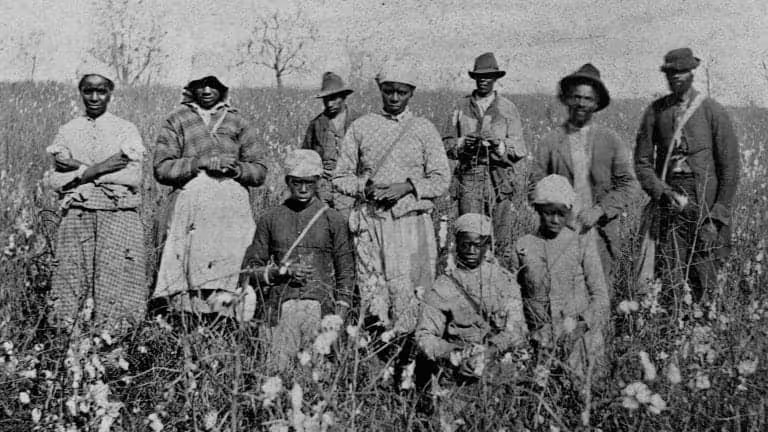
Reconstruction was the period after the American Civil War when the United States attempted to restore the former Confederate states and define freedom after slavery. Black Americans built new institutions and entered politics, while the Reconstruction Amendments transformed the Constitution. White supremacist violence and declining federal enforcement later destroyed many of these gains.
The end of the American Civil War did not resolve the political and social conflicts that had divided the United States.
The Union had survived, the Confederacy had collapsed and slavery was coming to an end. However, the country still faced several fundamental questions.
- How would the former Confederate states return to the Union?
- What rights would formerly enslaved people possess?
- Who would control land and labour in the postwar South?
- Would the federal government protect Black citizenship?
- How would Southern society respond to the destruction of slavery?
The period commonly known as Reconstruction lasted from 1865 to 1877. Some historians use a broader chronology beginning during the Civil War or extending into the late nineteenth century.
Reconstruction was not simply an unsuccessful attempt to rebuild the South. It was the first major effort to create an interracial democracy in the United States.

What was Reconstruction?
Reconstruction refers to the political, constitutional, economic and social reorganisation of the United States after the Civil War.
It involved two related processes.
- The former Confederate states had to establish governments recognised by the federal government.
- Nearly four million formerly enslaved people had to secure freedom, citizenship and control over their lives.
These objectives did not always support each other. Rapid reunion could restore political power to former Confederates before Black rights were secure.
Conversely, protecting freedom required sustained federal intervention in Southern state governments.
The conflict over Reconstruction therefore concerned the meaning of Union victory. Had the war merely prevented secession, or had it created a federal responsibility to guarantee equal citizenship?
For the military and political background, read The American Civil War: Causes, Battles and Consequences.
Emancipation began during the Civil War
Reconstruction did not begin suddenly after Confederate surrender. Enslaved people had already transformed the meaning of the war.
Thousands escaped to Union lines, withdrew their labour from enslavers and provided information or assistance to federal forces.
Congress passed Confiscation Acts in 1861 and 1862, while Abraham Lincoln issued the Emancipation Proclamation on 1 January 1863.
The proclamation declared enslaved people free in areas still rebelling against the United States. It did not abolish slavery in loyal border states or every region already controlled by the Union.
Nevertheless, it made emancipation an official war aim and authorised Black military enlistment.
By the end of the war, freedom had become a military reality across much of the South. A constitutional amendment was still required to abolish slavery throughout the country.

The Thirteenth Amendment
Congress approved the Thirteenth Amendment on 31 January 1865. The required number of states ratified it on 6 December.
The amendment abolished slavery and involuntary servitude throughout the United States, except as punishment for a crime after conviction.
This exception later acquired considerable importance. Southern states used criminal laws, discriminatory policing and convict leasing to force many Black prisoners into dangerous labour.
The abolition of slavery changed the legal status of millions of people. However, it did not automatically provide land, employment, housing, education or protection from violence.
Freedom therefore had to be defined through everyday struggles over family, work, mobility, property and political power.
Freedom as defined by formerly enslaved people
Formerly enslaved people did not wait for politicians to define their freedom.
They left plantations, searched for relatives, legalised marriages and rejected the authority of former enslavers.
Freedom meant control over movement and labour. It also meant education, family security, religious independence, land ownership and participation in government.
Reuniting families
Slavery had separated spouses, parents and children through sale and forced migration.
After emancipation, people travelled considerable distances, placed newspaper advertisements and contacted federal agencies in search of missing relatives.
Many couples formalised marriages that slave-state law had never recognised.
Family reunification represented more than a private concern. It asserted that formerly enslaved people possessed relationships and rights beyond the control of white employers.
Independent churches
Black congregations withdrew from white-controlled churches and established independent institutions.
Churches served as places of worship, education, political organisation and mutual assistance.
Ministers frequently became civic leaders because they possessed organisational experience and the confidence of their communities.
Education
Formerly enslaved people placed extraordinary importance on literacy and schooling.
Communities created schools, hired teachers, raised funds and provided buildings. Students included children and adults who had been legally denied education under slavery.
Northern aid societies and the Freedmen’s Bureau supported many schools, but Black communities supplied essential labour, money and leadership.
Reconstruction also contributed to the development of institutions that became Historically Black Colleges and Universities.

The Freedmen’s Bureau
Congress created the Bureau of Refugees, Freedmen and Abandoned Lands in March 1865.
Commonly known as the Freedmen’s Bureau, the agency assisted formerly enslaved people and displaced white Southerners.
Its responsibilities included:
- distributing food and clothing;
- providing medical assistance;
- supervising labour contracts;
- helping establish schools;
- operating or supporting courts;
- assisting people searching for relatives;
- managing some abandoned or confiscated land.
The Bureau achieved important results, especially in education and emergency relief.
However, it remained understaffed, underfunded and dependent on military support. Its agents also varied greatly in commitment and competence.
Some defended Black rights, while others prioritised the restoration of plantation labour and pressured freedpeople to sign restrictive contracts.
The Bureau could moderate exploitation, but it could not transform Southern land ownership or permanently protect Black communities on its own.
The struggle for land
Land ownership stood at the centre of the conflict over freedom.
Formerly enslaved people argued that their unpaid labour had created Southern wealth. Many believed that confiscated Confederate property should be distributed among freed families.
In January 1865, General William T. Sherman issued Special Field Orders No. 15. The order reserved coastal land in parts of South Carolina, Georgia and Florida for settlement by Black families.
Each family could receive a plot of up to forty acres. The later expression “forty acres and a mule” grew from this policy and related army practices.
The programme was limited in geographical scope. Nevertheless, thousands of formerly enslaved people settled on designated land.
President Andrew Johnson later restored much of the property to pardoned white owners.
The failure to redistribute land had lasting consequences. Most freed families lacked the capital and property required for economic independence.
Lincoln’s plan for reunion
Abraham Lincoln began developing a policy for restoring Southern states while the war continued.
His Proclamation of Amnesty and Reconstruction of December 1863 offered pardons to most Confederates who swore loyalty to the United States and accepted emancipation.
When loyal voters equal to ten per cent of a state’s 1860 electorate formed a government, Lincoln was prepared to recognise it.
This approach became known as the Ten Percent Plan.
Lincoln sought to weaken the Confederacy and encourage rapid reunion. However, congressional Republicans feared that his policy restored political authority too easily to former Confederates.
Congress passed the Wade-Davis Bill in 1864, which demanded stronger loyalty requirements. Lincoln prevented it from becoming law through a pocket veto.
His assassination left unresolved how he would have managed the postwar conflict between reunion and civil rights.
Lincoln’s assassination and Andrew Johnson
John Wilkes Booth shot Lincoln at Ford’s Theatre on 14 April 1865. The president died the following morning.
Vice President Andrew Johnson became president only days after Robert E. Lee’s surrender at Appomattox.
Johnson was a Southern Unionist from Tennessee. He had opposed secession but held deeply racist beliefs and did not support political equality for Black Americans.
His Reconstruction policy offered pardons to most former Confederates and allowed Southern states to create new governments rapidly.
States had to repudiate secession, reject Confederate debts and ratify the Thirteenth Amendment.
Johnson issued large numbers of individual pardons, including to wealthy Confederate leaders. Pardoned landowners could often reclaim property occupied by freed families.
By the end of 1865, former Confederate officials and slaveholders had regained substantial political power.
The Black Codes
Southern governments created under Johnson adopted laws known as Black Codes.
The exact provisions differed between states. Their common purpose was to restrict Black freedom and secure a controlled agricultural labour force.
- Vagrancy laws allowed authorities to arrest people without approved employment.
- Labour laws imposed restrictive annual contracts.
- Apprenticeship laws could place Black children under white employers.
- Some states restricted land ownership, occupations or movement.
- Black people often received unequal treatment in courts.
The codes did not formally restore slavery. However, they attempted to preserve many elements of the old racial and labour order.
Northern outrage over the Black Codes strengthened support for congressional intervention.
Congress challenges President Johnson
Congress refused to recognise immediately the representatives elected under Johnson’s programme.
Republicans disagreed among themselves. Moderates initially sought limited civil protections, while Radical Republicans demanded stronger federal action and Black political rights.
Johnson opposed both approaches. His vetoes and public attacks on Congress pushed moderate and radical Republicans closer together.
The Civil Rights Act of 1866
The Civil Rights Act of 1866 declared that people born in the United States, except most Native Americans subject to tribal authority, were citizens.
It guaranteed equal civil rights concerning contracts, property and legal protection.
Johnson vetoed the legislation. Congress overrode his veto, marking the first time it enacted major legislation over a presidential veto.
Congress also extended the Freedmen’s Bureau over Johnson’s opposition.
These confrontations transferred control of Reconstruction increasingly from the president to Congress.
The Fourteenth Amendment
Congress proposed the Fourteenth Amendment in 1866. It was ratified in 1868.
The amendment established several fundamental constitutional principles.
- People born or naturalised in the United States became citizens.
- States could not deprive a person of life, liberty or property without due process.
- States could not deny any person equal protection of the laws.
The amendment overturned the central citizenship principle of the 1857 Dred Scott decision.
It also gave Congress authority to enforce its provisions through legislation.
The Fourteenth Amendment did not immediately establish social equality or prevent racial discrimination. However, it transformed the relationship between federal citizenship and state power.
Its Due Process and Equal Protection Clauses later became central to civil rights litigation and the application of many Bill of Rights protections against the states.
Congressional Reconstruction
Republicans won major victories in the congressional elections of 1866.
Congress then passed the Reconstruction Acts of 1867 over Johnson’s veto.
The legislation divided ten former Confederate states into five military districts. Tennessee had already been readmitted after ratifying the Fourteenth Amendment.
To regain representation in Congress, the remaining states had to:
- write new state constitutions;
- provide voting rights to Black men;
- ratify the Fourteenth Amendment;
- establish governments acceptable to Congress.
The military supervised voter registration and elections. Federal occupation was not uniform or unlimited, but it created enough protection for new political coalitions to form.
By 1870, all former Confederate states had re-entered the Union under the congressional requirements.
The impeachment of Andrew Johnson
Conflict between Johnson and Congress intensified over control of Reconstruction.
Congress passed the Tenure of Office Act in 1867, restricting the president’s ability to remove certain officials without Senate approval.
Johnson attempted to remove Secretary of War Edwin Stanton, a supporter of congressional Reconstruction.
The House of Representatives impeached Johnson in February 1868.
The Senate trial concentrated on the Stanton dispute, although the deeper conflict concerned presidential obstruction of congressional policy.
Johnson avoided removal by one vote. He completed his term but exercised little influence over the remaining Reconstruction programme.
Black political participation
Congressional Reconstruction created unprecedented opportunities for Black political participation.
African American men registered to vote in large numbers. They attended political meetings, organised local branches of the Republican Party and served as delegates to constitutional conventions.
Black voters did not form one uniform political group. They debated education, land, labour, taxation and the proper relationship with white Republican allies.
Approximately two thousand Black men held public office during Reconstruction at local, state and federal levels.
They served as sheriffs, magistrates, legislators, school officials, state officers and members of Congress.
Hiram Revels of Mississippi became the first African American United States senator in 1870. Blanche K. Bruce later served a full Senate term.
Most Black officeholders had stronger educational or economic backgrounds than white supremacist caricatures suggested. Some had been free before the war, while others had acquired literacy, property or leadership experience under slavery and during wartime.
Reconstruction governments
Republican state governments brought together several groups.
- Black voters and officeholders;
- white Southern Republicans;
- Northerners who moved to the South;
- former Whigs, Unionists and economic modernisers.
Opponents called Northern migrants carpetbaggers, implying that they arrived with few possessions to exploit the defeated South.
They labelled white Southern Republicans scalawags, a term intended to portray them as traitors to their race and region.
These labels were political insults rather than neutral historical categories.
Reconstruction governments varied in competence, and corruption existed as it did elsewhere in nineteenth-century American politics.
However, the traditional image of uniquely corrupt governments controlled by ignorant Black legislators is false.
These governments produced significant reforms.
- They created or expanded public school systems.
- They rebuilt roads, railways and public institutions.
- They revised taxation and property laws.
- They established social services and charitable institutions.
- They expanded political participation.
- They abolished racial restrictions in state constitutions.
Many white Southerners opposed these governments less because of administrative performance than because they depended on Black voting and challenged white political supremacy.
The Fifteenth Amendment
Congress proposed the Fifteenth Amendment in 1869. It was ratified in 1870.
The amendment prohibited federal and state governments from denying or restricting the right to vote because of race, colour or previous condition of servitude.
It did not establish universal male suffrage through one comprehensive rule. States could still impose requirements that appeared racially neutral.
The amendment also did not extend voting rights to women.
Some women’s rights activists supported the measure as an important advance. Others opposed the creation of constitutional voting protections for men without equivalent protections for women.
The amendment nevertheless represented an extraordinary change. Men who had recently been enslaved now possessed a constitutional claim to political participation.
Economic freedom and sharecropping
The abolition of slavery destroyed legal ownership of labour but did not resolve control over land and agricultural production.
Former planters wanted a disciplined and dependent workforce. Freedpeople wanted family autonomy, flexible working arrangements and protection from supervision resembling slavery.
Sharecropping emerged as one compromise.
Under this system, a family cultivated part of a landowner’s property and received a share of the crop.
Sharecropping offered greater independence than gang labour under slavery. Families could organise much of their own work and live together.
However, landowners and merchants controlled credit, supplies and crop marketing.
The crop-lien system allowed farmers to obtain food and equipment on credit against future harvests. High interest rates and low crop prices often created permanent debt.
Sharecropping trapped many Black and white families in poverty. It did not reproduce slavery exactly, but it preserved profound economic dependence and unequal land ownership.
White supremacist violence
Political violence formed a central part of the campaign against Reconstruction.
White mobs attacked Black communities even before Congressional Reconstruction began.
In 1866, violence in Memphis and New Orleans killed numerous African Americans and demonstrated the inability or unwillingness of local authorities to protect them.
The Ku Klux Klan
The first Ku Klux Klan emerged in Tennessee in 1865 or 1866 and spread across the former Confederacy.
The Klan and related organisations used threats, beatings, sexual violence, arson and murder.
Their targets included Black voters, teachers, officeholders, community leaders and white Republicans.
The purpose was political. Terror sought to destroy Republican organisation, suppress Black voting and restore white Democratic control.
The burning cross became strongly associated with the second Ku Klux Klan founded in 1915. It should not be treated as a defining practice of the original Reconstruction-era organisation.
Federal action against the Klan
President Ulysses S. Grant took office in 1869 and supported congressional Reconstruction.
Congress passed the Enforcement Acts of 1870 and 1871 to protect voting rights and combat political violence.
The Ku Klux Klan Act allowed federal intervention against conspiracies that deprived citizens of constitutional rights.
Grant suspended habeas corpus in parts of South Carolina, while federal prosecutors brought thousands of cases against alleged Klansmen.
These measures weakened the first Klan significantly.
However, violence did not disappear. Other organisations, including the White League and Red Shirts, later operated more openly as paramilitary supporters of the Democratic Party.
Massacres at Colfax, Louisiana, in 1873 and Hamburg, South Carolina, in 1876 demonstrated the continuing use of organised violence to overturn Reconstruction governments.
The Supreme Court narrows federal protection
The Reconstruction Amendments expanded federal authority, but Supreme Court decisions limited their early application.
In the Slaughter-House Cases of 1873, the Court interpreted the Fourteenth Amendment’s Privileges or Immunities Clause narrowly.
In United States v. Cruikshank in 1876, the Court overturned federal convictions connected to the Colfax Massacre.
The ruling restricted federal power to prosecute private individuals for violating civil rights and placed greater responsibility on state governments.
Southern states were often controlled by officials unwilling to prosecute white supremacist violence.
Later decisions also weakened the Civil Rights Act of 1875, which had prohibited racial discrimination in public accommodations.
In the Civil Rights Cases of 1883, the Supreme Court declared key provisions of that law unconstitutional.
Why did Northern support decline?
Reconstruction did not end because one event suddenly convinced the North to abandon it.
Several developments weakened Republican commitment.
- The Panic of 1873 created a severe economic depression.
- Many Northern voters prioritised financial recovery and industrial growth.
- Political scandals damaged the Republican Party.
- Racial prejudice limited sympathy for Black equality.
- Supreme Court rulings narrowed federal enforcement powers.
- White Democratic violence made Southern elections increasingly difficult to protect.
- Some Republicans believed Reconstruction had lasted long enough.
Democrats regained control of the House of Representatives in the 1874 elections.
Republican governments remained in only a few Southern states by the presidential election of 1876.
The disputed election of 1876
The presidential election of 1876 opposed Republican Rutherford B. Hayes and Democrat Samuel J. Tilden.
Tilden won the national popular vote and appeared close to an Electoral College majority.
Results from Florida, Louisiana and South Carolina were disputed. Oregon also produced a controversy concerning one elector.
Congress created an Electoral Commission to resolve the dispute. The commission awarded the contested electoral votes to Hayes, giving him a one-vote victory.
The political negotiations surrounding the outcome are commonly described as the Compromise of 1877.
No single formal document recorded every element of this compromise. However, Democrats accepted Hayes’s presidency, while Republicans withdrew remaining federal troops from direct support of Republican governments in Louisiana and South Carolina.
The removal of troops symbolised the end of federal commitment to sustaining Reconstruction governments.
Federal troops did not vanish entirely from the South, and Reconstruction had already been weakening for years. Therefore, 1877 represents a political endpoint rather than one abrupt termination.
The rise of the Redeemers
White Southern Democrats called themselves Redeemers because they claimed to rescue their states from Republican rule.
In practice, Redemption restored governments committed to white supremacy, limited public spending and planter or business interests.
Redeemer governments reduced funding for public education and social services in many states.
They also weakened legal protections for Black citizens and tolerated or encouraged political intimidation.
Black political participation continued after 1877 in some areas. African American men still voted and held office, particularly where they formed large parts of the population.
However, the federal government became far less willing to intervene when Southern states violated their rights.
Disfranchisement and Jim Crow
Southern states did not eliminate Black voting immediately after 1877.
Large-scale legal disfranchisement developed mainly from the late 1880s through the early twentieth century.
States adopted several devices designed to appear racially neutral while targeting Black voters.
- Poll taxes required payment before voting.
- Literacy and understanding tests gave officials considerable discretion.
- Complex registration rules created procedural barriers.
- Grandfather clauses protected many illiterate white voters.
- White primaries excluded Black voters from decisive party elections.
Violence and economic retaliation reinforced these legal restrictions.
At the same time, Southern states established formal racial segregation through Jim Crow laws.
Schools, railway carriages, public facilities, neighbourhoods and commercial services became divided by race.
The Supreme Court legitimised the “separate but equal” doctrine in Plessy v. Ferguson in 1896.
In practice, segregated Black institutions received inferior funding and protection.
Lynching and racial terror
Racial violence continued after Reconstruction and intensified during the late nineteenth century.
Lynching was not simply spontaneous mob violence. It enforced racial hierarchy, punished economic competition and suppressed political participation.
Victims were denied legal process and often tortured before public crowds.
Journalist Ida B. Wells investigated lynching and demonstrated that accusations of sexual violence frequently concealed economic, political or personal motives.
Racial terror encouraged migration, weakened Black political organisation and communicated that constitutional citizenship lacked reliable protection.
Was Reconstruction a failure?
For much of the twentieth century, popular histories presented Reconstruction as a disastrous period of corruption and incompetent government.
This interpretation drew heavily on the Lost Cause and the Dunning School of historical scholarship.
It portrayed Black political participation as inherently irresponsible and federal intervention as an attack on legitimate Southern self-government.
Modern scholarship has rejected that framework.
Reconstruction achieved substantial and lasting changes.
- Slavery was constitutionally abolished.
- National birthright citizenship was established.
- Equal protection became a constitutional principle.
- Racial discrimination in voting was constitutionally prohibited.
- Black men participated in government at every level.
- Public education expanded across the South.
- Black churches, schools and civic organisations grew.
At the same time, Reconstruction failed to secure land redistribution, lasting economic independence or permanent federal protection from racial violence.
Its democratic institutions were defeated by organised resistance, judicial limitation and declining national commitment.
It is therefore more precise to say that Reconstruction was overthrown and abandoned than to say that it simply failed through its own defects.
The constitutional legacy
The Reconstruction Amendments are sometimes described as a second founding of the United States.
The original Constitution had protected slavery and left citizenship largely under state control.
The postwar amendments established national principles of freedom, citizenship, equal protection and voting rights.
These guarantees were not fully enforced for generations. Nevertheless, they remained part of the Constitution.
During the twentieth-century Civil Rights Movement, lawyers and activists relied on the Fourteenth and Fifteenth Amendments to challenge segregation and disfranchisement.
In Brown v. Board of Education in 1954, the Supreme Court used the Equal Protection Clause to reject racial segregation in public schools.
The Civil Rights Act of 1964 and Voting Rights Act of 1965 gave stronger federal enforcement to principles first established during Reconstruction.
Conclusion
Reconstruction attempted to rebuild the Union and transform a society emerging from slavery.
Formerly enslaved people defined freedom through family reunion, education, independent worship, paid labour, land ownership and political participation.
The Freedmen’s Bureau and congressional legislation supported parts of this transformation, although federal assistance remained limited.
Andrew Johnson’s lenient restoration policies allowed former Confederate elites to regain influence and adopt Black Codes.
Congress responded with the Civil Rights Act, Reconstruction Acts and Fourteenth Amendment. The Fifteenth Amendment later protected voting rights against racial discrimination.
For several years, Black voters and interracial Republican coalitions governed Southern states and established schools, institutions and civil rights protections.
White supremacist organisations used terrorism to destroy these governments. Economic crisis, judicial decisions and declining Northern commitment further weakened federal protection.
The political settlement of 1877 ended direct federal support for the remaining Reconstruction governments. Disfranchisement and Jim Crow later dismantled much of the period’s democratic progress.
Yet Reconstruction did not disappear without a legacy. Its constitutional amendments established principles that later generations used to renew the struggle for civil rights.
The expansion and transformation of the United States after this period are examined in America: West to the Pacific and Years of Growth.
Frequently asked questions
When did Reconstruction take place?
Reconstruction is commonly dated from 1865 to 1877. Some historians use a broader chronology beginning during the Civil War or continuing into the late nineteenth century.
What was the main purpose of Reconstruction?
Reconstruction sought to restore the former Confederate states and define the legal, political and economic meaning of freedom after slavery.
What did the Freedmen’s Bureau do?
The Freedmen’s Bureau provided food, medical care, legal assistance and labour supervision. It also helped establish schools and reunite families separated during slavery.
What were the Black Codes?
Black Codes were Southern state laws designed to restrict the movement, labour and civil rights of formerly enslaved people after the Civil War.
What were the Reconstruction Amendments?
The Thirteenth Amendment abolished slavery, the Fourteenth established citizenship and equal protection, and the Fifteenth prohibited racial discrimination in voting rights.
Did Black Americans hold political office during Reconstruction?
Yes. Approximately two thousand Black men held local, state or federal office. They served as legislators, officials, judges, representatives and senators.
Why did Reconstruction end?
Reconstruction weakened because of white supremacist violence, economic depression, Supreme Court decisions, Democratic electoral gains and declining Northern support for federal intervention.
What was the Compromise of 1877?
The term describes negotiations surrounding the disputed 1876 presidential election. Democrats accepted Republican Rutherford B. Hayes as president, while federal support for the remaining Southern Republican governments ended.
Was Reconstruction a complete failure?
No. Many political gains were violently dismantled, but Reconstruction abolished slavery, established national citizenship and created constitutional protections later used by the Civil Rights Movement.
Sources and further reading
- Library of Congress: Reconstruction primary source set
- Library of Congress: Reconstruction and its aftermath
- National Park Service: About the Reconstruction Era
- National Park Service: Reconstruction Era history and culture
- National Archives: Thirteenth Amendment
- National Archives: Fourteenth Amendment
- National Archives: Fifteenth Amendment
- National Archives: Freedmen’s Bureau records
- United States Senate: The impeachment trial of Andrew Johnson
- United States House of Representatives: Black political participation during Reconstruction
- Library of Congress: Civil Rights Act of 1866
- Library of Congress: The disputed election of 1876
