
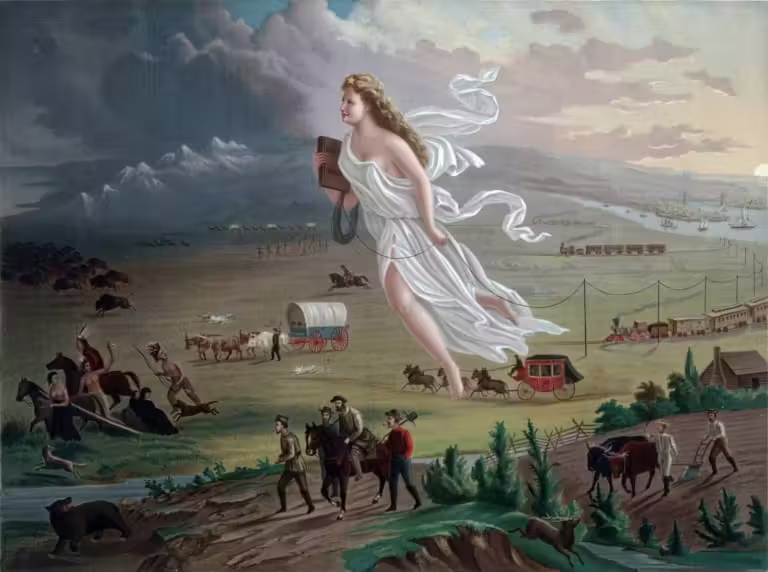
John L. O’Sullivan used the expression “Manifest Destiny” in 1845 to describe the supposed providential mission of the United States to expand across North America. His language presented territorial growth as natural and inevitable, while obscuring its consequences: Indigenous dispossession, war with Mexico and an escalating struggle over the expansion of slavery.
The idea of Manifest Destiny occupies a central place in the history of nineteenth-century American expansion.
It expressed the belief that the United States possessed a special mission to extend its institutions, population and territory across the North American continent.
Supporters described that expansion as the advance of liberty, republican government, Christianity and civilisation. Yet the lands they coveted were not empty. Indigenous nations governed much of the continent, while Mexico claimed Texas, California and the Southwest.
Manifest Destiny therefore did more than celebrate migration. It offered a moral and religious vocabulary that could turn political choices, settlement and military conquest into the apparent fulfilment of history.

Who was John L. O’Sullivan?
John Louis O’Sullivan was an American journalist, editor and political writer born in 1813.
He became closely associated with Jacksonian democracy and edited the United States Magazine and Democratic Review. The journal promoted democratic politics, literary nationalism and territorial expansion.
O’Sullivan supported the Democratic Party, but he was not an official government spokesman. He belonged instead to a wider political and journalistic culture that celebrated the growth of the United States.
His influence rests principally on two texts:
- The Great Nation of Futurity, published in 1839;
- Annexation, published in the July–August 1845 issue of the Democratic Review.
The first text developed a theory of American exceptionalism. The second introduced the phrase that later became inseparable from continental expansion.
What does “Manifest Destiny” mean?
The word manifest means clear, evident or plainly revealed. Destiny suggests an outcome established by a force greater than ordinary human decision.
Combined, the words implied that American continental expansion was both obvious and predetermined.
The expression contained three interconnected claims:
- The United States possessed a unique historical and moral character.
- Americans had a mission to spread republican institutions and their way of life.
- Providence had assigned the continent to the growing American population.
The phrase was powerful precisely because it converted an argument into an apparent fact. Expansion no longer appeared as one political option among others. It became destiny itself.

The religious roots of American destiny
O’Sullivan did not invent the idea that America had a special mission. Religious and political writers had expressed similar beliefs long before 1845.
Seventeenth-century Puritans interpreted their communities through covenant and providence. John Winthrop’s image of a “city upon a hill” described a Christian community whose conduct would be visible to the world.
The Puritan project did not amount to a nineteenth-century programme of continental conquest. Nevertheless, it helped establish a language of chosenness, collective mission and exemplary history.
After the American Revolution, that religious vocabulary merged with republican nationalism. The United States could now present itself as a political example rather than merely a religious community.
For a fuller analysis of this intellectual connection, read Puritanism and Expansionism in Early America.
The Great Nation of Futurity
O’Sullivan developed his vision of American exceptionalism in the 1839 essay The Great Nation of Futurity.
He argued that the United States differed fundamentally from European nations. European societies appeared burdened by monarchy, hereditary privilege, religious conflict and old political institutions.
America, by contrast, supposedly faced towards the future. Its principles included equality, individual rights, popular government and freedom of conscience.
O’Sullivan represented the United States as a new nation without responsibility for the historical crimes of Europe. This claim ignored both Indigenous dispossession and the continued existence of slavery.
His concept of national innocence nevertheless played an important ideological role. If the United States embodied political progress, then extending its institutions could appear beneficial rather than imperial.

The first use of “Manifest Destiny”
O’Sullivan first used the expression in Annexation, an unsigned editorial published in 1845.
The article defended the admission of Texas into the United States. O’Sullivan condemned what he regarded as British and French interference in the issue.
“The fulfillment of our manifest destiny to overspread the continent allotted by Providence for the free development of our yearly multiplying millions.”John L. O’Sullivan, “Annexation”, 1845
This sentence contains the principal elements of his argument.
- “Manifest destiny” presents expansion as evident and predetermined.
- “Allotted by Providence” gives territorial growth divine authority.
- “Yearly multiplying millions” uses population growth to make expansion appear necessary.
- “Free development” associates annexation with liberty rather than conquest.
The wording does not prove that Providence had granted the continent to the United States. It assumes the conclusion that the article seeks to establish.
Why was Texas controversial?
Texas had belonged to Mexico after Mexican independence from Spain. During the 1820s, Mexico encouraged immigration into the region under specific legal conditions.
Many migrants arrived from the United States. Tensions developed over political authority, immigration, slavery and the centralisation of the Mexican government.
Texas declared independence in 1836 after a military revolt and established the Republic of Texas. Mexico did not recognise that independence.
The republic sought annexation by the United States. However, annexation remained controversial for several reasons.
- Mexico warned that annexation could cause war.
- Texas permitted slavery and would strengthen slaveholding interests.
- Some politicians feared territorial overexpansion.
- Opponents regarded annexation as an aggressive seizure of Mexican territory.
Congress approved annexation in 1845, and Texas entered the Union as a slave state in December.
O’Sullivan rejected the argument that annexation primarily served slavery. His article claimed that territorial growth might eventually weaken the institution.
That prediction proved deeply misleading. Texas entered as a slave state, and the territory acquired from Mexico intensified the national struggle over slavery’s westward expansion.
O’Sullivan’s theory of natural expansion
O’Sullivan did not initially describe expansion as a programme of direct military conquest.
He imagined a process driven by migration. American settlers would move into neighbouring territories, develop communities, create republican institutions and eventually request admission to the Union.
Texas appeared to confirm this model. O’Sullivan treated its annexation as the natural consequence of demographic and political development.
However, the theory concealed the conditions that made such migration possible. Settlers entered territories already governed, inhabited or claimed by other peoples.
The supposedly peaceful spread of population could therefore alter political control before formal annexation occurred. Settlement itself became an instrument of expansion.
Describing the process as natural also reduced the visibility of government policy, military protection, land speculation and violence.
Manifest Destiny and the Oregon Country
O’Sullivan used the expression again in December 1845 during the dispute over the Oregon Country.
Britain and the United States had jointly occupied a vast territory extending towards the Pacific Northwest. American settlers increasingly travelled there along the Oregon Trail.
Expansionists demanded the whole disputed territory. The slogan “Fifty-four Forty or Fight” referred to latitude 54°40′, the northern boundary claimed by some Americans.
O’Sullivan argued that the United States possessed a providential right to the continent. British legal and diplomatic claims supposedly mattered less than the destiny of American settlement.
President James K. Polk adopted an assertive position, but the dispute ended through negotiation rather than war.
The Oregon Treaty of 1846 extended the boundary along the 49th parallel, with specific arrangements concerning Vancouver Island and navigation.
The settlement demonstrates that expansionist rhetoric did not always produce military conflict. When confronting a powerful empire such as Britain, the United States accepted compromise.
President James K. Polk and territorial expansion
James K. Polk won the presidential election of 1844 as an expansionist Democrat.
His administration pursued several major territorial objectives:
- the incorporation of Texas;
- the settlement of the Oregon boundary;
- the acquisition of California and New Mexico;
- the consolidation of United States power on the Pacific coast.
Polk did not need O’Sullivan to invent expansionism. American territorial growth had begun long before either man entered national politics.
Nevertheless, the language of Manifest Destiny expressed the political atmosphere surrounding Polk’s presidency. It presented expansion as the fulfilment of national purpose rather than a contested policy.
The Mexican-American War
The annexation of Texas worsened relations between Mexico and the United States. The two countries also disputed the new state’s southern boundary.
Mexico recognised the Nueces River as the boundary of Texas. The United States claimed territory farther south and west to the Rio Grande.
President Polk sent troops under General Zachary Taylor into the disputed area. After Mexican and American forces clashed in April 1846, Polk requested a declaration of war.
United States forces invaded northern Mexico, New Mexico and California. An American army eventually captured Mexico City.
The Treaty of Guadalupe Hidalgo ended the war in 1848. Mexico recognised the Rio Grande boundary and ceded an enormous territory to the United States.
The Mexican Cession included present-day California, Nevada and Utah, together with large parts of Arizona, New Mexico, Colorado and Wyoming.
The war fulfilled much of the continental ambition associated with Manifest Destiny. It also demonstrated that expansion did not proceed solely through peaceful migration.
Opposition to the Mexican-American War
Manifest Destiny never represented unanimous American opinion.
Many Whigs condemned the Mexican-American War as an unnecessary conflict created by President Polk. They accused him of provoking hostilities to acquire territory.
Abraham Lincoln, then a member of the House of Representatives, introduced his “Spot Resolutions”. He challenged Polk to identify the exact location where Mexico had supposedly shed American blood on American soil.
Henry David Thoreau opposed the war and slavery. His refusal to pay a poll tax contributed to the essay later known as Civil Disobedience.
Frederick Douglass and other abolitionists argued that the war would strengthen the slaveholding states by opening additional territory to slavery.
Ulysses S. Grant served in the conflict as a young officer. He later described it as an unjust war waged by a stronger nation against a weaker one.
These criticisms show that contemporary Americans recognised the difference between republican ideals and territorial conquest.
Manifest Destiny and slavery
The expansion of the United States immediately raised the question of whether slavery would spread into the new territories.
Slaveholders wanted access to western land and feared that restricting slavery would reduce their political power.
Many Northerners opposed expansion because they believed it formed part of a “Slave Power” conspiracy. Not all of them supported racial equality or immediate abolition.
Representative David Wilmot proposed banning slavery from territory acquired from Mexico. The Wilmot Proviso passed the House several times but failed in the Senate.
The proposal exposed a growing sectional divide. Each new territory threatened to change the balance between free and slave states.
The Compromise of 1850 provided only temporary relief. The Kansas-Nebraska Act, Bleeding Kansas and the Dred Scott decision later deepened the conflict.
Manifest Destiny therefore expanded both the national territory and the political crisis that eventually produced the Civil War.
For the wider sectional context, read North and South Before the American Civil War.
The consequences for Indigenous nations
The idea of Manifest Destiny treated North America as a continental space awaiting American settlement.
That representation erased the sovereignty and territorial rights of Indigenous nations.
Expansion involved treaties, land purchases, military campaigns, forced removals and repeated violations of earlier agreements.
The federal government had already adopted the Indian Removal Act in 1830. During the following decade, the United States forced several Southeastern nations west of the Mississippi.
Later migration to Oregon, California and the Great Plains brought settlers into further conflict with Native communities.
Railways, commercial hunting, mining and agricultural settlement transformed ecosystems and threatened established ways of life.
Manifest Destiny represented those consequences as the inevitable disappearance of supposedly backward societies before civilisation.
In reality, Indigenous nations negotiated, adapted, resisted and defended their sovereignty. Their dispossession resulted from policy and force, not from an impersonal law of history.
The consequences for Mexico and Mexican communities
The Treaty of Guadalupe Hidalgo transferred an immense territory from Mexico to the United States.
Mexican residents did not simply disappear when the international boundary moved. They became inhabitants of a territory governed by the United States.
The treaty promised protections for property and civil rights. In practice, many Mexican landowners faced costly litigation, discriminatory laws, taxation and dispossession.
American expansionist rhetoric commonly represented Mexico as racially inferior, politically unstable and incapable of developing its northern territories.
Such claims allowed conquest to appear as improvement. The language of civilisation concealed a transfer of power achieved through war.
Was Manifest Destiny an official policy?
Manifest Destiny was not a formal statute, constitutional doctrine or detailed government programme.
It functioned as a broad ideology. Politicians, editors and settlers could use it to support different territorial objectives.
Some expansionists emphasised peaceful migration. Others defended annexation, diplomatic pressure or war.
Nor did every supporter agree on the desired limits of expansion. Some wanted a continental republic extending to the Pacific. More radical voices imagined the annexation of Cuba, Mexico, Canada or parts of Central America.
The expression therefore described a flexible cluster of assumptions rather than one coherent policy.
Analysing the rhetoric of Manifest Destiny
O’Sullivan’s writing illustrates several techniques commonly found in expansionist rhetoric.
Expansion becomes inevitable
The word destiny removes political responsibility. If expansion is inevitable, resistance appears pointless or unnatural.
Providence replaces legal argument
O’Sullivan placed divine allocation above competing territorial claims. Providence supplied an authority that could not be tested or negotiated.
Population growth becomes entitlement
The growing American population supposedly required additional land. Demographic pressure became a moral claim against existing inhabitants.
Conquest becomes freedom
O’Sullivan associated territorial growth with liberty and republican government. The political freedom of American settlers overshadowed the sovereignty of Indigenous nations and Mexico.
Opponents become obstacles to progress
Britain, France, and Mexico appeared as foreign powers seeking to impede the natural growth of the United States.
This structure made expansion self-justifying. American growth proved that expansion was destined, while resistance confirmed that hostile forces sought to obstruct destiny.
American Progress and the visual language of expansion
John Gast’s painting American Progress, created in 1872, became one of the best-known visual representations of Manifest Destiny.
The central female figure represents America, often identified as Columbia. She moves westwards carrying a schoolbook and laying telegraph wire.
Behind her appear farms, cities, railways and artificial light. In front of her, Indigenous people and bison retreat into darkness.
The composition associates westward settlement with education, technology and illumination. It presents Indigenous presence as part of a disappearing wilderness rather than as organised societies defending their land.
The image was produced decades after O’Sullivan’s article. It does not illustrate his text directly. Instead, it shows how later American culture romanticised continental conquest.
From continental expansion to American imperialism
The continental frontier did not end the language of national mission.
During the late nineteenth century, some politicians and writers applied related ideas to overseas expansion.
Following the Spanish-American War of 1898, the United States acquired Puerto Rico, Guam and the Philippines. It also annexed Hawaii.
Supporters again claimed that the American government, commerce and civilisation would benefit other peoples.
Opponents argued that ruling overseas populations without their consent contradicted republican principles.
O’Sullivan’s continental vision and later imperialism were not identical. Nevertheless, both could present American power as a moral service rather than domination.
The historical legacy of Manifest Destiny
Manifest Destiny helped Americans explain the extraordinary territorial growth of the United States during the nineteenth century.
It connected religious providence, republican nationalism, demographic expansion and racial hierarchy.
The ideology also created a selective national memory. It celebrated pioneers, trails and settlement while minimising war, coerced removal and dispossession.
Its legacy remains visible in debates about American exceptionalism and foreign policy. Political leaders continue to describe the United States as a nation with a unique responsibility to spread freedom or lead the world.
Such claims do not automatically reproduce nineteenth-century Manifest Destiny. However, they draw upon a similar belief that American power serves a special historical purpose.
The later settlement of the continent is examined in America: West to the Pacific.
Conclusion
John L. O’Sullivan did not invent American expansion, exceptionalism or providential nationalism. He gave them a memorable expression.
Manifest Destiny transformed territorial ambition into an apparent law of history. Expansion seemed obvious because it was “manifest” and unavoidable because it was “destiny”.
This language helped supporters frame the annexation of Texas, American claims to Oregon and continental growth as the spread of freedom.
Yet expansion had material and human consequences. It displaced Indigenous nations, transferred Mexican territory, intensified racial domination and reopened the political struggle over slavery.
The ideology did not eliminate disagreement. Whigs, abolitionists, Indigenous leaders, Mexicans and other critics challenged both its assumptions and its consequences.
Manifest Destiny should therefore be understood not as an objective description of American history, but as a rhetorical framework. It made conquest appear natural, political decisions appear providential and national ambition appear morally inevitable.
Frequently asked questions
Who coined the expression “Manifest Destiny”?
John L. O’Sullivan used the expression in an unsigned 1845 editorial titled Annexation. Historians generally credit him with coining it, although the authorship of the unsigned article has occasionally been debated.
What did Manifest Destiny mean?
Manifest Destiny was the belief that the United States possessed an evident and providential mission to expand across North America and spread its population, institutions and way of life.
When did O’Sullivan first use the phrase?
He first used it in the July–August 1845 issue of the United States Magazine and Democratic Review while defending the annexation of Texas.
Was Manifest Destiny an official government policy?
No. It was a broad ideology rather than a statute or formal programme. However, it supported policies involving annexation, settlement, diplomacy, Indigenous removal and war.
How did Manifest Destiny affect Mexico?
It helped legitimise the annexation of Texas and the territorial ambitions that contributed to the Mexican-American War. Mexico ceded a vast northern territory to the United States in 1848.
How did Manifest Destiny affect Indigenous nations?
It treated Indigenous territories as land available for American settlement. Expansion brought warfare, coerced treaties, forced removal, ecological disruption and the loss of Indigenous land and sovereignty.
Did every American support Manifest Destiny?
No. Many Whigs, abolitionists and other critics opposed territorial conquest or the expansion of slavery. Indigenous nations and Mexicans also resisted American claims to their lands.
What is the connection between Manifest Destiny and slavery?
Territorial expansion raised the question of whether slavery would enter new states and federal territories. The resulting conflict intensified sectional division and contributed to the Civil War.
Sources and further reading
- John L. O’Sullivan: “Annexation”, 1845
- The American Yawp: John O’Sullivan Declares America’s Manifest Destiny
- United States House of Representatives: About Westward Expansion
- National Park Service: Manifest Destiny
- National Park Service: The Impact of Expansion on Indigenous Americans
- Library of Congress: American Progress
- Library of Congress: The Mexican-American War and the Border
- National Archives: Treaty of Guadalupe Hidalgo
- United States Senate: The Oregon Treaty
- Library of Congress: The Wilmot Proviso
