
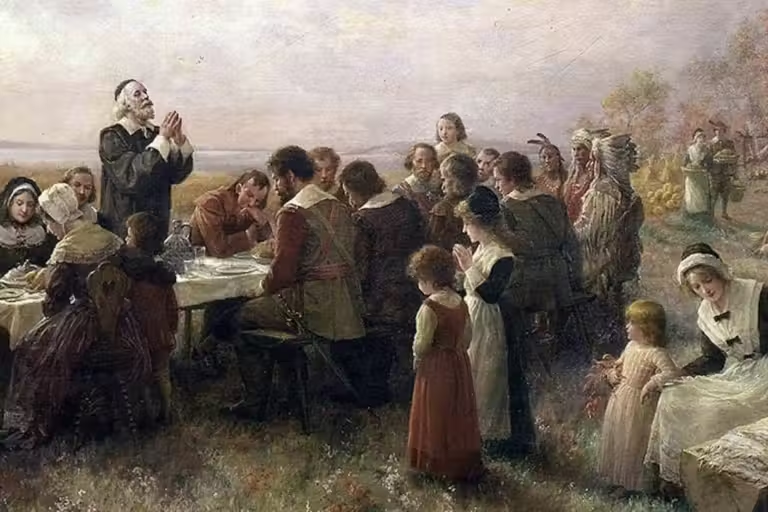
Puritanism profoundly shaped the religious, political and social culture of colonial New England. Although it did not directly cause American expansionism, its ideas of covenant, divine mission and collective chosenness supplied a language that later advocates of American exceptionalism and Manifest Destiny could adapt.
Puritanism and expansionism belong to different periods of American history. Puritan communities developed in New England during the seventeenth century, whereas the doctrine of Manifest Destiny emerged during the nineteenth century.
Nevertheless, the two movements share part of the same intellectual vocabulary. Both could present territorial occupation as a providential mission. Both also helped settlers represent inhabited land as an available wilderness.
The connection, however, requires careful qualification. Puritan theology did not automatically produce American expansionism. Political ambition, commercial interests, demographic growth, racial ideology and military power also drove territorial conquest.
/more

What was Puritanism?
Puritanism emerged from the Protestant Reformation in sixteenth-century England. Puritans believed that the Church of England had retained too many doctrines, ceremonies and institutions inherited from Roman Catholicism.
They therefore sought to “purify” the English Church. Their movement drew heavily on Reformed theology, especially the teachings associated with John Calvin.
Puritans did not form one perfectly unified denomination. They disagreed about how far reform should go and about whether believers should remain within the established Church.
Puritans and Separatists
Most Puritans wanted to reform the Church of England from within. Separatists adopted a more radical position. They believed that the established Church was so corrupt that true believers had to leave it.
The Pilgrims who founded Plymouth Colony in 1620 belonged to this Separatist tradition. By contrast, many settlers who established the Massachusetts Bay Colony from 1630 remained formally connected to the Church of England.
Consequently, the terms Pilgrim and Puritan are related but not interchangeable. The Pilgrims were Separatists, while the larger Puritan migration to Massachusetts Bay represented a distinct movement.
The Puritan view of humanity and salvation
Puritan theology emphasised original sin. Human beings were considered naturally inclined towards sin and incapable of achieving salvation through good works alone.
Puritans also accepted the Calvinist doctrine of predestination. According to this doctrine, God had already chosen those who would receive salvation. These people were commonly described as the elect.
No individual could earn election. Nevertheless, Puritans carefully examined their behaviour, emotions and spiritual experiences for possible signs of divine grace.
This introspective religious culture encouraged diaries, conversion narratives, sermons and autobiographical writing. It also created anxiety because no believer could obtain absolute proof of salvation.
Covenant and community
The covenant occupied a central place in Puritan thought. A covenant was a binding agreement that defined a relationship between God and human beings.
Puritans applied this model beyond individual salvation. They believed that an entire community could enter a collective covenant with God. If the community obeyed divine law, it might receive protection and prosperity. If it failed, it could face divine punishment.
This belief turned religion into a principle of social organisation. In New England, religious duties influenced education, family life, political participation and public morality.
However, colonial New England was not simply a theocracy in which ministers directly governed the population. Civil officials exercised political authority, while churches retained considerable influence over public life. Church membership also affected political participation during parts of the colonial period.
The Pilgrims and the Mayflower Compact
In November 1620, the passengers of the Mayflower reached Cape Cod, outside the territory covered by their original patent. Before establishing their settlement, forty-one male passengers signed the Mayflower Compact.
The document created what its signatories called a “civil Body Politick”. They agreed to enact and obey laws intended for the colony’s general good.
The Compact did not establish modern democracy or universal religious liberty. Women, servants, Indigenous people and many other inhabitants had no role in signing it. Nevertheless, it illustrates how covenant language could support both religious association and civil government.

The Massachusetts Bay Colony and the Great Migration
A much larger Puritan migration began in 1630. During the Great Migration of the 1630s, approximately 20,000 English people moved to New England.
Many settled in the Massachusetts Bay Colony. Unlike numerous migrants to other colonies, they often travelled as families and intended to establish permanent communities.
John Winthrop, repeatedly elected governor of Massachusetts Bay, expressed the colony’s collective mission in his sermon A Model of Christian Charity. He described the community as a “city upon a hill” whose successes and failures would be visible to the world.
This image did not initially proclaim a right to dominate the continent. Instead, it warned the settlers that their covenant imposed exceptional obligations. Failure would make them an example of religious hypocrisy rather than greatness.
Later American political rhetoric often detached the phrase from that warning. The “city upon a hill” gradually became a symbol of national exceptionalism and exemplary leadership.
Religious conformity and dissent
The Puritans had suffered pressure and persecution in England. Yet their own colonies did not generally establish religious liberty in its modern sense.
Massachusetts Bay leaders wanted to protect what they considered a true and orderly Christian community. They therefore regarded some forms of dissent as threats to both religion and civil stability.
Roger Williams
Roger Williams criticised the close relationship between civil government and organised religion. He argued that political authorities should not punish individuals for their religious beliefs.
Williams also challenged the legitimacy of colonial land claims that ignored Indigenous ownership. In 1635, the authorities banished him from Massachusetts Bay.
He founded Providence in 1636 on land acquired from the Narragansett. The settlement later became part of Rhode Island, which developed a comparatively broad policy of religious toleration.
Anne Hutchinson
Anne Hutchinson arrived in Massachusetts in 1634. She organised religious meetings in her home and attracted followers through her interpretations of sermons and discussions of grace.
Her opponents accused her of antinomianism: the belief that recipients of divine grace were not bound by ordinary moral law. The dispute also challenged conventional limits placed on women’s public religious authority.
Massachusetts authorities tried Hutchinson in 1637 and banished her from the colony. In 1638, she and her supporters helped establish Portsmouth on Aquidneck Island, rather than settling in Providence itself.
Did Puritanism disappear?
Puritanism did not suddenly end after the first colonial generation. Instead, it changed throughout the seventeenth and eighteenth centuries.
Several developments weakened the original religious model. Economic growth made New England society more diverse. New generations could not always describe the conversion experience required for full church membership. Other denominations also became more visible.
In 1662, the Half-Way Covenant allowed the baptised children of church members to obtain a limited relationship with the congregation, even when they could not demonstrate a personal conversion experience. The measure attempted to preserve the church’s social reach.
Puritan traditions later contributed to Congregationalism. Their influence also persisted through educational institutions, political vocabulary, moral culture and literary forms.
The Salem witch trials
The Salem witch trials of 1692 and 1693 reflected intense religious, judicial and social conflict. Colonial authorities prosecuted more than 150 people, although estimates vary according to the records counted.
Nineteen convicted people were hanged. Giles Corey died after being pressed beneath heavy stones, and several accused people died in prison. Contrary to a common misconception, colonial authorities did not burn convicted witches at Salem.
The trials damaged confidence in the colony’s institutions. However, historians do not treat them as the single cause of Puritanism’s decline. They formed part of a wider religious and social transformation.
Puritanism and the idea of wilderness
European settlers often described North America as a wilderness. In Puritan writing, wilderness carried several meanings. It could represent danger, temptation, isolation or a place in which believers tested their faith.
This description concealed an essential reality: the territory was neither empty nor unclaimed. Indigenous nations had occupied, cultivated, governed and travelled through these lands for generations.
New England included societies such as the Wampanoag, Narragansett, Massachusett, Pequot and Mohegan. These nations maintained their own political alliances, economic systems and territorial claims.
European disease had caused catastrophic Indigenous population losses before and during the first decades of English settlement. Colonists sometimes interpreted depopulated villages and fields as providential openings for settlement. Such interpretations transformed human disaster into evidence of divine approval.
Mission, conversion and colonial expansion
Some Puritans believed that they had a duty to spread Christianity among Indigenous peoples. Missionaries translated religious texts, established schools and created settlements commonly called “praying towns”.
Missionary activity did not remain separate from colonial power. Conversion programmes often encouraged Indigenous communities to adopt English religious practices, legal rules, clothing, agriculture and gender roles.
Meanwhile, English settlements expanded beyond their original boundaries. Population growth increased demand for land. Trade, war, treaties and coercive purchases gradually transferred territory to colonial control.
Religion could legitimise this movement, but it was not its only cause. Settlers also pursued farms, commercial opportunities, political security and strategic advantage.
From providential mission to American exceptionalism
Puritan communities interpreted their history through providence. They believed that God intervened in human affairs and judged collective behaviour.
This habit of thought survived after Puritan institutions changed. Later Americans could describe the nation as chosen, exemplary or entrusted with a special historical mission.
This idea became one source of American exceptionalism: the belief that the United States followed a distinctive historical path and possessed a unique political or moral purpose.
However, American exceptionalism developed from many traditions. Republican political theory, Enlightenment philosophy, the Revolution, nationalism and economic growth all contributed to it. Puritanism supplied one influential vocabulary, not a complete explanation.
From Puritan providence to Manifest Destiny
In 1845, journalist John L. O’Sullivan used the expression Manifest Destiny while defending the annexation of Texas and continental expansion.
The phrase suggested that the United States had an evident and providential mission to spread across North America. It presented expansion as natural, inevitable and morally justified.
This rhetoric echoed earlier religious ideas of chosenness and divine purpose. Yet the political context had radically changed. Nineteenth-century expansion served national power, settler migration, commercial development and the extension of competing systems of free and enslaved labour.
Manifest Destiny also justified the displacement of Indigenous peoples and helped legitimise war against Mexico. It converted territorial ambition into a supposed historical law.
For a detailed study of this nineteenth-century doctrine, read O’Sullivan’s Manifest Destiny. The later stages of territorial growth are examined in America: West to the Pacific.
The limits of the connection
It would be misleading to draw a straight line from the Puritan settlement of New England to the conquest of the American West.
Puritan settlers did not possess a unified programme for continental expansion. Nor did all Puritans interpret colonisation in the same way. Roger Williams, for example, criticised English claims to Indigenous territory.
Furthermore, many later expansionists came from regions and religious traditions with little direct connection to colonial Puritanism.
The strongest connection is therefore rhetorical and ideological. Puritan concepts of covenant, mission and providence helped establish a language through which later Americans could imagine collective destiny.
That language did not make expansion unavoidable. Instead, it helped political actors portray deliberate choices as divine, natural or historically inevitable.
Conclusion
Puritanism shaped colonial New England through its doctrines of original sin, election, covenant and collective responsibility. It also created tightly organised communities that combined religious conviction with civil authority.
These communities never occupied an empty wilderness. Their growth transformed lands already inhabited and governed by Indigenous nations. Religious mission frequently accompanied political settlement, cultural pressure and territorial dispossession.
Puritanism did not directly create Manifest Destiny. Nevertheless, its language of providence, chosenness and exemplary mission survived within American culture. During the nineteenth century, expansionists reused that language to present territorial conquest as the fulfilment of a national destiny.
Understanding this continuity reveals how religious ideas can outlive their original institutions. It also shows how political movements can adapt inherited beliefs to justify new ambitions.
Frequently asked questions
What was the main purpose of Puritanism?
Puritans wanted to reform the Church of England by removing practices they considered insufficiently Protestant. In New England, they also sought to build disciplined Christian communities organised around covenant, worship and moral responsibility.
Were the Pilgrims and Puritans the same people?
The Pilgrims belonged to the broader Puritan movement, but they were Separatists who had left the Church of England. Most settlers of Massachusetts Bay wanted to reform that Church rather than formally separate from it.
Was colonial Massachusetts a theocracy?
Religion strongly influenced government in Massachusetts Bay, but ministers did not directly hold all political power. Civil magistrates governed the colony, while church membership and Puritan doctrine shaped political participation and public policy.
Did Puritans believe in religious freedom?
Most New England Puritans sought freedom to practise and organise their own religion. They did not necessarily support equal freedom for beliefs they considered dangerous. Dissenters such as Roger Williams and Anne Hutchinson were banished.
How did Puritanism influence American expansionism?
Puritanism did not directly cause territorial expansion. However, its ideas of divine providence, collective mission and chosenness contributed to a vocabulary later used by advocates of American exceptionalism and Manifest Destiny.
Did the Puritans settle unoccupied land?
No. Indigenous nations had occupied and governed New England for generations. European disease reduced many communities, but the land remained inhabited, used and claimed by peoples including the Wampanoag, Narragansett, Massachusett, Pequot and Mohegan.
Sources and further reading
- National Park Service: The Puritans
- National Park Service: John Winthrop
- National Park Service: Anne Hutchinson
- National Park Service: Colonial Rhode Island timeline
- Library of Congress: The Mayflower Compact
- Commonwealth of Massachusetts: Salem witchcraft trials
- Yale Law School, Avalon Project: nineteenth-century American expansion

