
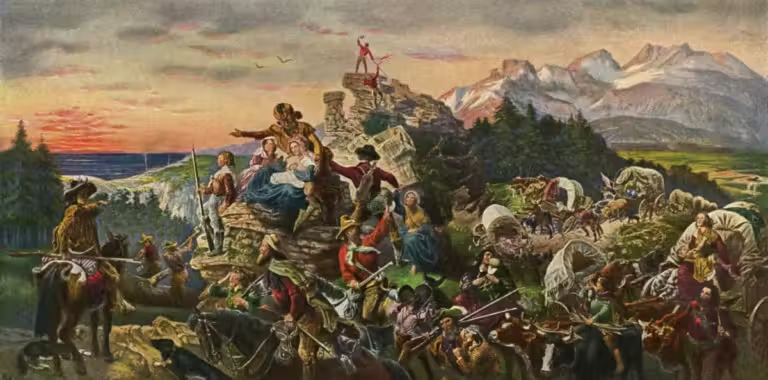
American expansion towards the Pacific combined exploration, settlement, trade, diplomacy, annexation and war. It transformed the United States into a continental power, but it also displaced Indigenous nations, transferred vast Mexican territories and intensified the conflict over the expansion of slavery.
During the nineteenth century, the United States expanded from a republic concentrated near the Atlantic coast into a continental nation extending to the Pacific Ocean. Americans often described this movement as natural, inevitable or providential, imagining an advancing frontier where farmers and pioneers brought settlement and republican government to an undeveloped wilderness.
This national mythology conceals much of the historical reality. The West was neither empty nor politically unclaimed: Indigenous nations governed most of the continent, while Britain, Spain, Russia and Mexico maintained territorial interests of their own.
Westward expansion therefore required more than individual courage. It depended on federal treaties, military expeditions, land surveys, forced removals, financial subsidies and wars. The process created opportunities for settlers and businesses, but it transferred land and political power away from Indigenous and Mexican communities.

What was westward expansion?
Westward expansion was the gradual extension of United States territory, settlement and political control across North America. It began before independence, when British colonists crossed the Appalachian Mountains, and accelerated after the American Revolution.
The process combined exploration, commercial trade, migration, treaties, annexation, military conquest, federal land distribution and railway construction. It was both territorial and economic: American officials wanted agricultural land, commercial routes, mineral resources and ports on the Pacific, as well as stronger access to trade with Asia.
The United States before the Louisiana Purchase
The Treaty of Paris of 1783 recognised the independence of the United States and assigned it territory extending westwards to the Mississippi River. However, this diplomatic boundary did not mean that the federal government controlled the entire region.
Indigenous nations occupied and governed extensive territories between the Appalachian Mountains and the Mississippi. Britain also retained frontier forts for more than a decade after the treaty, while American settlers moved increasingly into Kentucky, Tennessee and the Ohio Valley.
The Northwest Ordinance of 1787 created a process for organising territories and admitting new states. It established an important precedent: western territories would eventually join the Union as states rather than remain permanent colonies. At the same time, it encouraged settlement on lands that Indigenous nations continued to claim.

The Louisiana Purchase
France recovered the Louisiana territory from Spain through a secret agreement in 1800. President Thomas Jefferson was especially concerned with New Orleans and navigation on the Mississippi River because western farmers depended on the port to export their crops.
Jefferson sent representatives to negotiate the purchase of New Orleans and nearby territory. Napoleon Bonaparte instead offered to sell the entire Louisiana territory, which the United States purchased in 1803 for approximately 15 million dollars.
The acquisition roughly doubled the territory claimed by the United States. It extended from the Mississippi River towards the Rocky Mountains and from the Gulf of Mexico towards British North America, although its exact boundaries remained uncertain.
The transaction transferred France’s diplomatic claim, not actual possession of every part of the region. Indigenous nations continued to govern much of the territory and had not consented to the sale.
Was the Louisiana Purchase constitutional?
The Constitution did not explicitly grant the president authority to acquire foreign territory. Jefferson generally supported a narrow interpretation of federal power and briefly considered requesting a constitutional amendment.
He ultimately accepted that the treaty-making power could support the purchase. The episode revealed a recurring feature of American expansion: political leaders could embrace broad federal authority when territorial opportunities arose, even while defending limited government in other contexts.
The Lewis and Clark Expedition
Jefferson commissioned an expedition to explore the new territory and seek a practical route towards the Pacific. Meriwether Lewis and William Clark led the Corps of Discovery from 1804 to 1806.
The expedition travelled up the Missouri River, crossed the Rocky Mountains and followed the Columbia River to the Pacific coast. Its members gathered geographical, botanical and zoological information while also attempting to establish United States influence among Indigenous nations.
The explorers did not discover an easy continuous water route across the continent. The Rocky Mountains made the imagined Northwest Passage impossible, but the expedition’s maps and journals increased American knowledge of western geography and supported later commercial and political claims.
Sacagawea and Indigenous assistance
The expedition depended heavily on Indigenous knowledge, diplomacy and material assistance. Sacagawea, a Lemhi Shoshone woman, travelled with the group alongside her husband, the interpreter Toussaint Charbonneau.
She helped identify plants, interpret local conditions and establish contact with Shoshone communities. Her presence with an infant also signalled that the expedition was not simply a military raiding party.
Numerous Indigenous nations supplied food, horses, shelter, directions and diplomatic support. The traditional image of a self-sufficient expedition conquering an unknown wilderness is therefore misleading: the explorers crossed inhabited political landscapes and survived because local communities assisted them.
The fur trade and the mountain men
The western fur trade expanded during the early nineteenth century. American, British, French Canadian, Métis and Indigenous traders exchanged animal pelts, manufactured goods, food and information across extensive commercial networks.
Trappers commonly called mountain men entered the Rocky Mountains in search of beaver pelts. Figures such as Jedediah Smith, Jim Bridger and Kit Carson later became celebrated in frontier mythology, but they frequently relied on Indigenous routes, languages, trading networks and family alliances.
The fur trade helped map trails and mountain passes later used by emigrants. It also spread disease, altered local economies and intensified competition over resources.
The Oregon Country
The Oregon Country was a vast and contested region in the Pacific Northwest. In broad terms, it extended from the Rocky Mountains to the Pacific and from Spanish or Mexican California northwards towards Russian Alaska.
Spain, Russia, Britain and the United States all asserted interests in parts of the region. Spain withdrew its claims north of the 42nd parallel through the Adams-Onís Treaty of 1819, while Russia later accepted a southern boundary for Alaska at latitude 54°40′.
Britain and the United States remained the principal rival claimants. The Convention of 1818 established joint occupation without dividing the territory permanently.
British influence initially appeared stronger because the Hudson’s Bay Company operated extensive trading networks and posts. American missionaries, traders and farmers later established a growing presence, especially in the Willamette Valley.

The Oregon Trail
The Oregon Trail connected the Missouri River region to the Pacific Northwest. Parts of the route developed from Indigenous paths, fur-trading networks and earlier exploratory journeys.
Small groups travelled west during the 1830s, but large-scale family migration accelerated after the Great Migration of 1843. Most emigrants departed from towns near the Missouri River, followed river valleys across the Great Plains and crossed the Continental Divide through South Pass.
The journey commonly covered more than 2,000 miles and lasted several months. Travellers transported food, tools and household goods in wagons, although most people walked alongside them to reduce the burden on the animals.
What dangers did emigrants face?
Travellers faced dangerous river crossings, accidental injuries, extreme weather, exhaustion and shortages of food or water. Disease caused the greatest number of deaths, with cholera becoming especially destructive during the major migrations of the late 1840s and early 1850s.
Popular culture often exaggerates the danger of attacks by Indigenous people. Violent encounters occurred, but disease, accidents and environmental conditions killed far more emigrants.
Conflict increased as migration intensified. Wagon traffic damaged grazing areas, depleted firewood and spread disease through Indigenous territories, while growing settlement threatened local political authority and access to resources.
Manifest Destiny
The ideology of Manifest Destiny gave expansion a moral and providential meaning. Journalist John L. O’Sullivan used the expression in 1845 while defending the annexation of Texas.
O’Sullivan argued that Providence had assigned the continent to the growing population of the United States. The idea combined American exceptionalism, republican progress, demographic growth and a supposed providential right to continental territory.
Manifest Destiny was not a formal government programme, nor did every American support it. Whigs, abolitionists and other critics condemned territorial aggression or feared that expansion would spread slavery.
Indigenous nations and Mexicans also rejected the assumption that American settlers possessed a superior right to their territory. For a detailed analysis of O’Sullivan’s rhetoric, read O’Sullivan’s Manifest Destiny: Meaning and Legacy.
James K. Polk and continental expansion
Democrat James K. Polk won the presidential election of 1844 as a strong supporter of territorial expansion. His programme included the annexation of Texas, settlement of the Oregon boundary and acquisition of California.
Polk’s supporters portrayed expansion as an expression of national confidence and opportunity. Opponents feared war, the extension of slavery and the growth of presidential power.
The slogan “Fifty-four Forty or Fight” later became associated with demands for the entire Oregon Country up to latitude 54°40′. However, it was not the official slogan of Polk’s 1844 presidential campaign and became prominent mainly during the subsequent boundary dispute.
The Oregon boundary settlement
Polk initially asserted a broad American claim to the Oregon Country. Some expansionists demanded the whole territory, but neither Britain nor the United States wanted a major war over the Pacific Northwest.
The two governments negotiated the Oregon Treaty of 1846. The agreement extended the international boundary westwards largely along the 49th parallel, with specific arrangements concerning Vancouver Island and navigation.
The United States obtained the territory that later formed Oregon, Washington, Idaho and parts of Montana and Wyoming. No war occurred with Britain over Oregon.
The settlement also reveals the limits of expansionist rhetoric. The United States accepted compromise when facing the British Empire, even while adopting a more aggressive policy towards Mexico.
Texas under Mexican rule
Mexico gained independence from Spain in 1821 and inherited control over Texas. The Mexican government encouraged immigration to develop the sparsely populated region and strengthen its northern frontier.
Stephen F. Austin and other empresarios recruited settlers, many of whom came from the United States. Immigrants agreed to obey Mexican law, become citizens and formally adopt Catholicism.
Tensions nevertheless developed over immigration, local autonomy, taxation, political centralisation and slavery. Mexico had moved towards abolishing slavery, while many Anglo-American settlers wanted to preserve enslaved labour in cotton production.
The Texas Revolution
Armed rebellion began in Texas in 1835. Texan forces presented their cause as a struggle for constitutional liberty and resistance to Mexican centralisation, although the protection of slavery and the interests of Anglo-American settlers also shaped the conflict.
Mexican forces under General Antonio López de Santa Anna defeated Texan defenders at the Alamo in March 1836. Later that month, Mexican troops executed captured Texan soldiers at Goliad.
On 21 April, Sam Houston’s army defeated Santa Anna at the Battle of San Jacinto. Texas then operated as an independent republic, although Mexico refused to recognise its independence.
The annexation of Texas
Many Texans wanted the United States to annex the republic. American presidents initially hesitated because annexation could cause war with Mexico and intensify the political conflict over slavery.
Texas permitted slavery and covered enough territory potentially to form several states. Its admission could therefore strengthen slaveholding power in Congress.
Congress approved annexation through a joint resolution in 1845, and Texas entered the Union as a slave state in December. Mexico regarded annexation as an aggressive act, while a separate boundary dispute made the crisis even more dangerous.
The disputed Texas border
Texas claimed the Rio Grande as its southern and western boundary, while Mexico recognised the Nueces River farther north as the historical limit of Texas. The territory between the two rivers therefore remained disputed.
President Polk sent General Zachary Taylor and American troops into the contested area. Mexican and American forces clashed north of the Rio Grande in April 1846.
Polk declared that Mexico had shed American blood on American soil and requested a declaration of war. Critics rejected that description because the fighting had taken place on territory claimed by both countries.
The Mexican-American War
Congress declared war on Mexico in May 1846. United States forces invaded northern Mexico, New Mexico and California, while American settlers in California participated in the Bear Flag Revolt before naval forces secured the region.
General Winfield Scott later conducted an amphibious invasion through Veracruz and advanced towards Mexico City. American forces occupied the Mexican capital in September 1847.
The war demonstrated the military strength of the United States, but it remained politically controversial. Many Whigs accused Polk of provoking an unnecessary war of conquest.
Representative Abraham Lincoln introduced resolutions challenging Polk to identify the precise location where the first blood had been shed. Frederick Douglass and other abolitionists argued that territorial conquest would expand the political power of slavery, while Henry David Thoreau’s opposition to the war contributed to the essay later known as Civil Disobedience.
The Treaty of Guadalupe Hidalgo
The Treaty of Guadalupe Hidalgo ended the war in February 1848. Mexico recognised the Rio Grande as the boundary of Texas and transferred a vast northern territory to the United States.
The Mexican Cession included present-day California, Nevada and Utah, together with most of Arizona and parts of New Mexico, Colorado and Wyoming. The United States paid Mexico 15 million dollars and assumed certain claims held by American citizens.
The treaty promised to protect the property and civil rights of Mexican residents in the transferred territories. In practice, many Mexican landowners later lost property through litigation, fraud, taxation and discriminatory legal systems.
The Gadsden Purchase
The United States acquired additional territory from Mexico through the Gadsden Purchase of 1853. The purchase covered land in present-day southern Arizona and New Mexico.
American officials wanted a practical southern route for a transcontinental railway. The agreement helped establish the modern continental boundary between the United States and Mexico.
Expansion and the slavery crisis
The acquisition of western territory reopened the political conflict over slavery. The central question was whether slavery would be permitted in the lands taken from Mexico.
Representative David Wilmot proposed prohibiting slavery in territory acquired through the war. The Wilmot Proviso repeatedly passed the House of Representatives but failed in the Senate, revealing the growing sectional division between North and South.
Some Northerners opposed slavery on moral grounds, while others wanted western land reserved for white free labour. Southern slaveholders insisted that the federal government could not exclude their property from national territories.
The Compromise of 1850 attempted to settle the dispute, but the conflict continued through the Kansas-Nebraska Act, Bleeding Kansas and the Dred Scott decision. Westward expansion therefore helped create the sectional crisis that led to the American Civil War.
Gold, land and railroads
Territorial acquisition did not immediately produce settlement or economic integration. Mining discoveries, federal land legislation and railway construction accelerated migration during the second half of the nineteenth century.
The California Gold Rush
Gold was discovered at Sutter’s Mill in California in January 1848. News spread internationally, and hundreds of thousands of migrants travelled to California.
The migrants who arrived during 1849 became known as Forty-Niners. Some crossed the continent, while others sailed around Cape Horn or travelled across the Isthmus of Panama.
The Gold Rush transformed California’s population and economy with extraordinary speed. Mining camps became towns, and San Francisco developed into a major port and commercial centre.
Very few individual miners became permanently wealthy. Merchants, transport companies and suppliers often profited more reliably than prospectors.
The Gold Rush caused catastrophic disruption for Indigenous peoples in California. Mining polluted rivers, destroyed food sources and brought disease, while militias and state-supported campaigns killed or displaced thousands of Indigenous people.
Mexican, Chilean, Chinese and other foreign miners also faced discriminatory taxes and violence. The Gold Rush created a highly diverse society, but one structured by racial and economic inequality.
The Homestead Act of 1862
During the Civil War, Congress adopted the Homestead Act to encourage settlement of western land. President Abraham Lincoln signed it on 20 May 1862.
The law allowed eligible applicants to claim 160 acres of surveyed public land after paying a filing fee. Claimants generally had to live on the land, build a home, improve it and remain for five years before receiving title.
The Act opened applications to adult citizens and intended citizens who had not taken up arms against the United States. Women, formerly enslaved people and immigrants could qualify under certain conditions.
The policy is often celebrated as a democratic distribution of land. However, much of that land came from Indigenous territories obtained through war, coerced treaties or federal seizure.
Many homesteaders also failed to complete their claims because of drought, isolation, poor soil or insufficient capital. Land companies, speculators and railways acquired enormous areas alongside individual settlers.
The transcontinental railroad
A railway connecting the Atlantic states to the Pacific had been discussed for decades. Sectional disagreement prevented Congress from selecting a route before the Civil War.
After Southern states seceded, Congress selected a central route and passed the Pacific Railway Act in 1862. The federal government supported construction through loans and extensive land grants.
The Union Pacific built westwards from the Missouri River, while the Central Pacific built eastwards from California. The tracks met at Promontory Summit, Utah Territory, on 10 May 1869.
The railway reduced a transcontinental journey from several months to approximately one week. It accelerated migration, trade, mining, military movement and the shipment of livestock and agricultural products.
Who built the railroad?
Thousands of workers built the transcontinental railway under dangerous conditions. Chinese immigrants formed most of the Central Pacific workforce and blasted tunnels through the Sierra Nevada while working through severe winter weather.
Irish immigrants, Civil War veterans, formerly enslaved people and other labourers worked for the Union Pacific. Workers faced explosions, rockfalls, disease, extreme temperatures and inadequate medical care.
The famous completion photographs largely excluded the Chinese workers whose labour had made the achievement possible. The national memory of the railway therefore celebrated technology and industrial leadership while minimising the workforce behind them.
The consequences for Indigenous nations
Westward expansion treated Indigenous territories as land available for settlement, commerce and resource extraction. Indigenous nations did not passively disappear: they negotiated treaties, formed alliances, adapted their economies and resisted military occupation.
The federal government increasingly attempted to confine Native peoples to reservations. Treaties often promised permanent territory, food and protection, but settlers and government officials repeatedly violated those agreements when land or resources became valuable.
Major conflicts included the Dakota War, Red Cloud’s War, the Great Sioux War and the Nez Perce War. At the Battle of the Little Bighorn in 1876, Lakota, Northern Cheyenne and Arapaho warriors defeated forces led by Lieutenant Colonel George Armstrong Custer.
The victory did not stop federal expansion. The United States increased military pressure and forced many communities onto reservations.
The destruction of the bison herds
Millions of bison lived on the Great Plains before large-scale commercial hunting. Plains nations relied on them for food, clothing, shelter, tools and religious life.
Railways made it easier for commercial hunters to reach the herds and transport hides eastwards. Hunting intensified during the 1870s, and bison populations collapsed from millions of animals to only a few hundred by the late nineteenth century.
Some military officials openly recognised that destroying the herds would weaken Indigenous resistance and force Plains communities towards reservations. The destruction of the bison was therefore both an ecological catastrophe and an instrument of colonial power.
Assimilation and the Dawes Act
By the late nineteenth century, federal policy increasingly promoted forced assimilation. Officials sought to replace communal landholding, Indigenous governments and cultural traditions with individual farming and American institutions.
The Dawes Act of 1887 divided many reservation lands into individual allotments. Land classified as surplus was opened to non-Indigenous settlement, causing Indigenous nations to lose millions of acres.
Federal and religious boarding schools also removed children from their families and attempted to suppress Indigenous languages, clothing and spiritual practices. Assimilation was presented as humanitarian progress, but in practice it attacked collective sovereignty and cultural continuity.
Western labour and migration
The West was never populated only by white male pioneers. Women, African Americans, Mexican Americans, Indigenous people, Chinese immigrants and European migrants all contributed to western agriculture, mining, trade and transport.
The cattle kingdom
The cattle industry expanded across the Great Plains after the Civil War. Texas contained large herds of longhorn cattle but offered limited access to profitable eastern markets.
Cowboys drove cattle northwards along routes such as the Chisholm Trail to railway towns in Kansas. From there, trains transported the animals to slaughterhouses and urban consumers.
Popular culture later presented the cowboy as an independent white frontiersman. In reality, the workforce was ethnically diverse, and Black, Mexican, Indigenous and immigrant cowboys played substantial roles.
The open-range cattle industry declined as settlement expanded, farmers erected barbed-wire fences and severe winters destroyed large herds.
Women in western expansion
Women participated in every stage of westward expansion. They travelled on overland trails, maintained farms, operated businesses, taught in schools and worked in mining and railway towns.
The journey west did not automatically liberate women from domestic expectations. Many faced pregnancy, childbirth, isolation and heavy domestic labour under difficult conditions.
Western territories nevertheless sometimes granted women political rights earlier than eastern states. Wyoming Territory granted women voting rights in 1869, and Utah Territory followed in 1870, although federal legislation later temporarily removed those rights.
Chinese immigration and exclusion
Chinese migrants played a central role in the economic development of the West. They worked in mining, agriculture, domestic service, manufacturing and railway construction.
After the completion of the transcontinental railroad, many established businesses or found work in western towns. They also faced discriminatory taxation, legal exclusion, organised hostility and racial violence.
Economic depression during the 1870s strengthened anti-Chinese political movements. Congress responded with the Chinese Exclusion Act of 1882, which suspended the immigration of Chinese labourers and demonstrated the racial limits placed on western opportunity.
The idea of the frontier
Americans often imagined the frontier as a moving boundary between civilisation and wilderness. This model placed settlers at the centre of the story and represented Indigenous societies as obstacles or remnants of the past.
The federal census of 1890 announced that it could no longer identify one continuous frontier line because settlement had become widely distributed. Historian Frederick Jackson Turner responded with his 1893 essay on the significance of the frontier in American history.
Turner argued that the frontier had shaped American democracy, individualism and social mobility. His interpretation became highly influential, but it largely excluded Indigenous peoples, Mexican communities, women and the role of federal power.
The West was not simply a free space where individuals escaped established society. Government land policy, military force, railway corporations and financial investment structured its development.
The consequences of westward expansion
Westward expansion transformed the United States politically, economically and environmentally. Railways, farms, mines and ports created a continental economy, while Pacific ports strengthened American trade with Asia.
New territories and states increased western influence in Congress. Their admission also reopened the political conflict over slavery and helped destroy the fragile compromises between North and South.
Indigenous nations lost land through warfare, coerced treaties and federal policy. Mexican residents faced dispossession and racial discrimination under American rule, while Chinese migrants encountered exclusion despite their contribution to western development.
Expansion also transformed western ecosystems. Mining damaged rivers and forests, commercial agriculture altered grasslands and large-scale hunting brought the bison close to extinction.
Territorial expansion therefore offered land and opportunity to some populations while imposing dispossession, violence and exclusion on others.
Did westward expansion complete Manifest Destiny?
The acquisition of California and Oregon gave the United States access to the Pacific Ocean. However, describing the process as the completion of Manifest Destiny can be misleading.
Territorial claims did not produce immediate settlement or control, and Indigenous nations continued to defend their sovereignty across the West. The continental boundaries also continued to change through the Gadsden Purchase and the acquisition of Alaska in 1867.
American expansion did not stop at the Pacific coast. During the late nineteenth century, the United States annexed Hawaii and acquired overseas territories after the Spanish-American War.
The language of providential mission therefore moved from continental expansion towards overseas imperialism.
Conclusion
American expansion towards the Pacific did not result from one continuous movement or one unified national plan. It developed through purchases, exploration, migration, diplomacy, annexation, war and federal economic policy.
The Louisiana Purchase enlarged the country’s claimed territory, while the Lewis and Clark Expedition gathered geographical and diplomatic information. Fur traders and migrants then established routes and settlements across regions governed by Indigenous nations.
The annexation of Texas and settlement of the Oregon dispute extended American power. The Mexican-American War transferred California and the Southwest to the United States and intensified the political struggle over slavery.
After the Civil War, the Homestead Act and federal railway subsidies accelerated settlement and commercial development. The transcontinental railroad connected the Pacific coast to eastern markets, but it also carried settlers and soldiers into treaty lands.
The resulting continental nation offered land and opportunity to millions of people. Those opportunities, however, depended heavily on Indigenous dispossession, Mexican territorial loss, immigrant labour and federal power.
Westward expansion should therefore be understood neither as an inevitable national destiny nor as a simple adventure of individual pioneers. It was a contested process involving governments, corporations, migrants, workers and communities whose lands and sovereignty stood in the path of the expanding United States.
The rapid industrial and demographic development that followed is examined in Years of Growth.
Frequently asked questions
What was westward expansion?
Westward expansion was the extension of United States settlement, territory and political control across North America through migration, trade, treaties, annexation, federal land policy and war.
What did the Louisiana Purchase achieve?
The Louisiana Purchase of 1803 roughly doubled the territory claimed by the United States and gave it control of New Orleans and the western Mississippi River system.
Did Lewis and Clark discover an easy route to the Pacific?
No. The expedition reached the Pacific but demonstrated that no easy continuous water route crossed the continent. It nevertheless produced valuable maps, observations and diplomatic information.
What was the Oregon Trail?
The Oregon Trail was an overland migration route from the Missouri River region to the Pacific Northwest. Large-scale family migration accelerated during the 1840s.
Did the United States fight Britain for Oregon?
No. Britain and the United States negotiated the Oregon Treaty of 1846 and divided the region largely along the 49th parallel.
Why did the United States go to war with Mexico?
The annexation of Texas, a disputed border and President Polk’s territorial ambitions contributed to the war. Fighting began in disputed territory between the Nueces River and the Rio Grande.
What territory did Mexico lose in 1848?
Mexico transferred present-day California, Nevada and Utah, together with most of Arizona and parts of New Mexico, Colorado and Wyoming, under the Treaty of Guadalupe Hidalgo.
How did expansion contribute to the Civil War?
Every new western territory raised the question of whether slavery would be permitted there. The resulting sectional disputes destroyed political compromises between North and South.
What did the Homestead Act provide?
The Homestead Act allowed eligible applicants to claim 160 acres of surveyed public land after meeting requirements involving residence, construction and cultivation.
When was the transcontinental railroad completed?
The Union Pacific and Central Pacific railways met at Promontory Summit in Utah Territory on 10 May 1869.
How did westward expansion affect Indigenous peoples?
It brought land loss, broken treaties, warfare, forced removal, ecological destruction and assimilation policies. Indigenous nations resisted and continue to maintain distinct political and cultural identities.
Sources and further reading
- United States House of Representatives: About Westward Expansion
- Office of the Historian: Diplomacy and Westward Expansion, 1830–1860
- National Archives: Louisiana Purchase Treaty
- National Park Service: Lewis and Clark National Historic Trail
- National Park Service: The Lewis and Clark Expedition’s impact on Indigenous Americans
- National Park Service: Oregon National Historic Trail
- United States Senate: The Oregon Treaty
- National Archives: Treaty of Guadalupe Hidalgo
- Library of Congress: The Mexican-American War and the Border
- National Archives: Homestead Act
- National Archives: Pacific Railway Act
- National Park Service: Golden Spike National Historical Park
- National Archives: Exploration and Westward Expansion

