
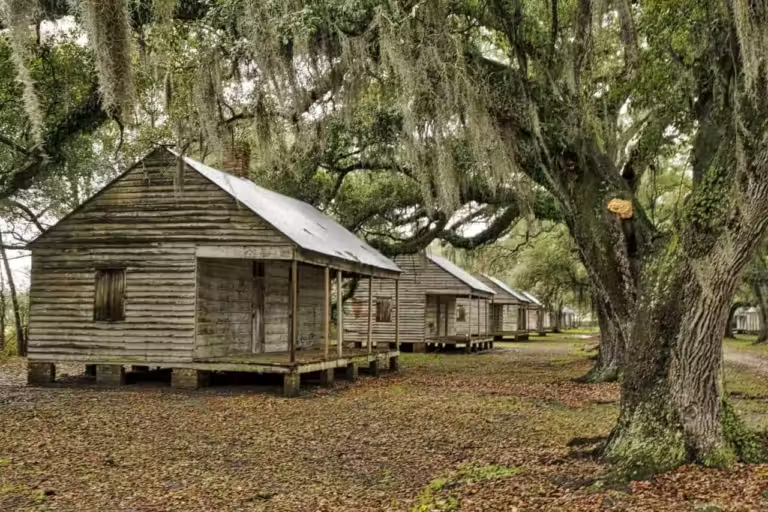
Life on Southern plantations was organised around forced labour, racial domination and the constant threat of violence. Enslaved people had little legal control over their work, movement or family lives. Nevertheless, they created communities, preserved cultural traditions and resisted slavery in both visible and everyday ways.
The plantation occupies a powerful place in representations of the antebellum American South. Popular culture has often focused on elegant mansions, wealthy planters and cultivated landscapes.
This image conceals the institution that made plantation wealth possible: racial slavery. Plantations functioned through the coerced labour of men, women and children whom the law treated as property.
The experiences of enslaved people varied widely. Conditions depended on the crop, region, size of the estate, type of labour, personality of the enslaver and strength of the enslaved community.
However, every plantation shared one basic reality. Enslaved people could not freely choose their work, employer, residence or future. Enslavers claimed ownership over their labour and, under the law, over their bodies.

What was a plantation?
A plantation was a large agricultural estate devoted primarily to producing crops for commercial sale. Historians often use the term for estates that employed at least twenty enslaved people, although definitions vary.
Not every enslaved person lived on a large plantation. Many lived on smaller farms, in towns or in urban households. Others worked in mines, factories, ports, hotels, workshops and transportation.
In 1860, approximately 3.6 million enslaved African Americans lived on farms and plantations. Around one million lived on plantations holding fifty or more enslaved people.
The plantation system was therefore extensive but not uniform. A person enslaved on a Louisiana sugar estate experienced different work and living conditions from someone held on a Virginia wheat farm or a South Carolina rice plantation.
The main plantation crops
The Southern economy produced several major commercial crops. Each crop required a particular labour system and shaped the rhythms of plantation life.
Cotton
Cotton dominated much of the Deep South during the nineteenth century. It became especially important in Alabama, Mississippi, Louisiana, Arkansas and Texas.
Enslaved workers cleared land, planted seeds, removed weeds and picked mature cotton. Picking season demanded exhausting labour because planters wanted the crop harvested before weather damaged it.
Many plantations imposed daily picking quotas. Overseers weighed each worker’s cotton and could punish those who failed to meet an assigned target.
Tobacco
Tobacco remained important in Virginia, Maryland, Kentucky and parts of North Carolina. Its cultivation required careful planting, weeding, harvesting and curing.
As tobacco production exhausted the soil, many Upper South enslavers shifted towards mixed agriculture or sold enslaved people to expanding plantations farther south.
Rice
Rice plantations developed along the coastal regions of South Carolina and Georgia. Their success depended partly on the agricultural knowledge of enslaved Africans from rice-growing regions of West Africa.
Workers constructed and maintained complex systems of dikes, canals and floodgates. They also laboured in wet environments where malaria and other diseases presented serious dangers.
Sugar
Sugar plantations were concentrated in Louisiana. Sugar cane demanded heavy physical labour and rapid processing after harvest.
During the grinding season, enslaved people often worked extremely long shifts around dangerous machinery. Contemporary accounts regularly described Louisiana sugar plantations as exceptionally harsh.

The organisation of plantation labour
Plantations used different systems to organise forced labour. The two best-known systems were the gang system and the task system.
The gang system
Under the gang system, enslaved workers laboured in groups under the supervision of an overseer or an enslaved driver.
The working day commonly began before sunrise and continued until sunset. During planting or harvest seasons, work could extend well into the night.
The gang system was common on cotton, tobacco and sugar plantations. It allowed enslavers to control the speed and intensity of labour closely.
The task system
The task system assigned each worker a specific amount of work for the day. It was especially associated with rice plantations in coastal South Carolina and Georgia.
After completing the assigned task, workers might have limited time to cultivate garden plots, fish, hunt, repair possessions, or visit relatives.
This limited flexibility did not make the system free or humane. Enslavers still determined the tasks, controlled the land and enforced labour through coercion.
Work beyond the fields
Not all enslaved plantation workers laboured in crop fields. Large estates required a wide range of specialised skills.
- Blacksmiths made and repaired tools, horseshoes and machinery.
- Carpenters constructed buildings, furniture and agricultural equipment.
- Coopers produced barrels for storing and transporting crops.
- Teamsters transported goods, animals and people.
- Millers operated grain or saw mills.
- Gardeners produced food for plantation households.
- Domestic workers cooked, cleaned, washed clothes and cared for children.
- Midwives and healers provided medical knowledge and assistance.
Some skilled workers could travel between plantations or be hired out to other employers. They might acquire knowledge, social connections or small amounts of money.
Nevertheless, any earnings remained vulnerable to confiscation. Skilled work did not remove a person from slavery or protect them from sale and punishment.

Women and children under slavery
Enslaved women performed agricultural labour alongside men on many plantations. They planted, hoed, harvested and carried crops while also maintaining households and caring for children.
Women assigned to domestic service worked as cooks, laundresses, cleaners, nurses and personal servants. Their proximity to enslavers did not necessarily provide safety.
Domestic workers remained under close surveillance and faced physical punishment. Enslaved women were also vulnerable to sexual harassment, assault and exploitation by white enslavers and overseers.
Children entered plantation labour gradually. Young children might carry water, collect firewood, watch animals or care for younger children. As they grew older, enslavers assigned them more demanding work.
Plantation records frequently assessed children according to their future economic value. This practice reveals how slavery converted human development and family relationships into calculations of property and profit.
Housing and material conditions
Enslaved families often lived in small cabins located away from the planter’s main house. Housing varied considerably between plantations.
Some cabins were made from logs, while others used rough wooden boards, brick or tabby. A single building might contain one or two rooms and house several people.
Cabins often provided limited protection from cold, heat, rain and insects. Poor ventilation and overcrowding could contribute to disease.
Furniture was generally sparse. Families might possess wooden beds or pallets, stools, tables, cooking vessels and handmade household objects.
Archaeological evidence also reveals creativity rather than mere deprivation. Enslaved people repaired ceramics, made tools, crafted toys, reused discarded objects and adapted their homes according to personal and cultural preferences.

Food and clothing
Enslavers generally distributed basic food rations because maintaining the workforce protected their investment. These provisions did not constitute generosity or social welfare.
Common rations included cornmeal, pork, fish, molasses, sweet potatoes and other inexpensive staples. The quantity, quality and regularity of provisions differed between plantations.
Where circumstances allowed, enslaved people supplemented their diets by cultivating gardens, raising chickens, fishing, hunting, gathering wild plants or exchanging goods.
These activities could improve nutrition and create a limited sphere of autonomy. However, they usually took place after the completion of exhausting forced labour.
Plantations also issued basic clothing, often once or twice a year. Field workers commonly received coarse and inexpensive garments designed for durability rather than comfort.
Enslaved people altered, repaired and personalised clothing when they could. Dress could express skill, identity, social connections and cultural preference despite the restrictions of slavery.
Health and medical care
Enslaved people faced injuries, disease, malnutrition and physical exhaustion. Working with agricultural tools, animals, mills and boiling equipment created additional dangers.
Enslavers sometimes paid physicians or provided basic treatment because illness reduced productivity and threatened the value they assigned to enslaved property.
Medical care was therefore often inconsistent and shaped by economic interests. White physicians could also perform painful or experimental procedures without meaningful consent.
Enslaved communities developed and preserved their own medical knowledge. Midwives, herbalists and healers used remedies drawn from African, Indigenous and European traditions.
Family life under slavery
Family relationships formed a central source of identity and support. Enslaved people married, raised children and maintained extended networks of relatives and fictive kin.
Slave-state laws did not generally recognise marriages between enslaved people as legally binding. An enslaver could therefore sell one spouse without consulting the other.
Parents also lacked a legal right to remain with their children. Sale, inheritance, debt and migration could separate families permanently.
The expansion of cotton production intensified this danger. The domestic slave trade transported hundreds of thousands of people from the Upper South to the Deep South during the first half of the nineteenth century.
Despite these threats, enslaved people worked to preserve family ties. They travelled between plantations, exchanged messages, named children after relatives and incorporated unrelated individuals into broader kinship networks.
Family life was therefore both vulnerable and resilient. It offered emotional support while remaining exposed to the commercial logic of slavery.
Religion and spiritual life
Religion occupied an important but complex place in plantation life. Enslavers often promoted selected Christian teachings that stressed obedience and submission.
Some required enslaved workers to attend white-controlled churches or plantation services. Ministers could be instructed to avoid messages that challenged slavery.
Enslaved Christians nevertheless developed their own interpretations. Biblical stories of Exodus, deliverance and divine justice offered hope that oppression would not last forever.
Secret prayer meetings allowed worshippers to preach, sing and pray beyond direct white supervision. These gatherings strengthened community bonds and could provide space for criticism and resistance.
African religious traditions also survived and influenced worship, music, healing, burial practices and beliefs about the spiritual world.
Spirituals did more than help people endure labour. They expressed grief, faith, hope and communal identity. Some songs could also communicate meanings that enslavers did not fully understand.
Education and literacy
Many slave states restricted the education of enslaved people, particularly after revolts and periods of political tension.
Following Nat Turner’s rebellion in 1831, several Southern legislatures strengthened laws against teaching enslaved African Americans to read and write.
These restrictions were not identical everywhere, nor were they always effectively enforced. Some enslaved people learned from relatives, free Black teachers, sympathetic white people or other literate workers.
Literacy could provide access to religious texts, news and written passes. It could also help a person communicate secretly or prepare an escape.
Frederick Douglass later described literacy as a decisive step in understanding both the injustice of slavery and the possibility of freedom.
Slave codes and surveillance
Colonial and state governments developed slave codes to regulate almost every aspect of enslaved life.
The rules differed according to location and period. However, they commonly restricted movement, assembly, weapons, education, employment and commercial activity.
Enslaved people often needed written passes to leave a plantation. Travelling without permission could lead to detention and punishment.
White patrols monitored roads, searched cabins and broke up unauthorised gatherings. These patrols involved both slaveholders and white men who owned no enslaved people.
The system therefore extended plantation authority into the wider community. It made surveillance and racial control collective responsibilities within white Southern society.
Punishment and violence
Violence was not an accidental feature of plantation slavery. It enforced labour, movement and submission.
Enslavers and overseers used whipping, confinement, shackling, humiliation and threats of sale. The possibility of separating a person from their family could function as punishment even when no physical violence occurred.
The severity of violence differed between plantations, but no enslaved person possessed a reliable legal right to refuse work or leave an abusive enslaver.
Some state laws nominally restricted extreme cruelty or murder. In practice, enslaved people often could not testify against white defendants, while local courts rarely challenged the authority of slaveholders.
Descriptions of unusually “kind” enslavers therefore miss the central issue. Even an enslaver who avoided extreme punishment still claimed ownership of another person’s labour, movement and family future.
Everyday resistance
Resistance did not always involve escape or armed rebellion. Enslaved people challenged the plantation system through numerous everyday actions.
- They worked more slowly than enslavers demanded.
- They feigned illness or injury.
- They broke or misplaced tools.
- They damaged crops or machinery.
- They took food and other resources produced through their own labour.
- They negotiated over work assignments and family visits.
- They preserved cultural and religious practices.
- They learned to read despite legal restrictions.
- They left plantations temporarily without permission.
These actions could reduce an enslaver’s control without producing an open confrontation that might lead to severe punishment.
Some behaviour recorded by enslavers as laziness, dishonesty or incompetence may instead reveal deliberate attempts to regain time, resources or autonomy.
Escape from slavery
Running away represented one of the clearest rejections of enslavement. However, escape involved enormous risks.
Some people fled permanently towards free states, Canada, Mexico, Indigenous territories or isolated maroon communities.
Others escaped temporarily to visit relatives, avoid punishment, negotiate working conditions or obtain a brief period of freedom.
Newspaper advertisements for fugitives reveal both the frequency of escape and the detailed surveillance practised by enslavers. Advertisements described clothing, scars, skills, family connections and speech patterns.
The Fugitive Slave Acts of 1793 and 1850 authorised the recapture of people accused of escaping from slavery. The 1850 law also compelled federal officials and, in some circumstances, ordinary citizens to assist slave catchers.
Free African Americans also faced kidnapping and fraudulent claims that they were fugitives. The law offered accused people very limited protection.
Open rebellion
Armed revolts were relatively rare because enslaved communities faced constant surveillance, lacked weapons and risked collective retaliation.
Nevertheless, several major uprisings and conspiracies deeply alarmed white society.
- The Stono Rebellion took place in South Carolina in 1739.
- Gabriel planned an uprising near Richmond, Virginia, in 1800.
- Denmark Vesey was accused of planning a revolt in Charleston in 1822.
- Nat Turner led an uprising in Southampton County, Virginia, in 1831.
After these events, white authorities executed suspected participants and often imposed stricter restrictions on education, assembly and movement.
The fear of revolt reveals a fundamental contradiction within proslavery ideology. Enslavers claimed that enslaved people were content, yet they maintained patrols, weapons and restrictive laws to prevent resistance.
Free Black people in the Southern states
Not every African American in the antebellum South was enslaved. By 1860, approximately 250,000 free Black people lived in Southern states.
People obtained freedom through several routes. Some purchased it, some were emancipated by enslavers, some were born to free mothers and others successfully sued for freedom.
Free Black communities established churches, schools, businesses and mutual-aid networks. Some individuals acquired substantial property and, in rare cases, owned enslaved people themselves.
However, legal freedom did not provide equality. State and local laws restricted voting, education, movement, employment, assembly and testimony.
Some states required free Black residents to register, obtain white guardians or leave after emancipation. They also remained vulnerable to kidnapping and illegal sale.
The expression “free slaves” should therefore be avoided. Once legally emancipated, these men and women were free Black people, although their freedom remained severely constrained.
Plantation slavery and the wider Southern economy
Plantations did not operate as isolated rural worlds. They formed part of extensive national and international commercial networks.
Merchants transported cotton, rice, sugar and tobacco to domestic and foreign markets. Banks financed land and enslaved property. Insurance companies protected commercial investments.
Northern textile mills processed slave-grown cotton, while Northern and European merchants profited from its trade.
Slavery therefore shaped more than the Southern countryside. It influenced shipping, finance, manufacturing, territorial expansion and national politics.
For a broader analysis of this society, read Antebellum South: Society, Slavery and Secession.
The plantation myth
After the Civil War, defenders of the former Confederacy promoted an idealised image of plantation life.
This mythology portrayed planters as honourable patriarchs and enslaved workers as loyal dependants. Novels, films, monuments and schoolbooks helped spread this version of the past.
The myth focused attention on mansions, clothing and hospitality while minimising forced labour, sale, punishment and family separation.
First-person narratives, plantation records, census documents and archaeological evidence contradict that romantic image. They reveal a system based on ownership, coercion and racial inequality.
The testimony of formerly enslaved people remains especially important. Writers such as Frederick Douglass, Harriet Jacobs and Solomon Northup described slavery from the perspective of those who endured and resisted it.
Conclusion
Plantation life differed according to region, crop, occupation and the size of the enslaved community. No single account can represent every person’s experience.
Nevertheless, all plantation slavery rested on the same principle: one group claimed legal ownership over the labour, movement and future of another.
Enslaved people faced exhausting work, surveillance, physical punishment and the constant possibility of sale. Families could be separated, while education and travel were heavily restricted.
Yet oppression did not erase human agency. Enslaved communities created families, religious traditions, music, knowledge and mutual support. They resisted through negotiation, cultural survival, sabotage, escape and, occasionally, armed revolt.
Understanding plantation life therefore requires two perspectives at once. Slavery was a system of extraordinary coercion, but those trapped within it remained individuals who thought, acted, loved and struggled for control over their lives.
The political conflict surrounding this institution eventually contributed to secession and the American Civil War.
Frequently asked questions
Did all enslaved people live on large plantations?
No. Many enslaved people lived on small farms, in towns or in urban households. Others worked in factories, mines, ports, hotels, workshops and transportation. Large plantations held only part of the enslaved population.
How long did enslaved people work each day?
Working hours varied by crop and season. Field labour commonly began before sunrise and continued until sunset. Planting, harvesting and sugar-processing seasons could require additional night work.
What did enslaved people eat?
Plantation rations commonly included cornmeal, pork, fish, molasses and vegetables. Where possible, enslaved people supplemented them through gardening, fishing, hunting, gathering and exchange.
Could enslaved families stay together?
Enslaved people formed marriages and families, but slave-state laws generally did not protect these relationships. Enslavers could separate spouses, parents and children through sale, inheritance or debt.
Were enslaved people allowed to learn to read?
Many Southern jurisdictions restricted or prohibited teaching enslaved people to read and write. The rules varied, and some people learned secretly from relatives, free Black teachers or sympathetic white people.
How did enslaved people resist slavery?
Resistance included slowing work, breaking tools, preserving forbidden cultural practices, learning to read, taking food, negotiating conditions, escaping temporarily or permanently and, more rarely, organising armed revolt.
Why were slave patrols created?
Slave patrols monitored the movement and gatherings of enslaved people. They searched for fugitives, inspected passes and enforced the racial laws that protected the plantation system.
Sources and further reading
- Library of Congress: Slavery and the Plantation System
- Library of Congress: Pre-Civil War African American Slavery
- Library of Congress: Born in Slavery — Slave Narratives
- Library of Congress: Free Blacks in the Antebellum Period
- National Park Service: Plantation Slavery
- National Park Service: Resisting Slavery
- National Park Service: Enslavement and Abolition
- National Park Service: Religion and the Enslaved
- National Humanities Center: Plantation Life and Enslavement
- National Humanities Center: African American Families under Slavery

hello this is a great webiste i think you have made the best wesite ever.
Report a typo