
Between 1815 and 1840, the United States expanded territorially, economically and politically. Roads, canals and factories connected a growing national market, while voting rights broadened for most white men. However, this democratic transformation remained inseparable from slavery, Indigenous dispossession and conflicts over federal power.
The decades following the War of 1812 were years of remarkable growth in the United States. The population increased, settlement moved westwards and new states entered the Union. Improvements in transport connected farms, towns and ports, while manufacturing expanded and political participation reached a larger proportion of white men.
Americans often interpreted these changes as evidence that their republican experiment was succeeding. Yet national growth did not benefit every population equally. Enslaved labour expanded with cotton cultivation, Indigenous nations lost land and political participation remained largely restricted by race and gender.
The period therefore combined democratisation with coercion. It created a broader political nation for white men while strengthening institutions that excluded or displaced millions of other people.

A nation transformed after the War of 1812
The War of 1812 ended with the Treaty of Ghent, signed on 24 December 1814. The treaty restored the pre-war relationship between Britain and the United States without resolving every maritime dispute that had contributed to the conflict.
News travelled slowly across the Atlantic. American and British forces therefore fought the Battle of New Orleans in January 1815, after the treaty had been signed but before the combatants in Louisiana knew that peace had been concluded.
General Andrew Jackson’s victory at New Orleans became a powerful national symbol. Although the battle did not determine the terms of the peace treaty, it allowed Americans to remember the war as a successful defence of national independence.
The United States had failed to conquer Canada, and British forces had burned public buildings in Washington in 1814. Nevertheless, the country emerged from the war with greater national confidence and a new generation of political leaders.
The growth of American manufacturing
The British naval blockade had interrupted the importation of manufactured goods. American entrepreneurs responded by expanding domestic production, particularly in textiles.
Manufacturing did not suddenly begin with the war, but the conflict accelerated existing developments. Textile mills, workshops and factories became increasingly important in the Northern economy, while protective tariffs attempted to shield emerging industries from British competition.
Political leaders debated how far the federal government should support economic development. Henry Clay promoted an economic programme later known as the American System, combining protective tariffs, a national bank and federal assistance for roads and canals.
Supporters believed that this programme would bind the regions together. Western farmers would sell food to industrial workers, Northern manufacturers would supply domestic goods and Southern planters would participate through commercial agriculture and exports.
The system never operated as harmoniously as its supporters imagined. Tariffs and federal spending created sectional disagreements, while the South’s dependence on exported cotton increasingly distinguished it from the industrialising North.
The Era of Good Feelings
James Monroe won the presidential election of 1816 and served two terms from 1817 to 1825. His presidency is commonly associated with the Era of Good Feelings, a phrase suggesting national unity and the decline of partisan conflict.
The Federalist Party had weakened dramatically after opposing the War of 1812. Monroe’s Democratic-Republican Party consequently dominated national politics, and he won re-election almost unanimously in 1820.
The expression should not be taken literally. Political disagreement did not disappear. Conflicts over tariffs, banking, slavery, internal improvements and the distribution of political power continued beneath the appearance of one-party unity.
The period was better understood as a transition. The first party system was collapsing, but the new Democratic and Whig parties had not yet fully formed.

Population growth and the creation of new states
The American population increased rapidly during the early nineteenth century. High birth rates, immigration and territorial expansion encouraged settlement beyond the Appalachian Mountains.
Ohio had entered the Union in 1803. Louisiana, Indiana, Mississippi, Illinois, Alabama, Maine and Missouri followed between 1812 and 1821. These admissions shifted political influence away from the original Atlantic states and gave western voters a growing role in national elections.
The federal government surveyed and sold land through systems derived from the Land Ordinance of 1785. Surveyors divided many western territories into rectangular townships and sections, transforming landscapes into property that could be sold to settlers and speculators.
This administrative system presented western land as public property available for development. Much of it, however, remained the homeland of Indigenous nations whose ownership and sovereignty the federal government sought to extinguish through treaties, pressure and warfare.
The wider process of territorial expansion is examined in Westward Expansion: America’s Road to the Pacific.
The Market Revolution
Economic historians use the term Market Revolution to describe the transformation of American production, transport and commerce during the first half of the nineteenth century.
Many farmers became more closely connected to distant markets. Instead of producing mainly for household consumption or local exchange, they increasingly specialised in crops and goods that could be sold elsewhere.
Manufacturing also moved towards larger workshops and factories. Wage labour became more common, particularly in Northern towns and industrial centres, while merchants and banks expanded systems of credit and distribution.
The new economy created opportunities for successful farmers, entrepreneurs and skilled workers. It also increased financial insecurity because families became more dependent on fluctuating prices, wages and access to credit.
Roads, canals and steamboats
Transport improvements reduced the cost and duration of travel. The National Road linked the Atlantic region to western settlements, while private and state-supported turnpikes improved overland movement.
Steamboats transformed traffic on major rivers. They could move goods upstream more efficiently than traditional vessels, connecting interior farms and towns to commercial centres such as New Orleans.
The Erie Canal opened in 1825 and connected the Great Lakes to the Hudson River. It dramatically reduced freight costs, strengthened New York City’s commercial position and encouraged settlement across the Old Northwest.
These networks carried more than agricultural products and manufactured goods. They also circulated newspapers, political speeches, religious movements and reform ideas, helping create a more integrated national society.
The early factory system
New England became an important centre of textile production. Entrepreneurs combined spinning and weaving machinery within factories powered first by water and later increasingly by steam.
The mills of Lowell, Massachusetts, recruited young women from rural families. Wage work offered them income and a temporary measure of independence, but their lives were regulated by long working hours, company rules and supervised boarding houses.
Industrialisation did not replace agriculture. Instead, it connected Northern factories to Southern plantations and western farms. Textile mills depended on cotton cultivated by enslaved workers, demonstrating that industrial growth and slavery belonged to the same national economy.
For a broader account of these social changes, read American Society in the Early Nineteenth Century.

The Panic of 1819
Economic expansion also produced instability. The Panic of 1819 was the first major financial crisis experienced by the United States after the adoption of the Constitution.
Land speculation, unstable banking practices, declining agricultural prices and tighter credit contributed to the downturn. Banks failed, businesses closed and indebted farmers lost property.
The crisis weakened public confidence in banks and financial elites. Western and Southern debtors frequently accused the Second Bank of the United States of protecting creditors at the expense of ordinary citizens.
These resentments later helped Andrew Jackson portray the national bank as a privileged institution hostile to democratic government.
The Missouri Compromise
National growth repeatedly raised the question of slavery’s expansion. In 1819, Missouri requested admission to the Union as a slave state, threatening the existing balance between free and slave states in the Senate.
The Missouri Compromise of 1820 admitted Missouri as a slave state and Maine as a free state. It also prohibited slavery in the remaining Louisiana Purchase territory north of latitude 36°30′, except within Missouri.
The agreement temporarily preserved the sectional balance, but it transformed slavery into an explicitly geographical political conflict. Every new territory could alter the balance of power between North and South.
The crisis disturbed many national leaders because it revealed how quickly territorial expansion could endanger the Union. It did not resolve the future of slavery; it merely postponed the confrontation.

The Monroe Doctrine
European empires remained active throughout the Americas. Spain had lost or was losing most of its mainland colonies, while political leaders in the United States feared that European powers might attempt to restore colonial rule.
In his annual message to Congress in December 1823, President Monroe announced principles later known collectively as the Monroe Doctrine. He declared that the American continents should no longer be considered open to future European colonisation.
Monroe also warned European powers against interfering in the affairs of newly independent American nations. In return, the United States would generally avoid intervention in European wars and existing European colonies.
The doctrine did not immediately give the United States control over the Western Hemisphere. The country lacked the military power to enforce such a broad declaration independently, and British naval strength helped discourage rival European intervention.
Nevertheless, the message expressed a growing national ambition. It imagined the Americas as a distinct political sphere in which the United States claimed a special strategic interest.
The election of 1824
The presidential election of 1824 demonstrated the collapse of the old one-party system. Four major candidates competed, all formally belonging to the Democratic-Republican tradition.
Andrew Jackson received the largest share of the popular and electoral votes, but he did not win an Electoral College majority. The House of Representatives therefore selected the president from the leading candidates, as required by the Constitution.
Speaker of the House Henry Clay supported John Quincy Adams, who became president. Adams subsequently appointed Clay secretary of state.
Jackson’s supporters denounced the result as a “corrupt bargain”, although no conclusive evidence proves that Adams and Clay had made an explicit agreement. The accusation became an effective political weapon and helped Jackson build a national opposition movement.
The rise of Andrew Jackson
Andrew Jackson was born in the Carolina backcountry in 1767. He experienced the American Revolution as a young man and later became a lawyer, politician, planter, enslaver and military commander.
Jackson’s victories against the Creek Nation and at New Orleans established his national reputation. Supporters celebrated him as a frontier hero who differed from the Virginia and Massachusetts elites that had dominated the presidency.
The image was carefully constructed. Jackson had risen from relatively modest origins, but by the time he reached national office he was a wealthy landowner and enslaver rather than an ordinary labourer or farmer.
He defeated John Quincy Adams in the election of 1828 and won re-election in 1832. His supporters helped organise the modern Democratic Party around a powerful national electoral structure.
Jacksonian democracy
Jacksonian democracy broadened political participation among white men. During the early nineteenth century, many states removed property requirements that had previously limited voting rights.
Political parties adopted nominating conventions, organised local committees and used newspapers, rallies and campaign symbols to mobilise voters. Presidential elections became mass political events rather than contests conducted primarily by social elites.
Jackson presented himself as the representative of the majority against entrenched privilege. He argued that government should remain accountable to ordinary citizens and that public offices should not become the permanent property of a professional class.
However, this democratic expansion possessed strict racial and gender boundaries. Women remained excluded from voting, while several states restricted or removed political rights previously exercised by free Black men.
Jacksonian democracy therefore broadened participation within the white male population while reinforcing the political exclusion of other Americans.
The spoils system
Jackson replaced a number of federal officeholders with political supporters. His allies defended rotation in office as a democratic principle that prevented the creation of a permanent bureaucracy.
Opponents called the practice the spoils system, suggesting that government appointments had become rewards for party loyalty. Patronage was not invented by Jackson, but his administration made it a more visible element of national party organisation.
The system strengthened political participation and party discipline, but it also encouraged favouritism and treated public administration as an extension of electoral competition.
The Indian Removal Act
The growth of white settlement placed intense pressure on Indigenous nations in the Southeast. Cotton cultivation made their land increasingly valuable to settlers, speculators and slaveholders.
The Cherokee, Choctaw, Chickasaw, Muscogee Creek and Seminole nations had adopted different strategies to preserve their sovereignty. These included diplomacy, written constitutions, commercial agriculture, centralised governments and legal appeals.
The nineteenth-century label “Five Civilized Tribes” suggested that these nations had adopted enough Euro-American practices to deserve protection. The expression is misleading because it accepts a colonial judgement about which societies counted as civilised.
Congress passed the Indian Removal Act in 1830 by narrow majorities, and Jackson signed it on 28 May. The law authorised the president to negotiate exchanges of Indigenous land east of the Mississippi for territory farther west.
Supporters represented removal as voluntary and protective. In practice, negotiations occurred under military, political and economic pressure. Federal and state authorities frequently ignored Indigenous opposition and treated removal as the only acceptable outcome.
The Cherokee Nation and Georgia
The Cherokee Nation maintained a constitutional government, a bilingual newspaper and a written legal system. Georgia nevertheless attempted to extend state law over Cherokee territory and distribute Cherokee land to white settlers.
In Worcester v. Georgia in 1832, the Supreme Court rejected Georgia’s attempt to impose its laws within Cherokee territory. The decision recognised that relations with Indigenous nations belonged primarily to the federal government.
The ruling did not protect the Cherokee Nation effectively. Georgia continued its policies, while the Jackson administration refused to use federal power to defend Cherokee sovereignty.
A small group of Cherokee men signed the Treaty of New Echota in 1835 without authorisation from the elected Cherokee government. Principal Chief John Ross and the majority of Cherokee people rejected the agreement, but the Senate ratified it.
The Trail of Tears
Federal troops began the forced removal of most remaining Cherokee people in 1838, during the presidency of Martin Van Buren. Families were driven from their homes and held in temporary camps before travelling westwards.
The routes collectively remembered as the Trail of Tears led towards Indian Territory in present-day Oklahoma. Disease, exposure, inadequate supplies and exhaustion caused thousands of deaths.
The Cherokee were not the first Indigenous nation removed under federal policy. Choctaw, Muscogee Creek, Chickasaw and Seminole communities also experienced expulsion, warfare and extensive loss of life.
Removal was not an unfortunate side effect of American growth. It was a deliberate policy that transferred Indigenous territory to white settlement and the expansion of slave-based agriculture.
The Nullification Crisis
Tariff policy created another major conflict during Jackson’s presidency. Southern critics argued that protective tariffs increased the price of imported goods and benefited Northern manufacturers at the expense of agricultural exporters.
South Carolina reacted particularly strongly to the tariffs of 1828 and 1832. Vice President John C. Calhoun developed the argument that a state could declare a federal law unconstitutional and refuse to enforce it.
In 1832, South Carolina adopted an ordinance declaring the federal tariffs null within the state. Jackson rejected the doctrine and insisted that secession and nullification threatened the survival of the Union.
Congress authorised the president to use force to enforce tariff collection, while Henry Clay negotiated a compromise tariff that gradually reduced rates. South Carolina withdrew its nullification ordinance, although it symbolically nullified the Force Act.
The crisis revealed the inconsistency of a simple states’ rights interpretation of Jacksonian politics. Jackson defended limited government in some contexts but asserted strong federal authority when he believed the Union itself was threatened.
The Bank War
The Second Bank of the United States served as a national financial institution. It held federal deposits, issued banknotes and attempted to regulate the lending practices of state banks.
Supporters considered the Bank essential to stable currency and public credit. Critics viewed it as an unconstitutional monopoly that concentrated economic power in the hands of wealthy investors.
Bank president Nicholas Biddle and Senator Henry Clay sought an early renewal of the institution’s charter in 1832. They expected Jackson either to approve the bill and anger his supporters or veto it and lose the presidential election.
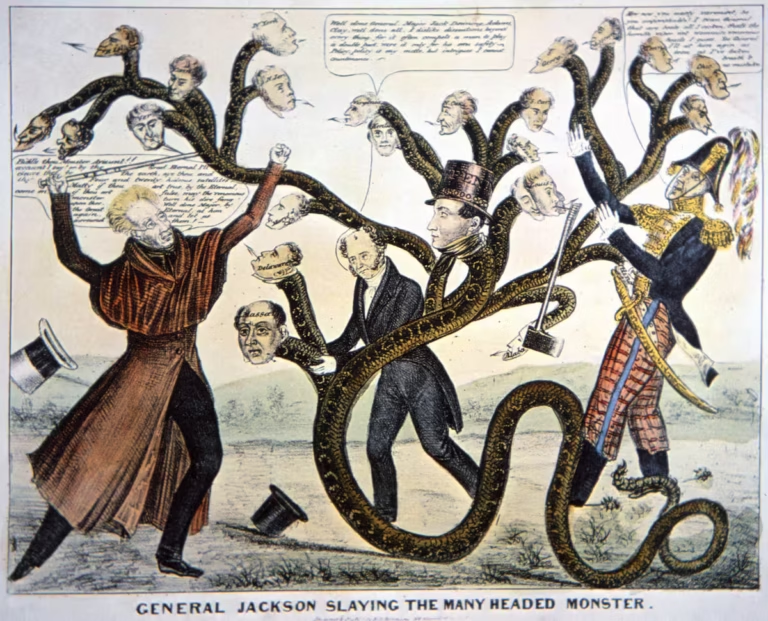
Jackson vetoed the recharter. His message argued that the Bank granted exclusive privileges, benefited foreign and wealthy stockholders and exceeded the proper purposes of government.
The veto transformed the issue into a national referendum on economic power. Jackson defeated Clay decisively in the election of 1832 and interpreted the result as public support for destroying the Bank.
His administration later removed federal deposits and placed them in selected state institutions. Critics called these institutions “pet banks” and accused Jackson of expanding presidential power while claiming to oppose concentrated authority.
The Bank’s destruction did not by itself cause the Panic of 1837. Speculation, international credit conditions, unstable state banking and federal financial policies all contributed to the severe downturn that began shortly after Jackson left office.
The Whig opposition
Opposition to Jackson helped create the Whig Party during the 1830s. The party’s name recalled British opponents of royal power and reflected the accusation that Jackson governed like “King Andrew”.
Whigs supported congressional authority, economic development, protective tariffs and federal assistance for internal improvements. Their coalition included Northern business interests, commercial farmers, reformers and Southern planters opposed to Jackson.
Democrats generally emphasised limited government, territorial expansion and hostility towards concentrated financial power. However, neither party followed one perfectly consistent philosophy, and both depended heavily on white male voters.
The emergence of competitive national parties increased voter turnout and political organisation. It also encouraged simplified slogans, partisan newspapers and personal attacks that made political campaigning a central part of popular culture.
Who benefited from the years of growth?
The economic and political changes of the period produced genuine opportunities. Farmers reached new markets, manufacturing expanded and many white men gained a stronger voice in elections.
Yet the benefits were distributed unevenly. Factory workers endured long hours and limited security, while indebted farmers remained vulnerable to financial crises and fluctuating crop prices.
White women participated in religious organisations, factories and reform societies but remained excluded from voting and lacked equal legal status. Free Black Americans faced discrimination, segregation and the loss of voting rights in several states.
In the South and Southwest, the expansion of cotton increased the demand for enslaved labour. The domestic slave trade transported hundreds of thousands of people away from the Upper South, frequently separating families.
Indigenous nations paid an even more direct territorial price. Their land became the foundation for white settlement, commercial agriculture and the growth of new states.
For the structure of the slaveholding South, read Antebellum South: Society, Slavery and Secession.
The contradictions of Jacksonian America
The period from 1815 to 1840 is often described as an age of democracy. That description is accurate only when its limits are stated clearly.
Political participation expanded substantially among white men. Campaigns became more accessible, property qualifications declined and organised parties competed for mass support.
At the same time, the federal government supported Indigenous removal, slavery expanded with the cotton economy and most women and Black Americans remained excluded from political power.
Jackson attacked concentrated financial privilege but exercised presidential authority forcefully. He defended the Union against South Carolina while refusing to defend Cherokee sovereignty against Georgia.
These were not minor contradictions surrounding an otherwise coherent democratic movement. They defined the nature of Jacksonian democracy itself: wider participation for white men built alongside racial exclusion, territorial conquest and economic inequality.
Conclusion
The decades following the War of 1812 transformed the United States. The population grew, the settlement moved westwards and transport networks connected previously distant regional economies.
The Market Revolution expanded commerce, manufacturing and wage labour. It created new opportunities but also exposed families to financial instability, unstable employment and a growing dependence on distant markets.
The Era of Good Feelings briefly concealed deep political disagreements. The Missouri crisis revealed the danger of slavery’s expansion, while the Monroe Doctrine expressed the country’s growing diplomatic ambition.
Andrew Jackson’s rise transformed presidential politics. His supporters created a mass party that appealed directly to white male voters and attacked established privilege.
However, the democratic language of the period excluded much of the population. Indian removal transferred Indigenous land to white settlers and slaveholders, while women and most Black Americans remained outside the electorate.
The Bank War, Nullification Crisis and emergence of the Whig Party established political conflicts that continued into the 1840s. At the same time, territorial and economic growth intensified the sectional divisions that eventually threatened the Union.
The next stage of this development is explored in North and South Before the American Civil War.
Frequently asked questions
Why were the years after 1815 a period of growth?
The population increased, western settlement expanded and roads, canals and steamboats connected regional economies. Manufacturing and commercial farming also became more important.
What was the Era of Good Feelings?
It was the period associated with James Monroe’s presidency and the decline of the Federalist Party. The name suggests national unity, although major disputes over banking, tariffs and slavery continued.
What was the Market Revolution?
The Market Revolution was the expansion of commercial farming, manufacturing, transport, credit and wage labour during the first half of the nineteenth century.
What did the Monroe Doctrine declare?
It declared that the American continents should no longer be open to future European colonisation and warned European powers against intervention in the newly independent nations of the Americas.
What was Jacksonian democracy?
Jacksonian democracy was a political movement that expanded mass campaigning and political participation among white men while opposing institutions presented as privileged or elitist.
Did Andrew Jackson come from a poor family?
Jackson came from relatively modest frontier origins, but he became a wealthy lawyer, landowner and enslaver before reaching the presidency.
What did the Indian Removal Act do?
The 1830 law authorised the president to negotiate exchanges of Indigenous land east of the Mississippi for territory farther west. In practice, it enabled coerced treaties and forced removals.
When did the Trail of Tears take place?
Most Cherokee people remaining in the Southeast were forcibly removed in 1838 and 1839. Thousands died from disease, exposure, inadequate supplies and exhaustion.
What was the Bank War?
The Bank War was the political struggle over the Second Bank of the United States. Jackson vetoed renewal of its charter in 1832 and later removed federal deposits from the institution.
Was Jacksonian America fully democratic?
No. Political participation broadened mainly for white men. Women, most Black Americans and Indigenous peoples remained excluded, while slavery and forced removal expanded.
Sources and further reading
- National Archives: Treaty of Ghent
- National Archives: Missouri Compromise
- National Archives: Monroe Doctrine
- National Archives: Andrew Jackson’s Message to Congress on Indian Removal
- Library of Congress: Andrew Jackson Papers
- Library of Congress: Renewal of the Second Bank vetoed
- National Park Service: Preludes to the Trail of Tears
- National Park Service: Trail of Tears National Historic Trail
- National Park Service: Cherokee relations with the United States before removal
- Library of Congress: National Expansion and Reform, 1815–1880
