
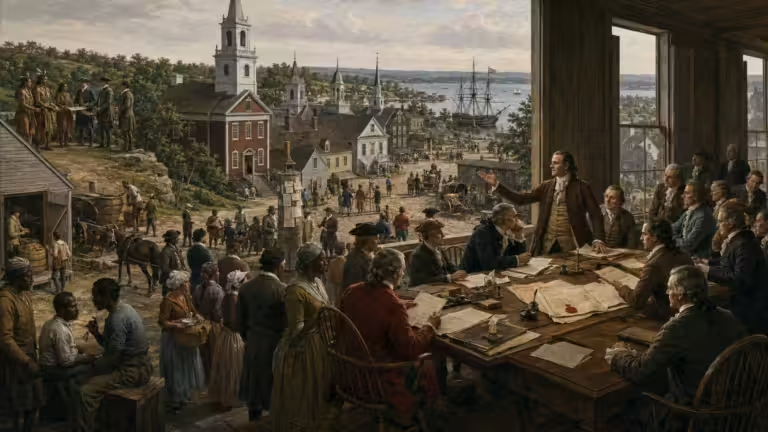
Religion and politics developed together throughout British colonial America. Congregationalists, Anglicans, Quakers, Catholics, Presbyterians, Baptists, Lutherans and other communities created sharply different colonial societies. Elected assemblies, town meetings and local courts encouraged habits of self-government, yet colonial liberty remained restricted by established churches, property qualifications, slavery, Indigenous dispossession and the continuing authority of the British Empire.
The colonies did not develop outside the Atlantic economy. British trade laws, protected markets, maritime commerce and enslaved labour shaped the societies whose religious and political institutions this article examines.

The American colonies were not one society
The thirteen colonies that later formed the United States did not share one religion, economy or political structure. They developed at different times under royal, proprietary and corporate charters. Their populations included English, Scottish, Irish, Welsh, Dutch, German, French, Swedish and African people, alongside Indigenous nations whose homelands long preceded European settlement.
New England contained compact towns, Congregational churches and maritime economies. The Chesapeake and Lower South relied increasingly on plantation agriculture and enslaved labour. The Middle Colonies developed commercially active ports and some of British North America’s most religiously diverse populations.
These distinctions influenced political institutions. Town meetings played an important role in parts of New England, whereas county courts, parish vestries and plantation elites exercised greater local authority in the South. Representative assemblies existed throughout the colonies, but their powers and electorates varied considerably.
The phrase “colonial America” can therefore conceal competing regional experiences. The colonies shared allegiance to the Crown and participation in the British Atlantic system, yet they remained strongly attached to their separate charters, assemblies, churches and local interests.
Religion as a foundation of colonial society
Religion was not confined to private belief. Churches organised worship, education, poor relief, community discipline and public ritual. Clergy interpreted warfare, epidemics, harvests and political crises through a religious understanding of providence.
Several colonies originated partly as religious projects. Puritans founded Massachusetts Bay, Quakers shaped Pennsylvania and Catholics played a central role in proprietary Maryland. Even commercially organised colonies such as Virginia assumed that Protestant institutions would support social and political order.
However, migration in search of religious freedom did not automatically create general toleration. Most seventeenth-century Europeans believed that governments should protect religious truth and restrain dangerous error. Colonial settlers often reproduced that assumption once they acquired political power.
Religious diversity eventually made uniformity more difficult to enforce. Population growth, migration, commerce and denominational competition encouraged increasingly plural societies, although legal equality developed slowly and unevenly.

The Puritan vision of a promised land
Puritan migrants interpreted New England through biblical history. Their Atlantic journey could resemble an exodus from a corrupt old world, while settlement offered an opportunity to create a disciplined Christian commonwealth.
This vision did not mean that Puritans considered America an empty continent. Rather, they often interpreted Indigenous population loss, available land and their own survival as evidence of divine providence. Such reasoning converted colonial expansion into a spiritual mission.

John Winthrop described Massachusetts Bay as a community observed by the world. His famous “city upon a hill” image expressed responsibility as much as confidence. If the settlers broke their covenant, their highly visible failure would dishonour their religious mission.
The colony therefore combined communal responsibility with coercive authority. Church membership, public morality and political participation were closely connected. Dissent could appear dangerous because religious error threatened the covenant binding the entire community.
The Mayflower Compact and consent
The passengers of the Mayflower arrived outside the territory covered by their intended patent in November 1620. To preserve order, forty-one adult men signed an agreement commonly known as the Mayflower Compact.
Its signatories formed a “civil Body Politick” and promised obedience to laws adopted for the colony’s general good. The Compact adapted familiar covenant language to an immediate governmental problem.
It did not establish independence from England or universal democracy. The document affirmed loyalty to James I, while women, servants, children and Indigenous inhabitants took no part in its creation.
Nevertheless, the Compact later became an important symbol of consensual government. Its historical significance lies less in creating modern democracy than in showing settlers deliberately constructing a political community through written agreement.

Massachusetts Bay: participation and religious authority
The Massachusetts Bay Company transferred its charter and government to New England in 1630. This unusual decision gave the colony substantial autonomy because its corporate administration operated from within the settlement rather than from London.
The colony elected governors, assistants and representatives through the General Court. From 1631, admission as a freeman normally required membership in an approved Congregational church, restricting colony-wide political participation to a minority of adult men.
Ministers did not directly occupy every civil office, so Massachusetts was not a simple government by priests. Yet scripture and Puritan theology strongly influenced law, education and public policy. Magistrates punished religious offences as well as conventional crimes.
The colony therefore combined representative institutions with religious exclusion. Its leaders could defend elections and communal consent while denying that political disagreement or theological pluralism deserved unlimited protection.
Roger Williams and liberty of conscience
Roger Williams challenged the relationship between religious truth and civil power. He argued that magistrates should govern outward conduct rather than compel worship or punish people for their beliefs.
Williams also rejected the assumption that an English monarch could grant land already governed and used by Indigenous nations. Colonial settlement, he argued, required valid negotiation with the people possessing the territory.
Massachusetts banished him in 1635. He fled and established Providence the following year with assistance from Narragansett people and through an agreement with their leaders.
The settlements that formed Rhode Island developed an unusually broad commitment to liberty of conscience. A parliamentary patent united them in 1644, while the royal charter of 1663 gave the colony more durable legal protection.
Williams’s position went beyond requesting tolerance for his own beliefs. He argued that a politically stable society did not require one religious establishment, creating a powerful alternative to Massachusetts Bay.
Anne Hutchinson and the boundaries of authority
Anne Hutchinson became the central figure in a theological and political conflict during the 1630s. She hosted religious discussions and criticised ministers whom she believed placed excessive emphasis on outward conduct as evidence of salvation.
Her opponents accused her of antinomianism and feared that her influence would divide the churches and colonial government. The controversy also involved rival political groups centred on Governor Henry Vane and John Winthrop.
The General Court banished Hutchinson in 1637, and her congregation later excommunicated her. She and several followers joined settlements around Narragansett Bay.
Her treatment reveals the limits of public authority available to colonial women. Women participated actively in religious life, but a woman who challenged male ministers and influenced electoral politics could appear to threaten both theological and social hierarchy.
The Salem witch trials
The Salem crisis of 1692 emerged from local disputes, religious anxiety, warfare, illness and a legal system willing to admit spectral evidence. Accusers claimed that the spirits or apparitions of suspected witches had attacked them.
More than 150 people were jailed. Nineteen were convicted and hanged, while Giles Corey died after being pressed under heavy stones for refusing to enter a plea. Several other prisoners died in custody.
The trials did not represent a routine or uncontested expression of Puritan government. Clergy, magistrates and inhabitants increasingly questioned the evidence, and the special court ceased operating after Governor William Phips intervened.
Salem nevertheless demonstrates how religious belief, judicial authority and community panic could combine. It also warns against treating colonial New England’s legal culture as a straightforward origin of modern civil liberty.
Congregational establishments in New England
Congregational churches enjoyed public support in much of New England. Towns collected taxes for ministers and meeting houses, while civil government enforced aspects of Sabbath observance and public morality.
Each congregation governed itself rather than submitting to a national hierarchy of bishops. This local organisation encouraged habits of participation and debate among church members.
Congregational independence did not produce a separation between Church and state. Civil authorities acted as protectors of religion, while inhabitants could be required to support churches whose theology they did not share.
Baptists, Quakers and other dissenters challenged these arrangements. Their resistance eventually contributed to broader arguments that taxation and political rights should not depend on conformity to an established church.
Anglican establishments in the South
The Church of England became legally established in Virginia and several southern colonies. Local parishes collected taxes, maintained churches and supported ministers.
Vestries composed of prominent laymen often exercised substantial local authority. They supervised poor relief, parish property and community administration while reinforcing the influence of landowning elites.
The Anglican establishment differed from the English model because no resident bishop governed the mainland colonies. Clergy received ordination in Britain, and lay vestries exercised more practical control than many English congregations possessed.
Religious establishment therefore strengthened local elites rather than merely extending clerical authority. In plantation regions, political power, parish government, land ownership and slavery became closely interconnected.
Maryland and limited Christian toleration
Charles I granted Maryland to the Calvert family, whose leading members were Catholic. The proprietors hoped to create a profitable colony where Catholics could live with greater security than English penal laws allowed.
Because Protestants soon formed a majority, the colony also required a practical policy of religious accommodation. The Maryland Assembly adopted the Act Concerning Religion in 1649.
The law protected Trinitarian Christians from persecution for their religion. It did not establish modern universal freedom: people denying central Christian doctrines remained outside its protections, while blasphemy could receive severe punishment.
Political conflict repeatedly disrupted the settlement. Following the Glorious Revolution, Protestant control increased and the Church of England became established in Maryland. Catholics then faced political restrictions in the colony originally created partly for their protection.
Pennsylvania and the Quaker holy experiment
Charles II granted Pennsylvania to William Penn in 1681. Penn, a Quaker, imagined the colony as a “holy experiment” combining religious liberty, representative government and commercial development.
Quakers rejected formal clergy, religious oaths and conventional signs of social deference. Their peace testimony also challenged the assumption that colonies required military institutions organised around compulsory service.
Pennsylvania welcomed Quakers, Mennonites, Lutherans, German Reformed settlers and other religious minorities. Philadelphia became one of the Atlantic world’s most commercially successful and culturally diverse ports.
The colony offered broader religious protection than most of its neighbours, although political rights were not perfectly universal. Officeholding and participation still operated within a Christian and property-owning political order.
Quaker political dominance also produced difficult conflicts over defence, frontier warfare and relations with Indigenous nations. Principles developed within a persecuted religious community became harder to maintain once that community governed an expanding colony.
The religious diversity of the Middle Colonies
New York, New Jersey, Pennsylvania and Delaware contained some of British North America’s most varied religious populations. Dutch Reformed, Anglicans, Quakers, Presbyterians, Lutherans, Mennonites, Moravians, Baptists and Jewish communities lived within the region.
This pluralism resulted from earlier Dutch settlement, commercial migration and deliberate recruitment. Proprietors and landowners needed settlers, while ports benefited from merchants possessing different languages and international connections.
Diversity made exclusive religious uniformity impractical. However, tolerance often reflected political necessity and economic interest rather than a complete philosophical commitment to equal rights.
The Middle Colonies demonstrate how demographic pluralism could change political practice. Where no single community could dominate securely, negotiation and limited accommodation became essential to government.
The First Great Awakening
Religious energy remained strong during the eighteenth century. From the 1730s, revivals in Britain and the colonies developed into the movement commonly called the First Great Awakening.
Preachers emphasised the “new birth”, personal conversion and an emotionally immediate relationship with God. Jonathan Edwards became influential through the revivals in Massachusetts, while George Whitefield attracted enormous audiences during his journeys through the colonies.
Whitefield preached across regional and denominational boundaries. Newspapers, printed sermons and personal correspondence transformed local revivals into an intercolonial religious event.
The Awakening divided churches between supporters and critics of revivalism. “New Light” ministers valued conversion and itinerant preaching, while “Old Light” opponents feared disorder, emotional excess and attacks on educated clergy.
The movement did not create the American Revolution. Nevertheless, it encouraged communication across colonial boundaries and taught ordinary believers to judge religious authority through personal experience rather than institutional status alone.
Religion among enslaved and free Africans
People of African descent formed an essential part of colonial religious history. Some arrived with Christian experience, while others preserved and adapted religious traditions from different African societies.
Plantation owners often hesitated to support conversion because they feared that baptism might challenge enslavement or encourage demands for equality. Colonial laws increasingly clarified that Christian conversion did not alter enslaved status.
Revivalist preaching reached some enslaved and free Black listeners during the Great Awakening. Its language of spiritual rebirth and equality before God could possess meanings that white ministers neither intended nor controlled.
African and African American Christians developed communities, interpretations and worship practices under severe legal constraints. Religious conversion did not erase African cultural knowledge or prevent resistance to enslavement.
The colonial language of Christian liberty therefore coexisted with racial slavery. Churches could preach spiritual equality while accepting institutions that denied legal freedom, family security and political participation.
Colonial government under the British Crown
The colonies developed under several constitutional forms. Royal colonies had governors appointed by the Crown. Proprietary colonies operated under individuals or families granted extensive authority, while charter colonies possessed greater institutional autonomy under corporate charters.
These categories changed over time. A proprietary or charter colony could lose its original arrangement and become a royal colony. Political institutions therefore developed through negotiation, conflict and the revision of charters.
Most colonies possessed a governor, an appointed or locally influential council and an elected lower assembly. The exact balance between these institutions varied considerably.
Governors represented imperial authority, enforced royal instructions and could often veto legislation. Assemblies passed local laws, approved taxation and defended privileges they believed belonged to British subjects.
The colonial constitution was not fully defined by one written document. Charters, royal instructions, local precedent, English law and practical bargaining all influenced government.
The House of Burgesses and representative government
Virginia’s General Assembly first met at Jamestown in 1619. The gathering included the governor, an appointed council and elected burgesses representing the colony’s settlements.
The assembly did not possess complete independence. The Virginia Company had authorised it, while the governor and council remained part of the legislative process.
Nevertheless, the institution established an enduring expectation that colonists should participate in taxation and local legislation through elected representatives. It later became known as the House of Burgesses.
Other colonies created their own assemblies. These bodies became centres of political ambition, patronage and conflict with governors, particularly when they controlled salaries and annual revenue.
Representative government developed within empire rather than in opposition to it. Colonial legislators initially viewed their assemblies as local versions of British constitutional institutions, not as parliaments of independent nations.
Town meetings and local government
New England town meetings allowed qualified inhabitants to make decisions about roads, schools, grazing, local taxation and the allocation of land. Towns elected selectmen and other officers to manage everyday administration.
These meetings encouraged direct participation, public speaking and scrutiny of local officeholders. They later became powerful symbols of democratic self-government.
However, participation was not universal. Voting rights could depend on property, church status, residence, taxpaying or recognition as an independent male householder.
Local government also differed outside New England. Southern county courts and Anglican vestries often exercised functions performed by towns in Massachusetts or Connecticut.
Colonial self-government therefore developed through several institutional traditions rather than one uniform democratic model.
Who could vote in colonial America?
A larger proportion of white adult men could vote in several colonies than in Britain. Land was more widely available to settlers, and property qualifications could therefore exclude a smaller share of white men than comparable English rules.
However, qualifications differed by colony and period. Freehold property, wealth, taxpaying, religious allegiance, age and residence could all determine eligibility.
Women could not normally vote in colonial elections. Married women also faced legal restrictions arising from the doctrine of coverture, although widows and unmarried women could own property and exercise significant economic influence.
Enslaved people possessed no electoral rights, while free Black political participation became increasingly restricted. Indigenous nations governed themselves through their own political institutions rather than through colonial assemblies, even as settlers claimed growing authority over their territories.
Colonial elections therefore expanded participation within a defined community of free men while excluding much of the population. The language of equality operated inside boundaries created by law, race, gender and property.
Slavery and colonial political power
Slavery developed within every colonial region, although its scale and organisation differed. Plantation societies in the Chesapeake and Lower South relied most heavily on enslaved labour, while enslaved people also lived and worked in northern towns, farms and ports.
Colonial assemblies helped construct racial slavery through legislation. They defined inherited status, regulated movement, restricted assembly and punished escape or resistance.
Slaveholders participated in elections and legislatures while the people whose labour produced their wealth remained excluded. Political liberty for white colonists could therefore expand alongside increasingly severe racial domination.
Enslaved people nevertheless shaped colonial politics through escape, rebellion, petition, negotiation and everyday resistance. White authorities repeatedly altered laws in response to actions they could not entirely prevent.
Slavery was not a contradiction located outside colonial government. Legislatures, courts, churches, merchants and local officials helped sustain it as a political and legal institution.
Indigenous nations and colonial diplomacy
European colonies existed beside powerful Indigenous nations rather than replacing them immediately. Native governments maintained laws, diplomacy, trade networks and military alliances across the continent.
Colonial officials negotiated treaties because they recognised that Indigenous nations exercised practical sovereignty. Agreements addressed land, trade, military alliances, boundaries and the settlement of disputes.
Indigenous leaders also negotiated with competing English, French, Dutch and Spanish powers. They used imperial rivalry to protect territory, obtain trade goods and strengthen their positions against regional opponents.
The Haudenosaunee Confederacy became especially influential in diplomacy involving New York, Pennsylvania, Britain and France. Its political decisions could determine whether colonial conflicts remained local or expanded into wider wars.
As settler populations grew, colonial governments increasingly treated treaties as mechanisms for acquiring land. Diplomatic relationships therefore coexisted with warfare, forced removal and repeated violations of Indigenous understandings of agreements.
Education, colleges and the colonial elite
Religious institutions encouraged formal education because colonies needed trained ministers and literate congregations. Harvard College was founded in Cambridge, Massachusetts, in 1636.
The College of William and Mary received its charter in 1693. The College of New Jersey, later Princeton University, opened in 1746, while the College of Rhode Island, later Brown University, received its charter in 1764.
These colleges served particular denominational and regional communities, although their intellectual functions expanded over time. They educated clergy, lawyers, physicians, merchants and political leaders.
Education remained socially unequal. Colleges admitted a small male elite, while access to schooling varied by region, wealth, race, legal status and gender.
Literacy nevertheless extended well beyond colleges. Newspapers, pamphlets, sermons, almanacs and political essays created a public culture through which colonists debated religion, commerce and government.
The colonial press and public opinion
Printing connected local disputes to wider audiences. Newspapers reprinted reports from Britain, Europe, the Caribbean and other colonies, creating an increasingly integrated Atlantic information network.
Religious revivals benefited from this circulation. Accounts of conversions and itinerant preaching allowed the Great Awakening to develop as an intercolonial movement rather than a collection of isolated meetings.
Political arguments also spread through print. Assemblies published disputes with governors, merchants discussed imperial legislation and readers followed parliamentary conflicts in Britain.
The press did not enjoy an unlimited modern right of expression. Printers faced licensing legacies, prosecution for libel and economic pressure from officials or patrons.
Even so, colonial print culture strengthened the ability of distant communities to recognise common problems. It helped transform local grievances into arguments shared across several colonies.
Colonial assemblies and the power of taxation
Assemblies acquired influence because colonial government required money. Representatives approved local taxes and could condition financial support on answers to their grievances.
Several assemblies controlled the salaries of governors, judges and other officials. This authority allowed legislators to influence appointed representatives of the Crown without formally controlling the executive.
Governors complained that assemblies used annual grants to weaken royal instructions. Colonists replied that taxation without local consent violated the constitutional rights they possessed as British subjects.
Before 1763, these disputes usually remained negotiations within the Empire. Both sides accepted imperial connection while disagreeing about the distribution of authority inside it.
The later revolutionary slogan “no taxation without representation” therefore developed from established colonial practice. Assemblies had spent generations associating legitimate taxation with the consent of locally elected representatives.
Were the colonies politically independent?
Colonial institutions possessed substantial autonomy, but the colonies were not sovereign states. Their charters derived from English or British authority, and governors could reserve legislation for review in London.
The Crown and Privy Council could disallow colonial laws. Parliament also legislated for imperial trade and claimed authority extending throughout British dominions.
Distance limited supervision, while European wars diverted attention and resources. Colonial assemblies consequently developed habits of governing many internal affairs with relatively little immediate interference.
This practical autonomy did not produce a settled constitutional division of powers. Britain believed Parliament remained legally sovereign, while colonists increasingly treated local control as an inherited right.
The ambiguity remained manageable while Britain enforced imperial authority selectively. After 1763, attempts to govern more consistently exposed the incompatible assumptions beneath the arrangement.
The New England Confederation
Massachusetts Bay, Plymouth, Connecticut and New Haven formed the New England Confederation in 1643. The colonies created the alliance themselves rather than acting at the invitation of the Crown.
The Confederation coordinated defence, diplomacy and the return of fugitives. Its members feared conflict involving Dutch New Netherland, French colonies and Indigenous nations.
Commissioners represented each colony, although Massachusetts possessed greater population and resources than its partners. The arrangement did not replace the separate colonial governments.
The Confederation provided an early experience of regional cooperation, but it remained limited and unstable. Local interests regularly outweighed the authority of the collective body.
The Albany Congress of 1754
Representatives from seven colonies met at Albany in 1754 as conflict with France intensified. Diplomacy with the Haudenosaunee formed an essential purpose of the meeting, alongside colonial defence.
Benjamin Franklin proposed a Plan of Union creating a president-general appointed by the Crown and a grand council chosen through the colonial assemblies. The body would coordinate defence, diplomacy, western settlement and common expenditure.
The delegates adopted a version of the plan, but neither the colonial assemblies nor the British government accepted it. Assemblies feared losing local authority, while imperial officials considered the proposed colonial institution too powerful.
The plan did not create an early federal government and was not implemented. Its failure demonstrates how strongly the colonies defended their separate political identities even when they recognised the practical need for cooperation.
After 1763, resistance to British policy would create stronger intercolonial organisation than fear of France had achieved. Shared opposition eventually supplied the political incentive that earlier plans lacked.
Colonial liberty and social hierarchy
British North America offered economic and political opportunities unavailable to many Europeans. Land ownership was more attainable for some settlers, while elected assemblies and local offices created routes to public influence.
However, colonial society was not classless. Large planters, merchants, proprietors and land speculators accumulated wealth and political power. Tenant farmers, labourers, servants and frontier settlers possessed fewer resources and less influence.
Social mobility also depended on access to appropriated Indigenous land. Opportunities available to settlers often resulted from the dispossession of the people already living within those territories.
The most prosperous colonial regions depended heavily on enslaved labour. White colonists could present independence and property ownership as signs of liberty while denying both to Africans and their descendants.
Colonial freedom was therefore genuine for some people and structurally dependent on the exclusion of others. Its contradictions would survive independence and shape the later United States.
Did colonial America separate Church and state?
No general separation existed during the colonial period. Congregationalism received public support in much of New England, while Anglican establishments operated in Virginia and several southern colonies.
Rhode Island and Pennsylvania developed broader forms of religious liberty, but neither represented the political structure of all thirteen colonies. Maryland’s toleration remained limited and later gave way to an Anglican establishment.
Religious pluralism weakened attempts to enforce complete uniformity. Dissenters also developed arguments that faith required voluntary commitment rather than taxation or civil coercion.
However, the constitutional separation associated with the later United States emerged principally through revolutionary and post-revolutionary debates. Even after independence, several states continued to support churches through taxation.
The colonial contribution lay in producing competing models: established churches, limited toleration, broad liberty of conscience and persistent dissent against religious taxation.
Did religion create American democracy?
Religious communities contributed important political practices. Congregational churches elected officers, discussed membership and governed local affairs through covenants. Dissenters developed arguments for conscience, equality before God and resistance to coercive authority.
Yet the same communities could defend hierarchy, establishment and exclusion. Puritan Massachusetts combined elections with persecution, while Anglican vestries joined parish government to planter influence.
Colonial democracy therefore had several sources. English constitutional traditions, charters, abundant land for settlers, local assemblies, religious organisation and imperial distance all contributed.
The result was not modern democracy. Colonial institutions expanded political participation among sections of the free male population without establishing universal citizenship or equal rights.
Religion, politics and the coming imperial crisis
By the mid-eighteenth century, colonists possessed strong traditions of local government. Assemblies controlled taxation, churches organised communities and newspapers connected political debates across regional boundaries.
Most colonists still considered themselves British. They valued imperial trade, military protection and the constitutional liberties associated with the Revolution Settlement of 1688.
However, they increasingly interpreted those liberties through colonial experience. Representation meant their own assemblies, taxation required local consent and religious plurality made metropolitan uniformity appear both undesirable and impractical.
The Seven Years’ War would expose the limits of this political arrangement. Britain’s victory removed France from much of eastern North America but created debt, territorial problems and a vastly expanded imperial administration.
The next article examines how military victory turned local political habits into a constitutional confrontation between Parliament and the colonies.
- The Glorious Revolution of 1688
- Puritanism, Dissent and the Great Migration
- Mercantilism, the Navigation Acts and the British Atlantic Empire
- Puritanism and Expansionism in Early America
- The American Revolution: Causes, Independence and Legacy
- USA: Birth of a Nation
Frequently asked questions about religion and politics in the colonies
Did the American colonies have religious freedom?
Religious freedom varied widely. Rhode Island and Pennsylvania offered broad protection, while Massachusetts enforced Congregational authority and several southern colonies established the Church of England. Toleration usually remained more limited than modern religious equality.
What was an established church?
An established church received legal recognition and public support from the colonial government. Taxes could fund ministers and churches, while members of other denominations sometimes faced restrictions on worship, voting or public office.
Was the Mayflower Compact a democratic constitution?
It established a political community based on agreement among forty-one adult male signatories. However, it preserved loyalty to the king and excluded women, servants, children and Indigenous inhabitants from its formation.
What was the House of Burgesses?
The House of Burgesses developed from Virginia’s representative General Assembly, first convened in 1619. Elected burgesses participated in legislation and taxation alongside the governor and appointed council.
Who could vote in colonial elections?
Voting usually belonged to free adult men meeting property, tax, residence or religious qualifications. Rules differed among colonies. Women, enslaved people and most free Black inhabitants lacked electoral rights.
What was the First Great Awakening?
The Great Awakening was a wave of Protestant revivalism during the 1730s and 1740s. It emphasised personal conversion and itinerant preaching, connected colonial audiences and divided established churches between supporters and opponents.
How were religion and slavery connected?
Churches operated inside societies sustained by slavery, and colonial laws ensured that Christian conversion did not free an enslaved person. Enslaved Africans nevertheless developed their own Christian practices and interpreted religious teachings through their experiences of captivity and resistance.
Did Indigenous nations participate in colonial politics?
Indigenous nations governed themselves and conducted diplomacy with colonies and European empires. Treaties and alliances recognised their political power, although colonial expansion increasingly violated their sovereignty and territorial rights.
Why did the Albany Plan of Union fail?
Colonial assemblies feared that the proposed union would reduce their autonomy, while British officials considered its central colonial government too powerful. The delegates adopted the plan in 1754, but neither side implemented it.
Were the colonies independent before 1776?
No. Their assemblies governed many local affairs, but colonial authority rested on charters granted under English or British sovereignty. The Crown and Parliament continued to claim powers over imperial government and trade.
Sources and further reading
- Library of Congress: America as a Religious Refuge
- Library of Congress: Religious Communities in Seventeenth-Century America
- Library of Congress: Religion in Eighteenth-Century America
- Library of Congress: Religion and State Government
- National Park Service: the First Legislative Assembly at Jamestown
- Library of Congress: Jamestown and the General Assembly
- National Park Service: Roger Williams and Rhode Island
- National Park Service: Anne Hutchinson
- Library of Congress: the Salem Witch Trials
- Library of Congress: spectral evidence at Salem
- National Park Service: the Great Awakening
- National Park Service: the arrival of captive Africans in Virginia
- National Park Service: slavery and law in colonial Massachusetts
- National Museum of the American Indian: Native sovereignty and government
- National Museum of the American Indian: colonial treaties and Native nations
- National Archives: Benjamin Franklin and the Albany Plan
- UK Parliament: Parliament and the American Colonies before 1765
The colonies had developed powerful assemblies, diverse religious cultures and strong expectations of local consent. The next article examines how the Seven Years’ War expanded the Empire and transformed those expectations into an imperial constitutional crisis.

