
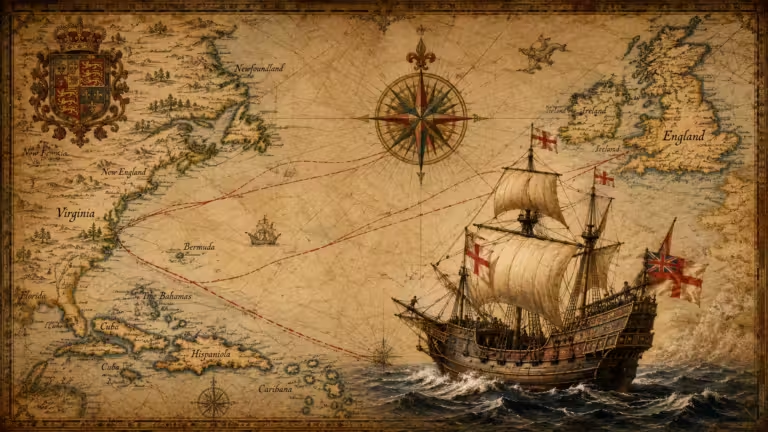
English expansionism began within the British Isles before developing into an Atlantic and global imperial system. Military conquest, religious policy, plantations, maritime exploration, chartered companies, settlement, mercantilism and slavery all contributed to this expansion. However, the process was neither continuous nor inevitable, and it produced conquest, resistance and dispossession alongside trade and migration.

What was English expansionism?
English expansionism describes the territorial, commercial and political growth of the English state beyond its original boundaries. It began with attempts to control neighbouring territories within the British Isles. It later extended across the Atlantic, the Caribbean, Africa and Asia through exploration, commerce, settlement and military force.
This process should not be reduced to a single national ambition. Monarchs sought strategic security and greater authority, while merchants pursued markets and profits. Religious communities wanted places to establish their own institutions, and migrants searched for land or employment. Chartered companies, private investors, soldiers, sailors and settlers frequently acted before the Crown possessed either the resources or the intention to govern directly.
Nor were “English” and “British” expansion interchangeable. England and Scotland remained separate kingdoms until the Acts of Union created Great Britain in 1707. Before that date, English overseas projects could compete with Scottish ventures. Afterwards, Scottish merchants, administrators, soldiers and settlers became deeply involved in the expanding British Empire.
Expansion within the British Isles
The Anglo-Norman conquest of England
The Norman Conquest of 1066 transformed England’s ruling elite and military organisation. William the Conqueror distributed land among Norman followers, constructed castles and established a more centralised monarchy. His successors then extended Anglo-Norman influence towards Wales and Ireland.
This expansion did not yet constitute a modern colonial empire. Nevertheless, it established several recurring methods of English territorial control: military invasion, land confiscation, settlement by loyal elites, the construction of fortified towns and the imposition of new legal institutions.
English power in medieval Ireland
Anglo-Norman forces entered Ireland in 1169 after becoming involved in conflicts between Irish rulers. Henry II landed in 1171 and sought to assert royal authority over both the invaders and Irish kings. English rule remained strongest around Dublin and parts of the eastern and southern coasts, while Gaelic Irish rulers retained authority across much of the island.
Anglo-Norman settlers introduced feudal landholding, castles, towns and new ecclesiastical institutions. Yet many settler families gradually adopted Irish languages, customs and alliances. The English administration viewed this cultural interaction as a threat to its authority.
The Statutes of Kilkenny of 1366 attempted to reinforce distinctions between English settlers and the Gaelic Irish. Among other provisions, they sought to restrict intermarriage, Irish dress, language and legal customs among the English population. Their existence reveals the limits of English control rather than a successful and complete colonisation of medieval Ireland.
Edward I and the conquest of Wales
Edward I launched military campaigns against the Welsh princes in 1276–1277 and 1282–1283. The death of Llywelyn ap Gruffudd in 1282 ended the independent principality of Gwynedd, while the Statute of Rhuddlan of 1284 reorganised the conquered territories under English authority.
Edward built or enlarged a network of castles at Caernarfon, Conwy, Harlech and other strategic sites. These fortifications supported military occupation and English-controlled boroughs. They also made the new political order visible within the Welsh landscape.
In 1301, Edward granted the title Prince of Wales to his son, the future Edward II. Contrary to a frequent misconception, the English king himself did not become Prince of Wales. The title became associated with the heir to the English and later British throne.
English conquest did not eliminate Welsh identity or resistance. Owain Glyndŵr led a major revolt from 1400, briefly creating Welsh political institutions and receiving extensive support. Although the rebellion ultimately failed, it demonstrated that military occupation had not produced complete cultural assimilation.
Scotland and the limits of English conquest
English kings also attempted to dominate Scotland. Edward I intervened in the Scottish succession and invaded the kingdom during the Wars of Scottish Independence. Resistance associated with William Wallace and Robert the Bruce prevented permanent English conquest.
Robert the Bruce’s victory at Bannockburn in 1314 did not immediately end the conflict, but it decisively strengthened the Scottish position. The Treaty of Edinburgh–Northampton recognised Robert as King of Scots in 1328. Scotland remained a separate kingdom, although warfare and political interference continued.

The Tudor state and territorial consolidation
The Tudor period brought a more systematic attempt to integrate or control the territories surrounding England. Royal government expanded its legal and administrative reach, while the Reformation joined political loyalty to religious allegiance.
The incorporation of Wales
The Laws in Wales Acts of 1536 and 1543 incorporated Wales into the English governmental and legal system. They abolished many separate marcher jurisdictions, extended English law and gave Welsh counties representation in the English Parliament.
The measures created a single jurisdiction commonly described as England and Wales. However, they also privileged the English language within public administration. Religious translation later produced a different consequence: the Welsh New Testament of 1567 and the complete Bible of 1588 helped preserve and standardise written Welsh.
The Kingdom of Ireland and the Tudor conquest
In 1541, the Irish Parliament declared Henry VIII King of Ireland. The change replaced the medieval Lordship of Ireland and asserted a stronger claim to sovereignty over the entire island. In practice, the Crown still exercised limited authority outside areas controlled by the English administration.
Tudor governments attempted to expand control through military campaigns, legal incorporation and a policy known as surrender and regrant. Gaelic lords surrendered their titles to the Crown and received them back under English law. The policy promised inclusion but also required recognition of royal supremacy and English political institutions.
When accommodation failed, conquest and confiscation followed. Rebellions in Munster ended with extensive land seizures, and the Munster Plantation began during the 1580s. English undertakers received confiscated estates on the condition that they introduce settlers and develop defensible communities.
The Plantation of Ulster
After the Nine Years’ War and the departure of leading Gaelic earls in 1607, the Crown confiscated large areas of Ulster. The official Plantation of Ulster began in 1609 and settled English and Scottish Protestants on forfeited land.
The plantation did not simply transfer population from one country to another. It redistributed land, created new towns, introduced British legal and economic institutions and weakened Gaelic political structures. Native Irish communities were displaced, restricted to less desirable land or incorporated into the new economy under unequal conditions.
The settlement contributed to the emergence of a substantial Protestant population in northern Ireland. However, present-day Northern Ireland cannot be explained by the plantation alone. Later wars, political unions, industrial development, partition and modern nationalism also shaped its history.
Cromwellian conquest and land confiscation
The wars of the mid-seventeenth century produced another major transformation of Irish landholding. Oliver Cromwell’s campaign of 1649–1650 formed part of a wider conquest conducted by the English Commonwealth. It included sieges, massacres, military occupation and the suppression of Catholic and royalist resistance.
The Act for the Settlement of Ireland of 1652 confiscated most Catholic-owned land and redistributed extensive estates to soldiers, creditors and Protestant settlers. Some land was restored after the monarchy returned in 1660, but the settlement left a predominantly Protestant landowning class in control of property occupied and worked largely by Catholics.
England turns towards the Atlantic
European voyages across the Atlantic changed the geographical scale of English ambition. Spain and Portugal initially dominated overseas exploration and claimed extensive territories through conquest, papal grants and the Treaty of Tordesillas of 1494.
England did not accept that Iberian agreements could permanently exclude other European powers. However, early English Atlantic activity remained intermittent. Fishing, privateering and the search for new routes often mattered more than immediate territorial settlement.
John Cabot and the North Atlantic
In 1497, the Venetian navigator John Cabot sailed from Bristol under the authority of Henry VII. He reached the coast of North America, although historians continue to debate his precise landfall. His voyage provided England with a later basis for territorial claims in the region.
The rich fisheries around Newfoundland proved more immediately valuable than formal colonisation. English, French, Portuguese and Spanish fishing fleets crossed the Atlantic regularly during the sixteenth century. Fishing therefore created practical knowledge, commercial networks and seasonal contact before permanent settlement developed.
John Dee and the idea of a British Empire
The mathematician, geographer and royal adviser John Dee promoted English maritime expansion during Elizabeth I’s reign. He studied navigation, collected maps and argued that England possessed historical claims to northern Atlantic territories.
Dee used expressions resembling “British Empire” decades before the political creation of Great Britain. His vision combined geography, Protestant rivalry with Catholic powers, trade and national mythology. However, maps and historical claims could not themselves create an empire. Voyages, finance, military protection and permanent occupation remained necessary.
Privateering and the Spanish Empire
Elizabethan maritime expansion frequently blurred the distinction between commerce, warfare and piracy. The Crown authorised privateers to attack enemy ships and settlements, allowing private investors and sailors to share captured wealth.
John Hawkins participated in early English voyages that trafficked enslaved Africans to Spanish America. Francis Drake later raided Spanish possessions and became the first English captain to complete a circumnavigation of the globe between 1577 and 1580. These expeditions brought profit, geographical intelligence and prestige, while also depending on violence and enslavement.
During his Pacific voyage, Drake claimed a region he called Nova Albion for Elizabeth I. He did not invent the name California, which already appeared in Spanish literature and geography. The exact location of Nova Albion remains disputed.
Walter Raleigh, Virginia and Roanoke
Elizabeth granted Walter Raleigh a patent to explore and colonise territory in North America in 1584. The name Virginia was applied to a broad region in honour of the unmarried queen. Raleigh organised expeditions but did not personally lead the initial exploration of the North American coast.
Colonists attempted to establish settlements on Roanoke Island in 1585 and 1587. Both ventures failed, and the fate of the later “Lost Colony” remains uncertain. These failures showed how difficult permanent colonisation could be without reliable supplies, stable relations with Indigenous peoples or sufficient financial support.
The Spanish Armada of 1588
Philip II sent the Spanish Armada towards England in 1588 as part of a plan to transport an invasion army from the Netherlands. English attacks, logistical failures, unfavourable weather and Spanish operational difficulties prevented the plan from succeeding.
The Armada’s defeat strengthened English confidence and became a powerful element of Protestant national mythology. However, it did not immediately give England permanent command of the seas or cause the sudden collapse of Spain. The Spanish monarchy remained a major European and imperial power for decades.

Chartered companies and permanent settlement
The English Crown lacked the revenue and administrative structure needed to organise every overseas enterprise directly. It therefore granted charters to companies and private groups. These organisations combined private investment with public authority.
Investors pooled capital and distributed risk through joint-stock arrangements. In return, companies received monopolies, territorial rights or permission to govern settlements. The model allowed the state to extend its influence without paying the full initial cost.
The East India Company
Elizabeth I granted the East India Company a royal charter in 1600. The company initially sought access to Asian trade rather than the territorial conquest of India. It established trading factories and negotiated with Asian rulers within commercial systems that Europeans did not control.
Over time, the company acquired forts, armies, tax revenues and political influence. This transformation from merchant corporation to territorial power became especially important during the eighteenth century. It demonstrates how private commercial institutions could become instruments of imperial government.
The Virginia Company and Jamestown
In 1606, James I issued a charter creating two branches commonly known as the London Company and the Plymouth Company. The London Company established Jamestown in Virginia in 1607, the first permanent English settlement in North America.
Jamestown nearly failed through disease, food shortages, internal conflict and unsuitable planning. The colonists entered the territory of the Powhatan paramount chiefdom and initially depended on Indigenous trade and diplomacy. Relations alternated between negotiation, alliance and warfare.
The development of tobacco cultivation transformed the colony’s economy. John Rolfe introduced commercially successful strains and married Pocahontas in 1614, not 1640 as the former version of this article stated. Their marriage accompanied a temporary peace but did not end the wider conflict over land and English expansion.
Plymouth and Puritan migration
The Mayflower reached Cape Cod in 1620 and its passengers founded Plymouth Colony. The group included Separatists, commonly known as Pilgrims, alongside other migrants. They should not be treated as interchangeable with every later Puritan settler.
A much larger migration followed during the 1630s, when approximately 20,000 English people moved to New England. Many settled in Massachusetts Bay and attempted to build disciplined Protestant communities. Their migration had religious causes, but land, family strategy, employment and political conflict also influenced settlement.
These colonies were not established in an empty wilderness. Nations including the Wampanoag, Narragansett, Pequot, Massachusett and Mohegan occupied and governed the region. Epidemics introduced through transatlantic contact had already devastated many Indigenous communities, but demographic catastrophe did not remove their territorial rights or political agency.
Indigenous diplomacy, resistance and dispossession
Early encounters between English settlers and Indigenous nations cannot be described simply as either friendship or hostility. Both sides traded, negotiated alliances and attempted to understand unfamiliar political systems. Indigenous leaders often used relations with Europeans within existing regional rivalries.
However, permanent English settlement created an expanding demand for land. Colonists enclosed fields, introduced livestock and imposed property rules that conflicted with Indigenous patterns of territorial use. Purchases and treaties were frequently interpreted differently by each side.
As settler populations increased, diplomacy repeatedly gave way to coercion and warfare. Conflicts such as the Anglo-Powhatan Wars, the Pequot War and King Philip’s War caused extensive destruction and displacement. English colonies gradually converted military victory into territorial control.
Colonists often contrasted their own conduct with the violence of Spanish conquest. Such comparisons served English propaganda but concealed warfare, forced removal, cultural pressure and the destruction of Indigenous communities. English colonisation followed a different institutional model from Spanish conquest, yet it was not peaceful or benevolent.

Labour, servitude and racial slavery
Colonial expansion required labour. Early English colonies relied heavily on indentured servants, who worked for a fixed period in exchange for passage, maintenance or the prospect of land. Their conditions could be violent and exploitative, although indentured status was legally different from hereditary slavery.
In 1619, “twenty and odd” captive Africans arrived at Point Comfort in Virginia after being taken from a Portuguese slave ship. They were not the first Africans in the Americas, where Spanish and Portuguese slavery had existed for generations. Nevertheless, their arrival became a significant moment in the history of English North America.
The legal status of Africans in early Virginia was not immediately defined by one comprehensive slave code. During the seventeenth century, colonial laws increasingly made enslavement lifelong, hereditary and explicitly racial. These measures separated African labourers from European servants and created a system in which children inherited the enslaved status of their mothers.
Sugar and the English Caribbean
The expansion of sugar cultivation in Barbados during the 1640s transformed English colonial slavery. Sugar required substantial capital, extensive land and an enormous labour force. Plantation owners increasingly imported enslaved Africans as smaller farms gave way to large estates.
England captured Jamaica from Spain in 1655. The island later became one of Britain’s wealthiest slave societies and sugar producers. Enslaved people nevertheless resisted through escape, sabotage, cultural survival and armed rebellion.
The Royal African Company
The Royal African Company received a charter in 1672 and a monopoly over English trade along much of the western African coast. It traded in gold, ivory and enslaved people while maintaining forts and commercial stations.
The company transported large numbers of captive Africans across the Atlantic under brutal conditions. Private merchants later challenged its monopoly, but the decline of one company did not reduce British participation. Britain became the leading European slave-trading power during the eighteenth century.
Mercantilism and the Navigation Acts
Mercantilism described a collection of policies rather than one perfectly unified economic theory. Governments sought to increase national power by controlling trade, protecting shipping, accumulating valuable resources and securing colonial markets.
Colonies supplied raw materials and bought manufactured goods. From the metropolitan perspective, colonial trade should strengthen English merchants, customs revenues and naval power. Colonists nevertheless pursued their own interests and frequently traded with foreign merchants when doing so proved profitable.
The Navigation Acts
Parliament introduced a Navigation Ordinance in 1651, partly to challenge Dutch commercial dominance. Further Navigation Acts followed in 1660, 1662 and 1663. They restricted much colonial trade to English or colonial ships and required certain products to pass through English-controlled channels.
The legislation did not entirely prohibit colonial commerce with the wider world. Instead, it created regulated routes, designated commodities and favoured ports. Enforcement also varied considerably according to war, local administration, corruption and the practical difficulty of policing the Atlantic.
The Acts helped connect commerce with naval strategy. Merchant shipping supplied sailors and vessels, while the navy protected commercial routes. Wars against the Dutch, French and Spanish therefore involved both European power politics and competition over overseas markets.
Was colonial trade really triangular?
The expression “triangular trade” describes a common pattern linking Europe, Africa and the Americas. European manufactured goods were exchanged in Africa, enslaved people were transported through the Middle Passage, and plantation commodities such as sugar or tobacco travelled to European markets.
However, the historical trade was more complex than a single triangle. Ships followed numerous direct and indirect routes between Britain, Ireland, continental Europe, Africa, North America and the Caribbean. Some vessels completed only one or two sections, while merchants combined colonial commodities, fisheries, provisions and manufactured goods through wider Atlantic networks.
Mercantilist regulation later became one source of conflict with the North American colonies. Yet colonial opposition did not arise simply because all colonists rejected commercial regulation. The crisis intensified after 1763, when Parliament attempted to enforce existing rules more consistently and raise new revenue.
From an English to a British Empire
The Union of the Crowns
Elizabeth I died without an heir in 1603, and James VI of Scotland inherited the English throne as James I. England and Scotland now shared a monarch, but they retained separate parliaments, laws, churches and economic systems.
The Union of the Crowns therefore did not immediately create a single British state. Scottish merchants and settlers participated in Ireland and the Atlantic, but Scotland could also pursue independent commercial ambitions. Its failed Darien scheme in Panama during the 1690s illustrated both those ambitions and their financial risks.
The Acts of Union of 1707
The English and Scottish Parliaments passed Acts of Union that created the Kingdom of Great Britain on 1 May 1707. Scotland received representation in a new Parliament of Great Britain and gained formal access to English colonial markets.
The union accelerated Scottish participation in imperial trade, administration, settlement and military service. From this point, “British Empire” becomes more accurate than “English Empire”, although English institutions and commercial interests remained highly influential.
The growth of the first British Empire
Competition with the Dutch
England fought three major naval wars against the Dutch Republic during the seventeenth century. These conflicts concerned shipping, trade and geopolitical rivalry rather than colonial territory alone.
English forces seized New Amsterdam in 1664 and renamed it New York after the Duke of York. Dutch control briefly returned in 1673, but the settlement became English again the following year. The Treaty of Breda had already confirmed England’s possession in 1667 as part of a wider imperial settlement.
The East India Company becomes a territorial power
During the eighteenth century, the East India Company moved beyond coastal commerce. The weakening of Mughal political authority, conflicts among regional powers and European warfare created opportunities for military intervention.
Company forces defeated the Nawab of Bengal and his allies at the Battle of Plassey in 1757. The victory did not instantly produce British rule over all India, but it greatly expanded Company influence in Bengal. In 1765, the Mughal emperor granted the Company the right to collect revenue in Bengal, Bihar and Orissa.
Financial instability, famine and reports of corruption eventually encouraged Parliament to intervene. The Regulating Act of 1773 established greater state supervision and created the office of Governor-General of Bengal. The governor was based in Calcutta, not Bombay as stated in the former article.
The Seven Years’ War
The Seven Years’ War was a global conflict involving Europe, North America, the Caribbean, West Africa, India and the oceans. Its North American phase began in 1754, two years before formal war in Europe.
Britain’s victory over France transformed the imperial balance. Under the Treaty of Paris of 1763, France surrendered Canada and most of its claims east of the Mississippi, while Spain transferred Florida to Britain. Britain returned several valuable Caribbean conquests rather than permanently retaining every French island it had occupied.
French military power did not disappear from the Americas entirely, but Britain now possessed a much larger and more expensive empire. It had to administer new territories, maintain troops and negotiate relations with Indigenous nations that had previously balanced British and French alliances.
The Royal Proclamation of 1763
Following an extensive Indigenous war commonly associated with Pontiac, George III issued the Royal Proclamation of 1763. It restricted colonial settlement west of the Appalachian Mountains and reserved a large interior territory for Indigenous nations unless land was formally transferred to the Crown.
The measure attempted to reduce frontier warfare and control colonial expansion. Many settlers and land speculators nevertheless viewed it as an obstacle to western settlement. The proclamation therefore exposed a growing difference between imperial strategy and colonial expectations.
Expansion and the coming American crisis
The Seven Years’ War appeared to confirm British imperial supremacy, yet victory created serious political problems. Britain had accumulated substantial debt and believed the colonies should contribute towards defence and administration.
Many colonists accepted the value of the Empire but disputed Parliament’s authority to tax them without their consent. They had developed assemblies, local tax systems and traditions of political negotiation during a period of relatively uneven imperial supervision.
After 1763, Parliament strengthened customs enforcement and introduced measures including the Sugar Act, Stamp Act and Townshend duties. Colonial resistance transformed disputes over trade into a constitutional argument about representation, sovereignty and the rights of British subjects.
English and British expansionism therefore contributed to the American Revolution in two apparently contradictory ways. Empire created the colonies, protected their maritime trade and connected them to British institutions. However, territorial victory and tighter imperial government also encouraged the colonies to challenge metropolitan authority.
Did American independence end the first British Empire?
The independence of the United States ended British rule over thirteen mainland colonies, but it did not destroy Britain’s wider empire. Britain retained Canada, Caribbean colonies, Atlantic islands and expanding interests in India.
Historians sometimes use “first British Empire” for the predominantly Atlantic system that developed before 1783 and “second British Empire” for the later expansion centred increasingly on Asia, Africa and the Pacific. This distinction is useful, but it can exaggerate the break between the two periods. Trade, slavery, naval power and chartered companies connected both phases.
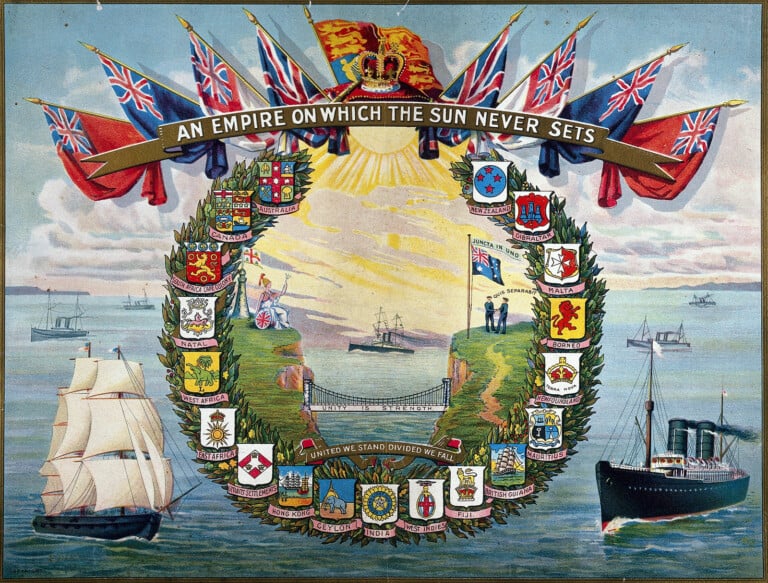
After 1783, Britain established a penal colony in New South Wales in 1788 and expanded its power in India. It took permanent possession of the Cape Colony in 1806, founded Singapore as a trading settlement in 1819 and acquired Hong Kong Island following the First Opium War in 1841–1842.
These later developments fall outside the chronological centre of this series. Nevertheless, they show that the loss of the American colonies redirected British expansion rather than ending it.
The driving forces behind English expansion
Security and state formation
English rulers viewed neighbouring territories and overseas bases through strategic calculations. Control of Wales and Ireland could limit foreign intervention, while ports and islands protected maritime routes. Expansion therefore developed alongside the growth of the central state.
Religion and confessional rivalry
The Reformation intensified rivalry with Catholic Spain and connected Protestant identity to national power. In Ireland, plantation and religious reform became closely linked. Across the Atlantic, some Protestant migrants sought autonomy while also establishing societies that restricted Catholic, Indigenous or dissenting beliefs.
Trade and private investment
Commercial ambition financed voyages, trading posts and colonies. Joint-stock companies allowed investors to share risks, while monopoly charters offered potential rewards. The Crown used private capital to extend influence beyond the reach of its administrative resources.
Land and migration
Land attracted settlers to Ireland and North America. Plantation schemes promised property to migrants while displacing existing populations. Demographic growth then produced further territorial expansion as later generations sought farms and settlements beyond established boundaries.
Coercion and unfree labour
Empire depended on multiple forms of coercion. Soldiers conquered territory, governments confiscated land and plantation owners exploited indentured and enslaved labour. The wealth of colonial commodities cannot be separated from the people forced to produce them.
The legacy of English expansionism
English expansion created institutions, migration routes and commercial networks that later became British and Atlantic systems. It connected the British Isles to North America, the Caribbean, Africa and Asia while increasing the power of merchants, companies and the navy.
It also displaced Indigenous populations, transformed Irish landholding and made racial slavery central to Atlantic production. These consequences were not secondary distortions of an otherwise commercial process. They formed essential mechanisms through which empire acquired territory and labour.
The resulting empire remained internally unstable. Colonists wanted protection and access to trade but resisted tighter control. Chartered companies demanded autonomy while eventually requiring state intervention. Settlers claimed British rights while denying political and territorial rights to Indigenous and enslaved peoples.
These contradictions shaped the creation of the United States. The American colonies emerged from English religious, commercial and political institutions, yet their growth produced disputes that the imperial system could not contain after 1763.
- The Reformation in the British Isles
- The Glorious Revolution of 1688
- The American Colonies: Religion and Politics
- USA: Birth of a Nation
- Puritanism and Expansionism in Early America
Frequently asked questions about English expansionism
What does English expansionism mean?
English expansionism describes the extension of English political, territorial and commercial influence beyond England. It included conquest within the British Isles, Atlantic exploration, settlement, plantation, chartered companies, mercantilism and naval warfare.
What is the difference between the English and British empires?
England and Scotland remained separate kingdoms until 1707. Overseas activity before the Acts of Union can therefore be described as English or Scottish. After the creation of Great Britain, “British Empire” better reflects the participation of both nations.
Did the defeat of the Spanish Armada make England master of the seas?
No. The defeat of the Armada in 1588 prevented one invasion plan and increased English confidence. Spain nevertheless remained a major naval and imperial power, while England continued to face serious maritime competition from Spain, the Dutch Republic and France.
What role did chartered companies play?
Chartered companies combined private investment with privileges granted by the Crown. They organised trade, founded settlements, maintained armed forces and sometimes governed territories. The Virginia Company and East India Company became major instruments of expansion.
How was slavery connected to English expansion?
Enslaved African labour became central to tobacco and sugar production in the Caribbean and southern North America. English merchants, private traders and the Royal African Company transported captive Africans across the Atlantic and profited from plantation commerce.
Why was 1763 a turning point?
Britain’s victory in the Seven Years’ War produced major territorial gains but also debt, administrative costs and frontier conflict. Attempts to govern and finance the enlarged empire created disputes that helped push the American colonies towards revolution.
Sources and further reading
- Cadw: the castles of Edward I and the conquest of Wales
- UK Parliament: the incorporation of Wales into England
- University College Cork: the Statutes of Kilkenny
- Maynooth University: People of Plantation Ulster
- UK Parliament: Ireland from Cromwell to the Boyne
- Royal Museums Greenwich: John Cabot and the North Atlantic fisheries
- Royal Museums Greenwich: Francis Drake, privateering and slavery
- Library of Congress: Colonial Settlement, 1600–1763
- Library of Congress: Africans in early colonial America
- UK Parliament: the Navigation Laws
- The National Archives: British transatlantic slave trade records
- Royal Museums Greenwich: history of the transatlantic slave trade
- UK Parliament: the Acts of Union of 1707
- UK Parliament: Parliament and the East India Company
- Office of the Historian: the Treaty of Paris of 1763
- Office of the Historian: the Proclamation Line of 1763
- Wellcome Collection: Seamen’s Hospital booklet cover
Territorial expansion was only one part of England’s transformation. During the same period, civil war and revolution redefined the relationship between monarchy, Parliament and individual rights.

