
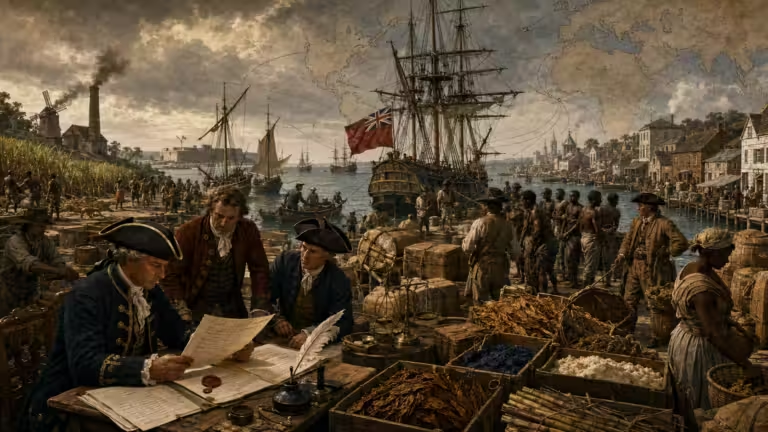
The British Atlantic Empire operated through a regulated commercial system that connected Britain, West Africa, the Caribbean and mainland North America. The Navigation Acts favoured British ships, ports and merchants, while colonial producers supplied tobacco, sugar, rice, indigo, timber and other commodities. This system supported naval power and colonial growth, but it also depended heavily on enslaved labour, commercial coercion and laws that merchants regularly evaded.
Religious migration created durable settlements in New England, but those colonies remained part of a wider imperial economy. Their merchants, ships and farms traded with Britain, the Caribbean and other colonies under rules designed at Westminster.

What was mercantilism?
Mercantilism describes a broad collection of early modern policies rather than one perfectly coherent economic theory. European governments attempted to strengthen the state by protecting shipping, directing trade, developing strategic industries and securing access to valuable colonial commodities.
Political leaders did not measure national wealth through modern economic statistics. They often focused on customs revenue, precious metals, shipping capacity, commercial balances and the ability to finance war. Trade mattered because it supplied both wealth and military power.
Colonies occupied a central place within this system. They supplied commodities that Britain could not produce domestically, while creating markets for British manufactured goods. Imperial legislation attempted to keep the greatest possible share of shipping, processing and commercial profit within British control.
However, the colonies did not exist merely as passive economic units. Colonial assemblies, planters, merchants, shipowners and Indigenous trading partners pursued their own interests. Their choices repeatedly altered or undermined policies designed in London.
The British Atlantic as an imperial marketplace
The British Atlantic Empire included more than the thirteen mainland colonies that later declared independence. It connected England, Wales, Scotland after 1707, Ireland in a more restricted position, Atlantic islands, Caribbean colonies, African trading forts and settlements across North America.
These territories possessed different economies and political institutions. Barbados and Jamaica produced sugar through large slave plantations, while Virginia and Maryland specialised in tobacco. South Carolina and Georgia exported rice and indigo, whereas the northern colonies supplied fish, timber, grain, ships and commercial services.
No single route connected every part of this system. Merchants created overlapping networks between British ports, African coasts, Caribbean islands, continental colonies and foreign markets. Cargoes, credit and information frequently passed through several ports before reaching their final destination.
The Empire therefore functioned less like a closed national warehouse than a regulated web of commercial relationships. Parliament attempted to shape those relationships, but geography and private initiative prevented complete control.
The Navigation Ordinance of 1651
The English Commonwealth passed the Navigation Ordinance in 1651. Its immediate purpose included challenging the Dutch Republic, whose merchants and ships carried a large proportion of European and Atlantic trade.
The legislation required many goods entering England or its territories to travel in English ships or vessels belonging to the country that produced them. It targeted the Dutch carrying trade because Dutch merchants often transported commodities between foreign producers and English consumers.
The Ordinance contributed to the commercial tensions that produced the First Anglo-Dutch War in 1652. Naval competition and trade policy had become inseparable because merchant fleets supplied vessels, sailors, customs income and strategic experience.
The Restoration did not abandon this republican legislation. Charles II’s Parliament replaced and expanded it through a series of Navigation Acts that became a lasting foundation of imperial commerce.
The Navigation Act of 1660
The Navigation Act of 1660 required trade with English colonies to use ships owned by English subjects or colonial inhabitants under English authority. Their crews also had to consist mainly of English or colonial sailors.
This rule aimed to exclude Dutch and other foreign carriers from colonial commerce. It supported English shipowners and trained sailors who could serve in the Royal Navy during wartime.
The Act also created a list of enumerated commodities. Producers could ship these goods only to England or another authorised English colony rather than selling them directly to foreign markets.
Tobacco and sugar belonged among the most important enumerated products. Parliament later expanded the list to include commodities such as rice, indigo, naval stores and other valuable colonial exports.
Enumeration did not necessarily mean that Britain consumed every commodity. Merchants could re-export colonial goods from British ports to continental Europe, but British shippers, warehouses, customs officials and intermediaries gained business from the process.

The Staple Act of 1663
The Staple Act of 1663 regulated goods travelling in the opposite direction. Many European products intended for the colonies first had to pass through an English port.
Merchants unloaded, recorded and frequently repacked these goods before sending them across the Atlantic. The system allowed the Crown to collect customs duties while giving English wholesalers and port communities a profitable intermediary role.
Colonial consumers consequently paid transport and handling costs that direct trade might have avoided. However, access to British credit, shipping and commercial distribution could also make imported goods easier to obtain.
The Act contained exceptions and underwent later modification. Nevertheless, it established the principle that Britain should serve as the commercial centre through which much of the Empire’s foreign trade passed.
The Plantation Duty Act of 1673
Merchants could evade enumeration by moving commodities between colonies before transferring them to foreign ships. Parliament responded through the Plantation Duty Act of 1673.
The Act imposed duties on enumerated goods carried from one colony to another unless merchants provided bonds guaranteeing lawful shipment. It also expanded the presence of customs officials within colonial ports.
These measures turned imperial regulation into a local administrative issue. Merchants no longer dealt only with distant legislation; they faced searches, documentation, bonds, seizures and customs payments within their own communities.
Enforcement remained inconsistent. Customs officers often lacked staff, reliable information and local political support, while merchants developed increasingly sophisticated methods of evasion.

What did the Navigation Acts try to achieve?
The Acts pursued several related objectives. They aimed to increase English shipping, weaken foreign commercial rivals and ensure that colonial trade contributed to customs revenue.
They also supported naval strength. A large merchant marine created demand for shipbuilding, rope, sails, timber and trained seamen who could transfer into naval service.
Finally, the laws gave English merchants privileged access to colonial commodities and consumers. The Empire would ideally supply Britain with raw materials and purchase British manufactured goods in return.
These goals did not always align. A restriction that benefited British sugar planters could damage New England distillers, while a policy supporting manufacturers might increase prices for colonial consumers.
Imperial trade policy therefore reflected political pressure from competing groups. Shipowners, refiners, planters, manufacturers and colonial agents all petitioned Parliament for favourable legislation.
From an English to a British commercial system
Before 1707, England and Scotland remained separate kingdoms. Scottish merchants did not automatically enjoy the same access to English colonial markets as English traders.
The Acts of Union created the Kingdom of Great Britain and brought Scotland within the Navigation system. Scottish merchants, ships and investors gained formal access to colonial trade.
Glasgow merchants later became particularly active in the Chesapeake tobacco trade. Scottish participation also expanded in the Caribbean, India, colonial administration and imperial military service.
Ireland occupied a more ambiguous and restricted position. Although Irish merchants traded actively with the colonies, Parliament often prevented Ireland from receiving all the commercial privileges available to Great Britain.
The expression British Atlantic Empire therefore describes a political and commercial system that remained internally unequal. English, Scottish, Irish, colonial and Caribbean interests did not receive identical treatment.
The Board of Trade and imperial administration
The Glorious Revolution increased Parliament’s involvement in colonial government and trade. In 1696, the Crown established the Board of Trade to examine colonial administration, legislation, commerce and appointments.
The Board received reports from governors and reviewed laws passed by colonial assemblies. It also collected information about population, production, defence and relations with Indigenous nations.
Parliament strengthened the Navigation system during the same period. Customs officials received broader authority, colonial governors had to enforce trade legislation and merchants faced more detailed requirements for bonds and documentation.
Vice-admiralty courts heard many maritime and customs cases without local juries. British officials considered these courts necessary because colonial juries might sympathise with merchants accused of illegal trade.
However, the Board of Trade did not operate like a modern ministry controlling every colonial decision. It advised the Crown, processed information and recommended policies, but distance and institutional fragmentation limited its authority.
Customs officers and colonial resistance
Customs officers worked within societies where merchants, judges and assembly members often shared family and commercial connections. Vigorous enforcement could make an officer socially isolated and politically unpopular.
Some officers accepted informal payments or tolerated minor violations. Others pursued seizures aggressively and faced lawsuits, intimidation or public hostility.
Colonial assemblies could obstruct enforcement indirectly. They controlled local salaries, legal procedures and expenditure while defending privileges that they believed their charters and English constitutional traditions protected.
Imperial government consequently depended on negotiation. London could issue instructions, but colonial cooperation determined how effectively many policies operated on the ground.
The Chesapeake tobacco economy
Tobacco transformed Virginia and Maryland into major export economies. European demand encouraged settlers to clear land along navigable rivers where producers could load barrels directly onto merchant ships.
Planters sold tobacco through British commercial networks and purchased clothing, tools, furniture and luxury goods on credit. Larger producers developed close relationships with merchants based in London, Bristol, Glasgow and other ports.
Credit allowed planters to obtain goods before selling the next harvest. It also left many deeply indebted to British merchants, particularly when tobacco prices fell or crops failed.
The Navigation system gave British merchants privileged access to the crop. At the same time, British markets and re-export networks provided tobacco growers with a vast commercial outlet.
The plantation economy initially relied heavily on indentured European servants. During the later seventeenth century, planters increasingly imposed permanent racial slavery on Africans and their descendants.
Sugar and the British Caribbean
Sugar became one of the most valuable commodities within the British Atlantic. Barbados pioneered a plantation system during the seventeenth century that later expanded dramatically in Jamaica and other Caribbean colonies.
Sugar cultivation required expensive mills, boiling houses, extensive land and a large labour force. Wealthy planters acquired smaller estates and concentrated production within increasingly unequal island societies.
Enslaved Africans planted, cut and processed sugar cane under violent conditions. High mortality forced plantation owners to purchase additional captives continuously rather than relying solely on natural population growth.
Raw sugar travelled to British ports for refining, while molasses entered distilling and intercolonial commerce. Rum, sugar and plantation credit connected Caribbean production to New England merchants and mainland consumers.
West Indian planters and their agents acquired substantial influence in Britain. They used petitions, personal connections and parliamentary representation to defend preferential access to imperial markets.
Rice, indigo and the Lower South
South Carolina developed a plantation economy closely connected to the Caribbean. Early settlers imported assumptions about land, slavery and social hierarchy from Barbados and other English colonies.
Rice became the colony’s leading export during the late seventeenth and early eighteenth centuries. Enslaved Africans contributed agricultural knowledge as well as forced labour, particularly within the difficult environments of tidal wetlands.
Indigo expanded during the eighteenth century with support from imperial subsidies. Producers extracted dye from the plant through a labour-intensive process performed largely by enslaved workers.
Charleston developed into a major port linking plantations to British and Caribbean markets. Merchants imported enslaved people, manufactured goods and credit while exporting rice, indigo, deerskins and naval stores.
The regional economy also depended on trade with Indigenous nations. The deerskin trade connected coastal merchants to inland communities, diplomacy and territorial competition.
The Middle Colonies and the grain trade
Pennsylvania, New York, New Jersey and Delaware produced wheat, flour, maize and other foodstuffs. Farms supplied growing colonial towns as well as plantation colonies that devoted much of their land to export crops.
Philadelphia and New York became major commercial ports. Merchants exported flour and provisions to the Caribbean, southern Europe and other Atlantic destinations.
This trade reveals why the Empire could not operate through one simple exchange between Britain and each individual colony. Caribbean plantations needed food, animals, timber and barrels supplied by continental colonies.
Colonial regions therefore specialised partly because they traded with one another. Intercolonial commerce made the Empire economically interdependent even when Parliament attempted to place Britain at its centre.
New England’s maritime economy
New England lacked the climate for tobacco, rice or sugar. Its merchants instead developed fisheries, shipbuilding, coastal trade and commerce with the Caribbean.
Cod caught in Atlantic waters entered several markets. Higher-quality fish travelled to southern Europe, while cheaper grades helped feed enslaved workers on Caribbean plantations.
New England exported timber, barrel staves, livestock, grain and preserved food to the sugar islands. Merchants returned with molasses, sugar, bills of exchange and other commodities.
Distillers converted imported molasses into rum for local consumption and wider trade. This industry made access to inexpensive French Caribbean molasses commercially important.
Shipbuilding also benefited from regional timber supplies and skilled labour. Colonial-built ships carried imperial commerce and sometimes entered British or foreign ownership.
Atlantic slavery at the centre of imperial commerce
Slavery did not form a marginal or separate branch of the British Atlantic economy. Enslaved labour produced many of its most valuable commodities, including sugar, tobacco, rice and indigo.
Plantation production generated business for shipowners, merchants, insurers, refiners, manufacturers and port workers. Consumers also participated through their demand for sugar, tobacco, rum and other colonial goods.
Northern colonies without dominant plantation economies remained involved. Their merchants supplied Caribbean estates, financed voyages, owned enslaved people and traded in commodities created through forced labour.
British prosperity did not derive exclusively from slavery, but the Atlantic system cannot be understood without it. Forced labour shaped production, shipping, consumption and imperial policy throughout the period.
The Royal African Company
Charles II granted the Royal African Company a charter in 1672. The Company received a monopoly over much English trade along the western coast of Africa.
It maintained forts and exchanged textiles, metal goods, weapons and other commodities for gold, ivory and captive Africans. The Company then transported enslaved men, women and children across the Atlantic for sale.
Royal and aristocratic investors supported the enterprise, while agents operated in colonial ports. Plantation owners purchased captives through these commercial networks and demanded a larger supply than the Company could consistently deliver.
Independent merchants challenged the monopoly, and Parliament opened the African trade more widely during the 1690s. Competition increased the number of British voyages rather than reducing the traffic in enslaved people.
London initially played a leading role, followed by Bristol and then Liverpool during the eighteenth century. Commercial growth rested on the captivity, transport and sale of human beings.
The Middle Passage
European traders acquired captives through African political and commercial networks shaped by warfare, kidnapping, judicial enslavement and debt. Europeans rarely controlled extensive inland territories during this period, but their demand transformed regional conflicts and markets.
Ships confined captives below deck for Atlantic crossings that could last several weeks or months. Overcrowding, disease, dehydration, violence and inadequate food caused severe suffering and death.
Captives resisted through hunger strikes, communication, sabotage, individual defiance and organised rebellion. Crews used weapons, restraints and terror to preserve control.
Survivors entered colonial markets where merchants sold them to plantation owners and other buyers. Colonial laws increasingly converted African ancestry into permanent and hereditary enslaved status.
Enslaved people nevertheless created families, preserved knowledge, developed new cultures and resisted the authority imposed upon them. The history of the Atlantic economy includes their agency as well as the violence used to exploit them.
Was Atlantic commerce really triangular?
The familiar triangular-trade model links European manufactured goods, captive Africans and American plantation commodities. It provides a useful introduction to the commercial relationship between Europe, Africa and the Americas.
However, few merchants followed one identical triangle. Some ships sailed directly from Britain to the Caribbean and returned with sugar, while others connected North America to southern Europe or traded between colonies.
New England vessels carried fish and provisions to the Caribbean, collected molasses and returned to northern ports. British ships might visit several African trading sites before crossing to one or more American colonies.
Credit and cargoes also moved without following the same physical route. Bills of exchange generated in one colony could pay debts in Britain or finance purchases elsewhere in the Atlantic.
It is therefore more accurate to describe interlocking Atlantic networks. The triangle represents one recurring structure within a much larger system.
British ports and commercial wealth
Colonial trade transformed British port cities. London remained the Empire’s principal financial and commercial centre, while Bristol, Liverpool and Glasgow developed powerful Atlantic interests.
Ships required investors, captains, crews, chandlers, rope-makers, sail-makers and dock labourers. Cargoes supported warehouse owners, customs officials, refiners, manufacturers and inland distributors.
Merchants spread risk through partnerships, marine insurance and diversified cargoes. Commercial information circulated through letters, newspapers, coffee houses and personal agents stationed in colonial ports.
Profits did not remain confined to the coast. Atlantic merchants purchased estates, invested in manufacturing, entered municipal government and influenced national politics.
However, aggregate commercial growth concealed unequal outcomes. Merchants and planters could accumulate fortunes while sailors, dock workers and enslaved producers faced dangerous and coercive conditions.
Credit, debt and bills of exchange
Colonial trade did not depend solely on coins moving between buyers and sellers. Specie remained scarce in many colonies, so merchants relied on credit, account books, commodity payments and bills of exchange.
A planter might purchase British goods on credit and repay the merchant after selling tobacco or rice. A Caribbean merchant could use a bill drawn on London to finance purchases in North America.
This system allowed commerce to expand beyond the available supply of currency. It also created chains of dependency in which one failed harvest or bankrupt merchant could affect creditors across the Atlantic.
Debt shaped political attitudes. Colonial elites benefited from British credit but could resent the control exercised by metropolitan firms over prices, shipping and repayment.
Did Britain prevent colonial manufacturing?
A common interpretation presents mercantilism as a complete prohibition on colonial industry. In reality, colonists manufactured household goods, built ships, processed food and operated mills, ironworks, distilleries and workshops.
Parliament did restrict activities that British producers considered threatening. The Wool Act of 1699 limited the export of colonial woollen products beyond the colony where manufacturers produced them.
The Hat Act of 1732 restricted the intercolonial hat trade and regulated apprentices within the industry. British hat-makers wanted to prevent colonial producers from developing a competitive export business.
The Iron Act of 1750 encouraged the shipment of colonial pig and bar iron to Britain while restricting the construction of certain new finishing facilities. Britain wanted colonial raw materials without encouraging every stage of higher-value manufacturing overseas.
These laws constrained particular industries rather than eliminating colonial production. Their political importance came from the principle that Parliament could shape colonial development for metropolitan advantage.
The Molasses Act of 1733
New England merchants purchased substantial quantities of molasses from French, Dutch and other non-British Caribbean colonies. These suppliers often offered lower prices than British West Indian planters.
British sugar interests persuaded Parliament to pass the Molasses Act in 1733. It imposed high duties on foreign molasses, sugar and rum imported into British mainland colonies.
The law aimed to redirect North American commerce towards the British Caribbean. Full enforcement would have disrupted New England distilling, fisheries and provision trades that depended on exchanges with foreign islands.
Merchants responded through false declarations, secret landings, bribery and negotiations with customs officials. The high duty encouraged evasion instead of producing a fully regulated British market.
The episode shows that colonial economies could depend on trade outside the formal Empire. Parliamentary law could not erase commercial relationships created by price, geography and mutual demand.
Smuggling in the British Atlantic
Smuggling took many forms. Merchants mislabelled cargoes, altered documents, landed goods in isolated coves or transferred them between ships before entering port.
Some practices involved organised commercial enterprises rather than occasional individual violations. Local officials, merchants and consumers could all benefit from cheaper or otherwise unavailable goods.
Colonists did not necessarily view every violation as political resistance. A merchant could support the British monarchy while treating customs evasion as an ordinary part of Atlantic business.
Nevertheless, repeated evasion weakened imperial authority. When Britain attempted stricter enforcement after 1763, colonists interpreted measures that officials considered routine regulation as an alarming expansion of metropolitan power.
What was salutary neglect?
The expression salutary neglect describes Britain’s comparatively flexible enforcement of colonial regulations before 1763. It does not mean that Parliament ignored the colonies completely or deliberately suspended every commercial law.
British governments faced European wars, changing ministries and limited administrative resources. Officials often prioritised strategic loyalty and expanding trade over perfect compliance with every regulation.
Colonial assemblies consequently acquired substantial control over taxation, salaries and local administration. Merchants built trade routes that operated partly outside strict interpretations of imperial law.
The arrangement benefited both sides while imperial commerce expanded. Britain received commodities and purchased colonial loyalty, while colonists enjoyed access to imperial markets alongside significant practical autonomy.
However, flexibility created incompatible expectations. British leaders continued to believe that Parliament possessed legal authority over imperial trade, while colonists increasingly regarded local autonomy as an established constitutional right.
Did the colonies benefit from the Navigation Acts?
The Acts imposed real costs, but their effects were not uniformly negative. Colonial ships qualified for much of the protected imperial trade and benefited from the exclusion of foreign carriers.
British markets purchased enormous quantities of tobacco, sugar, rice and other commodities. Parliament also offered bounties or preferential duties for selected colonial products.
Merchants gained access to British credit, naval protection and global re-export networks. Colonial shipbuilding and port activity could grow within the regulated system rather than merely in opposition to it.
The burdens also varied by region. Chesapeake tobacco growers could benefit from a protected market while disliking dependence on British merchants. New England traders suffered more directly when laws restricted commerce with foreign Caribbean islands.
The important question is therefore not whether mercantilism simply helped or harmed the colonies. It distributed advantages and restrictions unevenly while binding colonial prosperity to British political authority.
Indigenous nations and the Atlantic economy
British colonial commerce depended on Indigenous knowledge, production and diplomatic networks. European traders could not control the interior of North America without relationships with sovereign Indigenous nations.
Furs and deerskins entered Atlantic markets through trade involving Indigenous hunters and intermediaries. Imported textiles, metal tools, firearms and other European goods became part of regional economies and political alliances.
Trade did not make Indigenous nations passive dependants. Leaders used competing British, French, Dutch and Spanish alliances to pursue security, military advantage and commercial opportunity.
However, settler expansion changed the nature of these relationships. As colonial populations demanded more land, commercial partnerships increasingly coexisted with dispossession, warfare and attempts to impose imperial sovereignty.
Privateering, piracy and imperial war
Atlantic commerce operated within frequent warfare between European empires. Merchant ships carried valuable cargoes but remained vulnerable to enemy navies, licensed privateers and pirates.
Governments issued letters of marque allowing privately owned vessels to capture enemy shipping. Investors and crews shared prize money, while the state gained additional naval force without paying the full cost.
Privateering could become piracy when captains continued attacking ships without lawful authority or ignored the nationality of their targets. Colonial ports sometimes welcomed profitable cargoes while imperial officials attempted to suppress unauthorised violence.
Britain strengthened naval and legal enforcement during the late seventeenth and early eighteenth centuries. Protecting trade routes became one of the principal responsibilities of the expanding imperial state.
Commerce and the growth of state power
Mercantilism did not merely enrich private merchants. Customs duties provided government revenue, while commercial credit helped finance European wars.
Parliamentary taxation and public borrowing expanded after the Glorious Revolution. The Bank of England and the funded national debt allowed the state to mobilise resources on an unprecedented scale.
Naval expenditure supported dockyards, shipbuilding and global military operations. Commercial expansion helped finance state power, while naval protection made further expansion possible.
This relationship produced what historians sometimes call a fiscal-military state. Parliament, investors, taxpayers, merchants and armed forces became connected through permanent systems of revenue and credit.
Colonial commerce therefore strengthened both Parliament and the executive state. Representative government did not necessarily reduce imperial coercion; it could provide the money needed to extend it.
Colonial assemblies within the commercial empire
Most British mainland colonies possessed representative assemblies. These bodies passed local laws, approved taxation and often controlled the salaries of governors and other officials.
Assemblies did not challenge the existence of the Empire by definition. Their members usually considered themselves British subjects who deserved the inherited rights of Englishmen.
Conflict emerged because the imperial constitution lacked a clearly agreed division of authority. Parliament claimed the right to regulate trade throughout the Empire, while colonial assemblies defended control over internal taxation and local government.
Before 1763, negotiation and inconsistent enforcement prevented these disagreements from becoming a permanent constitutional rupture. Colonial prosperity often made the imperial relationship appear mutually advantageous.
Did the Navigation Acts cause the American Revolution?
The Navigation Acts did not produce immediate demands for independence. Colonists lived under the system for generations while their populations, ports and regional economies expanded.
Many colonial merchants criticised particular restrictions but benefited from British markets, credit and protection. They often responded through lobbying, negotiation and evasion rather than revolutionary resistance.
The critical change came after the Seven Years’ War. Britain attempted to enforce commercial laws more consistently and raise colonial revenue to support a larger imperial military establishment.
The Sugar Act of 1764 lowered the old molasses duty but aimed to collect it more effectively. Colonists objected to enforcement procedures and the broader claim that Parliament could use imperial regulation to raise revenue from them.
Mercantilism therefore created the institutional framework within which the later crisis developed. Enforcement, taxation and constitutional interpretation transformed commercial disputes into arguments over sovereignty.
The contradictions of the British Atlantic Empire
The Empire encouraged commercial integration while preserving political inequality. British merchants and colonial elites gained protected opportunities, but enslaved and Indigenous people bore much of the system’s human cost.
Parliament defended the liberty of its own debates while legislating for colonies that elected no representatives to Westminster. Colonial assemblies defended local rights while authorising slavery, territorial expansion and unequal suffrage.
Consumers gained access to sugar, tobacco and other commodities whose prices concealed forced labour and military conquest. Commercial prosperity made coercion appear distant from ordinary economic life.
The system also combined regulation with evasion. Parliament claimed authority over Atlantic commerce, yet the Empire grew partly because officials tolerated practices that violated its own rules.
These contradictions did not prevent imperial expansion. They created a flexible system that could generate wealth while postponing fundamental conflicts over representation, freedom and political authority.
From Atlantic commerce to colonial politics
By the middle of the eighteenth century, the mainland colonies had developed distinct regional economies while remaining commercially interdependent. Ports connected local production to Caribbean, British, African and European markets.
Economic diversity accompanied religious and political diversity. Puritan New England, Anglican Virginia, Quaker Pennsylvania and the pluralistic middle colonies did not share one social model.
Nevertheless, their assemblies, churches, newspapers and voluntary associations created increasingly confident colonial societies. These institutions shaped how colonists interpreted imperial authority.
The next article examines religion and politics within the American colonies before the imperial crisis. It explores established churches, dissent, colonial assemblies and the competing meanings of liberty within British North America.
- English Expansionism
- The English Civil War and Cromwell’s Commonwealth
- The Glorious Revolution of 1688
- Puritanism, Dissent and the Great Migration
- The American Colonies: Religion and Politics
- Puritanism and Expansionism in Early America
Frequently asked questions about mercantilism and the Navigation Acts
What was mercantilism?
Mercantilism describes policies that used trade regulation, protected shipping, colonial markets and strategic industries to strengthen the state. It was a broad approach rather than one uniform economic doctrine followed identically by every government.
What were the Navigation Acts?
The Navigation Acts were laws that directed much colonial commerce through English and later British ships, ports and merchants. They regulated shipping, enumerated exports, European imports, customs duties and intercolonial trade.
Why did England pass the first Navigation Ordinance?
The Commonwealth passed the 1651 Ordinance partly to challenge Dutch dominance of European carrying trade. It required many imports to arrive in English ships or vessels belonging to the producing country.
What were enumerated commodities?
Enumerated commodities were colonial products that merchants could ship only to authorised English or British destinations. The list included valuable exports such as tobacco and sugar and expanded through later legislation.
Did the Navigation Acts prohibit all foreign trade?
No. They restricted ships, routes and designated commodities rather than closing every colonial market. Merchants could also re-export colonial goods through British ports, while legal exceptions and widespread smuggling preserved foreign connections.
How was slavery connected to mercantilism?
Enslaved labour produced sugar, tobacco, rice, indigo and other valuable commodities. Slave trading and plantation production generated business for merchants, shipowners, insurers, manufacturers, refiners and colonial consumers throughout the Atlantic economy.
What was the Royal African Company?
The Royal African Company received a charter in 1672 and monopolised much English trade along the western African coast. It traded in gold and ivory while transporting captive Africans for sale in American and Caribbean colonies.
Was triangular trade a single fixed route?
No. The triangle offers a useful model linking Europe, Africa and the Americas, but merchants followed many direct and indirect routes. Atlantic commerce formed a network of overlapping voyages, cargoes, credit and intercolonial exchanges.
What was the Molasses Act of 1733?
The Molasses Act imposed high duties on sugar, rum and molasses imported from foreign colonies. It aimed to protect British West Indian producers but encouraged extensive smuggling because foreign molasses often cost less.
What does salutary neglect mean?
Salutary neglect describes Britain’s flexible and inconsistent enforcement of colonial regulation before 1763. It did not mean that Parliament abandoned the colonies, but it allowed assemblies and merchants considerable practical autonomy.
Did the colonies benefit from mercantilism?
Some colonists benefited from protected markets, British credit, naval defence and privileged shipping. Others faced higher prices or restrictions on foreign trade. The balance differed significantly between regions, commodities and social groups.
Did the Navigation Acts cause the American Revolution?
Not by themselves. Colonial economies expanded under the Acts for generations. Conflict intensified after 1763 when Britain strengthened enforcement, raised revenue and challenged colonial assumptions about local taxation and political autonomy.
Sources and further reading
- UK Parliament: The Navigation Laws
- UK Parliament: key dates in the Navigation Laws
- UK Parliament: Parliament and the American colonies before 1765
- UK Parliament: protecting British trade and manufacture
- The National Archives: records of the Boards of Customs and Excise
- The National Archives: the transatlantic slave trade
- The National Archives: British slave-trade records
- Royal Museums Greenwich: history of the transatlantic slave trade
- Royal Museums Greenwich: African and Caribbean historical timeline
- Library of Congress: colonial trade and mercantilism
- Library of Congress: British reforms and colonial resistance
- National Park Service: tobacco in colonial Virginia
- National Park Service: the colonial plantation system
- National Park Service: the Royal African Company
- National Park Service: Boston merchants and the economy of slavery
- National Park Service: indigo and enslaved labour in South Carolina
The Atlantic economy connected the colonies, but it did not make their societies identical. The next article examines established churches, religious pluralism, colonial assemblies and the political institutions through which British Americans governed themselves.
