
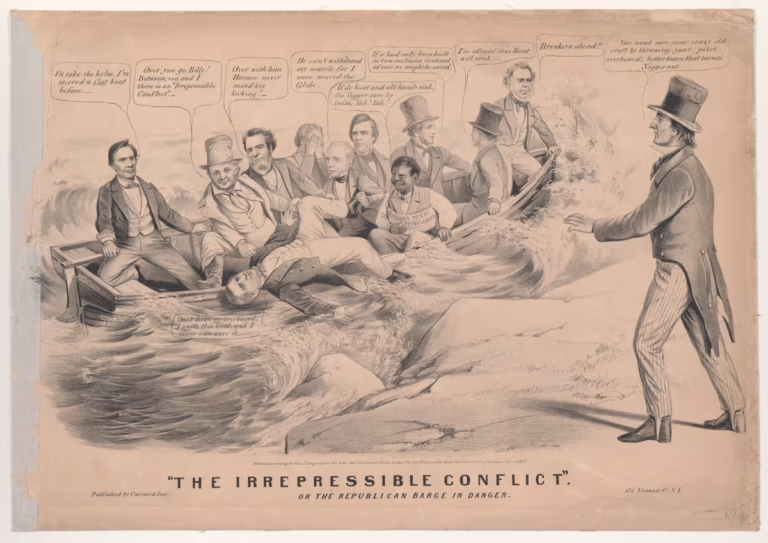
Between 1850 and 1861, every attempt to settle the expansion of slavery made the sectional conflict more severe. The Fugitive Slave Act, Bleeding Kansas, the Dred Scott decision, John Brown’s raid and Abraham Lincoln’s election progressively destroyed trust between North and South. Secession was not inevitable in 1850, but by early 1861 political compromise had collapsed.
The American Civil War did not begin suddenly with the attack on Fort Sumter in April 1861. It emerged from a decade of political crises in which the United States repeatedly failed to resolve the status of slavery in its expanding territories.
Territorial growth after the Mexican-American War made the conflict especially urgent. The United States had acquired California and a vast western region, but Congress had not decided whether slavery would be permitted there.
Southern slaveholders argued that they had a constitutional right to carry enslaved people into federal territories. Many Northerners opposed the expansion of slavery, although they did not all support racial equality or immediate abolition.
The crisis therefore concerned more than a moral disagreement. It involved political representation, economic power, federal authority and the future balance between free and slave states.
The structural differences between the sections are examined in North and South Before the American Civil War.

Why did western expansion intensify the slavery crisis?
The Treaty of Guadalupe Hidalgo ended the Mexican-American War in 1848 and transferred an enormous territory to the United States. Almost immediately, the question arose whether slavery would expand into these lands.
The dispute mattered because new states affected the balance of power in Congress. Representation in the House depended on population, while every state received two senators. The admission of each free or slave state could therefore alter national policy.
Southern leaders feared that permanent restriction would transform slaveholding states into a political minority. They argued that territories belonged equally to all states and that Congress could not exclude slave property from them.
Northern opposition contained several positions. Abolitionists condemned slavery as morally wrong, while many supporters of the Free Soil movement opposed its expansion because they wanted western land reserved for white farmers and wage labourers.
The conflict over western territory is explored more fully in Westward Expansion: America’s Road to the Pacific.
The Wilmot Proviso
In 1846, Democratic Representative David Wilmot proposed prohibiting slavery in any territory acquired from Mexico. His proposal became known as the Wilmot Proviso.
The House of Representatives approved versions of the measure several times, but the Senate rejected them. The failure reflected the sectional structure of Congress: the more populous North held an advantage in the House, while free and slave states remained more evenly balanced in the Senate.
The proviso never became law, but it reorganised political debate. Party loyalty increasingly competed with sectional identity, as Northern and Southern members of the same national parties divided over slavery.
The controversy also strengthened the Free Soil Party, founded in 1848. Its slogan — “Free Soil, Free Speech, Free Labor, and Free Men” — expressed opposition to the expansion of slavery rather than a general commitment to racial equality.

The crisis of 1850
The discovery of gold accelerated migration to California, which soon requested admission as a free state. Its application threatened to upset the political balance between free and slave states.
Other disputes intensified the crisis. Texas claimed territory that became part of New Mexico, while Southerners demanded stronger federal enforcement against people escaping slavery. Abolitionists also wanted the slave trade abolished in Washington, D.C.
Leading politicians attempted to construct another sectional settlement. Henry Clay proposed a broad compromise, while Daniel Webster supported concession in the hope of preserving the Union.
John C. Calhoun, speaking through a colleague because of poor health, warned that the South required stronger constitutional guarantees. William H. Seward rejected compromise with slavery and appealed to a “higher law” than the Constitution.
The Compromise of 1850
The Compromise of 1850 was not one single law. It consisted of several measures passed separately after Stephen A. Douglas divided Clay’s original proposal into individual bills.
- California entered the Union as a free state.
- Utah and New Mexico territories would decide the status of slavery through popular sovereignty.
- Texas abandoned part of its territorial claim in exchange for federal assumption of certain debts.
- The slave trade, but not slavery itself, was prohibited in Washington, D.C.
- A stronger Fugitive Slave Act required federal assistance in the capture of alleged fugitives.
The settlement postponed immediate disunion. However, it did not create an enduring agreement because its individual measures affected the sections very differently.
California strengthened the free-state majority, while popular sovereignty avoided a clear congressional decision about slavery in the remaining territories. The Fugitive Slave Act then brought the enforcement of slavery directly into Northern communities.

The Fugitive Slave Act
The Fugitive Slave Act of 1850 created a federal process for capturing and returning people accused of escaping slavery. Federal commissioners could issue certificates of removal, while accused fugitives could not testify on their own behalf or receive a jury trial.
The law required citizens and officials to assist in enforcement. Anyone who obstructed an arrest or helped a fugitive could face fines and imprisonment.
Commissioners received a larger fee when they ordered a person returned to slavery than when they ruled in favour of release. Critics viewed this payment structure as evidence that the legal process was fundamentally biased.
The law placed free Black people at risk as well as fugitives. Kidnappers and slave catchers could exploit weak procedural protections, while Black communities organised vigilance committees to prevent abductions and resist arrests.
Many white Northerners who had previously regarded slavery as a distant Southern institution now encountered federal enforcement in their own streets. Publicised cases in Boston, Syracuse, Philadelphia and other cities increased antislavery sentiment.
Resistance to the Fugitive Slave Act
Northern resistance took several forms. Lawyers challenged arrests, crowds attempted rescues and activists helped fugitives reach Canada through networks commonly associated with the Underground Railroad.
Some Northern states adopted personal liberty laws intended to protect residents from kidnapping or provide legal safeguards. Southern leaders argued that such laws violated the Constitution and proved that the North would not respect slaveholders’ rights.
The controversy exposed an important contradiction in Southern constitutional thought. Advocates of states’ rights demanded extensive federal power when it was required to enforce slavery beyond Southern borders.
Uncle Tom’s Cabin and the politics of slavery
Harriet Beecher Stowe published Uncle Tom’s Cabin in book form in 1852 after its serial appearance in an antislavery newspaper. The novel presented slavery through family separation, physical violence and the moral corruption of enslavers.
The book became a major commercial success in the United States and abroad. Stage adaptations and illustrations extended its influence even among people who had not read the novel.
Stowe’s work encouraged many Northern readers to interpret slavery as a personal and moral issue rather than an abstract constitutional dispute. Southern writers responded with proslavery novels that portrayed plantations as orderly and paternal institutions.
The novel did not cause the Civil War by itself, and its racial representations reflected nineteenth-century stereotypes. Its importance lay in its ability to turn the domestic consequences of slavery into a subject of mass political culture.
The Kansas-Nebraska Act
Senator Stephen A. Douglas wanted to organise the Kansas and Nebraska territories, partly to support western settlement and a possible transcontinental railway route.
His Kansas-Nebraska Act of 1854 allowed settlers to decide the status of slavery through popular sovereignty. Because both territories lay north of the Missouri Compromise line, the legislation effectively repealed the restriction established in 1820.
The repeal outraged many Northerners who had accepted the Missouri Compromise as a permanent settlement. They feared that slavery could now expand into territory previously reserved for freedom.
Douglas hoped popular sovereignty would remove the issue from Congress and allow local settlers to decide. Instead, the policy transformed Kansas into a battleground where opposing groups attempted to control the territorial government.
The collapse of the Whig Party
The Kansas-Nebraska Act accelerated the collapse of the Whig Party. Northern and Southern Whigs could no longer maintain a common position on the expansion of slavery.
Some former Whigs joined the nativist American or Know-Nothing Party, which opposed immigration and Catholic influence. Others entered antislavery coalitions with Free Soilers, Northern Democrats and independent reformers.
These coalitions produced the Republican Party during the mid-1850s. Its central purpose was to prevent slavery from expanding into federal territories.
Republicans did not initially call for the immediate abolition of slavery in states where it already existed. Their programme nevertheless threatened the long-term political influence of slaveholders because it aimed to surround slavery and prevent its territorial growth.
Bleeding Kansas
Proslavery and antislavery settlers moved into Kansas in the hope of controlling its political future. Proslavery activists from neighbouring Missouri crossed the border to influence elections, while Northern emigrant aid organisations encouraged Free-State settlement.
Fraudulent elections produced a proslavery territorial legislature, which Free-State settlers rejected. Rival governments and constitutions claimed legitimacy, creating political chaos.
Violence intensified in 1856 when proslavery forces attacked the Free-State town of Lawrence. Shortly afterwards, radical abolitionist John Brown and several followers killed five proslavery men near Pottawatomie Creek.
The territory experienced raids, assassinations and armed clashes for several years. Although the number of deaths was far lower than during the later Civil War, the conflict demonstrated that popular sovereignty could produce civil warfare rather than democratic compromise.
“Bleeding Kansas” also provided competing national narratives. Northerners portrayed proslavery forces as aggressors attempting to impose slavery through fraud and violence, while Southern newspapers depicted antislavery settlers as revolutionary abolitionists.
Violence in the United States Senate
The conflict over Kansas reached Congress. In May 1856, Senator Charles Sumner of Massachusetts delivered a speech entitled “The Crime Against Kansas”.
Sumner denounced proslavery violence and personally insulted Senator Andrew Butler of South Carolina. Two days later, Butler’s relative, Representative Preston Brooks, attacked Sumner with a cane on the Senate floor.
Sumner suffered severe injuries and remained absent from the Senate for years. Brooks resigned but was quickly re-elected by his South Carolina constituents.
Northerners presented Sumner as a martyr to free speech, while many Southerners celebrated Brooks. The response demonstrated how deeply sectional political cultures had diverged.
The election of 1856
The Republican Party entered its first presidential campaign in 1856 with explorer and military officer John C. Frémont as its candidate.
Democrat James Buchanan won the election, partly because Republicans remained weak in the South and Democrats warned that a Republican victory might cause disunion.
However, Frémont carried most Northern states. The result demonstrated that a party based primarily in one section could compete seriously for the presidency.
This development alarmed Southern leaders. If the North united behind one sectional party, it could eventually elect a president without meaningful Southern support.
The Dred Scott decision
Dred Scott was an enslaved man who had lived with his enslaver in Illinois and the Wisconsin Territory, where slavery was prohibited. Scott sued for freedom on the grounds that residence in free territory had made him legally free.
In March 1857, the Supreme Court ruled against him in Dred Scott v. Sandford. Chief Justice Roger B. Taney’s majority opinion declared that people of African descent whose ancestors had been enslaved were not citizens within the meaning of the Constitution and could not sue in federal court.
The Court also ruled that Congress lacked authority to prohibit slavery in federal territories. It therefore declared the territorial restriction contained in the Missouri Compromise unconstitutional.
The decision went far beyond resolving Scott’s individual claim. It attempted to remove the territorial issue from normal congressional politics by protecting slaveholders’ property rights throughout the territories.
Southern leaders welcomed the ruling, while Republicans condemned it as evidence of a powerful “Slave Power” controlling the federal government. The decision weakened the possibility of compromise because it suggested that Congress could not adopt the central Republican policy of restricting slavery’s expansion.
The Lecompton Constitution
The conflict over Kansas continued after the Dred Scott decision. Proslavery delegates drafted the Lecompton Constitution, which would have admitted Kansas as a slave state.
The process was deeply controversial because many Free-State voters had boycotted or rejected the elections associated with the convention. President Buchanan nevertheless supported admission under the Lecompton document.
Stephen Douglas opposed the administration because he believed the constitution did not reflect a fair expression of popular sovereignty. The dispute divided the Democratic Party between supporters of Buchanan and followers of Douglas.
Kansas voters ultimately rejected the Lecompton Constitution. Kansas entered the Union as a free state in January 1861, after the secession of several Southern states had changed the balance in Congress.
The Lincoln-Douglas debates
Abraham Lincoln challenged Stephen Douglas for an Illinois Senate seat in 1858. The two candidates participated in seven public debates focused primarily on slavery’s expansion.
Lincoln argued that the country could not remain permanently divided between free and slave systems. His “House Divided” speech did not predict an immediate civil war, but it warned that the sectional conflict would eventually produce a national decision.
Lincoln opposed the expansion of slavery while denying that he intended immediate federal abolition within existing slave states. He also expressed racial views that fell far short of modern equality and sometimes reassured white voters that he did not support full social or political integration.
Douglas defended popular sovereignty. At Freeport, Lincoln asked how settlers could exclude slavery after the Dred Scott decision had denied Congress the power to prohibit it.
Douglas replied that slavery could not survive without local laws protecting it. This answer, later called the Freeport Doctrine, helped him retain Northern Democratic support but alienated many Southern Democrats.
Douglas won the Senate contest because state legislators still selected senators. Lincoln, however, gained national recognition and became a leading candidate for the Republican presidential nomination.
John Brown’s raid on Harpers Ferry
John Brown had concluded that slavery would not end through peaceful political action. After participating in the violence in Kansas, he planned an armed attack on the federal arsenal at Harpers Ferry, Virginia.
Brown intended to seize weapons, encourage enslaved people to join him and establish a base from which an antislavery insurrection could spread through the Appalachian region.
On the night of 16 October 1859, Brown and twenty-one followers captured the armoury and several hostages. The expected uprising did not occur, and local militia trapped the group.
United States Marines commanded by Robert E. Lee assaulted the engine house where Brown had taken refuge. Several raiders were killed, while Brown was captured, tried by Virginia and convicted of treason, murder and inciting enslaved people to rebel.
Brown was executed on 2 December 1859. His raid failed militarily but had enormous political consequences.
How did North and South interpret John Brown?
Many Northerners rejected Brown’s violence, but some abolitionists praised his courage and willingness to sacrifice his life against slavery. Church bells rang and memorial meetings occurred in parts of the North after his execution.
Southern observers interpreted these responses as evidence that the wider North secretly supported slave rebellion. Even moderate praise for Brown seemed to confirm fears that Republican success would threaten Southern lives and property.
The raid encouraged Southern states to strengthen militias and prepare for possible insurrection. It also made compromise more difficult by connecting antislavery politics with the fear of armed racial revolution.
The Democratic Party splits
The Democratic Party entered the election of 1860 divided over the territorial question. Northern Democrats supported Stephen Douglas and popular sovereignty, while many Southern delegates demanded federal protection for slavery in the territories.
The national Democratic convention met in Charleston, South Carolina, but delegates failed to agree on a platform or candidate. Southern delegates withdrew, and the party eventually nominated two separate presidential candidates.
Northern Democrats nominated Douglas. Southern Democrats selected Vice President John C. Breckinridge, who supported federal protection for slavery in the territories.
A fourth party, the Constitutional Union Party, nominated John Bell. It attempted to avoid the slavery question by campaigning for the Constitution, the Union and enforcement of existing laws.
Abraham Lincoln and the election of 1860
The Republican Party nominated Abraham Lincoln in 1860. His relatively moderate reputation, western background and opposition to slavery’s expansion made him acceptable to several factions within the party.
The Republican platform opposed the expansion of slavery into federal territories but did not call for immediate abolition in states where it already existed. It also supported protective tariffs, western homesteads and internal improvements.
Lincoln won the election with less than forty per cent of the national popular vote but a clear majority in the Electoral College. He carried almost every free state and received virtually no electoral support in the slaveholding South.
His victory demonstrated that a Northern-based party could control the presidency without winning the South. Southern leaders saw this political isolation as a threat to their long-term influence and to the future of slavery.
Lincoln had repeatedly stated that he would not interfere directly with slavery in existing states. Secessionists nevertheless feared that Republican control of federal appointments, territories and national policy would place slavery on a path towards eventual extinction.
Why did South Carolina secede?
South Carolina called a convention after Lincoln’s election and adopted an ordinance of secession on 20 December 1860.
Its declaration of causes complained that Northern states had resisted the return of fugitives and that a political party hostile to slavery had gained control of the presidency.
Other Deep South states followed during January and early February 1861: Mississippi, Florida, Alabama, Georgia, Louisiana and Texas.
Their secession documents and commissioners’ speeches repeatedly identified slavery, racial hierarchy and opposition to Republican policy as central motives.
Secessionists also used the language of state sovereignty. However, the specific right they sought to protect was the maintenance and expansion of a slaveholding political order.
The creation of the Confederacy
Delegates from the first seven seceding states met at Montgomery, Alabama, in February 1861. They created the Confederate States of America and selected Jefferson Davis as provisional president.
The Confederate Constitution resembled the United States Constitution in many respects. However, it explicitly protected slavery and restricted the ability of the Confederate government to interfere with slave property.
Not every white Southerner supported secession. Unionists remained influential in parts of the Upper South, border states and mountainous regions.
At this stage, Virginia, North Carolina, Tennessee and Arkansas had not yet left the Union. Their decisions would depend heavily on whether open warfare began.
The failure of the final compromises
Political leaders attempted to prevent disunion during the winter of 1860–1861. Senator John J. Crittenden proposed constitutional amendments that would have extended the Missouri Compromise line westwards and protected slavery south of it.
Republicans rejected the proposal because it would have permitted the expansion of slavery into territories where their party had promised to prohibit it.
A Peace Conference also met in Washington in February 1861, but its proposals failed to secure sufficient support. The conflict had reached a point where compromise required one section to abandon what it considered a fundamental principle.
Southern secessionists demanded constitutional guarantees for slavery’s expansion and protection. Republicans insisted that the election result had to be respected and that slavery could not spread into federal territories.
Lincoln’s inauguration
Abraham Lincoln took office on 4 March 1861. In his inaugural address, he repeated that he had no lawful right or intention to interfere with slavery where it already existed.
He rejected the legality of secession and argued that the Union was perpetual. From the federal perspective, the seceded states remained part of the United States.
Lincoln also stated that the government would hold and protect federal property. This position created an immediate crisis at installations located within seceded states.
Fort Sumter in Charleston Harbor remained under federal control but was running short of supplies. Lincoln’s decision to send provisions forced Confederate leaders to decide whether to tolerate a continuing federal presence or initiate hostilities.
From secession to civil war
Confederate forces opened fire on Fort Sumter on 12 April 1861. The federal garrison surrendered the following day.
Lincoln responded by calling for 75,000 militia volunteers to suppress the rebellion. This call transformed the position of the Upper South.
Virginia, Arkansas, North Carolina and Tennessee refused to provide troops against the Confederacy and subsequently seceded. The Confederacy now contained eleven states.
The struggle that had developed through legislation, elections, court rulings and territorial violence had become a military conflict. The course of the war is examined in The American Civil War: Causes, Battles and Consequences.
Was the Civil War inevitable?
The Civil War was not inevitable at every point before 1861. Political leaders repeatedly made choices that escalated or temporarily reduced sectional tension.
However, compromise became increasingly difficult because slavery was both a labour system and a source of political power. Territorial expansion continually reopened the question of whether that power would grow or decline.
The Compromise of 1850 postponed disunion but nationalised the enforcement of slavery through the Fugitive Slave Act. The Kansas-Nebraska Act repealed an earlier settlement, while Bleeding Kansas demonstrated the failure of popular sovereignty.
The Dred Scott decision attempted to protect slavery constitutionally throughout the territories. Republicans interpreted the ruling as evidence that ordinary political limits could not contain slaveholding power.
John Brown’s raid intensified Southern fears of insurrection, and the split of the Democratic Party made Lincoln’s election possible. Secessionists then chose disunion rather than accept government by a party committed to restricting slavery’s expansion.
War was therefore the result of long-term structural conflict combined with political decisions made during a decade of repeated crises.
Conclusion
The road to the American Civil War began with the unresolved question of slavery in the territories acquired from Mexico. The Compromise of 1850 attempted to preserve sectional balance, but its Fugitive Slave Act spread the enforcement of slavery into the North.
The Kansas-Nebraska Act then repealed the Missouri Compromise restriction and allowed settlers to decide the status of slavery. Instead of creating a peaceful democratic solution, popular sovereignty produced competing governments, election fraud and violence in Kansas.
The emergence of the Republican Party reorganised national politics around opposition to slavery’s expansion. The Dred Scott decision deepened the conflict by denying Black citizenship and restricting congressional authority over slavery in the territories.
The Lincoln-Douglas debates exposed the instability of popular sovereignty, while John Brown’s raid convinced many white Southerners that antislavery politics threatened rebellion and social collapse.
Lincoln’s election in 1860 proved that a Northern-based party could win the presidency without Southern support. Secessionists responded by creating a new Confederacy dedicated to the protection of slavery.
Final compromise proposals failed because Republicans would not permit slavery’s territorial expansion and secessionists would not accept restriction. The attack on Fort Sumter converted this political breakdown into war.
Frequently asked questions
What was the main issue leading to the Civil War?
The central issue was slavery, particularly whether it would expand into western territories and new states. The dispute affected political representation, federal authority and the future power of slaveholding states.
What did the Compromise of 1850 do?
It admitted California as a free state, organised Utah and New Mexico under popular sovereignty, settled the Texas boundary, ended the slave trade in Washington and enacted a stronger Fugitive Slave Act.
Why was the Fugitive Slave Act controversial?
It denied accused fugitives a jury trial and the right to testify, required public assistance in captures and placed free Black residents at risk of kidnapping and wrongful enslavement.
What did the Kansas-Nebraska Act change?
The Act allowed settlers in Kansas and Nebraska to decide the status of slavery through popular sovereignty. It effectively repealed the Missouri Compromise restriction north of latitude 36°30′.
What was Bleeding Kansas?
Bleeding Kansas was a period of political fraud and armed violence between proslavery and antislavery forces attempting to control the Kansas Territory during the 1850s.
What did the Dred Scott decision declare?
The Supreme Court declared that Dred Scott could not claim federal citizenship and that Congress lacked authority to prohibit slavery in federal territories.
Why did John Brown attack Harpers Ferry?
Brown intended to seize federal weapons and encourage an uprising against slavery. The raid failed, but it intensified Southern fears of abolitionist violence.
Why did the Democratic Party split in 1860?
Northern Democrats supported Stephen Douglas and popular sovereignty, while Southern Democrats demanded federal protection for slavery in the territories.
Why did Lincoln’s election lead to secession?
Lincoln opposed slavery’s expansion and won without Southern electoral support. Secessionists feared that Republican control would weaken slavery’s political security and long-term survival.
Which state seceded first?
South Carolina became the first state to secede on 20 December 1860. Six other Deep South states followed before Lincoln’s inauguration.
When did the Civil War begin?
The war began when Confederate forces opened fire on Fort Sumter in Charleston Harbor on 12 April 1861.
Sources and further reading
- National Archives: Compromise of 1850
- National Archives: Kansas-Nebraska Act
- National Archives: Dred Scott v. Sandford
- Library of Congress: The Civil War in America timeline
- Library of Congress: National Expansion and Reform
- Library of Congress: Compromise of 1850 primary sources
- National Park Service: Bleeding Kansas
- National Park Service: John Brown’s Raid
- National Park Service: John Brown
- United States Senate: The caning of Charles Sumner
- United States House of Representatives: The election of 1856
- Library of Congress: Lincoln’s House Divided speech
