
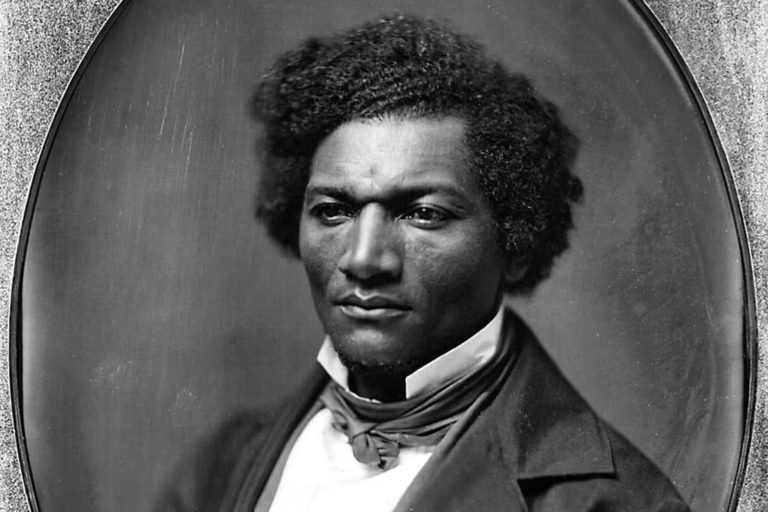
Before the Civil War, African Americans lived under radically different legal conditions, from enslavement in the South to restricted freedom in Northern and Western communities. Enslaved and free Black people nevertheless built families, churches, schools and political organisations while resisting oppression through cultural survival, negotiation, escape, public protest and abolitionism.
African American life before the Civil War cannot be reduced to one experience. Most Black people in the United States were enslaved, but a substantial free population also lived in both Northern and Southern states.
Enslaved people worked on plantations, small farms, docks, construction sites, in factories and inside private households. Free Black Americans worked as sailors, artisans, domestic workers, labourers, teachers, ministers, writers and business owners, although racial discrimination restricted almost every aspect of their lives.
Black resistance also assumed many forms. Armed revolts were exceptional, but resistance occurred daily through family formation, religious practice, education, work slowdowns, preservation of culture, escape and organised political action.
Understanding this history requires more than describing what slavery did to African Americans. It also requires examining how Black people created communities, defended their humanity and influenced the struggle that eventually destroyed legal slavery.
The organisation of plantation slavery is examined separately in Life in the Plantations.

African American life in a slaveholding republic
Slavery existed throughout the British colonies that became the United States, but gradual emancipation weakened the institution in much of the North after the American Revolution. It expanded rapidly in the South during the early nineteenth century as cotton production spread westwards.
By 1860, approximately four million people were enslaved in the United States. Most lived in Southern states, where their labour supported agriculture, transportation, industry and domestic service.
Nearly half a million free Black people also lived in the country. Their legal status distinguished them from enslaved people, but freedom did not guarantee equality, security or full citizenship.
State and local laws restricted movement, employment, education, property ownership, testimony in court and political participation. Free Black people could also be kidnapped and sold into slavery, especially when they lacked documents proving their status.
The United States was therefore neither simply divided into a free North and an enslaved South nor organised around two completely separate populations. Slavery, freedom and racial discrimination existed in interconnected forms across the nation.
The expansion of cotton slavery
The invention and commercial adoption of the cotton gin made short-staple cotton more profitable to process. International demand, fertile land and territorial expansion then encouraged plantation agriculture to spread across the Deep South.
States and territories such as Alabama, Mississippi, Louisiana, Arkansas and Texas became major centres of cotton production. This expansion depended on the forced labour of enslaved people and the seizure of Indigenous land.
The federal prohibition on the international slave trade took effect in 1808, but it did not reduce the importance of slavery. Instead, the domestic slave trade expanded as enslavers transported people from the Upper South to the developing cotton regions.
Hundreds of thousands of people were sold southwards through markets and forced marches. Families were separated as parents, children, spouses and siblings were sold to different purchasers.
The forced migration of enslaved people became known as the Second Middle Passage. It redistributed the enslaved population within the United States and connected older slaveholding states to the expanding plantation economy of the Southwest.
The wider economic and political structure of this society is explained in Antebellum South: Society, Slavery and Secession.

Work under slavery
Enslaved labour varied according to region, crop, occupation and the size of the enslaver’s property. The majority of enslaved people worked in agriculture, but their tasks differed substantially.
Cotton and sugar cultivation demanded exhausting physical labour. Sugar plantations were especially dangerous because harvesting and processing followed strict schedules involving heavy machinery and boiling liquids.
Rice cultivation in coastal South Carolina and Georgia required specialised knowledge of irrigation and wetland agriculture. Enslaved Africans and their descendants brought agricultural skills that contributed directly to the profitability of the crop.
On tobacco farms and smaller properties, enslaved people often performed a wider variety of tasks. They raised livestock, grew food, repaired buildings and produced goods required by the household.
Skilled workers included blacksmiths, carpenters, coopers, mechanics and boatmen. Some enslavers hired these workers to other employers and collected their wages, occasionally allowing them to retain a small portion.
Domestic slavery
Enslaved domestic workers cooked, cleaned, washed clothing, cared for children and served enslaving families. Their physical proximity to enslavers did not make domestic slavery less coercive.
Domestic workers experienced constant supervision and lacked clear boundaries between work and rest. Women and girls were especially vulnerable to sexual harassment and assault.
Some domestic workers gained access to information, food or mobility that could be used to assist relatives and other enslaved people. However, their position could also isolate them from larger Black communities.
Urban slavery
Slavery also existed in Southern towns and cities. Enslaved people worked in workshops, hotels, warehouses, ports, households and construction projects.
Urban employment could provide greater mobility and contact with free Black residents, sailors and workers. Hired-out labourers sometimes negotiated work arrangements or managed small amounts of money.
These limited opportunities did not remove the threat of sale, punishment or imprisonment. Municipal authorities used passes, patrols and curfews to control both enslaved and free Black populations.
Family life under slavery
Enslaved people formed marriages and families even though their relationships received little or no protection from slave law. Enslavers could sell spouses or children separately and had no legal obligation to keep families together.
Family formation was therefore both a source of emotional support and an act of resistance against a system that treated people as transferable property. Parents taught children how to survive, preserved family histories and created obligations extending across plantations and generations.
When spouses lived on different properties, they sometimes travelled at night or on Sundays to maintain their relationships. These visits depended on permission, secrecy or the willingness to risk punishment.
Extended kinship networks helped care for children when parents were sold, hired out or forced to work long hours. People also created fictive kinship, using terms such as aunt, uncle, brother and sister for trusted community members who were not biological relatives.
Enslavers sometimes encouraged family formation because they believed it would stabilise their workforce. Yet the domestic slave trade repeatedly demonstrated that commercial value took priority over family unity.

African American culture and community
Enslavement attempted to control labour, movement and family life, but it could not eliminate cultural creativity. African Americans developed traditions that drew from African, European and American influences.
Music, storytelling, foodways, naming practices, craftsmanship and religious expression helped preserve collective identity. Cultural forms varied between regions because enslaved communities had different African origins, occupations and relationships with surrounding populations.
Songs could coordinate work, express religious faith, communicate emotion and preserve historical memory. They should not be romanticised as evidence that enslaved people accepted their condition; Frederick Douglass later described slave songs as testimony to suffering and the desire for deliverance.
Storytelling allowed communities to transmit practical knowledge and moral lessons. Tales involving clever figures who defeated stronger opponents could offer symbolic criticism of enslavers and celebrate survival through intelligence.
Religion and the invisible institution
Christianity became central to many African American communities, but enslaved people interpreted it in ways that differed from the religion promoted by enslavers.
White ministers often emphasised biblical passages demanding obedience from servants. Enslaved worshippers placed greater emphasis on Exodus, deliverance, divine justice and the equality of souls before God.
Some worship took place under white supervision. Other gatherings occurred secretly in cabins, woods or secluded spaces and became known collectively as the invisible institution.
These meetings combined prayer, preaching, song and testimony. They allowed enslaved people to exercise spiritual leadership and create spaces partly beyond the control of enslavers.
Religion could encourage endurance, community solidarity or open resistance. Nat Turner, Denmark Vesey and other Black leaders interpreted Christian belief in ways that justified opposition to slavery rather than submission.

Education and literacy
Literacy offered access to information, religious texts, written passes and political ideas. It could therefore strengthen both personal independence and organised resistance.
Southern states increasingly restricted the education of enslaved people, especially after major rebellions. Some laws also limited instruction for free Black residents.
Despite these restrictions, African Americans learned to read and write through relatives, free Black teachers, sympathetic white people, churches or individual study. Children sometimes exchanged lessons with white playmates, while literate enslaved people taught others secretly.
Frederick Douglass described literacy as a decisive step in understanding the nature of slavery. Reading exposed him to abolitionist ideas and strengthened his determination to become free.
Education was not valuable only as a route to escape. It allowed Black people to interpret scripture independently, maintain correspondence, record experiences and challenge claims of racial inferiority.
Everyday resistance
Most resistance did not take the form of organised rebellion. Enslaved people resisted through daily actions that protected their time, bodies, families and sense of self.
They might work more slowly, pretend not to understand instructions, break tools, feign illness or take food and supplies. Such actions could reduce an enslaver’s control but carried serious risks of punishment.
Enslaved workers also negotiated informally over tasks, food, clothing, family visits and time away from labour. These negotiations did not make slavery voluntary, but they show that enslaved people continually contested the precise limits of domination.
Maintaining prohibited relationships, holding unsupervised worship and learning to read were also forms of resistance. They asserted a human identity that slave law attempted to deny.
Everyday resistance rarely destroyed the institution by itself. It nevertheless forced enslavers to devote time and resources to surveillance, punishment and patrols.
Escape and self-liberation
Escape was one of the clearest forms of resistance. Enslaved people usually described themselves as seeking freedom, whereas enslavers and official records labelled them runaways or fugitives.
Many escapes were temporary. People left to visit relatives, avoid punishment, negotiate better conditions or obtain a brief measure of autonomy before returning.
Permanent escape required planning, geographical knowledge and access to food, shelter and transportation. Freedom seekers travelled by foot, wagon, boat, railway or ship, sometimes using disguises and forged documents.
Not everyone travelled north. Destinations included free states, Canada, Mexico, Indigenous communities, cities, remote rural areas and maroon settlements. Some people remained close to their families while hiding locally.
The greatest responsibility and danger belonged to the people escaping. Assistance from relatives, free Black communities and antislavery activists could be crucial, but freedom seekers initiated and directed their own liberation.
The Underground Railroad
The Underground Railroad was not one centrally managed organisation and did not operate through literal underground tunnels. It was a flexible collection of routes, households and individuals who assisted freedom seekers.
Free Black communities formed its essential foundation. Residents provided shelter, information, transport, employment and contacts while facing prosecution, financial loss and physical violence.
Some white abolitionists, especially Quakers and members of other antislavery religious communities, also participated. The level of organisation varied considerably according to location and period.
Secrecy makes it impossible to reconstruct every route or participant. Later stories also exaggerated the role of elaborate codes and heroic white conductors while underestimating the agency of Black freedom seekers.
The most accurate interpretation treats the Underground Railroad as a form of African American self-emancipation supported by changing interracial networks.
Harriet Tubman
Harriet Tubman was born into slavery in Maryland around 1822. She escaped in 1849 and reached Philadelphia, but freedom did not end her concern for relatives who remained enslaved.
Tubman returned to Maryland repeatedly and guided family members and other freedom seekers away from slavery. She relied on careful planning, trusted contacts and detailed knowledge of the landscape.
Her missions became more dangerous after the Fugitive Slave Act of 1850 strengthened federal enforcement. Canada consequently became an important destination for some of the people she assisted.
Tubman’s later fame sometimes obscures the wider Black networks that made escape possible. Her achievements were exceptional, but they developed within communities already engaged in resisting slavery.
The Fugitive Slave Acts
The Constitution required the return of people legally held to service who escaped into another state. Congress attempted to enforce this provision through the Fugitive Slave Act of 1793.
The law allowed enslavers and their agents to pursue alleged fugitives across state lines. It also exposed free Black people to kidnapping because legal protections were weak and documentary proof of freedom could be ignored or destroyed.
The Fugitive Slave Act of 1850 created a stronger federal enforcement system. Accused people could not testify on their own behalf or receive a jury trial, while federal commissioners decided whether they would be released or sent into slavery.
Officials and citizens could be required to assist captures, and those who obstructed enforcement faced penalties. The law therefore attempted to make the entire country participate in the protection of slavery.
Black communities responded with vigilance committees, legal assistance, fundraising and physical resistance. Some families moved to Canada or left the United States because legal freedom no longer appeared secure.
The sectional consequences of the 1850 law are examined in The Road to the American Civil War, 1850–1861.
Armed revolt and collective resistance
Enslaved people repeatedly discussed, planned or carried out collective resistance. Large rebellions were rare because surveillance was intensive and the consequences of discovery were severe.
Enslavers responded to suspected conspiracies with executions, imprisonment, deportation and stricter laws. White authorities also used the fear of revolt to justify militia patrols and controls on free Black communities.
The limited number of successful uprisings should not be interpreted as acceptance of slavery. The institution was designed specifically to prevent communication, movement and access to weapons.
Gabriel’s Rebellion
Gabriel, an enslaved blacksmith in Virginia, helped organise a planned uprising in 1800. The conspirators intended to march on Richmond, seize weapons and pressure political leaders to end slavery.
Severe weather delayed the plan, and information reached white authorities before the uprising could begin. Gabriel and numerous participants were captured and executed.
The conspiracy demonstrated that enslaved artisans and hired workers could use their mobility and occupational networks for political organisation.
Denmark Vesey
Denmark Vesey was a free Black carpenter and church leader in Charleston, South Carolina. In 1822, authorities accused him of organising a large rebellion.
The exact extent of the conspiracy remains debated because the evidence came from secret trials and coerced testimony. Vesey and more than thirty other men were executed.
Charleston authorities destroyed the African Church associated with the accused conspirators and imposed tighter restrictions on Black worship and movement.
Nat Turner’s rebellion
Nat Turner was an enslaved preacher in Southampton County, Virginia. In August 1831, he led a group that killed approximately sixty white people before militia forces suppressed the revolt.
White mobs and military units killed many Black people who had no involvement in the rebellion. Turner avoided capture for several weeks before being tried and executed.
The uprising intensified Southern fears and produced harsher restrictions on education, movement, assembly and Black religious leadership. It also strengthened proslavery arguments that presented any criticism of slavery as an invitation to violence.
Free Black communities
Free African Americans lived throughout the United States, including in slaveholding states. Their communities varied according to local law, economic opportunity and the size of the surrounding Black population.
Some had been born free, while others gained freedom through state emancipation laws, individual manumission, self-purchase or escape. Legal freedom could also be inherited through a free mother.
Free Black residents created churches, schools, mutual-aid societies, literary organisations and businesses. These institutions provided practical support while cultivating independent leadership.
Philadelphia contained one of the largest and most influential free Black communities. Richard Allen and Absalom Jones emerged as important religious and civic leaders after experiencing discrimination within a white Methodist congregation.
Free Black communities also developed in New York, Boston, Baltimore, Richmond, Charleston, New Orleans and smaller towns. Their political conditions differed, but all confronted racial prejudice and insecurity.
Independent Black churches
Churches became central institutions in free Black communities. They provided worship, education, mutual aid, political meetings and support for migrants and freedom seekers.
Richard Allen founded the African Methodist Episcopal Church in 1816. The denomination gave Black congregations greater control over ministers, finances and religious organisation.
Black churches challenged white claims that African Americans required supervision. They trained leaders, supported schools and created regional networks capable of mobilising people and resources.
Religious independence did not eliminate internal disagreement. Black Christians debated theology, respectability, political strategy and the appropriate response to slavery and racism.
Mutual aid, education and the Black press
Mutual-aid societies collected contributions to assist members during illness, unemployment or bereavement. They also helped widows, orphans, new arrivals and people fleeing slavery.
Black educators established schools despite inadequate funding and legal hostility. Education was viewed as essential to economic survival, community leadership and the struggle against racist ideas.
The first Black-owned newspaper in the United States, Freedom’s Journal, began publication in New York in 1827. Its editors declared that Black Americans needed to speak for themselves rather than be represented by others.
Later newspapers included The Colored American, the National Anti-Slavery Standard and Frederick Douglass’s The North Star. They reported violence, debated political strategy and connected Black communities across regions.
The press helped create a national Black public sphere long before African Americans possessed equal political rights.
Black conventions and political organisation
Beginning in 1830, African American leaders organised a series of national and state conventions. Delegates discussed education, employment, abolition, voting rights, migration and collective security.
The convention movement demonstrated that free Black Americans were developing their own political institutions. Participants did not wait for white abolitionists to define their priorities.
Delegates debated whether Black people should remain in the United States, migrate to Canada or establish communities elsewhere. Most rejected the idea that racism made the United States exclusively a white nation.
The conventions produced reports and addresses that challenged exclusion while demanding citizenship based on birth, contribution and natural rights.
Colonisation versus citizenship
The American Colonization Society was founded in 1816 to encourage the migration of free Black Americans to Africa. Its supporters included some opponents of slavery as well as slaveholders who viewed free Black communities as a threat.
The organisation helped establish Liberia on the West African coast. However, most free Black Americans rejected colonisation because they considered the United States their country.
Black opponents argued that colonisation strengthened slavery by removing free communities that challenged racial hierarchy. They demanded equal rights in the nation where they had been born and to which their labour had contributed.
The debate clarified an essential difference between antislavery positions. Ending slavery did not necessarily mean accepting Black citizenship or racial equality.
Black abolitionism
African Americans had opposed slavery long before the rise of prominent white abolitionist organisations. Free Black communities petitioned legislatures, assisted freedom seekers and condemned both slavery and racial discrimination.
Black abolitionists argued from personal experience, religious belief and the principles of the American Revolution. They insisted that slavery was not a regional peculiarity but a national violation of human rights.
They also criticised racism within the antislavery movement. White abolitionists could oppose enslavement while maintaining segregated organisations, paternalistic attitudes or doubts about Black equality.
Black activists connected abolition to voting rights, education, equal access to transportation and protection from racial violence. For them, emancipation without citizenship would remain incomplete.
David Walker
David Walker was a free Black activist living in Boston. His 1829 Appeal to the Coloured Citizens of the World denounced slavery, colonisation and racial hypocrisy.
Walker rejected claims of Black inferiority and warned that oppressed people possessed a right to resist. Southern authorities treated the pamphlet as dangerous and attempted to prevent its circulation.
The Appeal represented a more confrontational Black abolitionism than the gradual reform favoured by many white opponents of slavery.
Maria Stewart
Maria Stewart became one of the first American women to address public audiences containing both women and men. Her speeches connected abolition, education, racial justice and women’s responsibility to participate in public life.
Stewart criticised white racism but also challenged Black communities to pursue education and collective advancement. Her career demonstrated that Black women helped shape abolitionist thought before the organised women’s rights movement emerged.
Frederick Douglass
Frederick Douglass was born into slavery in Maryland in 1818 and escaped in 1838. He became an internationally recognised orator, writer and newspaper editor.
His Narrative of the Life of Frederick Douglass, published in 1845, described the violence of slavery and the intellectual process through which he came to reject it.
Douglass initially worked closely with William Lloyd Garrison but later disagreed with Garrison’s rejection of electoral politics and the Constitution. Douglass came to argue that political action and constitutional interpretation could be used against slavery.
Through The North Star, speeches and organisational work, he linked emancipation to citizenship, education, women’s rights and equal treatment under the law.
Sojourner Truth
Sojourner Truth was born into slavery in New York under the name Isabella Baumfree. She obtained freedom after escaping with her infant daughter and later adopted a new name reflecting her religious mission.
Truth became a travelling speaker for abolition and women’s rights. Her public presence challenged assumptions that women should remain silent and that Black women lacked intellectual or political authority.
Her speeches connected enslavement, labour, motherhood, religion and gender inequality. Later versions of her words were sometimes rewritten into an invented Southern dialect, obscuring the fact that Dutch had been her first language.
The experience of free Black women
Free Black women supported families through domestic service, laundry, sewing, boarding houses, market trading and other occupations. Racial and gender discrimination restricted access to better-paid work.
Women organised churches, schools, literary societies, mutual-aid groups and antislavery fairs. Their labour sustained institutions even when men occupied most formal leadership positions.
Figures such as Maria Stewart, Sarah Mapps Douglass, Frances Ellen Watkins Harper and the women of local antislavery societies challenged both racism and gender exclusion.
Black women faced political problems that white women’s rights organisations did not always address adequately. Legal freedom, protection from kidnapping, access to employment and racial violence could be more immediate concerns than suffrage alone.
The relationship between abolitionism and the early women’s rights movement is developed in Reform Movements in Antebellum America.
Northern racism and restricted freedom
The legal abolition of slavery in Northern states did not produce racial equality. Black residents encountered segregation in schools, churches, public transport, accommodation and entertainment.
Many states restricted Black voting rights, and some prohibited or discouraged Black migration. Courts often limited Black testimony, while employers excluded African Americans from skilled occupations.
White mobs attacked Black communities, abolitionist meetings and printing presses. Racial violence occurred in cities including Cincinnati, Philadelphia and New York.
Black families responded by building independent institutions and organising collective defence. Their struggle demonstrated that freedom required more than the absence of legal ownership.
The persistence of Northern racism also complicated the sectional debate. Many Northerners opposed the expansion of slavery without supporting integration or equal citizenship.
Black sailors and mobility
Maritime work offered some Black men greater mobility than most land-based occupations. Free and enslaved sailors travelled between ports, carried news and connected communities across the Atlantic world.
Sailors could transport abolitionist literature, messages and information about escape routes. Their movement worried Southern authorities, who feared contact between local Black populations and politically independent seamen.
Several Southern states adopted Negro Seamen Acts requiring Black sailors arriving in port to be confined until their ships departed. Ship captains could be charged for the cost of imprisonment.
These laws show how slaveholding states attempted to control free Black people who entered their territory, even when they were citizens or subjects of another jurisdiction.
African American literature and testimony
Black writers used autobiography, poetry, journalism, speeches and fiction to challenge slavery and racism. Their publications allowed readers to encounter arguments that dominant institutions attempted to suppress.
Slave narratives combined personal testimony with political advocacy. Authors described family separation, physical violence, sexual exploitation and the denial of education while demonstrating their own literary authority.
Frederick Douglass, William Wells Brown, Harriet Jacobs and Solomon Northup produced some of the most influential accounts. Their experiences differed, but each exposed important aspects of slavery.
Harriet Jacobs’s narrative drew particular attention to the sexual vulnerability of enslaved women and the impossible choices imposed on mothers. Solomon Northup described how a free Black man could be kidnapped and sold into slavery.
These works were not simply records of suffering. They were interventions in national political debate and direct challenges to proslavery claims.
African American resistance and the sectional crisis
Black resistance influenced the growing conflict between North and South. Every successful escape challenged enslavers’ property claims and required political decisions about enforcement.
Southern leaders accused Northern communities of violating constitutional obligations by protecting freedom seekers. Northern resistance to the Fugitive Slave Act convinced many white Southerners that slavery was no longer secure within the Union.
Black abolitionists also pushed antislavery politics beyond proposals merely to restrict slavery’s expansion. They insisted that the institution itself had to be destroyed.
Through newspapers, lectures, petitions and conventions, African Americans made it increasingly difficult for national politicians to treat slavery as a technical dispute over territory.
When the Civil War began, free Black people immediately sought opportunities to serve the Union. Enslaved people weakened the Confederacy by escaping to Union lines, providing information and forcing federal authorities to confront the question of emancipation.
The military and political consequences are examined in The American Civil War: Causes, Battles and Consequences.
Resistance beyond famous individuals
The history of African American resistance is often told through a small group of exceptional figures. Frederick Douglass, Harriet Tubman and Sojourner Truth were important, but they acted within much larger communities.
Anonymous parents preserved family ties, workers negotiated daily conditions and teachers passed literacy from one person to another. Sailors carried information, church members raised funds and local residents protected people threatened by slave catchers.
Most of these actions left incomplete written records because secrecy protected participants and official archives were created largely by governments and enslavers.
Historical visibility should therefore not be confused with historical importance. The destruction of slavery resulted not only from famous speeches and federal policy but also from generations of resistance whose participants were never individually recorded.
The limits and meaning of freedom
Before the Civil War, legal status shaped African American life but did not divide it neatly into slavery and freedom. Enslaved people created areas of personal and communal autonomy, while free Black people remained subject to exclusion and possible re-enslavement.
Freedom therefore meant more than release from an individual enslaver. Black activists associated it with family security, education, paid work, mobility, political participation and protection under the law.
This wider conception of freedom later shaped African American demands during Reconstruction. Emancipation without land, education, civil rights or political power could not guarantee genuine independence.
The antebellum struggle established both the objectives and the institutions that African Americans would carry into the post-war period.
Conclusion
African American life before the Civil War developed under a national system structured by slavery and racial hierarchy. Most Black people were enslaved, while free Black communities lived with discrimination, restricted rights and the constant danger of violence or kidnapping.
Enslaved people worked in agriculture, domestic service, cities, workshops and transportation. Their experiences varied, but all remained subject to sale, punishment and the legal denial of personal autonomy.
Family, religion and culture helped sustain communities under these conditions. Maintaining relationships, worshipping independently and preserving collective knowledge challenged the attempt to reduce human beings to property.
Resistance ranged from daily negotiation and work slowdowns to escape and armed revolt. The rarity of large rebellions reflected the power of the system rather than an absence of opposition.
Free Black Americans built churches, schools, newspapers, mutual-aid societies and political conventions. These institutions defended communities while creating an independent movement for abolition and citizenship.
Black activists such as David Walker, Maria Stewart, Frederick Douglass, Harriet Tubman and Sojourner Truth became nationally influential. Their work emerged from broader networks composed of thousands of less visible organisers and participants.
African American resistance transformed the national debate over slavery. It exposed the limitations of sectional compromise and established that emancipation had to involve the actions and demands of Black people themselves.
The conflict between slavery and freedom ultimately became inseparable from the crisis of the Union. The structural differences that shaped that crisis are explored in North and South Before the American Civil War.
Frequently asked questions
How many African Americans were enslaved before the Civil War?
Approximately four million people were enslaved in the United States in 1860. Nearly half a million additional African Americans were legally free.
Did all enslaved people work on plantations?
No. Enslaved people also worked on small farms, in households, workshops, factories, ports, mines, construction and transportation.
How did enslaved people resist slavery?
Resistance included preserving family and culture, learning to read, working slowly, breaking tools, negotiating conditions, escaping, assisting other freedom seekers and occasionally organising armed revolt.
What was the Underground Railroad?
It was a decentralised network of freedom seekers and supporters who provided routes, shelter, information and transportation to people escaping slavery.
Did all freedom seekers travel north?
No. People escaped towards free states, Canada, Mexico, Indigenous territories, cities, maritime ports and isolated communities. Some remained hidden near their families.
Were free Black people safe from slavery?
No. Free Black Americans faced legal discrimination and could be kidnapped and sold into slavery. Fugitive slave laws made it difficult for accused people to prove their freedom.
Why were Black churches important?
Black churches provided independent worship, education, mutual aid, leadership and meeting spaces for abolitionist and community organisations.
Who were the main Black abolitionists?
Prominent figures included David Walker, Maria Stewart, Frederick Douglass, Sojourner Truth, Harriet Tubman, Henry Highland Garnet and Charles Lenox Remond.
What was the domestic slave trade?
It was the forced sale and transportation of enslaved people within the United States, especially from the Upper South to the expanding cotton regions of the Deep South.
How did African American resistance contribute to the Civil War?
Escape, abolitionist organising and resistance to fugitive slave laws made slavery a national political crisis. Black activists also pressed antislavery politics towards emancipation and equal citizenship.
Sources and further reading
- Library of Congress: Pre-Civil War African American Slavery
- Library of Congress: Free Blacks in the Antebellum Period
- Library of Congress: Abolition and Black Activism
- Library of Congress: Frederick Douglass Newspapers
- National Park Service: 400 Years of African American History
- National Park Service: What Is the Underground Railroad?
- National Park Service: Underground Railroad
- National Park Service: Frederick Douglass
- National Park Service: Harriet Tubman
- National Park Service: Insurrections, Slave Stampedes and Resistance
- National Archives: American Slavery in Judicial Records
- National Archives: Fugitive from Labor Cases
- National Archives: Compromise of 1850 and Fugitive Slave Act
- National Archives: People in Black History
