
During the decades before the Civil War, Americans organised campaigns against slavery, alcohol abuse, unequal education, abusive institutions and the political exclusion of women. These movements grew from evangelical religion, Enlightenment ideas and confidence in human improvement, but they also revealed conflicts over race, gender, personal liberty and the proper role of government.
The first half of the nineteenth century was an age of rapid social change in the United States. Population growth, territorial expansion, industrialisation and the Market Revolution connected previously isolated communities while disrupting established ways of life.
Many Americans believed that these transformations created both opportunity and disorder. Cities expanded, wage labour became more common and migration weakened older community structures. Reformers responded by attempting to improve individuals, institutions and society itself.
Their campaigns were diverse. Some sought to abolish slavery or extend women’s rights, while others promoted temperance, public schools, prison reform or new religious communities. The movements often shared activists, meeting spaces, newspapers and methods of organisation.
Reform did not always mean liberation. Some reformers defended personal autonomy, but others attempted to impose middle-class Protestant values on workers, immigrants, prisoners and the poor.
The wider social and economic context is examined in American Society in the Early Nineteenth Century.

Why did reform movements flourish before the Civil War?
Antebellum reform grew from several connected developments. Religious revivals encouraged individuals to reject sin and work towards moral improvement, while democratic politics gave ordinary white men a larger public role.
The expansion of printing helped organisations circulate sermons, pamphlets, petitions and newspapers. Roads, canals and railways allowed speakers and reform agents to travel more easily between towns and states.
Economic change also created new anxieties. Factory labour, immigration, urban poverty and commercial instability appeared to weaken traditional social bonds. Reformers frequently interpreted these problems as moral failures that could be corrected through discipline, education and voluntary association.
At the same time, the language of the American Revolution remained politically powerful. Activists used ideas of natural rights and equality to challenge slavery and women’s exclusion, asking why the nation’s founding principles applied only to part of the population.
The Second Great Awakening
The Second Great Awakening was a broad wave of Protestant revivalism that transformed American religious life from the late eighteenth century through the first half of the nineteenth century.
Revival preachers emphasised conversion, personal responsibility and the possibility of salvation. Their message challenged older Calvinist ideas that placed greater emphasis on divine predestination.
Camp meetings attracted large crowds, especially in frontier regions where established churches were less common. Emotional preaching, public testimony and collective worship made religion accessible beyond traditional congregations.
Methodist and Baptist churches expanded rapidly because travelling ministers and local congregations could respond effectively to population movement. Women formed a large proportion of converts and became central to church-based charitable work.
Revivalism encouraged the belief that individuals could change and that society could be purified through organised action. This confidence supplied religious energy to temperance, abolitionism, missions, education and institutional reform.
The Burned-Over District
Western and central New York became especially associated with revivalism and reform. The region was later called the Burned-Over District because successive waves of religious enthusiasm appeared to spread through it like fire.
The Erie Canal connected towns such as Rochester and communities in the Finger Lakes to expanding markets and migration routes. Goods, people, newspapers and religious ideas moved rapidly through the area.
The region supported abolitionists, temperance advocates, women’s rights campaigners and experimental religious groups. Seneca Falls, Waterloo, Rochester and Auburn became important centres of interconnected reform networks.

Voluntary associations and the reform network
Most reform movements operated through voluntary associations rather than political parties or federal programmes. Citizens created local societies, elected officers, raised funds and published reports.
National organisations coordinated campaigns through local branches. They sent travelling lecturers across the country and distributed large quantities of printed material.
Petitioning became an especially important political tool for people who could not vote. Women submitted petitions against slavery, alcohol licensing and other practices even though they were excluded from formal electoral politics.
These associations created opportunities for participation, but leadership often remained concentrated among white Protestant members of the middle class. Reformers could therefore challenge one hierarchy while reproducing others.
The temperance movement
Alcohol consumption was widespread in the early nineteenth-century United States. Spirits were served at elections, workplaces, militia gatherings and social events, while distilled alcohol was often safer or easier to transport than other beverages.
Reformers linked heavy drinking to domestic violence, poverty, workplace accidents and crime. They argued that alcohol damaged families and prevented men from fulfilling their economic and moral responsibilities.
The American Temperance Society, founded in 1826, encouraged voluntary abstinence. Early advocates often opposed distilled spirits while accepting moderate consumption of beer or wine, but many later demanded total abstinence.
Women played an important role because they experienced the economic and physical consequences of male drinking while possessing few legal protections within marriage. Temperance activism allowed them to enter public debate through an issue presented as an extension of domestic responsibility.
The movement combined moral persuasion with growing support for legislation. Maine adopted a statewide prohibition law in 1851, and other states experimented with similar measures.
Temperance could protect families from genuine harm, but it also carried elements of social control. Native-born Protestant reformers sometimes portrayed Irish and German immigrants as morally dangerous because of their drinking customs and Catholic identity.
The movement for public education
Educational opportunities varied widely between states and communities. Wealthy families could hire tutors or pay for private academies, while many children received only intermittent instruction.
Common-school reformers argued that publicly supported elementary education would create informed citizens and reduce crime and poverty. Schools would also help children from different social backgrounds develop a shared national identity.
Horace Mann became the best-known advocate of the common-school movement. As secretary of the Massachusetts Board of Education from 1837, he promoted trained teachers, improved school buildings, longer academic terms and public funding.
Mann presented education as a means of social improvement and economic mobility. He believed that universal schooling could reduce class conflict by giving children opportunities based on ability rather than inherited wealth.
Public education expanded unevenly. Rural districts lacked resources, Southern states invested less in universal schooling and racial segregation excluded most Black children from white public schools.
Education reform also had an assimilative purpose. Schools commonly promoted Protestant moral instruction and attempted to shape immigrant children according to dominant cultural expectations.
Education for women
Educational opportunities for white women expanded through academies and seminaries. Emma Willard founded the Troy Female Seminary, while Mary Lyon established Mount Holyoke Female Seminary in 1837.
These institutions challenged the assumption that women required only limited domestic instruction. They offered serious academic study and trained many women for teaching.
Teaching became one of the few respectable professions widely available to middle-class women. School systems recruited women partly because they could be paid substantially less than male teachers.
Expanded education did not automatically produce equal political rights, but it equipped women with intellectual training and organisational experience later used in reform movements.
Prison reform
Early American prisons often confined debtors, people awaiting trial and convicted offenders together. Conditions could be violent, unsanitary and poorly supervised.
Reformers argued that punishment should rehabilitate rather than merely inflict suffering. The penitentiary was designed as a place where discipline, work and reflection would produce repentance.
Two influential systems developed. The Pennsylvania model emphasised individual confinement, while the Auburn system combined solitary cells at night with silent collective labour during the day.
Both systems attempted to reshape behaviour through strict routine. Their supporters described them as humane improvements, but prolonged isolation and enforced silence could cause severe psychological harm.
Prison reform therefore illustrated a recurring contradiction within antebellum reform. Institutions claimed to improve individuals while subjecting them to increasingly intensive surveillance and control.

Dorothea Dix and asylum reform
People with mental illnesses were frequently confined in prisons, poorhouses or private homes. They often received little medical care and could be restrained in degrading conditions.
Dorothea Dix began investigating institutions in Massachusetts during the 1840s. She documented neglect and abuse, then presented her findings to state legislatures.
Dix argued that governments had a moral responsibility to provide specialised hospitals. Her campaigns contributed to the creation or expansion of public institutions in numerous states.
The reform improved conditions for some patients and helped establish mental health care as a public concern. However, large institutions later developed their own problems of overcrowding, isolation and coercion.
The abolitionist movement
Opposition to slavery existed from the colonial period, but antebellum abolitionism adopted a more immediate and confrontational form. Activists increasingly rejected gradual emancipation and demanded the complete end of slavery.
Free Black communities had long organised against enslavement, kidnapping and racial discrimination. Black churches, mutual-aid societies, conventions and newspapers provided essential leadership and institutional support.
White abolitionists joined these efforts through organisations such as the American Anti-Slavery Society, founded in Philadelphia in 1833. The movement relied on lectures, petitions, newspapers, antislavery fairs and networks assisting freedom seekers.
Abolitionists represented a minority even in the North. They faced mob violence, destroyed printing presses, attacks on meeting halls and accusations that they threatened the Union.
The social structure and ideology of the slaveholding South are explored in Antebellum South: Society, Slavery and Secession.
William Lloyd Garrison and immediate abolition
William Lloyd Garrison began publishing The Liberator in Boston in 1831. He demanded immediate emancipation and condemned gradual approaches that treated slaveholders’ interests as more important than the freedom of enslaved people.
Garrison used uncompromising moral language and denounced the Constitution as supporting slavery. He generally rejected electoral politics in favour of moral persuasion and individual refusal to cooperate with unjust institutions.
His approach attracted dedicated supporters but also generated division. Some abolitionists believed political parties, legislation and constitutional action were necessary to achieve change.
Frederick Douglass
Frederick Douglass escaped slavery in Maryland in 1838 and became one of the most influential abolitionist speakers and writers in the United States.
His autobiographical narrative, published in 1845, exposed the violence of slavery and challenged racist claims that enslaved people lacked intellectual ability.
Douglass founded The North Star in Rochester in 1847. He increasingly defended political action and eventually argued that the Constitution could be interpreted as an antislavery document.
His career demonstrated that formerly enslaved people were not merely victims represented by white reformers. They were central theorists, organisers and leaders of the abolitionist movement.
Black abolitionist leadership
Black activists frequently adopted positions more radical than those of white reformers. David Walker’s 1829 Appeal denounced slavery and called on Black Americans to resist oppression.
Maria Stewart became one of the first American women to speak publicly before audiences that included both men and women. She connected racial justice, education, religion and women’s public responsibility.
Henry Highland Garnet, Sojourner Truth, Charles Lenox Remond and numerous local organisers challenged slavery and Northern racism. Their activism reminded white abolitionists that emancipation without equal citizenship would remain incomplete.
The Underground Railroad
The Underground Railroad was not a single organisation or a literal railway. It was a changing network of individuals, households, routes and local communities that assisted people escaping slavery.
Most successful escapes were planned and carried out by enslaved people themselves. Free Black communities provided essential information, shelter, transport and contacts, while some white abolitionists also participated.
Harriet Tubman escaped from Maryland in 1849 and repeatedly returned to assist relatives and other freedom seekers. Her knowledge, discipline and courage later made her one of the best-known figures associated with the network.
The Fugitive Slave Act of 1850 increased the danger by strengthening federal enforcement and threatening anyone who assisted an escape. It also encouraged some fugitives to travel beyond Northern states into Canada.
The political consequences of the Fugitive Slave Act are examined in The Road to the American Civil War, 1850–1861.
Women in the abolitionist movement
Women formed antislavery societies, organised fairs, circulated petitions and raised funds. These activities gave them experience in public speaking, publishing and national organisation.
The Grimké sisters, Sarah and Angelina, came from a slaveholding South Carolina family and became prominent abolitionist lecturers. Their decision to address mixed audiences of women and men provoked criticism from religious leaders who considered such public activity improper.
Defending their right to speak led the sisters to connect abolitionism with women’s equality. Other female activists similarly discovered that campaigning against slavery exposed their own legal and political subordination.
Women’s participation also divided the abolitionist movement. Some members accepted women in leadership, while others believed that the controversy distracted from the campaign against slavery.
The rise of the women’s rights movement
Antebellum women possessed few independent legal rights. Under the doctrine of coverture, a married woman’s legal identity was largely absorbed into that of her husband.
Married women generally could not control wages or property independently, sign contracts freely or claim equal authority over their children. Political participation remained closed because women could not vote or hold most public offices.
Reform activism made these restrictions increasingly visible. Women who raised money, circulated petitions and spoke publicly discovered that their political work was limited by the very gender rules they were expected to obey.
The women’s rights movement therefore emerged partly from abolitionism, temperance and religious reform. These campaigns provided networks, organisational experience and a language of universal equality.
The World Anti-Slavery Convention of 1840
American abolitionists travelled to London for the World Anti-Slavery Convention in 1840. The organisers refused to seat female delegates as full participants.
Lucretia Mott and Elizabeth Cady Stanton met during the convention. Their exclusion demonstrated that a movement defending human freedom could still deny women equal public authority.
The experience did not immediately produce an organised women’s rights campaign, but it became an important element in the development of the Seneca Falls Convention eight years later.
The Seneca Falls Convention
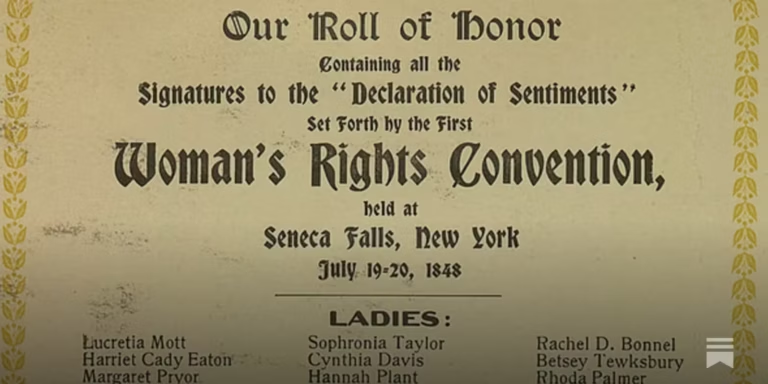
In July 1848, Elizabeth Cady Stanton, Lucretia Mott, Martha Wright, Mary Ann M’Clintock and Jane Hunt organised a convention at the Wesleyan Chapel in Seneca Falls, New York.
The organisers belonged to communities already active in abolitionism, Quaker reform and the Underground Railroad. Their previous campaigns supplied the organisational skills and networks required to hold the meeting.
The convention met on 19 and 20 July and attracted women and men from the surrounding region. Participants discussed women’s legal, educational, economic and political status.
The meeting adopted a Declaration of Sentiments modelled on the Declaration of Independence. Its most famous proposition declared that “all men and women are created equal”.
The document listed grievances concerning property rights, employment, education, religious authority, marriage and political representation. It accused men collectively of establishing an unjust system of domination over women.
The demand for women’s suffrage
The most controversial resolution demanded women’s right to vote. Even some supporters of women’s rights considered suffrage too radical or likely to discredit the convention.
Frederick Douglass attended and spoke in favour of the resolution. He argued that women could not protect their rights without political power.
The convention approved the suffrage resolution, establishing voting rights as a central objective of the movement. One hundred women and men signed the Declaration of Sentiments.
Seneca Falls was not the beginning of all women’s activism, nor did it create a unified national organisation overnight. It nevertheless provided a programme and symbolic starting point for a sustained women’s rights movement.
Married women’s property reform
Women’s rights activists pursued legal reforms as well as suffrage. Property law was especially important because married women could lose control of inherited wealth, wages and personal possessions.
New York adopted a Married Women’s Property Act in 1848. The legislation allowed married women to retain certain property separately from their husbands.
Later reforms expanded women’s control over earnings and inheritance. Other states adopted their own measures, although the extent and timing varied.
These laws did not establish complete legal equality. They nevertheless weakened coverture and demonstrated that marriage law could be changed through organised political action.
Utopian communities
Some Americans attempted to reform society by creating experimental communities rather than lobbying existing institutions. These groups tested alternative approaches to property, labour, marriage, religion and education.
Brook Farm in Massachusetts sought to combine intellectual life with cooperative labour. Its members hoped to escape competitive capitalism and create a community where work and culture supported one another.
The Oneida Community in New York practised communal property and unconventional marriage arrangements under the leadership of John Humphrey Noyes. It also developed successful manufacturing enterprises.
The Shakers organised celibate religious communities with communal property and relatively prominent roles for women. Their commitment to celibacy meant that growth depended largely on conversion and adoption rather than biological reproduction.
New Harmony in Indiana attempted to establish a cooperative community associated with the social ideas of Robert Owen. Internal disagreements and practical difficulties caused the experiment to fragment.
Most utopian communities remained small or short-lived, but they demonstrated the breadth of antebellum confidence in social experimentation.
The movement for peace and non-resistance
Religious reform also produced organisations opposed to war. Peace societies argued that international conflict violated Christian morality and that disputes should be settled through arbitration.
Some abolitionists embraced non-resistance and refused participation in governments they considered dependent on violence. William Lloyd Garrison associated slavery, war and coercive political power within a wider moral critique.
Pacifism became difficult to maintain as conflict over slavery intensified. The Mexican-American War, resistance to the Fugitive Slave Act and violence in Kansas forced reformers to debate whether force could ever be justified against oppression.
Labour reform
The Market Revolution created a growing class of wage workers, particularly in Northern cities and manufacturing towns. Long hours, low pay and economic insecurity encouraged workers to form associations and demand reform.
Ten-hour movements campaigned to reduce the working day. Skilled workers also organised trade unions to defend wages and control over their occupations.
Labour activists used the language of republican independence. They warned that permanent dependence on wages could create a new form of economic servitude inconsistent with citizenship.
Women factory workers participated in strikes and petitions. The Lowell Female Labor Reform Association campaigned for shorter hours and investigated working conditions in Massachusetts textile mills.
Labour reform remained fragmented by occupation, region, race and immigration status. It nevertheless challenged the assumption that rapid economic growth automatically improved the lives of workers.
Moral reform and sexual behaviour
Female moral reform societies campaigned against prostitution and the sexual double standard. They condemned a society that punished women involved in prostitution while tolerating the behaviour of male clients.
Activists published the names of men accused of visiting brothels and established homes intended to rehabilitate women leaving prostitution.
The movement criticised genuine gender inequality, but it often treated poor women as objects of moral supervision. Economic conditions, sexual exploitation and limited employment opportunities received less attention than personal conduct.
Moral reform therefore combined an early challenge to male privilege with middle-class attempts to regulate working-class sexuality.
The limits of antebellum reform
Reform movements expanded public debate and created new forms of political participation. Women, free Black Americans and people excluded from voting used petitions, lectures and newspapers to influence national issues.
However, the movements frequently reproduced existing prejudices. Temperance campaigns could become anti-immigrant, school reform promoted Protestant assumptions and some white abolitionists opposed slavery without accepting full racial equality.
Women’s rights organisations also contained racial and class divisions. Middle-class white activists sometimes treated their own experience as representative of all women while overlooking the different conditions faced by Black, Indigenous and working-class women.
Reformers also disagreed over strategy. Moral persuasion, electoral politics, legal action, civil disobedience and armed resistance each attracted supporters at different moments.
These disagreements did not make reform meaningless. They reveal that movements for justice develop within the inequalities of their own societies and must continually confront their internal limits.
How reform contributed to the sectional crisis
Many reform movements remained regional or national, but slavery increasingly divided them along sectional lines. Southern states restricted antislavery literature and treated abolitionist organising as a threat to public security.
Congress adopted the gag rule in 1836 to prevent discussion of antislavery petitions in the House of Representatives. The policy transformed abolition into a free-speech issue and attracted opposition from people who did not necessarily support immediate emancipation.
Religious denominations divided over slavery. Baptists, Methodists and Presbyterians experienced sectional fractures that anticipated the political break between North and South.
The Fugitive Slave Act of 1850 forced Northern communities to decide whether they would assist federal enforcement. Abolitionist resistance then reinforced Southern claims that the North would not respect constitutional protections for slavery.
Reform did not cause the Civil War by itself. However, abolitionism made the moral conflict over slavery impossible to contain entirely within conventional political compromise.
The legacy of antebellum reform
Antebellum reformers did not achieve all their objectives. Slavery survived until the Civil War, women remained excluded from national voting and institutions created in the name of rehabilitation often became oppressive.
Nevertheless, the movements established organisations, arguments and methods that continued after the war. Petition campaigns, national conventions, reform journalism and grassroots associations became enduring features of American political life.
Abolitionism helped redefine slavery as a national moral and political crisis. Women’s rights activists created a programme extending from property reform to suffrage, while education advocates strengthened the principle of publicly supported schooling.
The movements also demonstrated that political influence extended beyond elections. People excluded from formal citizenship could organise communities, circulate ideas and force institutions to respond.
Conclusion
Antebellum reform emerged from a society transformed by religious revival, economic growth and territorial expansion. Reformers believed that individuals and institutions could be improved through organised moral action.
The Second Great Awakening supplied much of the movement’s religious energy. It encouraged personal conversion while teaching believers that they had a responsibility to confront social sin.
Temperance, public education and institutional reform attempted to create disciplined and responsible citizens. These campaigns addressed genuine social problems but sometimes imposed Protestant middle-class values on populations with less power.
Abolitionism challenged the institution most fundamentally opposed to American claims of liberty. Black activists and formerly enslaved people played central roles in exposing slavery and demanding equal citizenship.
Women gained organisational experience through abolitionism and other reforms, then applied the language of universal rights to their own legal and political condition. The Seneca Falls Convention transformed these demands into a recognisable movement.
Utopian communities, labour organisations and peace societies revealed the extraordinary range of antebellum experimentation. Americans debated not only individual laws but the organisation of work, property, family and authority.
The movements expanded democratic participation while exposing the limitations of American democracy. Their conflicts over slavery, race and citizenship fed directly into the political crisis that preceded the Civil War.
The society these movements attempted to reform included a powerful slaveholding region explored in Antebellum South: Society, Slavery and Secession.
Frequently asked questions
What were the main antebellum reform movements?
Major movements included abolitionism, temperance, public education, prison and asylum reform, women’s rights, labour reform, peace activism and the creation of utopian communities.
What was the Second Great Awakening?
It was a broad Protestant revival movement that emphasised conversion, personal responsibility and the possibility of improving both individuals and society.
Why was temperance important?
Temperance reformers linked alcohol abuse to poverty, violence and family instability. The movement progressed from voluntary moderation towards total abstinence and legal prohibition.
Who was Horace Mann?
Horace Mann was a leading advocate of publicly funded common schools, trained teachers, improved facilities and broader access to elementary education.
What did Dorothea Dix reform?
Dorothea Dix investigated the treatment of people with mental illnesses and campaigned for specialised public hospitals rather than confinement in prisons or poorhouses.
What did abolitionists demand?
Immediate abolitionists demanded the complete end of slavery rather than gradual emancipation. Black abolitionists also insisted that freedom had to include equal citizenship and opposition to racial discrimination.
What was the Underground Railroad?
It was a decentralised network of freedom seekers and supporters who provided information, shelter and assistance to people escaping slavery.
How were abolitionism and women’s rights connected?
Abolitionism gave women organisational experience and a language of universal equality. Resistance to women speaking and leading publicly also exposed their own political and legal subordination.
What happened at the Seneca Falls Convention?
The 1848 convention adopted the Declaration of Sentiments, demanded legal and educational equality and controversially called for women’s right to vote.
Were antebellum reformers always progressive?
No. Many challenged serious injustices, but reform campaigns could also reproduce racism, nativism, class prejudice and attempts to impose Protestant middle-class behaviour on others.
Sources and further reading
- Library of Congress: National Expansion and Reform, 1815–1880
- Library of Congress: American Women collections
- Library of Congress: Abolition
- Library of Congress: Seneca Falls and the women’s rights movement
- Library of Congress: Report of the Woman’s Rights Convention at Seneca Falls
- National Park Service: Abolition, Women’s Rights and Temperance
- National Park Service: Abolition and the Seneca Falls Convention
- National Park Service: The Underground Railroad and the first Women’s Rights Convention
- National Park Service: Women’s Rights in Seneca Falls
- National Park Service: Underground Railroad
- National Park Service: Frederick Douglass
- National Park Service: Harriet Tubman
