
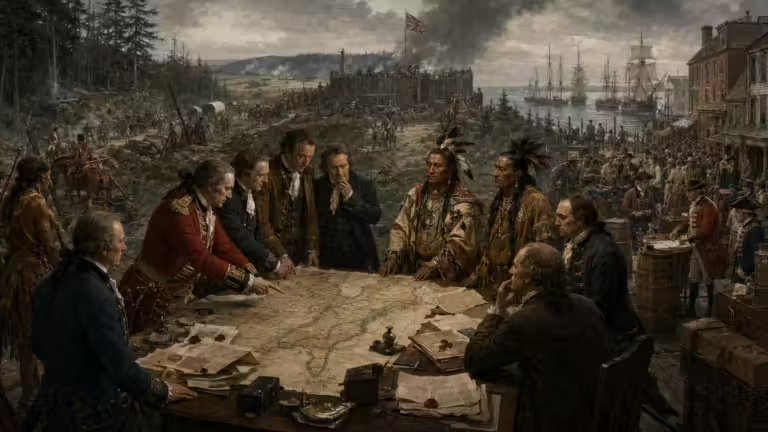
The Seven Years’ War transformed the British Empire and destabilised its relationship with the American colonies. Victory removed France from most of eastern North America, but Britain inherited new territories, a large military establishment, substantial debt and unresolved conflicts with Indigenous nations. The Sugar Act, Stamp Act and other reforms then turned disagreements over imperial finance into a constitutional dispute over taxation, representation and parliamentary sovereignty.
Britain entered the war with thirteen colonies already accustomed to elected assemblies, local taxation and substantial political autonomy. Their religious and constitutional traditions shaped how they interpreted every post-war reform imposed from London.

What was the Seven Years’ War?
The Seven Years’ War was a global conflict fought between 1756 and 1763, principally between alliances led by Britain and France. Fighting had already begun in North America in 1754, where the conflict became known as the French and Indian War.
The North American name can be misleading because Indigenous nations did not form one unified “Indian” side serving France. Different peoples pursued their own diplomatic, territorial and commercial interests, while alliances changed according to local conditions.
The war extended far beyond the thirteen colonies. British and French forces fought in Europe, Canada, the Caribbean, West Africa, India and the Philippines, while their navies competed for control of global shipping routes.
Britain ultimately emerged with greatly expanded imperial power. However, its victory also created the financial and administrative problems that produced the first sustained constitutional crisis between Parliament and the mainland colonies.
British and French North America before 1754
Britain’s mainland colonies stretched along the Atlantic coast from New England to Georgia. Their rapidly growing settler population increasingly demanded western farmland, commercial opportunities and access to the interior.
New France contained far fewer European settlers but claimed an immense territory extending from Canada through the Great Lakes and Mississippi Valley to Louisiana. Rivers, forts, missions and trading relationships connected its widely separated settlements.
French influence depended heavily on diplomacy and commerce with Indigenous nations. British colonies also maintained Indigenous alliances, but their larger settler population placed greater pressure on Native land.
The Ohio Valley became especially contested. British land companies, colonial governments, French officials and Indigenous nations all claimed interests within a region that no European empire controlled exclusively.

Indigenous nations and the contested Ohio Valley
The Ohio Valley was not an unclaimed frontier waiting for European occupation. Delaware, Shawnee, Mingo and other Indigenous communities lived, hunted, traded and exercised political authority throughout the region.
The Haudenosaunee Confederacy also claimed influence over parts of the Ohio Country, although the meaning and extent of that authority remained contested. Indigenous leaders negotiated with Britain and France while attempting to preserve autonomy from both empires.
European officials often treated treaties with one group as permission to control land used by several peoples. Such assumptions ignored the complexity of Indigenous territorial relationships and repeatedly created conflict.
France began constructing a chain of forts linking Lake Erie to the Ohio River. British colonial officials interpreted these forts as a direct challenge to land claims, commercial expansion and access to the continental interior.
George Washington and the first fighting
Virginia’s lieutenant governor Robert Dinwiddie sent the young George Washington to warn French forces to leave territory claimed by Britain. The French rejected the demand and continued strengthening their military position.
Washington returned in 1754 with Virginia troops. His force attacked a French party near Jumonville Glen, killing its commander Joseph Coulon de Jumonville under circumstances that immediately became controversial.
Washington then constructed Fort Necessity. A larger French and Indigenous force surrounded the position in July, compelling him to surrender and withdraw.
The encounter did not begin the war through one deliberate master plan. Local military decisions, rival territorial claims and misunderstandings transformed a frontier confrontation into an imperial conflict.

The Albany Congress of 1754
Representatives from seven British colonies met at Albany in 1754. Their immediate objectives included diplomacy with the Haudenosaunee and the coordination of colonial defence against France.
Benjamin Franklin proposed a Plan of Union creating a president-general appointed by the Crown and a grand council chosen through the colonial assemblies. The proposed government would oversee defence, western settlement, Indigenous relations and common expenditure.
The delegates approved a version of the plan, but neither the colonial assemblies nor the British government adopted it. Assemblies feared losing local authority, while imperial officials worried that a strong intercolonial institution might become too independent.
The failed plan did not establish an early United States. Nevertheless, it demonstrated that colonial leaders recognised the practical weaknesses of conducting war and diplomacy through thirteen separate governments.
General Braddock’s defeat
Britain sent Major General Edward Braddock to North America in 1755 with regular soldiers. He planned to capture Fort Duquesne, located where the Allegheny and Monongahela rivers meet to form the Ohio.
French and Indigenous forces attacked Braddock’s column near the Monongahela River. British formations struggled within wooded terrain, and Braddock received a mortal wound during the defeat.
The disaster exposed weaknesses in British logistics, intelligence and cooperation with colonial forces. It also encouraged attacks on frontier settlements as Britain temporarily lost military credibility within the region.
The defeat should not be explained through a simple contrast between incompetent European soldiers and irregular frontier warfare. British forces later adapted, while Indigenous and French success depended on planning, intelligence and effective use of the terrain.

Why the colonies struggled to cooperate
Colonial assemblies raised soldiers, supplied provisions and approved wartime expenditure. However, they frequently disagreed with governors over taxation, command and the duration of military service.
Each colony defended its own treasury and territorial priorities. A government distant from the principal fighting could resist paying for campaigns that appeared to benefit neighbouring colonies.
Regular British officers also disputed rank with colonial commanders. They often regarded provincial troops as poorly disciplined, while colonists resented military arrogance and the expectation that they should obey officers unfamiliar with local conditions.
These conflicts did not prevent colonial participation. Tens of thousands of provincials served during the war, gaining military experience and a clearer understanding of both intercolonial cooperation and British command.
Indigenous alliances were decisive
Both European empires needed Indigenous allies for intelligence, diplomacy, transport and military operations. Native warriors could move rapidly through territories that European armies understood poorly.
French officials maintained relationships through trade, diplomacy, intermarriage and the exchange of gifts. These connections did not make Indigenous nations French subjects or guarantee permanent loyalty.
British officials also sought alliances, particularly with the Haudenosaunee Confederacy. However, the Confederacy itself contained differing opinions, and many communities attempted to avoid complete commitment to either European side.
Indigenous leaders fought to defend territory and preserve strategic independence. Reducing them to auxiliaries in a European war obscures the political objectives that shaped their choices.
William Pitt changes British strategy
Britain suffered serious setbacks during the early years of the war. William Pitt, who became the government’s dominant war minister, redirected resources towards defeating France overseas while subsidising British allies in Europe.
The government sent additional troops, expanded naval operations and reimbursed colonial assemblies for parts of their military expenditure. These measures improved cooperation and allowed Britain to mobilise the colonies more effectively.
British naval strength restricted French reinforcements and supplies. The resulting pressure affected Canada, French Caribbean possessions, African trading posts and French operations in India.
Victory resulted from financial resources, naval power, colonial manpower and alliances rather than from one commander alone. Britain could sustain simultaneous operations on a scale that France increasingly struggled to match.
The turning point of 1758
British forces captured the fortress of Louisbourg in 1758, opening the route towards the St Lawrence River and Canada. The victory also limited the ability of France to protect its Atlantic supply network.
Another expedition advanced through Pennsylvania and forced the French to abandon Fort Duquesne. The British constructed Fort Pitt at the strategic river junction, giving the future city of Pittsburgh its name.
The Treaty of Easton helped weaken French alliances by addressing some Indigenous grievances and promising limitations on settlement. British officials did not consistently honour such assurances after victory.
By the end of 1758, the balance in North America had shifted decisively. France retained Canada, but its western forts, alliances and supply routes faced increasing pressure.
Quebec and the Plains of Abraham
British forces commanded by James Wolfe besieged Quebec in 1759. The city occupied a strong defensive position above the St Lawrence River and resisted months of bombardment and attempted attacks.
In September, British troops climbed to the Plains of Abraham and confronted a French army under Louis-Joseph de Montcalm. The relatively brief battle ended in a British victory, while both commanders received fatal wounds.
Quebec surrendered, but the conquest of Canada was not yet complete. French forces won a battle near Quebec the following spring but could not recover the city before British naval reinforcements arrived.
Montreal surrendered in September 1760. Organised French military government in Canada effectively ended, although the wider global war continued until 1763.
A global rather than merely colonial war
While armies fought in North America, Britain and France competed throughout the Atlantic and Indian oceans. Caribbean sugar islands possessed enormous commercial value because their plantations generated highly profitable exports.
British forces captured French and Spanish possessions, including islands whose economic value rivalled or exceeded that of large continental territories. Britain also expanded its influence in India through victories involving the East India Company.
Spain entered the war on the French side in 1762. Britain subsequently captured Havana and Manila, demonstrating the reach of its naval and amphibious power.
The peace settlement therefore involved global trade-offs. Governments compared fisheries, sugar colonies, continental territory, naval bases and commercial access rather than simply counting land on a North American map.
The Treaty of Paris of 1763
The Treaty of Paris took effect on 10 February 1763. France surrendered Canada and most of its claims east of the Mississippi River to Britain, while Spain transferred Florida to the British Crown.
France had already transferred Louisiana west of the Mississippi and New Orleans to Spain. Britain returned several valuable Caribbean conquests to France and Spain as part of the wider diplomatic settlement.
Britain became the dominant European power in eastern North America. The removal of French Canada greatly reduced the immediate threat that had encouraged mainland colonists to depend on British military protection.
However, France’s territorial withdrawal did not transfer Indigenous sovereignty to Britain. Native nations had not authorised European diplomats to divide their homelands through the peace treaty.
Why victory created an imperial problem
Britain’s territorial gains made its empire larger but not easier to govern. New subjects in Canada spoke French and were predominantly Catholic, while Florida and the western interior required new military and administrative arrangements.
The government also had to decide how to manage relations between settlers and Indigenous nations. Colonial land companies and migrants wanted immediate western expansion, while renewed warfare threatened to make the frontier extremely expensive to defend.
British ministers planned to retain thousands of regular troops in North America. They considered the force necessary for frontier defence, imperial security and the administration of newly acquired territory.
Many colonists questioned why a large standing army remained after France’s defeat. Their suspicion drew on the English constitutional tradition that associated permanent peacetime armies with executive coercion.
The cost of Britain’s victory
The war dramatically increased Britain’s national debt, which approached £140 million by the end of the conflict. Interest payments absorbed a substantial share of government revenue.
British taxpayers already paid customs, excise, stamp and land taxes that were generally heavier than those imposed on mainland colonists. Ministers therefore argued that the colonies should contribute towards the cost of their own defence.
Colonists had supplied troops and money during the war, often through taxes approved by their assemblies. They did not necessarily oppose contributing to defence, but many insisted that their own representatives should determine the form and amount of taxation.
The conflict therefore concerned constitutional authority as much as financial burden. Parliament believed that it could legislate for every part of the Empire, whereas colonial assemblies claimed a protected role in taxing their inhabitants.
Pontiac’s War and Indigenous resistance
British victory disrupted the diplomatic relationships that had connected French officials with Indigenous nations around the Great Lakes and Ohio Valley. British commanders often reduced gift-giving and treated Native peoples as conquered dependants rather than political allies.
Indigenous communities also faced expanding settlement, restrictions on trade and uncertainty over ammunition and supplies. These policies threatened both political autonomy and everyday security.
In 1763, a broad resistance movement attacked British forts and settlements. The conflict is commonly called Pontiac’s War after the Odawa leader Pontiac, although many nations and leaders acted through their own regional strategies.
Indigenous forces captured several forts and placed others under siege. Britain eventually re-established military control, but the conflict demonstrated that European victory over France had not produced unquestioned sovereignty over the interior.
The Royal Proclamation of 1763
George III issued the Royal Proclamation on 7 October 1763. It reorganised Britain’s new territories and attempted to limit settlement west of a boundary associated with the Appalachian Mountains.
The Proclamation reserved a vast western area for Indigenous nations unless land was formally ceded to the Crown. Colonial governors could not simply authorise private purchases or grant territory beyond the designated boundary.
British officials hoped to reduce frontier warfare and control the pace of expansion. They did not intend to recognise permanent Indigenous independence from imperial authority, but they acknowledged that uncontrolled settlement threatened peace.
Many colonists interpreted the measure as an obstacle to landownership and economic opportunity. Veterans, settlers and speculators already possessed western claims that the Proclamation appeared to suspend.
The boundary remained difficult to enforce and changed through later treaties. Nevertheless, the Proclamation exposed a fundamental conflict between imperial strategy, settler expansion and Indigenous sovereignty.
The Grenville ministry reorganises the Empire
George Grenville became prime minister in 1763. His government attempted to reduce expenditure, improve customs collection and raise revenue from colonies whose defence now required a permanent military presence.
British officials did not necessarily intend to provoke a revolution or reduce colonists to political servitude. They believed they were making an expensive and loosely administered empire more orderly and financially sustainable.
However, colonial merchants and assemblies had developed under decades of inconsistent enforcement. Measures that appeared administratively reasonable in London could therefore seem like a sudden constitutional transformation in America.
The reforms also arrived during a post-war economic downturn. Merchants faced debt and declining wartime demand, making new enforcement and taxation particularly unpopular.
The Sugar Act of 1764
Parliament passed the American Revenue Act, commonly called the Sugar Act, in 1764. It replaced provisions of the poorly enforced Molasses Act of 1733.
The new Act reduced the nominal duty on foreign molasses but strengthened the government’s determination to collect it. It also adjusted duties on several other goods and expanded customs enforcement.
New England merchants depended heavily on trade with foreign Caribbean colonies. They purchased molasses for rum production and exchanged fish, timber and provisions through commercial networks that did not remain inside the British Empire.
The Sugar Act therefore threatened established business practices even though it lowered one headline rate. Merchants objected to seizures, documentation requirements and trials in vice-admiralty courts without local juries.
The Act also stated a revenue-raising purpose more openly than earlier trade regulations. That purpose encouraged colonists to ask whether Parliament was regulating commerce or taxing them without their consent.
Vice-admiralty courts and colonial juries
Customs prosecutions could be heard in vice-admiralty courts rather than ordinary colonial courts. These maritime tribunals operated without juries and often covered large geographical districts.
British officials believed local juries frequently sympathised with accused smugglers and made effective enforcement impossible. Admiralty jurisdiction therefore appeared necessary to implement laws that Parliament had legitimately enacted.
Colonists interpreted jury trial as a fundamental protection against arbitrary government. They feared that distant courts and salaried judges created incentives to condemn merchants and seize property.
Disagreement over customs procedures therefore became part of a broader constitutional argument. The question was no longer only how much duty a merchant owed, but which institutions possessed lawful authority over colonial subjects.
The Currency Act of 1764
Many colonies had issued paper money to address shortages of gold and silver. The value and legal status of these currencies varied, creating uncertainty for British merchants and other creditors.
The Currency Act of 1764 restricted the colonies from issuing new legal-tender paper currency. British creditors welcomed protection against repayment in money they considered depreciated.
Colonial debtors and assemblies viewed the restriction differently. Limiting paper money during a credit shortage made debts harder to pay and reduced the flexibility available to local governments.
The Act did not attract the same immediate popular resistance as the Stamp Act. Nevertheless, it contributed to the impression that Parliament was reorganising colonial economies without adequate understanding or representation.
Why did Parliament pass the Stamp Act?
Parliament passed the Stamp Act on 22 March 1765. The legislation required printed or embossed revenue stamps on newspapers, legal documents, licences, pamphlets, playing cards, dice and numerous commercial papers.
Stamp duties already existed in Britain and provided a familiar form of revenue. British officials believed a similar tax could help pay for the North American army without placing an excessive burden on any one colony.
The tax differed politically from ordinary customs duties because it applied to documents created and used within the colonies. It affected lawyers, printers, merchants, shipowners, students and ordinary consumers.
Grenville’s government gave colonial agents advance notice that a stamp tax was being considered. However, ministers rejected the idea that colonial assemblies possessed an exclusive constitutional right to raise the required revenue.
Taxation and representation
Colonists did not deny that Parliament could regulate imperial trade. The immediate dispute concerned Parliament’s attempt to impose an internal tax for revenue on people who elected no members to the House of Commons.
British defenders of the Act invoked virtual representation. They argued that members of Parliament represented the interests of all British subjects, including people in Britain who could not vote and colonists living overseas.
Colonial critics rejected that analogy. Unrepresented inhabitants of Britain lived close enough to influence elections, petitions and parliamentary debate, whereas the colonies possessed separate assemblies thousands of miles away.
For many colonists, legitimate taxation required consent through their own representatives. The slogan “no taxation without representation” condensed this argument but did not initially demand independence from Britain.
Was Parliament sovereign over the colonies?
The British constitution offered no universally accepted answer. Parliament had long regulated colonial commerce, reviewed laws and altered imperial institutions without giving the colonies representation at Westminster.
From the metropolitan perspective, dividing taxation from other legislation threatened parliamentary sovereignty. If colonial assemblies could decide which Acts applied to them, the Empire might cease to possess one supreme legislative authority.
Colonists increasingly distinguished between external regulation and internal taxation. They could accept parliamentary rules governing Atlantic commerce while denying that Parliament possessed unlimited authority over their property.
This distinction proved difficult to maintain. Customs duties could raise revenue, while taxes could also regulate consumption. The constitutional crisis therefore concerned the location of sovereignty rather than a perfectly clear category of legislation.
The Quartering Act of 1765
The Quartering Act required colonial governments to provide barracks and specified supplies for British troops. These provisions could include food, fuel, bedding, drink and transportation.
The Act did not generally order soldiers directly into occupied private family homes, as later popular memory sometimes suggested. Existing barracks, inns, empty buildings and other accommodation were considered first.
Colonial assemblies nevertheless objected to being ordered to spend local funds without their own unrestricted consent. The presence of a standing army also appeared unnecessary after France’s defeat.
The dispute joined military power to taxation. Troops supposedly protected the colonies, yet colonists increasingly feared that the same army might enforce unpopular parliamentary laws.
The Sons of Liberty and popular protest
Resistance extended beyond formal arguments issued by colonial assemblies. Urban artisans, merchants, sailors and labourers organised demonstrations against stamp distributors and government officials.
Groups later associated with the Sons of Liberty used processions, effigies and intimidation to prevent the Act from operating. Most designated stamp distributors resigned before the tax took effect.
Protest sometimes became destructive. Crowds attacked property belonging to officials, most notoriously the Boston home of lieutenant governor Thomas Hutchinson.
Elite critics welcomed pressure capable of forcing repeal but feared uncontrolled popular action. The Stamp Act crisis therefore expanded political participation while exposing tensions between orderly constitutional protest and crowd mobilisation.
Women and non-importation
Colonial merchants supported agreements limiting imports from Britain. These boycotts connected constitutional resistance to household consumption and commercial pressure.
Women participated by producing homespun cloth, reducing purchases of imported goods and organising social practices around colonial substitutes. Their economic choices acquired political meaning even though they lacked formal voting rights.
Non-importation also mobilised shopkeepers, artisans and consumers whose livelihoods depended on Atlantic trade. Resistance could therefore unite groups with different motives around a shared programme of economic pressure.
However, participation remained uneven. Merchants could violate agreements when profits became attractive, while poorer consumers did not always have access to acceptable local substitutes.
The Stamp Act Congress
Twenty-seven delegates representing nine colonies met in New York in October 1765. The meeting became known as the Stamp Act Congress.
The delegates affirmed their loyalty to the Crown while declaring that taxation required consent through representatives chosen by the people being taxed. They denied that colonial inhabitants could be effectively represented in Parliament.
The Congress prepared petitions addressed to the king and Parliament. Its purpose was to secure repeal within the British constitutional system rather than declare independence.
Four colonies sent no official delegates, and intercolonial cooperation remained incomplete. Nevertheless, the Congress demonstrated that one parliamentary measure could produce coordinated resistance across regional boundaries.
The Stamp Act fails before taking effect
The Stamp Act officially came into force on 1 November 1765. In practice, resistance had forced many distributors to resign, leaving stamps unavailable across much of the continent.
Courts, ports and newspapers faced uncertainty because many legal and commercial activities technically required stamped paper. Some institutions suspended operations, while others continued without complying.
The crisis showed that Parliament could pass a law without possessing the local machinery required to enforce it. Colonial officials depended on cooperation from communities that had become organised against the measure.
This success gave resistance movements confidence. It also alarmed British officials who believed intimidation had prevented the lawful operation of parliamentary authority.
British merchants demand repeal
Non-importation harmed British manufacturers and merchants who depended on colonial markets. Commercial interests petitioned Parliament and warned that the crisis threatened employment, debt repayment and Atlantic trade.
George Grenville had left office in July 1765. The new Rockingham ministry inherited a law that had become extremely difficult to enforce and commercially expensive to maintain.
Benjamin Franklin testified before the House of Commons and explained the depth of colonial opposition. He distinguished between Parliament’s regulation of trade and internal taxation imposed without colonial consent.
Support for repeal therefore combined constitutional sympathy, economic pressure and practical recognition that the Act could not operate without military coercion.
Repeal and the Declaratory Act
Parliament repealed the Stamp Act on 18 March 1766. Celebrations spread through the colonies, and merchants abandoned many non-importation agreements.
However, Parliament passed the Declaratory Act on the same day. It asserted the authority to legislate for the colonies “in all cases whatsoever”.
The paired measures represented compromise without constitutional agreement. Parliament withdrew an unenforceable tax while refusing to concede that colonial resistance had limited its sovereignty.
Many colonists concentrated on the practical victory of repeal and did not immediately treat the Declaratory Act as a reason for renewed resistance. The underlying conflict nevertheless remained unresolved.
Why did the crisis not produce independence in 1766?
Most colonists still identified as British subjects. They valued the Empire’s commercial networks, naval protection and constitutional traditions, even while disputing Parliament’s interpretation of those traditions.
Resistance leaders petitioned the king and Parliament rather than creating an independent government. They often blamed ministers for unconstitutional policies while presenting George III as a potential protector of colonial rights.
The colonies also remained divided by religion, economy, geography and local political interests. Coordinated opposition to one tax did not erase their attachment to separate assemblies and identities.
Independence became plausible only after repeated crises convinced growing numbers of colonists that their rights could not be secured within the Empire. That conclusion remained far from universal in 1766.
The limits of colonial arguments for liberty
Colonists described parliamentary taxation as a form of slavery and warned that arbitrary government threatened to reduce free subjects to dependence. Such language drew on powerful English constitutional traditions.
However, literal slavery remained legal throughout British North America. Many leading defenders of colonial liberty owned enslaved people or profited from economies structured by forced labour.
Women contributed to boycotts and political communication but possessed no formal representation in colonial assemblies. Free Black inhabitants also faced growing racial restrictions despite revolutionary claims about consent and natural rights.
Indigenous nations had still less reason to celebrate unrestricted colonial self-government. Settler resistance to the Proclamation frequently demanded greater freedom to occupy Native land.
The war transformed colonial identity
Military service brought colonists from different regions into contact. Officers and soldiers compared their institutions, resources and experiences while serving within a wider British war effort.
The war also strengthened pride in British victory and Protestant empire. Colonists initially celebrated the conquest of Canada rather than interpreting it as the beginning of separation.
At the same time, disputes with regular officers and imperial administrators exposed differences in status. British officials could regard provincials as politically immature, while colonists resented being treated as socially or militarily inferior.
The Stamp Act crisis converted these experiences into a shared constitutional grievance. Colonists increasingly recognised that policies directed at one province could threaten institutions throughout British America.
Why 1763 was the decisive turning point
Before 1763, Britain and the colonies frequently disagreed, but French power gave both sides a strong reason to preserve military cooperation. Victory removed much of that common external threat.
Britain then attempted to make imperial government more systematic. Ministers retained troops, enforced customs laws, restricted western settlement and asked colonists to contribute more directly to imperial revenue.
Colonial assemblies interpreted these reforms through decades of practical autonomy. They did not see local taxation as a privilege granted temporarily by Britain, but as an inherited constitutional right.
The year 1763 therefore changed the relationship without making revolution inevitable. It created the conditions under which every subsequent tax, military deployment and administrative reform could become a dispute over sovereignty.
From the Stamp Act crisis to revolution
The repeal of the Stamp Act restored commercial calm but did not define the limits of parliamentary authority. Britain maintained its claim to complete legislative sovereignty through the Declaratory Act.
In 1767, Parliament imposed the Townshend duties and used part of the revenue to pay imperial officials. Colonists increasingly feared that financially independent governors and judges would no longer answer to their assemblies.
The following years brought non-importation, military occupation, the Boston Massacre, the Tea Act and the Coercive Acts. Resistance gradually moved from petitions within the Empire towards intercolonial government and armed conflict.
The next article follows that transformation from constitutional resistance to independence, war and the creation of the United States.
- English Expansionism
- Mercantilism, the Navigation Acts and the British Atlantic Empire
- The American Colonies: Religion, Politics and Self-Government
- The American Revolution: Causes, Independence and Legacy
- USA: Birth of a Nation
- Puritanism and Expansionism in Early America
Frequently asked questions about the Seven Years’ War
Was the French and Indian War the same as the Seven Years’ War?
The French and Indian War was the North American phase of the wider imperial conflict. Fighting began in North America in 1754, while Britain and France formally entered the broader Seven Years’ War in 1756.
Why did the war begin?
The conflict developed from rival British, French and colonial claims in the Ohio Valley. Indigenous nations governed the region and pursued their own interests, making the struggle more complex than a simple dispute between two European empires.
Who won the Seven Years’ War?
Britain and its allies defeated France in the principal colonial theatres. The Treaty of Paris transferred Canada, Florida and extensive French claims east of the Mississippi to British control.
How did Indigenous nations participate?
Indigenous nations formed alliances, remained neutral or changed strategies according to their own diplomatic and territorial goals. Their military knowledge and political support were essential to both French and British operations.
What was Pontiac’s War?
Pontiac’s War was a broad Indigenous resistance movement that attacked British forts and settlements after 1763. It responded to British policies, settler expansion and the disruption of diplomatic and trading relationships after France’s defeat.
What did the Proclamation of 1763 do?
It attempted to restrict settlement west of the Appalachian boundary and reserved western land for Indigenous nations unless formally ceded to the Crown. Britain hoped to limit frontier warfare and control colonial expansion.
Why did Britain tax the colonies after the war?
The war had greatly increased Britain’s debt, while the government intended to maintain troops in North America. Ministers believed the colonies should contribute towards imperial defence and administration.
What was the Sugar Act?
The Sugar Act of 1764 reorganised customs duties and enforcement, particularly on foreign molasses. Although it lowered one existing duty, the government intended to collect it more effectively and raise colonial revenue.
Why did colonists oppose the Stamp Act?
The Act imposed duties on documents and printed materials used within the colonies. Colonists argued that Parliament could not tax them internally because they elected no representatives to the House of Commons.
What was virtual representation?
Virtual representation was the British argument that members of Parliament represented the interests of all subjects, including people who could not vote. Colonial critics insisted that only their own elected assemblies could represent them for taxation.
What was the Stamp Act Congress?
The Stamp Act Congress was an intercolonial meeting held in New York in October 1765. Delegates from nine colonies petitioned for repeal and declared that taxation required consent through representatives chosen by the colonists.
Why did Parliament repeal the Stamp Act?
Colonial resistance made enforcement extremely difficult, while non-importation damaged British commerce. Parliament repealed the tax in 1766 but simultaneously passed the Declaratory Act asserting its authority over the colonies.
Sources and further reading
- Office of the Historian: French and Indian War and Seven Years’ War
- Office of the Historian: incidents leading to the war
- Office of the Historian: Albany Plan of Union
- Office of the Historian: Treaty of Paris, 1763
- Office of the Historian: Proclamation Line of 1763
- Office of the Historian: parliamentary taxation and imperial trade
- National Park Service: Native self-determination after 1763
- National Park Service: Pontiac and Indigenous resistance
- National Park Service: the Proclamation boundary
- Library of Congress: British reforms and colonial resistance, 1763–1766
- Library of Congress: timeline for 1764–1765
- Library of Congress: no taxation without representation
- Library of Congress: the Stamp Act and resistance
- National Park Service: Sugar and Stamp Acts
- National Park Service: opposition to the Stamp Act
- UK Parliament: the Stamp Act and American colonies
- UK Parliament: colonial petitions against the Stamp Act
The repeal of the Stamp Act ended the first imperial confrontation but left the central constitutional question unanswered. The next article follows the Townshend duties, Boston resistance, the Continental Congress, independence and the creation of the United States.
