Rory Gallagher
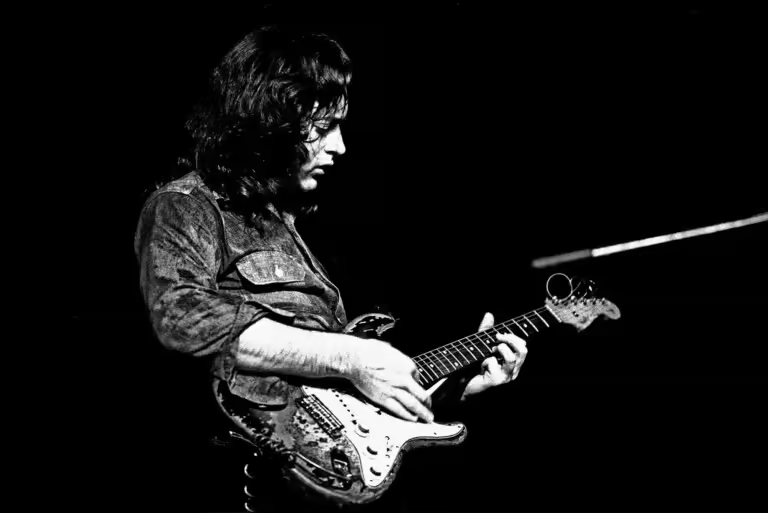
William Rory Gallagher (/ˈrɔːri ˈɡæləhər/ GAL-ə-hər; 2 March 1948 – 14 June 1995) was an Irish blues and rock guitarist, singer, songwriter, and producer. Born in Ballyshannon, County Donegal, and brought up in Cork, Gallagher formed the band Taste in the late 1960s and recorded solo albums throughout the 1970s and 1980s. His albums have sold over 30 million copies worldwide.
Gallagher toured under his own name, hiring former Deep Joy bass player Gerry McAvoy to play on Gallagher’s self-titled debut album, Rory Gallagher.
It was the beginning of a twenty-year musical relationship between Gallagher and McAvoy; the other band member was drummer Wilgar Campbell. The 1970s were Gallagher’s most prolific period. He produced ten albums in that decade, including two live albums, Live in Europe and Irish Tour ’74. November 1971 saw the release of the album Deuce.
In the same year he was voted Melody Maker’s International Top Guitarist of the Year, ahead of Eric Clapton. However, despite a number of his albums from this period reaching the UK Albums Chart, Gallagher did not attain major star status.
Gallagher played and recorded what he said was « in me all the time, and not just something I turn on … ». Though he sold over thirty million albums worldwide, it was his marathon live performances that won him greatest acclaim. He is documented in Irish Tour ’74, a film directed by Tony Palmer.
During the heightened periods of political unrest in Northern Ireland, as other artists were warned not to tour, Gallagher was resolute about touring Ireland at least once a year during his career, winning him the dedication of thousands of fans, and in the process, becoming a role model for other aspiring young Irish musicians.
Gallagher admitted in several interviews that there were not any international Irish acts until Van Morrison and he, and later Phil Lynott and Thin Lizzy. The line-up which included Rod de’Ath on drums and Lou Martin on keyboards, performed together between 1973–1976. However, he eventually dropped down to just bass, guitar and drums, and his act became a power trio. Other releases from that period include Against the Grain, Calling Card, Photo-Finish, and Top Priority.
In January 1975, when the Rolling Stones gathered in Rotterdam, Netherlands, to continue working towards their album Black and Blue they auditioned new guitarists, to replace Mick Taylor, as they recorded. Gallagher went over for a jam with the band « just to see what was going on, » but did not join the group, happy with his solo career.
Gerry McAvoy has stated that the Gallagher band performed several TV and radio shows across Europe, including Beat-Club in Bremen, Germany and the Old Grey Whistle Test. He recorded two « Peel Sessions » (both February 1973 and containing the same tracks), but only the first was broadcast. Along with Little Feat and Roger McGuinn, Gallagher performed the first Rockpalast live concert at the Grugahalle, Essen, Germany in 1977.
Gallagher collaborated with Jerry Lee Lewis and Muddy Waters on their respective London Sessions in the mid-1970s. He played on Lonnie Donegan’s final album.
In the 1980s he continued recording, producing Jinx, Defender, and Fresh Evidence. After Fresh Evidence, he embarked on a tour of the United States. In addition he played with Box of Frogs, a band formed in 1983 by former members of The Yardbirds. Becoming obsessive over details and plagued by self-doubt, Gallagher nevertheless retained a loyal fanbase. During this period he stated « I agonize too much ».
Gallagher received a liver transplant in 1995, but died of complications later that year in London at the age of 47.
Notes From San Francisco, an album of unreleased studio tracks and a San Francisco 1979 concert, was released in May 2011.
Rory Gallagher guitar tabs