
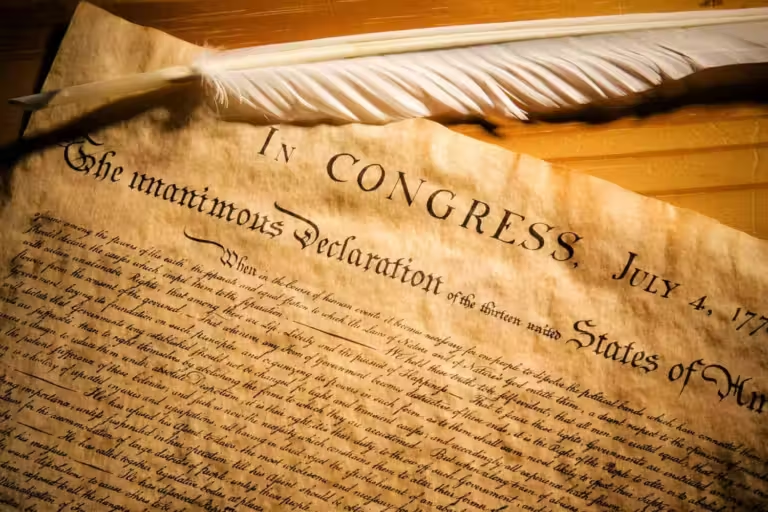
The United States was not born in a single moment on 4 July 1776. The Declaration of Independence announced that the colonies considered themselves free states, but independence still required military victory, diplomatic recognition and a functioning political union. The Articles of Confederation created the first national government, while the Constitution of 1787 replaced that loose alliance with a stronger federal republic.
The creation of the United States began inside a crisis of the British Empire. War debt, western expansion, customs enforcement and parliamentary taxation had already transformed disagreement into organised colonial resistance.

When was the United States born?
Several dates can represent the birth of the United States. The Declaration of Independence announced separation from Britain in 1776, while the Treaty of Paris secured international recognition in 1783. The Constitution created the present federal system in 1787–1789, and the Bill of Rights added important protections in 1791.
Each date represents a different stage of nation-building. Independence was first a political claim, then a military achievement, then a diplomatic reality and finally a constitutional system. The new nation emerged through this cumulative process rather than through one ceremony or document.
The term “nation” also requires care. The thirteen colonies became thirteen states before they developed a powerful national government. Many inhabitants initially felt stronger loyalty towards their state, locality, religious community or region than towards an abstract American nation.
The Revolution nevertheless created new shared institutions, symbols and political language. Congress, the Continental Army, foreign diplomacy and common resistance encouraged people from separate colonies to imagine themselves as part of one political community.
From the Stamp Act to renewed parliamentary taxation
Parliament repealed the Stamp Act in 1766 but simultaneously adopted the Declaratory Act. This statute maintained that Parliament could legislate for the colonies “in all cases whatsoever”. The immediate tax disappeared, but the underlying dispute over sovereignty remained unresolved.
The Townshend Acts of 1767 imposed duties on imports including glass, lead, paint, paper and tea. British ministers presented them as customs duties, but colonial critics argued that their purpose was to raise revenue without consent.
The revenue would help pay governors and judges appointed by the Crown. Colonial assemblies feared that officials who no longer depended on locally approved salaries would become less accountable to representative institutions.
Resistance again combined petitions, political essays and non-importation agreements. Merchants, artisans and consumers turned purchasing decisions into political action, while colonial newspapers circulated arguments across provincial boundaries.

The Boston Massacre and political propaganda
British troops arrived in Boston in 1768 to support customs enforcement and maintain order. Their presence created daily conflict with inhabitants over employment, accommodation, authority and the meaning of military occupation.
On 5 March 1770, a confrontation outside the Custom House escalated when soldiers fired into a hostile crowd. Five civilians died, including Crispus Attucks, a sailor of African and Indigenous ancestry.
Patriot writers named the event the Boston Massacre. Paul Revere circulated an engraving that represented the soldiers firing in disciplined formation upon peaceful inhabitants, although the actual confrontation had been far more confused.
John Adams defended the soldiers during their trial. Most received acquittals, while two were convicted of manslaughter. The proceedings allowed Patriot leaders to present resistance as a defence of law rather than a rejection of legal justice.
The Tea Act and the Boston Tea Party
The Tea Act of 1773 did not create a new tax on tea. Instead, it allowed the financially troubled East India Company to sell tea more directly in the colonies while retaining the existing Townshend duty.
The arrangement could reduce the price of legally imported tea. However, Patriots believed that purchasing it would acknowledge Parliament’s right to tax them. Colonial merchants also opposed the commercial privilege granted to the East India Company.
On 16 December 1773, protesters boarded three ships in Boston Harbor and destroyed 342 chests of tea. Some participants used Indigenous disguises, symbolically distancing themselves from Britain while appropriating Native identities for their own political purposes.
The destruction divided colonial opinion. Supporters viewed it as a disciplined rejection of unconstitutional taxation, whereas critics feared that attacking private property would encourage disorder and provoke severe punishment.

The Coercive Acts unite the colonies
Parliament responded in 1774 with measures known in Britain as the Coercive Acts and in America as the Intolerable Acts. They closed Boston Harbor, restricted the Massachusetts government and altered arrangements for the trial of certain officials.
British ministers hoped to isolate Massachusetts and demonstrate the cost of resistance. Instead, other colonies interpreted the attack on one assembly and port as a threat to colonial government generally.
Communities sent food and supplies to Boston. Committees of correspondence circulated information and resolutions, while political leaders called for an intercolonial meeting.
The Coercive Acts therefore produced the cooperation that earlier plans of union had failed to create. Shared resistance to imperial punishment proved more effective than earlier attempts to unite the colonies through defence or administrative convenience.
The First Continental Congress
Delegates from twelve colonies met in Philadelphia in September 1774. Georgia did not participate, partly because it remained particularly dependent on British military assistance along its frontier.
The First Continental Congress did not demand independence. Its members defended colonial rights within the British Empire and sought the repeal of the Coercive Acts.
The delegates approved the Continental Association, which organised a coordinated boycott of British goods. Local committees monitored compliance and identified merchants who violated the agreement.
This enforcement system extended political participation beyond colonial assemblies. Committees increasingly exercised authority within towns and counties, creating a revolutionary structure alongside the official imperial government.

Lexington and Concord begin the war
Massachusetts Patriots collected weapons and organised militias while British General Thomas Gage attempted to restore imperial authority. In April 1775, British regulars marched from Boston towards Concord to destroy military supplies.
Riders including Paul Revere, William Dawes and Samuel Prescott warned surrounding communities. Militiamen confronted the British column at Lexington on the morning of 19 April.
A shot from an uncertain source began a brief exchange that killed several colonists. At Concord, militia forces fought British troops near the North Bridge before attacking the regulars repeatedly during their return to Boston.
The fighting transformed a constitutional conflict into open warfare. Neither side had formally planned a long war for national independence, but armed resistance made a return to the previous political relationship increasingly difficult.
The Second Continental Congress becomes a government
The Second Continental Congress assembled in May 1775. Its delegates inherited a war without possessing a constitution, executive administration, independent revenue or permanent military organisation.
Congress created the Continental Army and appointed George Washington as commander in chief. Choosing a Virginian helped transform a New England military crisis into a continental cause.
Congress issued currency, appointed diplomats, organised supplies and coordinated military policy. These actions made it a provisional national government even though the colonies had not yet declared independence.
At the same time, delegates continued seeking reconciliation. The Olive Branch Petition appealed to George III to help restore peace, but the King rejected the petition and declared that the colonies were in rebellion.
Bunker Hill: a costly British victory
Colonial forces fortified positions overlooking Boston in June 1775. Most of the fighting occurred on Breed’s Hill, although the engagement became known as the Battle of Bunker Hill.
British soldiers launched repeated frontal attacks. The defenders eventually withdrew after exhausting much of their ammunition, leaving the British in possession of the ground.
Britain therefore won the battle tactically. However, the heavy British casualties demonstrated that colonial forces could resist professional troops and made a rapid suppression of the rebellion appear unlikely.
The battle strengthened determination on both sides. British leaders concluded that rebellion required decisive military action, while Patriots interpreted their resistance as evidence that independence might become achievable.
From reconciliation to independence
Most colonists did not begin the conflict by demanding separation from Britain. They claimed the rights of British subjects and distinguished resistance to parliamentary taxation from rejection of monarchy.
Military escalation changed those assumptions. George III refused to receive the Olive Branch Petition, Britain employed German auxiliary troops and royal governors encouraged forces loyal to the Crown.
Thomas Paine’s Common Sense, published in January 1776, attacked monarchy and hereditary succession. Paine argued that an independent republic could protect American interests better than continued membership of an empire governed from across the Atlantic.
His direct style brought constitutional debate to a wide reading public. Independence no longer appeared merely as an elite proposal discussed behind closed doors, but as a political possibility debated in towns, taverns, churches, camps and newspapers.
The Declaration of Independence
Virginia delegate Richard Henry Lee introduced a resolution declaring the colonies free and independent states in June 1776. Congress appointed Thomas Jefferson, John Adams, Benjamin Franklin, Roger Sherman and Robert R. Livingston to prepare a formal declaration.
Jefferson drafted the principal text, which Congress debated and revised. Congress approved the Lee Resolution on 2 July and adopted the Declaration of Independence on 4 July 1776.
The parchment copy was prepared later, and delegates began signing it on 2 August. The familiar image of every representative signing together on 4 July therefore belongs to later national memory rather than the precise documentary chronology.
The Declaration announced that the thirteen colonies now considered themselves free and independent states. It also attempted to justify that decision to foreign governments and international opinion.
Natural rights and government by consent
The Declaration argued that legitimate governments derived their powers from the consent of the governed. People possessed rights that government did not create and therefore could not remove arbitrarily.
When a government systematically destroyed those rights, the people could alter or abolish it. This principle transformed the colonial case from a dispute over inherited English liberties into a universal argument about political legitimacy.
The document listed grievances against George III and represented his government as a pattern of tyranny. This structure justified independence by arguing that repeated abuses had dissolved the relationship between ruler and subjects.
The Declaration did not itself establish a national government or provide enforceable constitutional rights. Its power lay in the political principles it announced and the international claim it made on behalf of the new states.
The contradiction between equality and slavery
The claim that all men were created equal entered public life within a society structured by slavery. Hundreds of thousands of Africans and African Americans remained legally enslaved, including people held by several leading revolutionaries.
Jefferson’s original draft included an accusation against George III concerning the slave trade. Congress removed the passage, which blamed the Crown while obscuring the deep involvement of colonial merchants, assemblies and enslavers.
Enslaved and free Black people nevertheless used revolutionary language for their own purposes. They petitioned legislatures, escaped towards military lines and demanded that universal liberty include those whom colonial law had excluded.
Some northern states later introduced gradual emancipation, but the Revolution did not abolish slavery nationally. Instead, the new political system left its future largely under state control and protected several slaveholding interests.
The states write new constitutions
Independence required the former colonies to replace royal and proprietary governments. Congress encouraged them to establish institutions based on popular authority rather than allegiance to the Crown.
States adopted written constitutions defining legislatures, executives, elections and individual rights. These documents turned revolutionary principles into practical systems of government.
The arrangements differed significantly. Pennsylvania created a highly democratic unicameral legislature, while other states adopted bicameral assemblies and stronger executives to restrain sudden popular majorities.
Virginia adopted its Declaration of Rights in June 1776. Massachusetts later submitted its constitution to a form of popular ratification and created a comparatively strong governor under the constitution of 1780.
These experiments provided important models for the federal Constitution. They also revealed enduring disagreements over executive power, representation, property qualifications and the protection of minority rights.
The Revolution becomes an international war
Independence allowed the United States to seek formal recognition and military alliances. Without foreign support, the new republic faced enormous difficulty defeating Britain’s army, navy and global financial system.
France had already supplied covert assistance, weapons and money. The American victory at Saratoga in 1777 convinced the French government that the rebellion possessed a realistic chance of success.
France formally recognised the United States and signed treaties of commerce and alliance in 1778. French entry transformed a colonial rebellion into a wider international war.
Spain entered the conflict against Britain in 1779 without forming the same alliance with the United States. The Dutch Republic also became involved, while Britain had to defend possessions and shipping across several continents and oceans.
The military struggle for independence
The Continental Army suffered serious defeats around New York in 1776. Washington preserved the army through retreat, then restored morale through victories at Trenton and Princeton during the winter.
The British captured Philadelphia in 1777, forcing Congress to move temporarily. Washington’s army endured severe shortages during its winter encampment at Valley Forge, where training helped convert separate contingents into a more cohesive military force.
The victory at Saratoga prevented a British army from isolating New England and encouraged the French alliance. However, it did not immediately end the war.
Britain later shifted its principal effort towards the South, expecting strong Loyalist support. The region instead experienced destructive campaigning, partisan warfare and severe conflict between Patriots and Loyalists.
The war was therefore not a simple sequence of battles between two national armies. It combined conventional warfare, local civil conflict, frontier violence, naval operations and international competition.
Yorktown and the French alliance
In 1781, British General Charles Cornwallis established a position at Yorktown in Virginia. Washington and the French commander Rochambeau marched south while a French fleet under Admiral de Grasse prevented British naval relief.
American and French forces besieged Yorktown through coordinated artillery and infantry operations. Cornwallis surrendered his army on 19 October 1781.
The surrender effectively ended major British offensive operations in the thirteen states, although it did not formally end the war. British forces still occupied New York, Charleston and other positions.
Yorktown also demonstrates that American independence did not result from colonial effort alone. French soldiers, ships, finance and diplomacy played a decisive role in creating the conditions for victory.
Patriots, Loyalists and civil war
American society did not divide cleanly between a united people and a foreign occupier. Loyalists remained attached to the Crown, opposed independence or feared the social and economic consequences of revolutionary government.
Their motives varied. Loyalists included royal officials, merchants, tenant farmers, recent immigrants, members of religious minorities, enslaved people seeking British protection and individuals who simply distrusted Patriot leaders.
Patriot governments confiscated Loyalist property, imposed oaths and punished suspected opponents. In regions where military control changed repeatedly, civilians could face retaliation from both sides.
Tens of thousands of Loyalists eventually left the United States for Canada, Britain, the Caribbean and other parts of the British Empire. Their departure reshaped property ownership, settlement and political culture within the new republic.
African Americans choose between competing promises
African Americans served on both sides of the Revolution. Their decisions often depended on which military force appeared more likely to provide freedom, security or escape from enslavement.
Lord Dunmore, Virginia’s royal governor, offered freedom in 1775 to enslaved men belonging to rebels who joined British forces. Thousands of enslaved people later escaped towards British lines.
British protection remained inconsistent and dangerous. Disease killed many refugees, while some people were abandoned, re-enslaved or transported elsewhere when military conditions changed.
Free and enslaved Black men also served in Patriot forces, often in integrated units. Military service enabled some individuals to obtain freedom but did not create national emancipation or equal citizenship.
Indigenous nations and the struggle for land
Indigenous nations did not regard the Revolution merely as a constitutional dispute between Britain and its colonies. The principal issue for many communities was the rapid expansion of settler populations into their territories.
Several nations supported Britain because the Crown appeared more willing than colonial governments to restrict western settlement. Others allied with the Americans, attempted neutrality or divided internally.
The Revolution split the Haudenosaunee Confederacy. Many Mohawk, Seneca, Cayuga and Onondaga communities supported Britain, while many Oneida and Tuscarora people assisted the American cause.
American campaigns destroyed Indigenous settlements, food stores and crops. The Sullivan-Clinton expedition of 1779 devastated numerous Haudenosaunee communities across New York.
Britain later transferred its territorial claims to the United States without obtaining the consent of its Indigenous allies. The peace treaty between European and American powers therefore did not extinguish Native sovereignty or ownership.
Women and revolutionary politics
Women maintained farms, businesses and households while men served in armies and political institutions. They manufactured clothing, supplied camps, gathered intelligence and managed family property.
Boycotts gave women an especially visible political role before independence. Homespun production and the rejection of imported tea transformed domestic consumption into collective resistance.
Some women travelled with armies as cooks, laundresses, nurses and suppliers. Others acted as messengers, spies or battlefield assistants, while Deborah Sampson served in the Continental Army disguised as a man.
The Revolution did not grant women national voting rights or equal legal status. The ideology of republican motherhood instead argued that educated women should raise virtuous male citizens, expanding their civic importance without recognising full political equality.
The Articles of Confederation
Congress began debating a formal union soon after independence. It adopted the Articles of Confederation on 15 November 1777, but every state had to approve them before they could take effect.
Disputes over western land claims delayed ratification. Maryland became the final state to approve the Articles, which entered into force on 1 March 1781.
The Articles described the states as entering a “firm league of friendship”. Each state retained its sovereignty, freedom and independence except for powers expressly delegated to Congress.
Congress consisted of one chamber in which each state possessed one vote. The system contained no separate national executive and no general federal judiciary comparable to those created under the later Constitution.
Why was the Confederation government deliberately weak?
Americans had rebelled against a distant government that they believed had abused taxation and executive power. They therefore hesitated to create another central authority capable of dominating states and citizens.
State governments already possessed legislatures, executives, courts and taxation systems. Many political leaders considered the states the principal guardians of republican liberty.
Congress received responsibility for diplomacy, war, peace, coinage and relations involving western territories. However, it could not levy taxes directly on individuals and depended on state contributions.
Congress could not regulate interstate or foreign commerce effectively. Major decisions required approval from nine states, while amendments to the Articles required unanimity.
These restrictions were not accidental drafting errors. They reflected a political choice to preserve state sovereignty and prevent the recreation of centralised imperial authority.
The achievements of the Articles of Confederation
The Confederation period should not be described only as a failure. Congress coordinated the final years of the war, negotiated foreign treaties and secured recognition of American independence.
States gradually transferred western land claims to Congress, giving the national government a territorial domain. This settlement reduced conflicts between states with extensive claims and states confined by their colonial boundaries.
The Land Ordinance of 1785 established a system for surveying and selling western land. Its rectangular grid profoundly shaped later settlement, property boundaries and the physical organisation of the Midwest.
The Northwest Ordinance of 1787 created a process through which territories could become states on an equal constitutional basis. It also protected several civil liberties and prohibited slavery within the Northwest Territory.
However, the ordinance treated western territory as available for American government despite continuing Indigenous sovereignty. Its orderly programme of expansion rested on land that Native nations had not simply surrendered to Congress.
The Treaty of Paris of 1783
Preliminary peace negotiations began before every British military position had been evacuated. American commissioners Benjamin Franklin, John Adams and John Jay negotiated directly with British representatives.
Britain and the United States signed the definitive Treaty of Paris on 3 September 1783. Britain formally recognised the United States as free, sovereign and independent.
The treaty established generous boundaries extending from the Atlantic to the Mississippi River and from British Canada towards Spanish Florida. It also addressed fishing rights, debts and property confiscated from Loyalists.
The agreement did not grant the United States every territory it later possessed. Britain retained Canada, Spain controlled Florida and Louisiana, and Indigenous nations continued to govern extensive regions inside the boundaries claimed by the new republic.
International recognition therefore created a state on diplomatic maps without giving its government practical control over all the land within those boundaries.
Peace exposes the weaknesses of the union
Wartime necessity had encouraged the states to cooperate, although even military funding remained unreliable. Peace removed that immediate pressure and made the limitations of the Confederation increasingly visible.
Congress lacked dependable tax revenue and struggled to pay soldiers, foreign creditors and holders of public debt. Requests for money could be delayed, reduced or ignored by state legislatures.
States created separate trade policies and sometimes imposed duties on goods from neighbouring states. Congress could negotiate commercial treaties but lacked the power to guarantee uniform access or compliance.
Britain continued occupying frontier forts and criticised American failures to honour treaty provisions involving debts and Loyalist property. Congress could recommend compliance but could not compel state governments to act.
Spain restricted American access to the lower Mississippi River, while Mediterranean corsairs threatened American shipping. The Confederation government possessed limited financial and military capacity to defend its commercial interests.
Veterans, debt and social conflict
The end of the war did not bring immediate prosperity. Farmers faced taxes and private debts, while soldiers waited for pay and merchants struggled with disrupted trade.
State governments adopted different monetary and fiscal policies. Debtors often supported paper money and legal relief, whereas creditors demanded stable currency and strict repayment.
These conflicts concerned more than personal finance. They raised questions about whose property the republic should protect and whether elected majorities could alter contracts in response to economic hardship.
Nationalists interpreted state-level instability as evidence that republican government required stronger central institutions. Their opponents feared that commercial elites were using the crisis to weaken democratic state legislatures.
Shays’ Rebellion
Economic and political tensions became especially severe in western Massachusetts. Farmers faced high taxes, court proceedings, property seizure and imprisonment for debt.
During 1786, protesters closed courts to prevent foreclosures and debt cases. Revolutionary War veteran Daniel Shays became one of the movement’s most prominent leaders.
In early 1787, an armed group attempted to seize the federal arsenal at Springfield. A privately financed Massachusetts force defeated the insurgents.
Supporters of stronger national government treated the rebellion as proof that the Confederation could not preserve order. Others argued that the protesters expressed legitimate grievances against an unresponsive and creditor-dominated state government.
Shays’ Rebellion did not alone cause the Constitution. However, it intensified existing fears concerning public debt, military weakness and the capacity of republican institutions to survive social conflict.
From Annapolis to Philadelphia
Representatives from several states met at Annapolis in 1786 to discuss commercial problems. Only five states sent delegates, making comprehensive reform impossible.
The delegates called for a wider convention to consider the defects of the federal system. Congress eventually authorised a meeting in Philadelphia to revise the Articles of Confederation.
The Convention assembled in May 1787. Fifty-five delegates attended at some point, representing twelve states; Rhode Island sent no delegation.
George Washington presided, lending the meeting prestige and revolutionary legitimacy. Delegates included James Madison, Benjamin Franklin, Alexander Hamilton, Gouverneur Morris and several other experienced politicians.
The Convention soon moved beyond its instruction to revise the Articles. A majority decided to design an entirely new framework of national government.
The Virginia Plan and the New Jersey Plan
The Virginia delegation presented a plan largely developed by James Madison. It proposed a government with legislative, executive and judicial branches and a bicameral legislature based substantially on population.
Large states favoured proportional representation because it reflected population and financial contribution. Small states feared that this system would allow Virginia, Pennsylvania and Massachusetts to dominate national policy.
William Paterson introduced the New Jersey Plan, which preserved equal state voting while expanding several powers of Congress. Its supporters wanted reform without destroying the federal character of the existing union.
The disagreement concerned the basic nature of the new government. Would it represent states as sovereign political communities, individual citizens according to population or a combination of both?
The Great Compromise
The Connecticut or Great Compromise created a bicameral Congress. The House of Representatives would allocate seats by population, while every state would receive two senators.
This arrangement prevented the Convention from collapsing over representation. It also created a permanent tension between democratic population-based representation and constitutional equality among states.
Members of the House would face direct election by voters qualified under state law. State legislatures originally selected senators, giving state governments a direct institutional role within the federal system.
The compromise did not make every citizen equally represented. Senate equality gave residents of small states greater representation per person, while voting qualifications remained under state control.
Creating the presidency
The framers wanted an executive capable of enforcing laws and conducting national administration. At the same time, memories of monarchy made concentrated executive power deeply suspicious.
The Constitution created a single president rather than an executive council. The president would command the armed forces, conduct diplomacy, appoint officials and exercise a qualified veto over legislation.
Congress retained taxation and legislative power, while the Senate received roles in appointments and treaties. Impeachment offered a constitutional process for removing officials who committed serious abuses.
The Electoral College represented another compromise. It avoided both direct national election and unrestricted selection by Congress, while connecting presidential elections to state-based representation.
A national judiciary
The Articles of Confederation possessed no general national court system capable of resolving every constitutional or interstate dispute. The Constitution created a Supreme Court and authorised Congress to establish lower federal courts.
Federal jurisdiction would extend to cases involving the Constitution, federal laws, treaties, ambassadors and disputes between states or citizens of different states.
The Constitution did not expressly describe the full modern doctrine of judicial review. The Supreme Court later asserted its power to invalidate unconstitutional federal legislation in Marbury v. Madison in 1803.
The judiciary nevertheless formed an essential part of the new constitutional structure. Courts could apply federal law across a union whose states possessed different statutes, interests and political cultures.
Federalism and divided sovereignty
The Constitution did not abolish the states or create a completely unitary nation. It divided authority between state governments and a national government acting directly upon individuals.
Congress received powers involving taxation, interstate and foreign commerce, defence, currency, naturalisation and several other national concerns. States retained extensive authority over property, criminal law, elections, education and local government.
Federal law would become supreme when enacted under the Constitution. This provision prevented states from ignoring treaties or national legislation as they sometimes had under the Articles.
The precise boundary between federal and state authority remained contested. Federalism created a framework for negotiation and conflict rather than a permanent solution accepted identically by every generation.
Slavery and the Constitutional Convention
The Convention did not use the words “slave” or “slavery” in the original constitutional text. Nevertheless, several provisions protected the political and economic interests of slaveholding states.
Delegates disagreed over whether enslaved people should count when allocating representation and direct taxation. The Three-Fifths Compromise counted three-fifths of the enslaved population for these purposes.
Enslaved people received no political rights from being counted. The provision instead increased the representation and presidential influence of states that denied them freedom and citizenship.
The Constitution prevented Congress from prohibiting the international slave trade before 1808, although it allowed taxation of imported captives. Another clause required the return of people escaping from forced labour across state boundaries.
These compromises helped secure support from slaveholding delegates. They also embedded slavery within the federal order and increased the political power available to its defenders.
Indigenous nations in the new constitutional order
The Constitution gave the federal government important authority over commerce and treaties involving Indigenous nations. However, it did not grant Native peoples representation within Congress or recognise them as ordinary members of the American electorate.
Indigenous nations continued to exercise sovereignty through their own governments and diplomatic relationships. The United States nevertheless claimed territorial jurisdiction over lands transferred by Britain in 1783.
Federal authorities negotiated treaties while settlers continued moving westward. These agreements frequently operated under military pressure and competing interpretations of land, sovereignty and political authority.
The constitutional system therefore strengthened the government that would direct American expansion. A more effective union could negotiate and wage war more efficiently than the Confederation it replaced.
Why the Convention met in secret
Delegates agreed to keep their discussions confidential. Closed proceedings allowed members to change positions, test compromises and debate controversial proposals without immediate public pressure.
Secrecy also created suspicion. Critics later argued that delegates had exceeded their authority and designed a government without sufficient public supervision.
James Madison kept detailed notes that became a major historical source, although they were not published until after his death. Contemporary citizens therefore judged the Constitution mainly through the finished document and subsequent public debate.
Thirty-nine delegates signed the Constitution on 17 September 1787. Several attendees refused to sign because they considered the new government too powerful or the document insufficiently protective of liberty.
Federalists and Anti-Federalists
The Constitution could not take effect simply because Convention delegates approved it. Article VII required ratification by special conventions in nine states.
Supporters became known as Federalists. They argued that the Confederation lacked the authority required to protect commerce, public credit, national defence and the Union itself.
Alexander Hamilton, James Madison and John Jay defended ratification through essays published under the name Publius. These writings later became known collectively as The Federalist or the Federalist Papers.
Opponents became known as Anti-Federalists, although they did not form one unified movement. They feared consolidated government, distant taxation, a permanent army, an aristocratic Senate and an executive resembling monarchy.
Anti-Federalists also criticised the absence of a declaration protecting freedom of religion, speech, press, assembly, jury trial and other rights. Their opposition forced Federalists to address concerns that the Convention had not resolved.
The ratification struggle
Delaware became the first state to ratify the Constitution on 7 December 1787. Pennsylvania, New Jersey, Georgia and Connecticut followed, but the result remained uncertain in several larger states.
Massachusetts approved the Constitution in February 1788 after Federalists supported a recommendation for amendments. This compromise offered a model for securing ratification without altering the document beforehand.
New Hampshire became the ninth state to ratify on 21 June 1788, meeting the constitutional requirement for implementation. Virginia and New York approved soon afterwards following closely contested debates.
North Carolina initially refused ratification and joined the Union in November 1789. Rhode Island remained outside until May 1790, when commercial and political pressure finally produced approval.
Ratification was therefore not an effortless national consensus. The Constitution survived an extensive public argument over power, representation and the meaning of republican liberty.
The new federal government begins
The Confederation Congress arranged elections and selected New York City as the initial seat of the new government. The First Federal Congress formally convened in March 1789, although delays prevented an immediate quorum.
George Washington received the Electoral College’s unanimous support and became the first president under the Constitution. He took the oath of office in New York on 30 April 1789.
The new Congress established executive departments, organised the federal judiciary and began constructing systems of taxation and public administration. The Constitution provided a framework, but legislation and practice had to give its institutions practical form.
The transition also distinguished Washington from the earlier presidents of Congress under the Articles. Those officials presided over a legislative body; they were not chief executives of the United States.
The Bill of Rights
Federalists had argued that the national government possessed only delegated powers and therefore did not need a separate declaration of rights. Anti-Federalists answered that constitutional silence left essential liberties vulnerable.
James Madison introduced proposed amendments in the House of Representatives in June 1789. Congress approved twelve amendments and sent them to the states in September.
The states ratified ten, which became the Bill of Rights on 15 December 1791. They protected religious exercise, speech, press, assembly, petition, due process and several rights involving criminal justice.
The Tenth Amendment reserved undelegated powers to the states or the people. This provision reflected continuing concern that the new federal government might absorb authority previously exercised by the states.
The original Bill of Rights principally limited the federal government rather than the states. Its later application to state governments developed through constitutional amendments and judicial interpretation after the Civil War.
Was the new United States a democracy?
The Constitution created a representative republic with elected institutions, but it did not establish universal democracy. The states continued to define voting qualifications, which usually favoured free adult men meeting property or tax requirements.
Women remained excluded from national political office and nearly every electorate. Enslaved people possessed no political rights, while free Black voting rights varied and became more restricted in several states.
Members of the House faced direct election, but senators were selected by state legislatures until the twentieth century. The Electoral College placed another institution between voters and the presidency.
The Constitution nevertheless created a broader national system of representative government than the Articles. It also allowed future political movements to use its language, institutions and amendment process in campaigns for expanded citizenship.
A nation founded on liberty and exclusion
The United States emerged from a revolution against imperial taxation and unaccountable government. Its founding documents made consent, representation and individual rights central to national political identity.
Yet those principles operated inside restrictive boundaries. Nearly 700,000 people remained enslaved when the first federal census counted the population in 1790, representing almost one person in five.
Indigenous nations remained outside the constitutional community while facing accelerating territorial pressure. Women contributed to revolutionary society but possessed no equal national political status.
The contradiction does not make the founding principles irrelevant. It explains why later abolitionists, women’s-rights campaigners, civil-rights activists and Indigenous advocates repeatedly used those principles against the institutions that denied them.
Did the Revolution fulfil the Glorious Revolution?
American Patriots drew heavily on the British constitutional tradition. They invoked representative taxation, protection against standing armies, the right to petition and resistance to arbitrary executive power.
The Revolution initially presented itself as a defence of rights associated with 1688. However, it eventually challenged Parliament’s claim to sovereignty and rejected hereditary monarchy entirely.
The American founding therefore extended and transformed the British revolutionary tradition. It replaced parliamentary monarchy with written constitutions, republican government and a federal division of authority.
At the same time, British constitutionalism continued developing without adopting the American model. The two systems shared historical roots but produced different answers to representation, sovereignty and executive power.
Was the Constitution a second revolution?
The Constitution replaced a confederation of states with a government possessing direct authority over citizens. It could tax, regulate commerce, enforce laws and maintain national institutions without depending entirely on voluntary state cooperation.
Supporters described this transformation as necessary to preserve the Revolution. Without stronger government, they argued, public credit, national defence and republican union could collapse.
Critics interpreted the same development as a retreat from revolutionary liberty. A distant federal capital, powerful executive and permanent national tax system resembled some features of the imperial government that Americans had resisted.
The Constitution can therefore appear both revolutionary and conservative. It created an unprecedented federal republic while restraining aspects of democratic state politics and protecting established forms of property.
The international significance of the American founding
The American Revolution demonstrated that a colonial independence movement could defeat a major European empire and create a republican government. Its success attracted political attention throughout the Atlantic world.
The Declaration’s language of natural rights influenced reformers and revolutionaries abroad. However, different movements adapted its principles to their own social, colonial and political circumstances.
American independence also altered the British Empire. Britain redirected commercial and strategic attention towards Canada, the Caribbean, India, Australia and other imperial territories.
The United States entered international society as a relatively weak republic dependent on European trade and vulnerable along its borders. Constitutional creation did not instantly transform it into a secure continental power.
From revolutionary union to the Early Republic
By 1789, the United States possessed a written Constitution, elected Congress, president and federal judiciary. It had survived war, diplomatic isolation and the limitations of its first national government.
However, the Constitution left many political questions unanswered. Leaders still had to establish public credit, interpret federal powers, organise political opposition and manage relations with Britain, France, Spain and Indigenous nations.
Disagreements between Alexander Hamilton, Thomas Jefferson, James Madison and other leaders would produce the first party system. Foreign revolution and European war would test the new republic’s independence almost immediately.
The next article examines how the Constitution operated in practice under Washington and Adams, and how federalism, finance and partisan conflict defined the Early Republic.
- The Glorious Revolution of 1688
- Mercantilism, the Navigation Acts and the British Atlantic Empire
- The American Colonies: Religion, Politics and Self-Government
- The Seven Years’ War and the Imperial Crisis
- The American Revolution: Causes, Independence and Legacy
- The New American Nation: Constitution and Early Republic
Frequently asked questions about the birth of the United States
When was the United States founded?
The United States declared independence on 4 July 1776, gained British recognition through the Treaty of Paris in 1783 and established its present federal constitutional system between 1787 and 1789. Each date marks a different stage of national creation.
Did the Declaration of Independence create the US government?
No. The Declaration justified separation from Britain and announced that the colonies were independent states. The Articles of Confederation later created the first formal national government, which the Constitution replaced in 1789.
Was the Declaration signed on 4 July 1776?
Congress adopted the Declaration on 4 July, but the formal parchment copy was prepared later. Most delegates began signing the engrossed document on 2 August 1776 rather than during one collective ceremony on 4 July.
Why was the French alliance important?
France supplied money, weapons, soldiers and naval power. French intervention expanded the conflict into an international war and proved decisive at Yorktown, where the French fleet prevented Britain from rescuing Cornwallis’s army.
What were the Articles of Confederation?
The Articles were the first constitution of the United States. They created a confederation in which each state retained extensive sovereignty and Congress depended heavily on voluntary state cooperation.
Why were the Articles of Confederation replaced?
Congress could not levy taxes directly, regulate interstate commerce or enforce many national decisions. Financial instability, diplomatic weakness, interstate conflict and events including Shays’ Rebellion strengthened support for constitutional reform.
What did the Treaty of Paris establish?
The Treaty of Paris of 1783 formally recognised American independence and established broad national boundaries extending towards the Mississippi River. It also addressed debts, fishing rights and Loyalist property.
What was the Great Compromise?
The Great Compromise created a House of Representatives based on population and a Senate in which each state received two seats. It balanced the demands of large and small states during the Constitutional Convention.
How did the Constitution protect slavery?
It increased slaveholding states’ representation through the Three-Fifths Compromise, protected the international slave trade from federal prohibition until 1808 and required the return of people escaping from legally recognised forced labour.
Who were the Federalists and Anti-Federalists?
Federalists supported the Constitution and a stronger national government. Anti-Federalists feared centralised authority and criticised the absence of explicit protections for individual rights, helping secure the later adoption of the Bill of Rights.
When did the Constitution take effect?
New Hampshire became the ninth state to ratify the Constitution on 21 June 1788. The new federal government began operating in 1789, and George Washington took office as president on 30 April.
Did the Constitution establish universal democracy?
No. Voting rules remained under state control and usually favoured free adult men who met property or tax requirements. Women, enslaved people and most free Black Americans lacked equal political participation.
Sources and further reading
- National Archives: the Declaration of Independence
- Office of the Historian: the Declaration and foreign recognition
- National Park Service: timeline of the American Revolution
- National Park Service: the Battle of Saratoga
- Office of the Historian: the French alliance
- National Park Service: Valley Forge
- National Park Service: the Siege of Yorktown
- Office of the Historian: Treaty of Paris, 1783
- National Archives: Articles of Confederation
- Library of Congress: road from the Articles to the Constitution
- National Archives: Northwest Ordinance of 1787
- National Park Service: Shays’ Rebellion
- National Archives: drafting and ratifying the Constitution
- United States Senate: the Great Compromise
- Library of Congress: Convention and ratification
- Library of Congress: the Federalist Papers
- National Archives: the Bill of Rights
- National Archives: the first United States census
The Constitution created the framework of a federal republic, but it did not determine how that republic would operate. The next article examines Washington’s presidency, Hamilton’s financial programme, the emergence of political parties and the first crises of the Early Republic.
