
The Reformation in the British Isles was not a single religious revolution. England established royal supremacy, Scotland developed a Calvinist Kirk, Wales adopted the English settlement through vernacular translation, while most Irish people remained Catholic. These contrasting reformations reshaped political authority, national identity and the later Atlantic world.

One archipelago, several reformations
The Protestant Reformation began in continental Europe, but it developed differently across England, Wales, Scotland and Ireland. Political institutions, languages, dynastic interests and relations with continental powers shaped each national settlement. The expression “British Reformation” can therefore conceal several distinct and sometimes competing movements.
England’s monarch initiated a jurisdictional break with Rome before the English Church became doctrinally Protestant. Scotland’s reformers challenged both Catholic authority and royal policy, then looked towards Calvinist Geneva. In Ireland, the Crown established a reformed church without converting most of the population. Wales followed the English institutional settlement, although the translation of scripture into Welsh gave its Reformation a distinctive linguistic legacy.
Here, “British Isles” serves as a geographical expression covering Great Britain and Ireland. It does not suggest that the four nations shared one political or religious identity during the sixteenth century.
Continental origins: Luther, Calvin and scriptural authority
In 1517, Martin Luther challenged the sale of indulgences and the authority surrounding them. His protest soon widened into a dispute over salvation, scripture, clerical authority and the nature of the Church. The printing press allowed reforming arguments and translated biblical texts to circulate across Europe with unprecedented speed.
Luther defended justification by faith and treated scripture as the supreme religious authority. However, the principle of sola scriptura did not simply invite every believer to invent a private theology. Reformers still produced confessions, catechisms and disciplined churches that defined acceptable interpretation.
John Calvin later developed a systematic form of Reformed theology in Geneva. His teaching on divine sovereignty, predestination, moral discipline and church government strongly influenced Scotland, English Puritanism and several North American colonies. The Reformation that reached the British Isles therefore combined continental theology with local political crises.

England: royal supremacy before Protestant doctrine
Henry VIII’s “Great Matter”
Henry VIII did not begin his reign as a Protestant reformer. He opposed Luther and received the title “Defender of the Faith” from Pope Leo X in 1521. His conflict with Rome developed from a dynastic and constitutional crisis rather than an early commitment to Protestant theology.
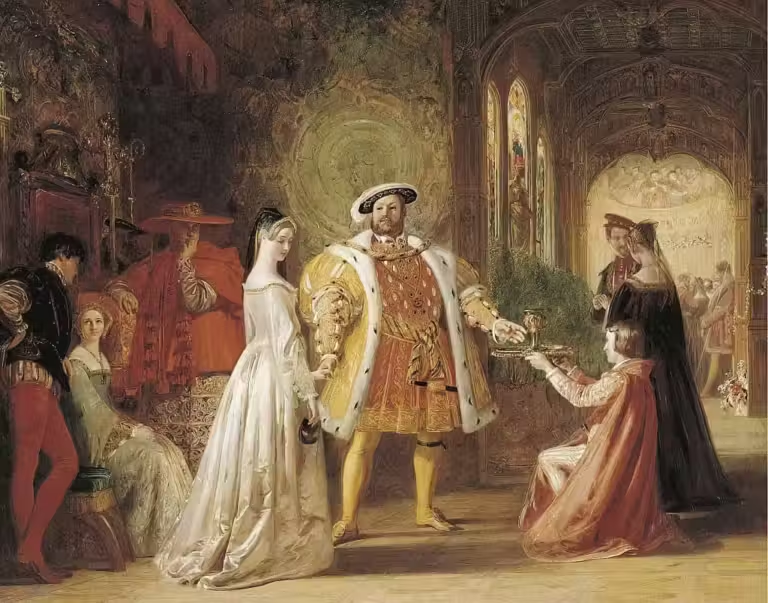
Henry’s marriage to Catherine of Aragon had produced no surviving legitimate son. The king sought an annulment so that he could marry Anne Boleyn and secure the Tudor succession. When he failed to obtain a satisfactory decision from Pope Clement VII, Henry’s government began removing papal jurisdiction from England.
Thomas Cromwell used Parliament to give the break with Rome a statutory foundation. The Act of Supremacy of 1534 recognised Henry as the “Supreme Head on earth” of the Church of England. Ecclesiastical allegiance now rested with the Crown rather than the papacy.
This change carried personal, political and financial advantages. Henry could control senior appointments, determine ecclesiastical policy and remove an external source of jurisdiction. Nevertheless, describing the break as a simple attempt to seize church wealth understates its dynastic and constitutional dimensions.
The dissolution of the monasteries
Between 1536 and 1540, the Crown dissolved England’s monasteries and confiscated their property. The policy transformed the religious landscape and greatly expanded the resources available to the monarchy. Much former monastic land later passed to nobles and local landowners, creating influential interests that benefited from the new order.
The dissolution did more than close religious houses. Monasteries had supported education, hospitality, poor relief, pilgrimage and local employment. Their destruction therefore altered economic and communal life as well as religious practice.
Resistance sometimes became violent. The Pilgrimage of Grace in 1536 united religious grievances with opposition to taxation and central government. The Crown suppressed the movement and executed several of its leaders.
Henry VIII’s religious conservatism
The royal supremacy did not immediately make England fully Protestant. Henry rejected papal authority and authorised an English Bible, yet he retained many traditional doctrines. The Six Articles of 1539 defended teachings such as transubstantiation and clerical celibacy, while Protestants and Catholics could both face persecution.
The English Reformation must therefore be separated into two questions. The first concerned who governed the Church. The second concerned what that Church should believe and how it should worship.
Edward VI, Mary I and Elizabeth I
Edward VI and Protestant reform
Protestant reform accelerated after Edward VI succeeded his father in 1547. Because Edward was a child, councillors and senior clergy directed government policy. Archbishop Thomas Cranmer helped introduce an English liturgy through the first Book of Common Prayer in 1549 and a more clearly Protestant revision in 1552.
Reformers removed images, changed church interiors and attacked doctrines associated with the Mass. Clerical marriage became lawful, while worship increasingly centred on preaching and scripture. These policies gave the English Church a more recognisably Protestant theology.
Mary I and Catholic restoration
Mary I reversed Edward’s settlement after taking the throne in 1553. She restored communion with Rome, revived Catholic worship and repealed much of the preceding religious legislation. Her government also prosecuted Protestants for heresy, including Cranmer and other prominent reformers.
Mary’s reign demonstrated that England’s religious settlement remained unstable. Catholicism still retained substantial support, while Protestant communities survived through exile, clandestine worship and printed polemic. The memory of Marian persecution later became central to English Protestant identity, particularly through John Foxe’s Acts and Monuments.
The Elizabethan Religious Settlement
Elizabeth I restored royal control over the Church in 1559. She adopted the title “Supreme Governor” rather than Henry’s “Supreme Head”. The Act of Uniformity introduced a revised prayer book that combined Protestant doctrine with some deliberately ambiguous language and traditional forms.
The Thirty-Nine Articles later defined the Church of England’s doctrinal position. They rejected papal authority and several Catholic teachings while preserving bishops, dioceses and an elaborate national ecclesiastical structure. The resulting Church combined Protestant theology with institutional continuity.
The settlement is often described as a via media, or middle way, between Catholicism and continental Protestantism. That description captures its later identity but can exaggerate its original tolerance. Attendance at authorised worship remained compulsory, Catholic priests faced severe penalties, and radical Protestants also encountered repression.
Wales: uniformity, translation and the Welsh Bible
The Laws in Wales Acts of 1535 and 1542 integrated Wales more closely into the English legal and administrative system. Consequently, the English Crown extended its religious settlement to Welsh dioceses. English became the principal language of government, although most people in Wales still spoke Welsh.
This linguistic gap threatened the effectiveness of Protestant worship. Reformers placed particular importance on hearing scripture and services in a language that congregations understood. An Act of 1563 therefore required translations of the Bible and the Book of Common Prayer into Welsh.
William Salesbury and his collaborators published a Welsh New Testament in 1567. Bishop William Morgan completed the first full Welsh Bible in 1588. The National Library of Wales presents these translations as major religious and linguistic landmarks.
The Welsh Bible helped Protestant worship reach local communities. At the same time, it gave written Welsh greater stability and prestige. A policy intended to create religious uniformity therefore contributed to the survival of a distinct national language.
Scotland: a Calvinist and Presbyterian Reformation
The Scottish Reformation followed a different political path. Henry VIII imposed the English break with Rome through royal and parliamentary authority. In Scotland, Protestant reform developed against a monarchy that remained connected to Catholic France.
Lutheran and Reformed ideas circulated in Scotland during the early sixteenth century. The authorities executed Patrick Hamilton for heresy in 1528 and George Wishart in 1546. Such punishments did not halt Protestant organisation among nobles, merchants, preachers and urban communities.
John Knox and the Lords of the Congregation
John Knox became the most influential public voice of the Scottish Reformation. His time in Geneva strengthened his commitment to Calvinist theology and a disciplined Reformed Church. When he returned to Scotland in 1559, conflict was already developing between the Protestant Lords of the Congregation and the regency of Mary of Guise.
Religious protest, noble rivalry and international politics soon converged. England supported the Protestant lords, while French forces defended the Catholic regency. The withdrawal of French troops following the Treaty of Edinburgh in 1560 gave the reformers a decisive advantage.
The Reformation Parliament of 1560
In August 1560, the Scottish Parliament approved the Scots Confession and rejected papal jurisdiction. It also condemned the Mass and authorised a Protestant national settlement. The Scottish Parliament’s historical timeline describes this assembly as the Reformation Parliament.
Knox and other ministers also drafted the First Book of Discipline. It proposed a national system of preaching, education and poor relief. However, the nobility proved reluctant to surrender enough former church property to finance the programme fully.
The Scottish Kirk gradually developed a Presbyterian structure based on ministers, elders, kirk sessions and representative assemblies. Unlike the Church of England, it rejected government by bishops as its defining model. The Church of Scotland still identifies the Reformation of 1560 as the formative moment in its Reformed and Presbyterian identity.
Presbyterian organisation did not mean unrestricted individual freedom. Kirk sessions supervised worship, marriage, sexual conduct, Sabbath observance and public morality. The Scottish Reformation challenged hierarchy in one form while creating powerful institutions of communal discipline.

Ireland: an established Church without a Protestant majority
The Tudor monarchy also extended royal supremacy to Ireland. The Irish Parliament recognised Henry VIII as head of the Irish Church, while the Crown of Ireland Act of 1541 changed Henry’s title from Lord to King of Ireland. Yet legislation did not produce widespread religious conversion.
The reformed Church of Ireland inherited dioceses, cathedrals and parish property. However, its authority often remained strongest within areas controlled by the English administration. Many communities continued to follow Catholic clergy, worship and devotional traditions.
Several factors limited Protestant expansion. The Crown lacked effective control across much of the island, while English-language worship reached Gaelic-speaking populations poorly. Local loyalties, the survival of Catholic networks and resistance to English government also reinforced Catholic allegiance.
Consequently, Ireland became an unusual case: a Protestant established Church served a predominantly Catholic population. Historians therefore debate whether the Irish Reformation “failed” or whether it succeeded institutionally while failing to win broad religious allegiance. History Ireland’s discussion of Ireland and the European Reformation outlines this central problem.
Religion, conquest and plantation
In Ireland, religious reform became closely connected to conquest and colonisation. The Tudor state increasingly presented Protestantism, English law and political obedience as parts of the same civilising programme. Catholic resistance could therefore appear both religiously suspect and politically disloyal.
The Munster and Ulster plantations transferred land to English and Scottish Protestant settlers. These settlements altered patterns of property, political power and population. They also helped create the confessional divisions that later shaped Irish and Northern Irish history.
Those divisions should not be treated as the automatic outcome of sixteenth-century theology. Plantation, land ownership, conquest, constitutional allegiance and economic inequality all mattered. Religion provided a powerful identity through which these conflicts were organised and remembered.
Puritanism and the limits of the Anglican settlement
Some English Protestants believed that Elizabeth’s settlement had preserved too many Catholic ceremonies and institutions. They wanted to “purify” the Church of England through simpler worship, stronger preaching and stricter moral discipline. Their opponents called them Puritans.
Puritanism contained several positions rather than one organised denomination. Some Puritans sought reform from within the established Church. Presbyterians wanted representative church government, while Separatists believed that faithful congregations must leave the national Church entirely.
The monarchy regarded radical reform as a threat to both ecclesiastical uniformity and political authority. If congregations could reject bishops, critics feared that subjects might also challenge the wider hierarchy of the state. Religious organisation therefore became inseparable from constitutional debate.
Persecution and frustration encouraged some Separatists and Puritans to migrate. Their ideas later influenced New England’s covenanted communities, although colonial Puritans could prove as intolerant of dissent as the authorities they had left behind. This contradiction forms a central theme in Puritanism and Expansionism.
Nonconformity and Protestant plurality
Attempts to impose religious uniformity produced further division. Congregationalists defended the autonomy of individual congregations. English Baptists emerged from Separatist circles during the early seventeenth century and insisted that baptism should follow a conscious profession of faith.
George Fox and other Quakers rejected formal sacraments, professional clergy and elaborate worship during the 1650s. They emphasised direct spiritual experience and the “Inner Light”. Their refusal to swear oaths or show conventional deference frequently brought them into conflict with civil authorities.
Methodism developed much later through the eighteenth-century preaching of John and Charles Wesley. It began as a renewal movement within the Church of England but eventually created separate institutions. Methodists combined personal conversion, disciplined religious societies and extensive popular preaching.
William and Catherine Booth founded the Salvation Army in 1865. Although far removed from the Tudor Reformation, it inherited the broader Protestant traditions of conversion, lay participation and organised social action. Its work among impoverished urban communities linked evangelism with material relief.
Catholics, dissenters and civil exclusion
Religious plurality did not immediately create toleration. Successive governments treated confessional conformity as a test of political loyalty. Catholics and Protestant dissenters faced restrictions on worship, education, public office, universities and parliamentary participation.
The Toleration Act of 1689 allowed many Protestant dissenters to worship in licensed meeting houses. However, it did not establish full religious equality and excluded Catholics. The established Churches retained legal privileges, while religious tests continued to shape public life.
Parliament repealed the Test and Corporation Acts in 1828, removing major disabilities imposed on Protestant dissenters. The Roman Catholic Relief Act followed in 1829 and allowed Catholics to sit in Parliament, although several restrictions remained. The UK Parliament’s chronology of religion and belief traces this gradual movement from toleration towards emancipation.
In Ireland, the Church of Ireland remained the established Church until the Irish Church Act took effect in 1871. Its privileged position had long symbolised Protestant political power over a Catholic majority. Religious inequality therefore survived for centuries after the original Tudor legislation.
The cultural and political influence of Protestantism
Scripture, literacy and vernacular language
Protestant reformers placed scripture, preaching and catechisms at the centre of religious life. This emphasis encouraged reading and supported demands for accessible religious texts. English, Welsh and later Gaelic translations helped standardise written languages and expanded the cultural authority of vernacular prose.
The King James Bible of 1611 became the most influential English translation, but it was not the first. It followed the work of William Tyndale, Miles Coverdale, the translators of the Great Bible and the Geneva Bible. Its language later shaped English literature, public rhetoric and religious expression across the Atlantic world.
The growth of state authority
The Reformation challenged papal jurisdiction, but it did not simply liberate individuals from authority. In England, it strengthened the Crown’s control over religion and made Parliament an essential instrument of ecclesiastical change. The state demanded oaths, regulated worship and punished nonconformity.
At the same time, religious controversy encouraged arguments about conscience, resistance and the limits of obedience. Presbyterians, Puritans, Catholics and Separatists all had to decide when spiritual duty might conflict with civil commands. These disputes later contributed to the constitutional crises of the Stuart period.
Protestantism, capitalism and the Weber thesis
Some historians and sociologists have connected Protestantism with the development of capitalism. Max Weber famously argued that forms of ascetic Protestantism encouraged disciplined labour, saving and systematic economic activity. The commercial success of several Quaker and Nonconformist families later appeared to support that interpretation.
However, capitalism developed in Catholic as well as Protestant societies, and commercial expansion predated the Reformation. Religious ethics interacted with law, trade, empire, technology, property and financial institutions. Protestantism may have shaped particular economic cultures without acting as capitalism’s single cause.
From persecution to negotiated pluralism
The Reformation’s relationship with freedom remains deeply paradoxical. Reformers challenged inherited authority and encouraged access to scripture, yet Protestant and Catholic governments both persecuted opponents. Churches that defended conscience for themselves did not always extend the same liberty to others.
Toleration often emerged from political necessity rather than immediate ideological conversion. Governments struggled to eliminate confessional diversity, while commerce and settlement required cooperation among people of different beliefs. Religious freedom developed gradually through conflict, compromise and the failure of coercion.
From the Reformation to the Atlantic world
The Reformation altered the political geography from which English and Scottish expansion developed. Royal supremacy strengthened the relationship between religious policy and territorial government. In Ireland, conquest and plantation joined Protestant identity to colonial power, while Puritan migration carried English religious conflicts across the Atlantic.
These movements did not transfer one coherent Protestant model to North America. Anglicans, Puritans, Presbyterians, Baptists, Quakers and other groups created different colonial institutions. Some defended established churches, while others promoted congregational autonomy or liberty of conscience.
The religious settlements of the British Isles therefore created both authority and dissent. They strengthened monarchies and national churches, yet they also generated communities that challenged official control. This tension would influence English expansionism, the politics of the American colonies and, eventually, the struggle for independence.
- English Expansionism
- The Glorious Revolution of 1688
- The American Colonies: Religion and Politics
- The American Revolution: Causes, Independence and Legacy
- USA: Birth of a Nation
Frequently asked questions about the British Reformation
Was Henry VIII a Protestant when he broke with Rome?
No. Henry VIII rejected papal jurisdiction but retained many traditional Catholic doctrines. England became more clearly Protestant during Edward VI’s reign, while Elizabeth I later established a durable Protestant national Church.
How did the Scottish Reformation differ from the English Reformation?
The English Crown initiated the break with Rome and retained bishops under royal authority. Scotland’s Reformation developed through opposition to a Catholic regency and produced a Calvinist Church that gradually adopted Presbyterian government through ministers and elders.
Why did Ireland remain predominantly Catholic?
The Protestant settlement lacked broad social and linguistic support outside areas controlled by the English Crown. Catholic clergy and traditions survived, while many Irish communities associated the reformed Church with conquest, plantation and foreign political authority.
Did the Reformation create religious freedom?
Not immediately. Protestant and Catholic governments both enforced religious conformity and persecuted opponents. Wider toleration developed gradually because confessional diversity proved impossible to eliminate and political compromises became necessary.
What is the main difference between Anglican and Presbyterian government?
Anglican government retains a hierarchy of bishops and archbishops within a national Church connected to the Crown. Presbyterian government distributes authority through ministers and elected elders organised in local, regional and national assemblies.
Sources and further reading
- The National Archives: The English Reformation, c. 1527–1590
- UK Parliament: The Reformation
- UK Parliament: Act of Supremacy 1534
- UK Parliament: Act of Uniformity 1559
- National Library of Wales: William Salesbury’s New Testament
- Church of Scotland: History of the Church of Scotland
- History Ireland: Ireland and the European Reformation
- National Portrait Gallery: King Edward VI and the Pope
The Reformation strengthened the English Crown, divided the kingdoms and transformed relations between religion and political authority. The next article examines how these changes supported English territorial and colonial expansion.

good to remember the interesting history of the US
Report a typoLollards and non-academic instances are also a factor in the English contribution of the Reformation. It is important that we note the State as a needed apparatus for the Church. Thus when foreign contributions are set aside we have room for an Arminian aspect. Even though many wanted Arminians to be equated with Catholic spiritual lawlessness, the Catholics are not Arminian. Although Calvinist and Lutheran points are not without merit. Also we Anglicans have an unmatched libertarian streak and have made–in the form of the stewardship and the Great Commission by way of empire — social and spiritual liberty unmatched. From the Magna Carta to a lack of persecution of Anabaptists’, we have reigned by the very hand of God.
Report a typo