
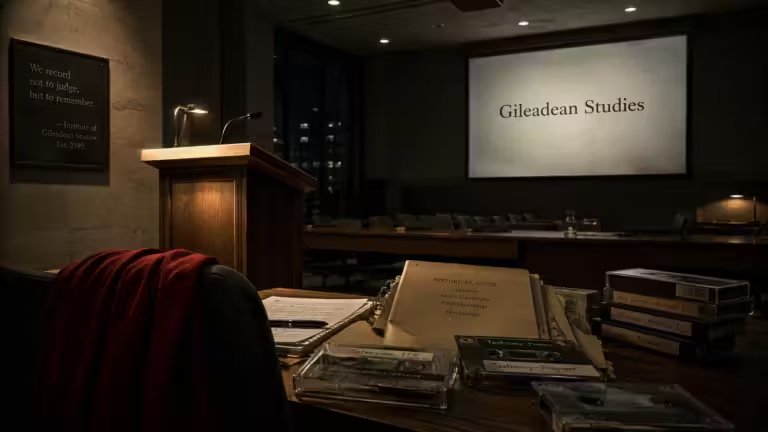
The Historical Notes at the end of The Handmaid’s Tale radically change the meaning of Offred’s story. Her intimate testimony is reframed as an academic document discussed centuries later at a symposium on Gilead. Through Professor Pieixoto’s detached tone, archival language and final question, Margaret Atwood exposes how women’s voices can survive history and still be distorted by the institutions that preserve them.
The Historical Notes are not a simple appendix. They are the novel’s second ending. After Offred’s unresolved departure in the black van, the reader is suddenly moved to a future academic conference where her story has become an object of study. The shift is jarring, funny, chilling and deeply political.
This final section forces us to reread everything. Offred’s voice has survived, which means Gilead did not fully erase her. Yet her testimony is now handled by scholars, classified through archives and interpreted by a male academic whose jokes and assumptions partly repeat the very attitudes the novel has criticised. The future is freer than Gilead, but it is not innocent.
/more

What are the Historical Notes in The Handmaid’s Tale?
The Historical Notes are the final section of The Handmaid’s Tale. They take the form of a partial transcript from an academic symposium on Gilead Studies, held long after the fall of the regime. Instead of continuing Offred’s first-person narration, the novel shifts to a scholarly lecture about the origin, authenticity and interpretation of her recorded testimony.
The main speaker is Professor James Darcy Pieixoto, who presents Offred’s narrative as a historical document. He explains how the tapes were discovered, how they were arranged and why scholars cannot easily identify Offred, the Commander or Nick with absolute certainty. The section therefore gives the reader more historical distance, but less emotional certainty.
This frame matters because it changes the status of the novel. What we have read is not presented as a polished written memoir. It is a reconstructed oral testimony, edited from recorded fragments. Atwood therefore turns the act of reading into an act of listening to a damaged archive.
Why do the Historical Notes matter?
The Historical Notes matter because they prevent a comfortable ending. Without them, the novel would end with Offred stepping into uncertainty. With them, we learn that her story survives into the future, but we also see that survival does not guarantee respectful interpretation.
This is one of Atwood’s sharpest moves. The future academic world is not Gilead. Women can study, teach and chair conferences. Scholars can openly discuss the regime. Yet the tone of the symposium often feels detached, complacent and faintly condescending towards Offred’s suffering.
The ending therefore asks a difficult question: what happens to testimony after it becomes history? A woman’s voice may be preserved, but preservation can become another kind of possession. Offred escapes silence, but she does not fully escape interpretation by others.
A sudden shift from testimony to academic discourse
Offred’s voice disappears
The most immediate shock of the Historical Notes is the disappearance of Offred’s voice. For most of the novel, readers live inside her memory, fear, irony, desire and uncertainty. Then, suddenly, she is no longer speaking. Others speak about her.
This shift is emotionally brutal. Offred has spent the novel trying to create a listener. She has imagined a “you” who might receive her story. Yet in the final section, the listener becomes an academic audience. Her intimate address is converted into a conference paper.
The effect is not simply intellectual. It is ethical. Readers must ask whether they too have been treating Offred as an object of study rather than as a witness. The Historical Notes turn the act of literary analysis back against the analyst. Cheeky move, Professor Atwood.
The language becomes cold and institutional
Offred’s language is fragmented, bodily and emotionally charged. The language of the Historical Notes is formal, archival and professional. It speaks of authenticity, reconstruction, identification and historical context. This shift in register changes the emotional temperature of the novel.
The coldness matters because it shows how institutions process suffering. A woman’s terror becomes data. Her survival becomes a document. Her gaps become scholarly problems. The conference does not deny her suffering, but it often keeps that suffering at a safe distance.
Atwood does not reject scholarship itself. After all, the Historical Notes help preserve Offred’s story. However, she warns that scholarship without humility can turn testimony into material, and material into professional entertainment.
Professor Pieixoto: historian or unreliable interpreter?
Pieixoto preserves Offred’s story
Professor Pieixoto is not simply a villain. He is one of the reasons Offred’s story reaches the future reader. He explains the discovery of the tapes, discusses their arrangement and situates them within the study of Gilead. Without historians and archivists, the testimony might have remained unread or unheard.
This makes his role genuinely important. Atwood is not saying that historical study is useless. Quite the opposite: archives matter because regimes destroy, distort and suppress evidence. The survival of Offred’s voice depends on later acts of recovery.
Yet Pieixoto’s preservation is compromised by tone. He saves the testimony and reduces it at the same time. That contradiction gives the Historical Notes their sting.
Pieixoto also distances and diminishes Offred
Pieixoto often seems more interested in identifying the Commander than in understanding Offred. He wants historical certainty, names, political connections and elite male actors. Offred’s emotional reality becomes secondary to the problem of reconstructing power structures.
This is one of the central ironies of the ending. The novel has given us the inside of Offred’s experience, but the scholar reorients attention towards the men around her. The Commander, Nick and Gilead’s institutions become the focus of academic curiosity. Offred risks becoming the source rather than the subject.
That does not make Pieixoto stupid. It makes him dangerous in a subtler way. His intelligence allows him to organise evidence, but his assumptions shape what he considers important. Atwood shows that interpretation is never neutral, even when it calls itself historical method.

“Context is all”: meaning and irony
One of the most important ideas in the Historical Notes is the claim that “context is all”. On one level, this is true. Offred’s story must be understood in relation to Gilead’s laws, rituals, geography, politics and social hierarchy. Without context, testimony can be misunderstood.
However, the phrase is also ironic. Context can illuminate, but it can also excuse detachment. Pieixoto uses historical context to explain Gilead, yet his distance sometimes weakens moral judgement. He understands the system, but he does not always seem fully answerable to Offred’s pain.
Atwood therefore complicates the scholar’s favourite tool. Context matters, yes. But context should not become a shield against compassion. The reader must understand Gilead historically without forgetting that the archive contains a human voice.
Offred’s testimony as an archive
The tapes change how we read the novel
The Historical Notes reveal that Offred’s story was recorded on tapes. This changes the reader’s understanding of the narrative. We have not been reading a diary written in secret. We have been receiving an edited reconstruction of spoken testimony.
This matters because oral testimony is shaped by voice, memory, performance and interruption. Offred’s repetitions, hesitations and alternative versions now make even more sense. Her narrative is not a clean document produced at leisure. It is a survival account assembled from fragments.
The tape format also intensifies the novel’s concern with voice. Gilead tried to silence women by banning reading, writing and public speech. Offred answers not with an official manuscript, but with a spoken record. Her voice becomes the medium of survival.
The archive is fragile and edited
Pieixoto admits that the tapes had to be arranged. This means Offred’s testimony reaches us through editorial intervention. The sequence may not be exactly the sequence in which she recorded it. The story has survived, but not untouched.
This fragility is essential. Archives do not simply preserve the past. They shape it. Choices about order, naming, authentication and classification affect what later readers believe they know. Atwood makes this process visible instead of hiding it.
The novel therefore refuses documentary innocence. Even when a victim’s voice survives, it may arrive through damaged media, incomplete evidence and institutional framing. The reader must listen carefully because the archive itself has a politics.

A satire of academic detachment
The Historical Notes are often funny, but the humour is uncomfortable. The conference setting, the formal title, the professional jokes and the rituals of academic politeness create a satire of scholarly detachment. The subject is reproductive slavery, but the tone can drift towards career performance.
This satire is not anti-intellectual. It is anti-complacency. Atwood understands the value of scholarship, but she also understands its temptations: cleverness without care, context without judgement, expertise without listening.
The final section therefore asks scholars, teachers and readers to examine their own habits. Are we listening to Offred, or merely using her? Are we reading testimony, or converting it into a tidy argument? Tiny academic slap on the wrist. Fully deserved.
Gender and voice in the Historical Notes
The gender politics of the Historical Notes are crucial. Offred’s female voice is replaced by a male scholar’s interpretation. This does not simply repeat Gilead, but it echoes one of Gilead’s habits: men explain women’s lives from positions of authority.
Pieixoto’s talk is not violent in the way Gilead is violent. Yet his tone sometimes reproduces a softer form of dismissal. Offred’s body is no longer controlled by the Ceremony, but her story is controlled by academic framing. The form of power changes; the problem of who gets to speak remains.
This is why the section is so important for feminist interpretation. Atwood does not simply ask whether women can survive oppression. She asks whether women’s accounts of oppression will be believed, centred and ethically received after the fact.
The problem of authentication
Pieixoto’s lecture is concerned with authentication. Who was Offred? Which Commander owned the household? Was Nick a member of Mayday? How reliable are the tapes? These are legitimate historical questions, but they also reveal the limits of institutional listening.
Authentication can become a trap when it shifts attention away from testimony itself. Pieixoto wants certainty about names and dates, but Offred’s story is powerful precisely because it preserves what certainty cannot: fear, hunger, shame, desire, memory and survival under coercion.
The section therefore distinguishes factual uncertainty from moral uncertainty. We may not know every identity with precision, but we know enough to understand the violence of Gilead. Atwood refuses to let missing data erase ethical clarity.
The title “The Handmaid’s Tale” inside the novel
The Historical Notes also explain the title The Handmaid’s Tale as an editorial or scholarly label. This matters because the title itself may not fully belong to Offred. Her testimony is named by others after it has been recovered.
The title carries an obvious echo of Chaucer’s The Canterbury Tales, where social types tell stories. That echo can make Offred’s narrative sound like one tale among many, but it also risks reducing her to a category: the Handmaid. The personal voice is preserved through a social label.
This tension runs through the whole novel. Offred is both a specific woman and a representative figure. The Historical Notes intensify that tension by showing how later institutions classify her voice for public consumption.
Does the future escape Gilead’s sexism?
The future society of the Historical Notes has clearly moved beyond Gilead in many ways. Gilead is studied as a past regime, not accepted as normal order. Women can occupy visible academic roles. Public discussion is possible. That matters.
Yet Atwood refuses to make the future morally pure. The jokes, tone and priorities of the symposium suggest that sexist habits can survive even after a sexist regime has fallen. The future condemns Gilead, but it does not fully understand Offred.
This is one of the ending’s most unsettling implications. Historical progress is not the same as ethical completion. A society can outlive tyranny and still mishandle the voices of those who suffered under it.
The double ending of the novel
The Handmaid’s Tale has two endings. Offred’s narrative ends with the black van and the uncertain movement into darkness or light. The Historical Notes end in a conference room, with scholars discussing the remains of her story. The first ending is immediate and existential. The second is historical and interpretive.
This double ending is central to the novel’s power. The van ending asks whether Offred survived. The academic ending asks how her survival, or at least her voice, will be understood. One ending concerns fate. The other concerns reception.
Together, they prevent closure. We learn that Offred’s story reached the future, but we do not receive the emotional resolution we want. Atwood gives survival to the testimony, not certainty to the reader.
“Are there any questions?”
The final words of the Historical Notes ask whether there are any questions. The line is formally addressed to the fictional academic audience, but it also reaches the reader. After everything Offred has told us, what kind of question are we prepared to ask?
This ending is brilliant because it makes interpretation unavoidable. The novel does not end with an answer. It ends with the structure of inquiry itself. Yet the question is also uncomfortable because the symposium has already shown how questions can miss the point.
The reader must therefore distinguish curiosity from responsibility. It is not enough to ask what happened to Offred. We must ask how we listen to victims, how institutions frame testimony and how easily distance can become moral laziness.
Historical distance and moral danger
The academic conference takes place long after Gilead. This distance gives scholars perspective, but it also creates danger. Events that were terrifying for Offred become historical material. The further the past recedes, the easier it becomes to treat suffering as an intellectual puzzle.
Atwood uses this distance to warn readers about their own relationship to history. We often study oppressive regimes after the fact, with dates, documents and explanations neatly arranged. That organisation can be useful, but it can also dull the shock of lived experience.
The Historical Notes insist that the past must be studied without being sterilised. Offred’s testimony belongs in an archive, but it also demands an ethical response. A file is not a substitute for listening.
Offred’s fate after the Historical Notes
The Historical Notes do not reveal Offred’s final fate. They show that her story survived as recorded testimony, but they do not tell us whether she escaped, lived in hiding, reunited with her family or died soon after leaving the Commander’s house.
This uncertainty matters because it protects the novel from false comfort. The survival of the archive is not the same as the survival of the person. Offred’s voice reaches the future, but her life remains partly unknowable.
That unknowability is also historically honest. Many victims of political violence leave fragments rather than complete biographies. Atwood honours that incompleteness instead of converting Offred into a solved case.
Nick, the Commander and scholarly obsession with men
Pieixoto spends significant attention trying to identify the Commander and interpret Nick’s role. These questions are not irrelevant, but their prominence is revealing. The male figures around Offred become objects of historical fascination, while Offred herself remains partly unnamed and unrecovered.
This repeats one of the novel’s central patterns. Men occupy official names, titles and archives. Women are often recorded through relation, function or absence. Even when Offred’s voice is the main evidence, the scholarly apparatus risks moving attention back to male power.
Atwood’s irony is lethal here. A conference dedicated to the Handmaid’s tale may still be tempted to make the story about Commanders. The reader is pushed to notice that temptation and resist it.
The Historical Notes and unreliable narration
The Historical Notes complicate Offred’s reliability without destroying her credibility. We learn that the tapes were arranged and that details cannot always be verified. However, this does not mean Offred lied. It means testimony under oppression is necessarily partial.
This distinction matters. Readers often use uncertainty to dismiss victims. Atwood blocks that reflex. Offred’s memory may be incomplete, but incompleteness is not falsehood. Her narrative gives access to the lived truth of Gilead even when archives cannot confirm every fact.
The section therefore asks readers to develop a more responsible idea of truth. Truth is not only a perfectly documented sequence of events. It is also the record of what power feels like from inside the body it controls.
The Historical Notes as metafiction
The Historical Notes are metafictional because they make the reader think about how the story was produced, transmitted and interpreted. Atwood does not let the narrative pretend to be transparent. She shows us the frame around it.
This metafictional device deepens the novel’s politics. Gilead controlled texts, names and interpretation. The future scholars also control texts, names and interpretation, though in a different way. The question becomes not only who speaks, but who edits, titles, archives and explains.
By ending with a frame, Atwood turns the novel into a warning about reading itself. Interpretation can rescue voices, but it can also domesticate them. The reader must decide which kind of interpreter to become.
Why the Historical Notes matter in The Handmaid’s Tale
The Historical Notes matter because they reveal that Gilead has fallen but the problems of power, gender and interpretation remain. Offred’s voice survives, yet it is mediated by institutions. The future is better than Gilead, but still capable of distance, condescension and misreading.
The section also transforms the reader’s role. We are no longer simply asking what happened to Offred. We are asking what we do with her story. Do we treat it as evidence, literature, entertainment, warning, testimony or all of these at once?
Most importantly, the Historical Notes make the novel’s final warning broader. A regime can fall, but the struggle over meaning continues. Offred’s tale survives as an archive. Whether it is heard with justice remains an open question.
Key ideas in the Historical Notes
| Idea | How it appears | Why it matters |
|---|---|---|
| Academic framing | Offred’s testimony is discussed at a symposium. | Her private suffering becomes public historical material. |
| Archival mediation | The tale is reconstructed from tapes. | The story survives, but not without editing and arrangement. |
| Male interpretation | Pieixoto controls much of the final discourse. | A woman’s voice is preserved through a male academic frame. |
| Historical distance | The future studies Gilead after its fall. | Distance creates perspective but also moral detachment. |
| Irony | The scholars condemn Gilead while sometimes echoing its dismissive habits. | The future is not free from all forms of sexism. |
| Uncertainty | Offred’s identity and fate remain partly unknown. | The archive cannot fully restore the person. |
| Metafiction | The novel reveals the conditions of its own transmission. | Readers must question how stories are produced and received. |
| Ethical reading | The final question turns towards the audience. | The reader becomes responsible for how Offred’s testimony is heard. |
Key literary devices in the Historical Notes
| Device | Example in the section | Effect |
|---|---|---|
| Frame narrative | Offred’s story is surrounded by a future academic symposium. | The reader reconsiders the whole novel as recovered testimony. |
| Satire | The conference tone is polite, clever and sometimes complacent. | Atwood mocks academic detachment from suffering. |
| Irony | A freer future still mishandles a woman’s voice. | The fall of Gilead does not end the problem of interpretation. |
| Metafiction | The text reflects on its own editing, title and transmission. | The novel makes storytelling and archiving part of its meaning. |
| Change of register | Offred’s intimate voice gives way to formal scholarly prose. | The emotional force of testimony is cooled by institutional language. |
| Open ending | Offred’s ultimate fate remains unknown. | The reader is denied biographical closure. |
| Juxtaposition | Personal trauma is placed beside academic wit. | The contrast exposes moral distance. |
| Direct address | The final question reaches both the symposium and the reader. | Interpretation becomes an ethical responsibility. |
Possible essay thesis
In the Historical Notes of The Handmaid’s Tale, Margaret Atwood transforms Offred’s intimate testimony into an academic artefact in order to expose the politics of historical interpretation. Through frame narrative, satire, archival uncertainty and Professor Pieixoto’s detached discourse, the section shows that even when women’s voices survive oppression, they may still be reframed, diminished or appropriated by institutions of knowledge. The ending therefore shifts the novel’s central question from survival to listening.
Essay plan: how to analyse the Historical Notes
I. A new frame that changes the whole novel
You can first analyse the sudden shift from Offred’s first-person testimony to the academic symposium. This frame reveals that the narrative is a recovered archive and forces the reader to reconsider the status of everything previously read.
II. Academic distance and the risk of misreading
You can then focus on Pieixoto’s tone. His scholarship preserves Offred’s voice, but his jokes, priorities and detachment also diminish it. The section satirises interpretation when it becomes clever rather than responsible.
III. Offred’s testimony and the reader’s responsibility
Finally, you can examine the final question and the unresolved fate of Offred. Her story survives, but its meaning remains contested. The reader must decide how to listen to incomplete testimony without reducing it to an academic puzzle.
Continue the analysis of The Handmaid’s Tale
- The Handmaid’s Tale by Margaret Atwood: Gilead, power and resistance
- The Handmaid’s Tale: incipit analysis
- The Handmaid’s Tale: Chapter 2 analysis
- The Handmaid’s Tale: Chapter 5 analysis
- The Handmaid’s Tale: the Ceremony analysis
- The Handmaid’s Tale: the Wall analysis
- Nolite te Bastardes Carborundorum: meaning and analysis
- The Handmaid’s Tale: the Commander’s study analysis
- The Handmaid’s Tale: how Gilead took power
- The Handmaid’s Tale: Jezebel’s analysis
- The Handmaid’s Tale ending explained
- The Handmaid’s Tale: Chapter 25 analysis
- The Handmaid’s Tale: Chapter 41 analysis
FAQ: Historical Notes in The Handmaid’s Tale
What are the Historical Notes in The Handmaid’s Tale?
The Historical Notes are the final section of the novel. They present Offred’s story as a recovered testimony discussed at a future academic symposium on Gilead Studies.
Why are the Historical Notes important?
The Historical Notes are important because they reframe Offred’s intimate story as a historical document. They show that her voice survives, but also that institutions may distance, classify or misread women’s testimony.
Who is Professor Pieixoto?
Professor James Darcy Pieixoto is the scholar who presents Offred’s testimony at the symposium. He helps preserve and explain the archive, but his detached tone also reveals the risks of academic misreading.
Do the Historical Notes reveal what happened to Offred?
No. The Historical Notes show that Offred’s testimony survived, but they do not confirm her final fate. We do not know for certain whether she escaped, died or lived under another identity.
What does “Are there any questions?” mean at the end?
The final question is addressed to the fictional academic audience and to the reader. It asks us to think about how we interpret Offred’s testimony and whether we listen ethically to voices shaped by trauma.
Sources and further reading
- Margaret Atwood, The Handmaid’s Tale, McClelland & Stewart, 1985.
- SkyMinds — The Handmaid’s Tale: Gilead, power and resistance
- Margaret Atwood’s official website — The Handmaid’s Tale
- Penguin Random House — The Handmaid’s Tale reader’s guide
- The Booker Prizes — The Handmaid’s Tale
- The Booker Prizes — reading guide to The Handmaid’s Tale
- Dominick M. Grace — “The Handmaid’s Tale: Historical Notes and Documentary Subversion”
