
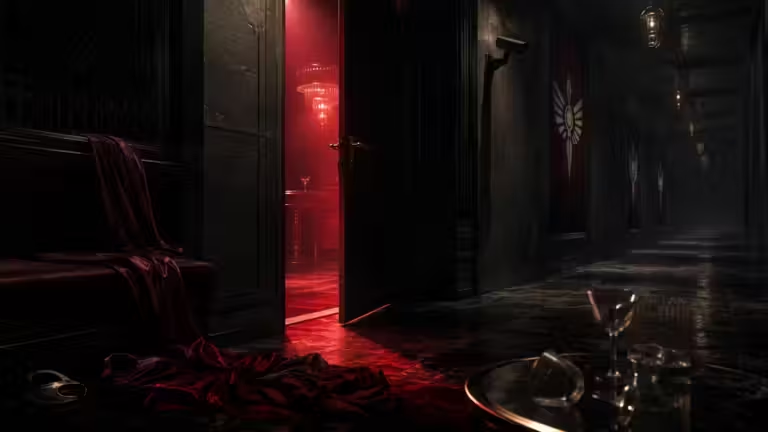
In The Handmaid’s Tale, Jezebel’s exposes Gilead’s deepest hypocrisy. The regime publicly condemns sexual freedom, female desire and moral “decadence”, yet it secretly preserves a brothel for Commanders, officials and foreign visitors. Through Jezebel’s, Margaret Atwood reveals that Gilead does not abolish exploitation. It reorganises exploitation for the benefit of powerful men.
Jezebel’s is one of the most disturbing spaces in Margaret Atwood’s novel because it seems, at first, to contradict everything Gilead claims to stand for. The regime imposes modest clothing, ritualised reproduction, public punishment and strict gender hierarchy. Yet behind closed doors, elite men enter a hidden club where alcohol, makeup, costumes, prostitution and sexual display still exist.
This contradiction is not a mistake in the regime. It is the regime. Jezebel’s shows that Gilead’s puritanism is selective. Rules bind the powerless; exceptions serve the powerful. The scene therefore dismantles the fantasy that authoritarian moralism is really about virtue. In Gilead, morality is a costume worn by power.

What is Jezebel’s in The Handmaid’s Tale?
Jezebel’s is a secret club and brothel used by Commanders and other privileged men in Gilead. It operates outside the public values of the regime, but not outside the regime’s protection. The place is unofficial, yet tolerated. It violates Gilead’s laws, but serves Gilead’s elite.
Women at Jezebel’s wear sexualised clothes from the time before, drink, smoke, talk and entertain men. On the surface, they seem freer than Handmaids, Wives or Marthas. Yet this appearance is deceptive. Their freedom exists only inside a controlled space designed for male pleasure.
Jezebel’s therefore functions as a pressure valve for the ruling class. Publicly, Gilead claims to suppress lust and restore religious order. Privately, it gives powerful men access to the same “corruption” it condemns. Atwood uses this space to expose the obscene convenience of official purity.
Why is it called Jezebel’s?
The name “Jezebel’s” evokes the biblical figure Jezebel, traditionally associated with seduction, idolatry and female wickedness in patriarchal interpretation. Gilead uses the name to brand the women inside the club as fallen, immoral and already condemned.
This naming is important because it shifts blame away from the men who use the club. The women are marked as Jezebels, while the Commanders remain respectable in public. The name turns female survival into moral failure and male exploitation into private entitlement.
Atwood’s irony is sharp. Gilead creates Jezebel’s, supplies its clients and benefits from its existence, yet the women inside carry the stigma. Once again, the regime controls language in order to control moral interpretation.

A hidden space that reveals the whole regime
Jezebel’s is secret, but not rebellious
Because Jezebel’s is hidden, it may first look like a place of resistance. It contains forbidden clothes, makeup, alcohol, music and informal speech. These details contrast sharply with the regulated public world of Gilead, where women are sorted by colour and function.
However, secrecy does not automatically mean rebellion. Jezebel’s is not an underground feminist space. It exists for powerful men. Its illegality is carefully managed, which means it is not truly outside Gilead. It is one of Gilead’s private rooms.
This makes the scene more disturbing than a simple exposure of hidden vice. Jezebel’s reveals that the regime has two moral systems: one for public discipline and one for elite indulgence. The contradiction strengthens power rather than weakening it.
The club is Gilead without the mask
Jezebel’s strips Gilead of its pious surface. At the Ceremony, the Commander’s access to Offred’s body is disguised as religious duty. At Jezebel’s, that same male entitlement appears more openly as pleasure, consumption and status.
The setting therefore reveals continuity between official ritual and unofficial vice. The Ceremony and Jezebel’s look opposite, but they share the same logic: women’s bodies are organised for male use. One room calls this reproduction; the other calls it entertainment.
That is why Jezebel’s is so important. It does not contradict Gilead’s system. It clarifies it. The regime’s real aim is not purity, but control over who may desire, who may choose and who must be used.
The Commander’s hypocrisy
The Commander breaks the laws he benefits from
The Commander takes Offred to Jezebel’s after already inviting her into his study for Scrabble, magazines and private conversation. The pattern matters. He repeatedly breaks Gilead’s rules, but he does so from a protected position. His transgressions feel exciting because they are dangerous for Offred, not because they truly threaten him.
This is the privilege of power. The Commander can treat forbidden things as games, novelties or indulgences. Offred cannot. For her, each breach may lead to punishment, disappearance or death. Their shared secret is never shared equally.
Jezebel’s therefore exposes the Commander’s moral emptiness. He does not believe in Gilead’s public ideals enough to obey them, but he believes in the system enough to profit from it. That combination makes him more damning than a simple hypocrite. He is a beneficiary who wants to enjoy both repression and exception.
His charm depends on coercion
The Commander presents Jezebel’s as a privilege offered to Offred. He gives her access to a forbidden world and expects fascination, gratitude or complicity. Yet the invitation is coercive because Offred cannot safely refuse him.
This dynamic extends what we already see in the Commander’s study. He offers favours, but the favours remain inside a hierarchy. A gift from a captor is never only a gift. It can create obligation, confusion and emotional dependence.
Atwood’s treatment of the Commander is brutally precise. He wants to feel interesting, generous and lonely rather than simply powerful. Jezebel’s allows him to stage himself as worldly and rebellious, while Offred experiences the risk created by his vanity.

Jezebel’s and the false freedom of women
The women at Jezebel’s appear to have what other women in Gilead lack. They wear revealing clothes, use makeup, speak more openly and move in a space filled with music, drink and spectacle. Compared with Handmaids’ red uniforms and white wings, this looks almost free.
Yet this freedom is theatrical. The women are displayed, consumed and controlled. Their costumes are not signs of autonomy; they are uniforms of another kind. They may look different from Handmaids, but they too have been assigned a function.
This is one of the scene’s central insights. Gilead does not offer women a real choice between repression and liberation. It offers different forms of use. The Handmaid is used for reproduction. The Martha is used for labour. The Wife is used for legitimacy. The Jezebel is used for pleasure.
Costumes from the time before
The clothing at Jezebel’s is made from fragments of the old world: sexualised costumes, evening wear, lingerie, entertainment outfits and artificial glamour. These clothes survive as relics, but their meaning has changed. What once belonged to consumer culture now belongs to elite male fantasy under dictatorship.
Atwood does not idealise the old world here. The costumes are often tacky, objectifying or absurd. Yet their survival inside Gilead is revealing. The regime has not destroyed sexual commodification. It has monopolised it.
This complicates the novel’s feminism. Atwood shows that the pre-Gilead world already contained forms of objectification, but Gilead’s answer is worse. It does not liberate women from objectification. It removes choice and preserves objectification for powerful men alone.
Moira at Jezebel’s
Moira’s reappearance shocks Offred
The most painful moment in the Jezebel’s sequence is Offred’s reunion with Moira. Earlier in the novel, Moira represents defiance, escape and irrepressible energy. She is the friend who resists, jokes, refuses and makes Gilead look ridiculous. Finding her at Jezebel’s changes the emotional meaning of the place.
Offred wants Moira to remain a heroic figure. She wants proof that someone escaped Gilead’s categories. Instead, she finds Moira alive but compromised, surviving in another controlled role. This discovery hurts because it damages one of Offred’s private sources of hope.
The Booker guide frames Moira as the figure who shows Offred that cheating the system is possible, which makes her later position at Jezebel’s even more tragic. Moira still matters as a sign of defiance, but her story also shows how Gilead absorbs, redirects and exhausts resistance. :contentReference[oaicite:2]{index=2}
Moira’s survival is not defeat, but it is not freedom
It would be too easy to call Moira defeated. She has survived. She has avoided the Colonies. She still jokes, speaks and understands the system around her. Those facts matter. Moira has not become obedient in any pure sense.
However, survival at Jezebel’s is not freedom. Moira’s choices are constrained by terror. She has selected one form of exploitation over another form of death. Atwood refuses to turn this into moral failure. Under tyranny, survival choices are made inside traps.
This is why Moira’s scene is so devastating. It does not erase her courage. It reveals the cost of a system designed to make courage insufficient. Gilead does not need to defeat every rebel in battle. Sometimes it only needs to give them a worse set of options.
Offred’s disillusionment
Jezebel’s changes Offred’s relationship to resistance. Until this point, Moira’s escape has remained a kind of legend in her mind. It proves that rebellion can happen. It gives Offred a story of movement, cleverness and refusal. At Jezebel’s, that legend becomes human, wounded and partial.
This disillusionment is not purely negative. It forces Offred to see resistance without fantasy. Moira is not a symbol who exists to comfort her. She is a person under pressure. Her survival belongs to her own pain, not to Offred’s need for heroic reassurance.
Atwood thereby resists a sentimental version of dystopian rebellion. She does not give the reader a clean hero who remains untouched by the system. Instead, she gives us damaged people making tactical choices under intolerable conditions. That is harder to read, and much truer.
Jezebel’s as a parody of liberation
Jezebel’s imitates freedom while hollowing it out. It contains sexual display, alcohol, conversation, music and cosmetics, all of which Gilead publicly condemns. But because these things exist only for elite male consumption, they no longer mean liberation.
This parody matters. The old world’s symbols of freedom have been repurposed inside a closed system. Makeup no longer expresses choice. Revealing clothes no longer signal self-fashioning. Speech no longer guarantees autonomy. Everything is staged for the men who enter.
The scene therefore asks a sharp question: what is freedom without power? The women at Jezebel’s may appear less restricted than Handmaids, but they remain unfree because they do not control the terms of their visibility, labour or survival.
Sexuality and power
Jezebel’s reveals that Gilead does not fear sexuality itself. It fears uncontrolled sexuality. The regime condemns sexual freedom when it belongs to women, queer people or the old world, but it preserves sexual access for powerful men.
This distinction is essential. Gilead’s sexual morality is not coherent. It is hierarchical. The question is not whether desire is permitted, but whose desire is permitted to matter. Male desire is accommodated. Female desire is punished, redirected or sold.
The Commander’s visit to Jezebel’s makes this hierarchy visible. In the Ceremony, Offred’s sexuality is erased in the name of reproduction. At Jezebel’s, women’s sexuality is exaggerated in the name of entertainment. Both arrangements deny women genuine autonomy.
Foreign visitors and diplomatic hypocrisy
Jezebel’s also serves a diplomatic function. It entertains foreign visitors and allows Gilead to manage its image while privately offering what its public ideology forbids. This adds another layer of hypocrisy: the regime performs moral purity while using sexual exploitation as hospitality.
This connects Jezebel’s to the Japanese tourists in chapter 5. In both scenes, Gilead is seen from the outside. However, the tourist scene shows public display and controlled politeness, while Jezebel’s reveals the hidden accommodations made for foreign and elite male eyes.
The contrast is powerful. Handmaids must appear modest in public so Gilead can claim moral authority. Jezebels must appear available in private so Gilead can maintain elite privilege. Two opposite performances serve the same regime.
The Aunts and controlled degradation
The presence or authority of Aunts around Jezebel’s shows that the club is not outside Gilead’s machinery. Even here, women are supervised, sorted and managed. The regime may relax certain rules for male pleasure, but it does not abandon control.
This is important because Jezebel’s could otherwise look like chaos. It is not chaos. It is organised degradation. The women’s bodies are removed from public virtue, but they remain disciplined by Gilead’s hierarchy.
Atwood repeatedly shows that Gilead uses women to control women. Aunts train Handmaids; Wives supervise households; Jezebel’s women are managed inside a system that treats them as already fallen. Limited female authority becomes a tool of patriarchal order.
Jezebel’s and the Colonies
Jezebel’s must also be understood beside the Colonies. For many women, the club is presented as an alternative to a slower death elsewhere. That choice is horrifying because it is not a real choice. It is a forced selection between different forms of disposal.
The Colonies represent contamination, punishment and removal from society. Jezebel’s represents sexual exploitation under elite protection. Both spaces contain women Gilead has classified as unusable for respectable reproductive or domestic roles.
This comparison clarifies Gilead’s hierarchy of female value. Fertile women may become Handmaids. Elite married women become Wives. Domestic workers become Marthas. Women who do not fit these roles may be sent to the margins, where they are either worked to death or consumed as entertainment.
Jezebel’s and the old world
Jezebel’s is full of remnants from the time before, but these remnants do not restore the past. Instead, they show how the past has been looted. Clothes, songs, drinks and gestures survive as props inside Gilead’s private theatre.
This gives the scene a ghostly quality. The old world is present, but only as debris. Its pleasures have been detached from freedom and repurposed for domination. Offred sees fragments of a world she once knew, but those fragments now belong to the men who destroyed it.
Atwood’s critique therefore cuts in two directions. She criticises Gilead’s puritan control, but she also refuses to romanticise the old world’s sexual marketplace. Jezebel’s shows what happens when the worst habits of the old world are preserved under the harsher power of the new one.
Offred’s costume and loss of identity
When Offred is dressed for Jezebel’s, she becomes another kind of spectacle. The red Handmaid uniform is replaced by clothing that marks her as sexually available, but the underlying logic remains the same. She is still being dressed by others for a role she did not choose.
This costume change is symbolically important. It seems to remove the Handmaid identity, yet it does not restore Offred’s selfhood. One imposed image replaces another. Gilead can dress women as modest vessels or erotic objects; in both cases, it controls the script.
Offred’s discomfort reveals the difference between clothing as self-expression and clothing as assignment. Jezebel’s does not give her the freedom of fashion. It gives her a costume in a male fantasy staged by her Commander.
The scene as a descent into the underworld
Jezebel’s can be read as an underworld scene. Offred enters a hidden space beneath or behind the official surface of Gilead. There she meets figures from the past, especially Moira, who appears almost like someone returned from the dead.
This underworld pattern gives the scene mythic force. Offred crosses a threshold, sees forbidden truths and returns with knowledge she cannot easily use. The journey does not free her, but it changes what she understands about Gilead.
The underworld reading also suits the name Jezebel’s. The women inside have been symbolically damned by the regime. They live in a hidden moral basement where Gilead stores the desires and contradictions it cannot admit in daylight.
Why Jezebel’s matters in The Handmaid’s Tale
Jezebel’s matters because it exposes Gilead’s moral structure more clearly than almost any public ritual. The Wall shows fear. The Ceremony shows reproductive control. The Commander’s study shows forbidden privilege. Jezebel’s shows the secret economy that links all three: power gives men access to women while calling that access by different names.
The scene also deepens Offred’s disillusionment. She sees the Commander without the mask of solemn duty, and she sees Moira without the comfort of heroic myth. The result is painful knowledge. Gilead is not only brutal; it is adaptable, hypocritical and able to absorb even rebellion into its machinery.
Most importantly, Jezebel’s reveals that authoritarian systems do not eliminate vice. They privatise it. They punish the powerless for what they permit the powerful to enjoy. Atwood’s insight is as cold as a locked door: the regime’s secret rooms tell the truth about its public virtues.
Key literary devices in the Jezebel’s sequence
| Device | Example in the Jezebel’s sequence | Effect |
|---|---|---|
| Irony | Gilead condemns sexual freedom while maintaining a secret brothel. | The regime’s moral hypocrisy becomes impossible to ignore. |
| Spatial symbolism | Jezebel’s is hidden from public view but protected by elite power. | The secret room reveals the truth behind the public ideology. |
| Costume symbolism | Women wear sexualised remnants from the old world. | Clothing becomes another assigned role rather than genuine freedom. |
| Contrast | Jezebel’s contrasts with the Ceremony, the Wall and the Commander’s study. | Different spaces reveal different forms of male power. |
| Disillusionment | Offred finds Moira alive but trapped in another system of exploitation. | The heroic fantasy of escape becomes more complex and painful. |
| Biblical allusion | The name Jezebel marks women as fallen or immoral. | Gilead uses religious language to blame women for male desire. |
| Underworld motif | Offred enters a hidden space filled with figures from the past. | The scene becomes a descent into Gilead’s repressed truth. |
| Parody | The club imitates glamour, freedom and pleasure. | Atwood shows freedom emptied out and repurposed for domination. |
Possible essay thesis
In The Handmaid’s Tale, Jezebel’s exposes the hypocrisy at the heart of Gilead’s sexual politics. Through irony, costume symbolism, spatial contrast and Offred’s painful reunion with Moira, Margaret Atwood shows that the regime does not abolish sexual exploitation but reserves it for powerful men. The scene reveals that Gilead’s public morality is less a belief system than a mechanism for organising access to women’s bodies.
Essay plan: how to analyse Jezebel’s
I. A hidden space that exposes Gilead’s hypocrisy
You can first analyse Jezebel’s as a secret contradiction inside Gilead. The club violates the regime’s public morality, yet it exists for Commanders and foreign visitors. This reveals that Gilead’s purity is selective and class-based.
II. Women’s bodies reassigned to another function
You can then focus on the women at Jezebel’s. Their costumes and apparent freedom do not mean autonomy. Like Handmaids, Wives and Marthas, they are assigned a role by the regime. Their function is pleasure rather than reproduction or domestic labour.
III. Moira and the collapse of heroic escape
Finally, you can examine Offred’s reunion with Moira. Moira’s presence at Jezebel’s complicates the idea of resistance. She has survived and remains lucid, but her survival reveals how Gilead can absorb and exhaust even rebellious women.
Continue the analysis of The Handmaid’s Tale
- The Handmaid’s Tale by Margaret Atwood: Gilead, power and resistance
- The Handmaid’s Tale: incipit analysis
- The Handmaid’s Tale: Chapter 2 analysis
- The Handmaid’s Tale: Chapter 5 analysis
- The Handmaid’s Tale: the Ceremony analysis
- The Handmaid’s Tale: the Wall analysis
- Nolite te Bastardes Carborundorum: meaning and analysis
- The Handmaid’s Tale: the Commander’s study analysis
- The Handmaid’s Tale: how Gilead took power
- The Handmaid’s Tale: Chapter 25 analysis
- The Handmaid’s Tale: Chapter 41 analysis
FAQ: Jezebel’s in The Handmaid’s Tale
What is Jezebel’s in The Handmaid’s Tale?
Jezebel’s is a secret club and brothel used by Commanders and other privileged men in Gilead. It violates the regime’s public morality, but it is tolerated because it serves elite male pleasure.
Why is Jezebel’s important?
Jezebel’s is important because it exposes Gilead’s hypocrisy. The regime publicly condemns sexual freedom and female display, yet it secretly preserves sexual exploitation for powerful men.
What happens to Moira at Jezebel’s?
Offred finds Moira at Jezebel’s after believing she had escaped Gilead more completely. Moira has survived, but she remains trapped in another form of exploitation. Her presence complicates Offred’s hope and the idea of heroic resistance.
What does Jezebel’s reveal about the Commander?
Jezebel’s reveals the Commander’s hypocrisy and privilege. He breaks the rules he helps benefit from, treating forbidden pleasure as a private indulgence while Offred carries the real danger of transgression.
What does Jezebel’s symbolise?
Jezebel’s symbolises Gilead’s hidden corruption, male entitlement and selective morality. It shows that the regime does not eliminate sexual exploitation; it reorganises it for those in power.
Sources and further reading
- Margaret Atwood, The Handmaid’s Tale, McClelland & Stewart, 1985.
- SkyMinds — The Handmaid’s Tale: Gilead, power and resistance
- Margaret Atwood’s official website — The Handmaid’s Tale
- Penguin Random House — The Handmaid’s Tale by Margaret Atwood
- Penguin Random House — Margaret Atwood biography
- The Booker Prizes — The Handmaid’s Tale
- The Booker Prizes — reading guide to The Handmaid’s Tale
