
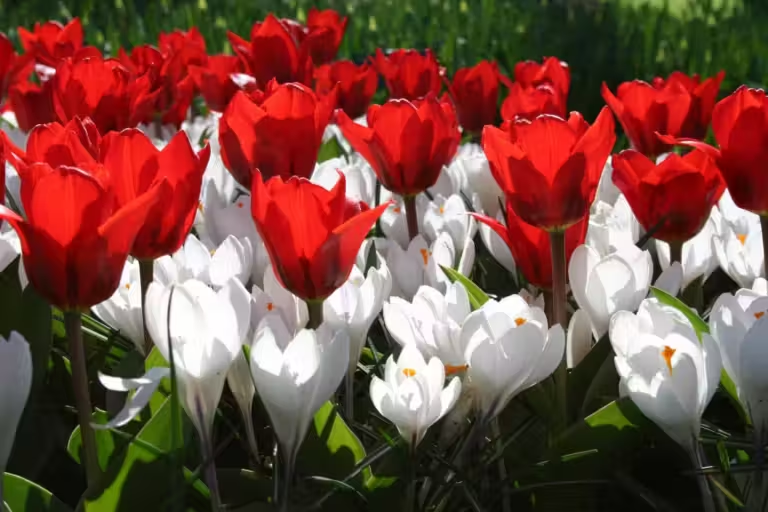
In chapter 25 of The Handmaid’s Tale, Serena Joy’s garden becomes one of the novel’s most disturbing symbolic spaces. Tulips, irises, bleeding hearts, heat, scent and ripeness create an atmosphere of fertility and desire, while Serena’s shears introduce violence, control and symbolic castration. Through this garden, Offred begins to recover a dangerous awareness of her body, her desire and her capacity for inner resistance.
Chapter 25 is one of the most sensual and symbolically dense passages in Margaret Atwood’s novel. The scene focuses on Serena Joy’s garden, but the garden is never merely decorative. It becomes a living body, a forbidden theatre of desire and a counter-world to Gilead’s sterile ideology.
At first, the garden seems to oppose Gilead. It overflows with colour, scent, movement and fertility. However, the same space also reveals violence. Serena cuts seed pods with shears, Offred covets the tool, and the flowers become charged with images of bodies, sexuality and mutilation. The chapter therefore turns natural abundance into a political and psychological drama.
That was in May. Spring has now been undergone. The tulips have had their moment and are done, shedding their petals one by one, like teeth. One day I came upon Serena Joy, kneeling on a cushion in the garden, her cane beside her on the grass. She was snipping off the seed pods with a pair of shears. I watched her sideways as I went past, with my basket of oranges and lamb chops. She was aiming, positioning the blades of the shears, then cutting with a convulsive jerk of the hands. Was it the arthritis, creeping up? Or some blitzkrieg, some kamikaze, committed on the swelling genitalia of the flowers? The fruiting body. To cut off the seed pods is supposed to make the bulb store energy.
Saint Serena, on her knees, doing penance.
I often amused myself this way, with small mean-minded bitter jokes about her; but not for long. It doesn’t do to linger, watching Serena Joy, from behind.
What I coveted was the shears.Well. Then we had the irises, rising beautiful and cool on their tall stalks, like blown glass, like pastel water momentarily frozen in a splash, light blue, light mauve, and the darker ones, velvet and purple, black cat’s-ears in the sun, indigo shadow, and the bleeding hearts, so female in shape it was a surprise they’d not long since been rooted out. There is something subversive about this garden of Serena’s, a sense of buried things bursting upwards, wordlessly, into the light, as if to point, to say: Whatever is silenced will clamour to be heard, though silently. A Tennyson garden, heavy with scent, languid; the return of the word swoon. Light pours down upon it from the sun, true, but also heat rises, from the flowers themselves, you can feel it: like holding your hand an inch above an arm, a shoulder. It breathes, in the warmth, breathing itself in. To walk through it in these days, of peonies, of pinks and carnations, makes my head swim.
The willow is in full plumage and is no help, with its insinuating whispers. Rendezvous, it says, terraces; the sibilants run up my spine, a shiver as if in fever. The summer dress rustles against the flesh of my thighs, the grass grows underfoot, at the edges of my eyes there are movements, in the branches; feathers, flittings, grace notes, tree into bird, metamorphosis run wild. Goddesses are possible now and the air suffuses with desire. Even the bricks of the house are softening, becoming tactile; if I leaned against them they’d be warm and yielding. It’s amazing what denial can do. Did the sight of my ankle make him lightheaded, faint, at the checkpoint yesterday, when I dropped my pass and let him pick it up for me? No handkerchief, no fan, I use what’s handy.
Winter is not so dangerous. I need hardness, cold, rigidity; not this heaviness, as if I’m a melon on a stem, this liquid ripeness.
The Handmaid’s Tale, chapter 25.

Chapter 25 summary: what happens?
In chapter 25, spring has passed, and Serena Joy’s garden has moved from tulips to irises, bleeding hearts, peonies, pinks and carnations. Offred watches Serena kneeling in the garden, cutting off seed pods with shears. The gesture looks like ordinary gardening, but Offred interprets it through the violent logic of Gilead: fertility is managed, controlled, redirected and punished.
Offred’s attention then moves from Serena to the garden itself. The flowers seem alive, sensual and almost bodily. Their scent, colour and warmth produce a lyrical atmosphere that sharply contrasts with the rigid world of rules, uniforms and rituals around them. As Offred walks through this garden, she becomes intensely aware of her own body.
The chapter also recalls a moment at a checkpoint, where Offred deliberately drops her pass so that a young guard has to pick it up. This small act becomes a form of flirtation and power. Offred cannot openly rebel, but she can still disturb, attract, remember and desire. Chapter 25 therefore marks a quiet rebirth of bodily consciousness.
Serena Joy’s garden: abundance under control
A garden of fertility
The garden is first associated with abundance. It is full of flowers, colours, smells and seasonal change. Unlike the regulated rooms of the Commander’s house, the garden seems to obey a natural rhythm. Spring gives way to summer, flowers rise and fade, and life pushes upwards from the earth.
This matters because Gilead is obsessed with fertility, yet terrified of uncontrolled life. The regime reduces fertility to a state function. The garden, by contrast, presents fertility as excessive, sensual and disorderly. It does not fit neatly into Gilead’s theological bureaucracy. It grows, overflows and suggests meanings that the regime cannot fully manage.
Atwood’s description reinforces this effect through accumulation. The number of flowers, adjectives and sensory impressions creates a feeling of saturation. Offred is not simply looking at the garden; she is almost overwhelmed by it. The natural world presses against her senses and reawakens what Gilead has tried to numb.
The garden as a body
The garden is repeatedly described as if it were bodily. Flowers swell, ripen, breathe and open. Heat rises from them as if from skin. This body imagery turns the garden into an external version of Offred’s own repressed physical life.
That connection is essential. Gilead has confiscated Offred’s body by defining it through reproduction. The garden offers another bodily language: not legal, not ritual, not official, but sensual and imaginative. Through the garden, Offred can feel the body as experience rather than function.
This is why the passage feels both beautiful and dangerous. Beauty is not harmless in Gilead. Beauty awakens desire, and desire threatens control. The garden becomes subversive because it reminds Offred that life cannot be reduced to obedience.

Serena Joy as a disturbing figure
Serena kneeling in her own Eden
Serena appears kneeling in the garden, with her cane nearby and her shears in hand. The posture suggests piety, labour and weakness at once. Offred’s ironic imagination turns her into a mock-saint, but the image remains unsettling. Serena is both diminished and dangerous.
The garden might look like Serena’s private kingdom, yet it also reveals her frustration. She can cultivate fertility, but she cannot produce a child herself. She tends flowers because Gilead has denied her reproductive centrality. Her authority over the garden compensates for her lack of authority over the one thing Gilead values most: biological fertility.
This makes Serena an ambiguous figure. She benefits from Gilead’s hierarchy, but she is also damaged by it. She dominates Offred, yet remains trapped inside the same ideology of reproduction, age and usefulness. Atwood makes her cruel without making her simple.
The shears symbolise control and violence
Serena’s shears are one of the chapter’s key objects. On the surface, she is performing a gardening task: cutting seed pods so that energy returns to the bulbs. Symbolically, however, the gesture looks much darker. She cuts off the reproductive parts of flowers in a world already obsessed with controlling reproduction.
The shears therefore carry several meanings at once. They suggest domestic order, castration, female rivalry, violence and forbidden agency. Serena uses them to discipline the garden. Offred wants them because they could become a weapon or a tool of escape. The object links cultivation and aggression with nasty little brilliance.
Offred’s desire for the shears is revealing. She does not simply desire freedom in the abstract. She desires a concrete object that might cut, wound, open or interrupt. The thought is brief, but it exposes a pressure building beneath her outward passivity.
Flowers, femininity and symbolic violence
Tulips, bleeding hearts and female imagery
The flowers in chapter 25 are not neutral. Tulips, irises and bleeding hearts carry strong associations with femininity, sexuality, fragility and reproductive life. Atwood does not use them as pretty background. She makes them speak the body’s language in a regime that has silenced women’s bodies.
The bleeding hearts are especially important because their shape makes female symbolism almost unavoidable. They suggest both tenderness and wound, beauty and vulnerability. In Gilead, female bodies are valued as reproductive instruments, yet feared as sources of disorder. The flowers expose that contradiction.
Flowers also represent the women of Gilead. They are arranged, cultivated, watched and cut back. Their beauty is tolerated only when controlled. Serena’s gardening becomes a symbolic version of the regime’s treatment of women: it manages fertility while suppressing autonomous growth.
Silenced things still rise
Offred senses that the garden contains something buried and insistent. The flowers rise from the soil as if silent things were pushing towards expression. This gives the chapter one of its central political meanings: repression does not destroy desire. It drives it underground, where it waits, mutates and returns.
That return is not necessarily gentle. The garden’s beauty is lush, but also excessive and almost aggressive. The flowers do not politely decorate Gilead; they disturb it. They suggest that life continues beneath the official surface, even when language, sexuality and memory have been policed.
Offred recognises herself in this movement. Like the flowers, she has been buried under rules, clothes, names and rituals. Yet something in her continues to rise. The garden becomes a metaphor for her own re-emerging self.

Offred’s bodily awakening
From repression to sensory intensity
Chapter 25 is saturated with physical sensation. Offred notices warmth, scent, softness, rustling fabric, movement at the edge of vision and the pressure of desire. These sensations matter because Gilead tries to make the Handmaid’s body purely functional. It wants her womb, not her pleasure.
The garden interrupts that reduction. As Offred walks through it, she becomes aware of her body as a living, desiring presence. She feels the summer dress against her thighs, the warmth of the house bricks and the heaviness of ripeness. The world touches her, and she begins to feel herself again.
This is not liberation yet. It is more fragile than that. Offred’s awakening remains internal, partial and dangerous. However, the chapter makes clear that Gilead has not killed her sensual imagination. That survival is politically important.
Summer becomes dangerous
Offred contrasts summer with winter. Winter is hard, cold and rigid; therefore, it feels safer. Summer is warm, ripe and fluid; therefore, it is dangerous. This reversal is brilliant because spring and summer usually suggest renewal, but in Gilead renewal can become a threat.
Summer intensifies the body. It loosens clothing, sharpens the senses and makes desire harder to suppress. For Offred, this is both exhilarating and frightening. She needs hardness because softness opens her to memory, appetite and risk.
The seasonal contrast also gives the chapter its structure. Time is not marked by dates, but by flowers and bodily states. In Gilead, official time is ritualised, but Offred’s private time follows the garden. Nature becomes her alternative calendar.
Desire as a form of resistance
Flirtation at the checkpoint
The checkpoint memory shows Offred using what little freedom she has. She drops her pass so that a young guard must pick it up. The gesture is small, deniable and almost old-fashioned. Yet in Gilead, even this tiny performance of attraction becomes transgressive.
Offred is not powerless in this moment. She knows the rules, but she also knows how to disturb them. She cannot openly seduce, speak freely or choose a lover. Still, she can create a charged moment through gesture, timing and bodily suggestion.
This does not make her free. It makes her resourceful. Atwood avoids turning Offred into a simple rebel. Instead, she shows how resistance may survive as irony, desire, memory and tactical performance. Offred uses what is available because almost nothing is available.
The return of desire
Desire in this chapter is not merely sexual. It is existential. Offred desires the shears, the guard’s reaction, bodily sensation, imaginative freedom and a self not fully defined by Gilead. Desire proves that she is not only a Handmaid. She is still a person who wants.
This matters because Gilead’s power depends on reducing women to assigned functions. The Handmaid must want only what the regime commands: pregnancy, obedience, piety and survival. Offred’s desires do not fit that programme. They are excessive, private and morally untidy. Good. That untidiness keeps her human.
Chapter 25 therefore presents desire as a form of inner resistance. It does not overthrow the regime, but it prevents total inward surrender. Offred’s body becomes the place where Gilead’s meanings are challenged by older, deeper impulses.
Literary imagination: Tennyson, Ovid and metamorphosis
Offred’s perception of the garden is filtered through literary and mythological imagination. She sees a lush, almost Victorian garden associated with languor, scent and swooning. She also thinks in terms of metamorphosis, as if trees, birds, flowers and bodies could pass into one another.
This matters because literature gives Offred a way to interpret her experience. Gilead tries to narrow language into slogans and Bible fragments, but Offred’s mind remains full of images, echoes and associations. Her literary memory becomes a counter-language.
The reference to metamorphosis is especially important. Offred is not static. Like the garden, she is changing. She is moving from numb endurance towards bodily awareness, from passive observation towards a more dangerous sense of self. The garden externalises that transformation.
Pathetic fallacy and personification
Chapter 25 uses pathetic fallacy, a literary technique in which natural elements seem to reflect human feelings. The garden appears to breathe, whisper, desire and press itself against Offred’s senses. These effects do not simply beautify the passage. They dramatise Offred’s own repressed emotions.
The garden’s life mirrors Offred’s inner life. Its rising heat reflects her rising desire. Its flowers suggest her own buried vitality. Its excessive growth contrasts with the official rigidity of Gilead. Atwood therefore turns setting into psychology.
Personification also allows the garden to become a silent speaker. In a society where women are silenced, nature seems to speak for them. It does not use words, but its colours, scents and forms insist on meanings that Gilead would rather suppress.
Offred’s limited assertion of self
Mockery as inner freedom
Offred mocks Serena Joy in her own mind. These jokes are small, bitter and private, but they matter. Mockery creates distance. It prevents Serena from becoming an unquestionable authority and keeps Offred’s judgement alive.
This form of resistance remains limited. Offred cannot safely insult Serena aloud, and she does not linger too long while watching her. Yet the private joke still creates a space Gilead cannot fully occupy. Inner irony protects the self from ideological submission.
The chapter repeatedly works at this scale. Resistance appears as a glance, a fantasy, a bodily memory, a joke, a desire for shears. None of these acts overturns power. Together, however, they show that Offred’s inner life remains active.
Writing the body
By describing the garden in such bodily language, Offred begins to write the body back into existence. Gilead has made the body a legal object, but Offred makes it a narrative subject. She feels, remembers, interprets and desires from within her own skin.
This is a crucial development in the novel. Offred’s body has been confiscated by ritual, clothing and reproductive ideology. In chapter 25, however, her narrative voice returns to sensation. She does not simply report what happens. She records what it feels like to inhabit a body under repression.
That shift prepares later developments in the novel, especially Offred’s movement towards more explicit forms of desire, secrecy and storytelling. Chapter 25 is not an escape scene. It is a rebirth scene, and Atwood makes it bloom like trouble.
Why chapter 25 matters in The Handmaid’s Tale
Chapter 25 matters because it turns the garden into a symbolic map of Gilead’s contradictions. Gilead worships fertility but fears uncontrolled life. It glorifies women’s reproductive function while suppressing women’s desire. It claims to preserve order, yet depends on cutting, pruning and punishing natural growth.
The chapter also develops Offred’s evolution. She is not merely surviving now. She is beginning to feel herself again, and that feeling is risky. Her body, imagination and memory start working together against the regime’s definitions.
Most importantly, the passage shows that resistance may begin before action. It may begin in perception. Offred sees the garden differently from Gilead. She understands the violence behind Serena’s shears, the desire behind the flowers and the self returning through sensation. That way of seeing is already dangerous.
Key literary devices in chapter 25
| Device | Example in the chapter | Effect |
|---|---|---|
| Symbolism | Serena’s garden, flowers and shears carry political and bodily meanings. | The domestic scene becomes a critique of Gilead’s control over fertility. |
| Pathetic fallacy | The garden seems to breathe, whisper and desire. | Nature reflects Offred’s repressed emotions and awakening body. |
| Personification | Flowers and trees appear almost animate. | The silenced world seems to speak without words. |
| Sexual imagery | Flowers, heat, ripeness and softness evoke desire. | The passage restores bodily experience against Gilead’s repression. |
| Irony | Offred imagines Serena as a saintly figure while mocking her. | Private irony creates distance from authority. |
| Metaphor | The garden becomes a body and Offred becomes associated with ripening fruit. | The setting externalises Offred’s transformation. |
| Allusion | The passage evokes Tennyson-like languor and Ovidian metamorphosis. | Literary memory becomes a counter-language to Gilead. |
| Motif of cutting | Serena cuts seed pods with shears. | Gardening becomes a symbolic act of control, pruning and castration. |
Possible essay thesis
In chapter 25 of The Handmaid’s Tale, Margaret Atwood transforms Serena Joy’s garden into a symbolic space where fertility, violence and desire collide. Through flower imagery, pathetic fallacy, bodily metaphors and the motif of cutting, the passage exposes Gilead’s attempt to control female reproduction while also staging Offred’s gradual rebirth as a desiring, perceiving and resisting subject.
Essay plan: how to analyse chapter 25
I. A garden of abundance and fertility
You can first analyse the garden as a space of excess. The flowers, colours, scent and seasonal movement create a natural world that contrasts with Gilead’s rigidity. This abundance suggests life beyond ideological control.
II. Serena Joy’s garden as a scene of violence
You can then focus on Serena and the shears. Her cutting of the seed pods turns gardening into a symbolic act of control. The shears suggest discipline, castration, female rivalry and Offred’s dangerous desire for agency.
III. Offred’s bodily and imaginative awakening
Finally, you can examine Offred’s sensory experience. The garden awakens her body, her memory and her literary imagination. Through desire and perception, she begins to recover a self that Gilead has tried to suppress.
Continue the analysis of The Handmaid’s Tale
- The Handmaid’s Tale: Chapter 41 analysis
- The Handmaid’s Tale: Chapter 5 analysis
- The Handmaid’s Tale: Chapter 2 analysis
- The Handmaid’s Tale opening analysis: memory and control
- The Handmaid’s Tale analysis: Gilead and resistance
FAQ: The Handmaid’s Tale chapter 25
What happens in chapter 25 of The Handmaid’s Tale?
Offred describes Serena Joy’s garden in spring and summer. She watches Serena cut seed pods with shears, then reflects on flowers, fertility, desire and her own bodily awakening. The chapter also recalls Offred’s flirtatious gesture towards a young guard at a checkpoint.
Why is Serena Joy’s garden important?
Serena Joy’s garden is important because it symbolises fertility, repression and uncontrolled life. It contrasts with Gilead’s rigid order while also revealing the violence used to manage fertility, especially through Serena’s cutting of the seed pods.
What do the shears symbolise in chapter 25?
The shears symbolise control, violence, castration and forbidden agency. Serena uses them to discipline the garden, but Offred wants them because they could also become a tool of resistance or escape.
How does chapter 25 present Offred’s desire?
Chapter 25 presents Offred’s desire through sensory imagery, flower symbolism and the checkpoint memory. Her desire is sexual, but also existential: she wants to feel alive, to recover her body and to escape Gilead’s definitions.
What literary devices are used in chapter 25?
Atwood uses symbolism, pathetic fallacy, personification, sexual imagery, irony, metaphor and literary allusion. These devices turn the garden into a living body and reveal Offred’s inner transformation.

