
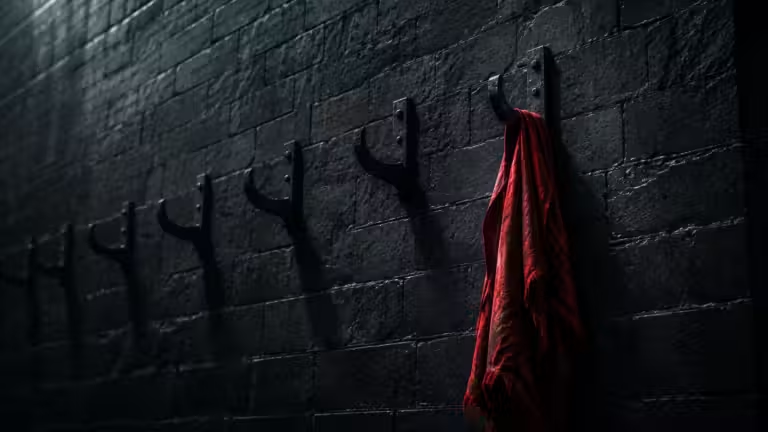
In The Handmaid’s Tale, the Wall is Gilead’s most visible instrument of fear. It turns dead bodies into political messages and forces citizens to read punishment as warning. Through public display, silence, symbolism and Offred’s uneasy gaze, Margaret Atwood shows how authoritarian regimes use spectacle to discipline the living.
The Wall is one of the most disturbing spaces in Margaret Atwood’s novel. It is not only a place where bodies are displayed after execution. It is also a public text, a theatre of fear and a reminder that Gilead controls life, death and interpretation. The regime does not merely kill its enemies. It arranges them, labels them and makes others look.
This is why the Wall deserves its own analysis. Like the Ceremony, it condenses Gilead’s ideology into a visible ritual. However, while the Ceremony brings state power into the bedroom, the Wall brings state violence into the street. It teaches obedience through spectacle, and it reveals how cruelty becomes ordinary when people must pass it every day.

What is the Wall in The Handmaid’s Tale?
The Wall is a public execution site in Gilead. Bodies of executed people are displayed there as warnings. They are often marked with symbols that identify their alleged crimes or social category. The Wall therefore functions as punishment, propaganda and intimidation at the same time.
Its location matters. The Wall is not hidden inside a prison. It stands in public space, where citizens, Handmaids and passers-by can see it. This visibility turns death into a civic lesson. Gilead wants people to understand that disobedience has consequences, but it also wants them to internalise that lesson without asking questions.
The Wall also reflects one of Atwood’s central concerns in The Handmaid’s Tale: who controls bodies? On her official website, Atwood frames the novel around the question of who will control women’s bodies, and the Wall extends that question to all bodies under authoritarian rule. Gilead claims the power to use bodies while alive and to display them after death. :contentReference[oaicite:1]{index=1}
The Wall as public theatre
Gilead stages death
The bodies on the Wall are not displayed randomly. They are arranged. They are made visible. They are turned into signs. This staging transforms punishment into theatre, with the regime as director and the citizens as unwilling audience.
Theatricality matters because Gilead needs spectators. A secret execution eliminates one enemy. A public display disciplines thousands. The Wall therefore multiplies violence by making it visible. Everyone who sees the bodies is forced to imagine the same fate.
Atwood’s brilliance lies in the calm presentation of horror. Offred does not describe the Wall in a sensational tone. She observes it as part of the route, part of the city, part of daily life. That normality is the point. Terror becomes stronger when it becomes routine.
The street becomes a political classroom
The Wall teaches without speeches. It shows what happens to doctors, dissidents, religious opponents or anyone Gilead chooses to mark as dangerous. The bodies become a brutal curriculum. Citizens learn obedience by looking at the consequences of disobedience.
This turns public space into a classroom of fear. Ordinary movement through the city becomes political training. Offred cannot simply walk past the Wall as if it were background. The regime has placed meaning there. She must receive the message, whether she accepts it or not.
The Wall also controls memory. It tells citizens which deaths are supposed to matter and how those deaths should be interpreted. Gilead presents the executed as criminals, enemies or moral threats. Offred’s narration quietly challenges that imposed reading.

Bodies turned into signs
The body loses privacy after death
In Gilead, even death does not restore privacy. The executed body remains useful to the state. It becomes evidence, warning and spectacle. The person’s name disappears, but the body remains exposed as a political object.
This is a crucial extension of the novel’s treatment of bodies. Handmaids are reduced to reproductive bodies while alive. The executed are reduced to warning bodies after death. In both cases, Gilead refuses personhood and turns the body into a function.
The Wall therefore reveals Gilead’s deeper logic. The regime does not see bodies as belonging to selves. It sees them as resources. A fertile body can produce children. A dead body can produce fear. The political usefulness changes, but the dispossession remains.
Symbols replace individual stories
The symbols attached to the bodies reduce people to categories. Instead of learning who they were, what they did, whether they were guilty or how they died, spectators are given official signs. The sign replaces the story.
This is propaganda in its most compact form. Gilead does not need to explain. It labels. The label invites citizens to stop thinking because the state has already interpreted the body for them. A person becomes a crime. A life becomes a warning.
Offred’s response resists this reduction. She notices the bodies, but she also senses the gap between official meaning and human reality. Her unease reminds the reader that behind every label there was a person whom Gilead has erased.
The Wall and the politics of looking
Gilead forces people to look
The Wall makes looking compulsory in practice, even when no one directly commands it. Its public position ensures that citizens will see it. Looking becomes part of obedience because the spectacle is designed to train the mind.
This connects the Wall to a wider pattern in the novel. Gilead controls who may look, who must be seen, who must lower their eyes and who becomes an object of inspection. The Handmaids’ white wings restrict their vision, but the Wall forces their attention towards state violence.
The result is a cruel paradox. Offred is often prevented from seeing freely, yet she is forced to see what Gilead wants her to see. Vision is not neutral. It is managed, narrowed and weaponised.
Offred looks without fully surrendering her judgement
Offred’s gaze is dangerous because it is not passive. She looks, but she also interprets. She notices the bodies, the symbols, the reactions of others and the emotional pressure of the scene. This interpretive gaze prevents Gilead’s message from becoming complete.
Her narration separates seeing from believing. Gilead wants the Wall to mean justice. Offred’s description makes it mean fear, cruelty and control. This gap between official meaning and private interpretation is one of the novel’s recurring forms of resistance.
At the same time, Offred is not unaffected. The Wall frightens her. It also fascinates her, as public violence often does. Atwood does not present moral perception as clean or easy. Offred’s gaze is disturbed, compelled and resistant all at once.

Fear as a system of government
The Wall works before punishment happens
The Wall’s main function is not only retrospective. It does not simply show what has already happened to the executed. It works prospectively by shaping what the living will dare to do next. Its real target is the future behaviour of those who pass by.
This makes the Wall an efficient instrument of government. It reduces the need for constant visible force because citizens begin to police themselves. They lower their voices, avoid questions, distrust friends and rehearse obedience in advance.
Gilead’s power therefore depends on imagination. The Wall makes people imagine arrest, accusation, trial, execution and display. Fear becomes internal once the spectacle has entered the mind.
Uncertainty intensifies terror
The Wall is terrifying not only because people have died, but because the meaning of their deaths is controlled by the state. Offred and others cannot verify the charges. They cannot know what really happened. They must live under labels supplied by power.
This uncertainty is essential to Gilead’s atmosphere. If people do not know exactly where the line is, they become more cautious. They avoid not only rebellion, but also ambiguous gestures, private jokes, unusual words and uncertain alliances.
The Wall therefore trains citizens in paranoia. It does not merely say “do not disobey”. It says “you may never know what counts as disobedience until it is too late”. That is authoritarian genius, in the worst possible sense.
The doctors on the Wall
Among the most important figures displayed on the Wall are doctors. Their presence is politically charged because doctors belong to the world of bodies, medicine, fertility and women’s reproductive choices. Gilead punishes them to rewrite the moral history of the time before.
By displaying doctors, the regime declares that earlier forms of reproductive agency were criminal. It retroactively condemns a past in which women could make choices about their own bodies. The Wall therefore does not only punish individuals. It rewrites history in public.
This connects directly to Atwood’s larger dystopian premise. The novel imagines a future in which women lose control over their names, money, work, movement and reproductive lives. The Wall shows how the regime enforces that loss through spectacular punishment. :contentReference[oaicite:2]{index=2}
Religious persecution and political control
The Wall also displays Gilead’s treatment of religious difference. Although Gilead claims religious authority, it does not tolerate independent religious life. Faith is acceptable only when controlled by the regime. Alternative beliefs become political threats.
This is a key part of Atwood’s critique. Gilead is not simply religious. It is theocratic and authoritarian. It uses religion as state power, which means spiritual difference becomes treason. The Wall makes that fusion visible.
The regime therefore persecutes not only political rebels but also competing moral authorities. Anyone who might interpret scripture, ethics or community outside official control becomes dangerous. Gilead’s monopoly on meaning must be protected with death.
The Wall and Offred’s memory of the past
The Wall forces Offred to compare Gilead with the time before. She remembers a world where doctors, churches, public speech and ordinary civic life had different meanings. These memories do not free her, but they help her recognise distortion.
Memory is dangerous in Gilead because it creates contrast. If citizens remember another system, they can see that the present order is neither natural nor eternal. Offred’s memory therefore turns the Wall from a successful propaganda object into a site of mental resistance.
Atwood repeatedly makes this contrast central to Offred’s narration. The old world was not perfect, and Offred knows that. However, remembering its imperfections still allows her to judge Gilead’s brutality. The past gives her a moral comparison the regime cannot fully erase.
Ofglen, silence and shared witnessing
Offred often encounters the Wall while walking with Ofglen. Their partnership is itself a surveillance mechanism because each Handmaid may report the other. Yet their shared witnessing also creates a fragile possibility of connection.
At first, Offred cannot know whether Ofglen is pious, loyal, frightened or resistant. This uncertainty gives the Wall scenes extra tension. Public violence does not merely frighten isolated individuals. It also poisons social relations by making trust risky.
However, looking together can become the beginning of recognition. The Wall is meant to isolate citizens through fear, but it can also expose the regime’s cruelty to more than one witness. Shared silence may hide obedience, but it may also hide dissent.
The Wall as anti-memorial
A memorial usually honours the dead and invites reflection. The Wall does the opposite. It dishonours the dead, controls their meaning and forbids genuine mourning. It is an anti-memorial: a public structure that uses memory against the living.
This inversion is important. Gilead does not want people to grieve the executed as human beings. It wants them to read the bodies as warnings. Mourning would restore individuality and sympathy. Fear suppresses both.
Offred’s narration quietly repairs this damage. By noticing the bodies and refusing to accept only the official labels, she gives them a trace of human presence. She cannot name or save them, but she can prevent the reader from seeing them only as Gilead wants them seen.
Links with the Ceremony and Salvaging
The Wall belongs to the same symbolic system as the Ceremony and Salvaging. All three are rituals of control. The Ceremony controls reproduction in private. Salvaging controls punishment through public participation. The Wall controls memory and fear through public display.
These rituals show that Gilead governs through repeated performances. It makes citizens enact, witness or interpret power again and again. The repetition matters because it turns ideology into habit. People do not merely hear what Gilead believes. They live through it.
The Wall is especially effective because it remains after the event. The Ceremony ends. A Salvaging ends. The Wall stays. It freezes punishment into architecture and makes the city itself speak Gilead’s threat.
The Wall and dystopian tradition
The Wall places The Handmaid’s Tale within the wider dystopian tradition, where public punishment often reveals the true nature of the state. Gilead’s violence is not chaotic. It is ritualised, aestheticised and bureaucratically controlled.
This is one reason the novel remains so powerful. The Booker Prizes describes The Handmaid’s Tale as Atwood’s 1985 classic and continues to treat it as a major work in her career; its force comes from the precision with which it links private life, public power and historical warning. :contentReference[oaicite:3]{index=3}
The Wall is central to that warning. It shows what happens when a regime controls not only laws, but also streets, symbols, bodies and the meanings attached to death. Gilead’s terror is architectural as much as ideological.
Why the Wall matters in The Handmaid’s Tale
The Wall matters because it makes Gilead’s violence visible. It shows that the regime does not rely only on hidden surveillance or private coercion. It also uses public death as a language. The bodies say what the state wants citizens to remember: obedience is survival.
The Wall also deepens Offred’s role as narrator. She is not only a victim who sees terrible things. She is a witness who interprets those things against the official story. Her narration gives the reader access to the difference between Gilead’s message and human truth.
Most importantly, the Wall shows how authoritarian power colonises everyday life. It turns a walk through the city into a lesson in terror. It turns bodies into signs. It turns silence into complicity or survival. And yet, through Offred’s uneasy attention, it also becomes evidence against Gilead.
Key literary devices in the Wall scenes
| Device | Example in the Wall scenes | Effect |
|---|---|---|
| Symbolism | The Wall stands for public punishment and state terror. | It makes Gilead’s violence visible and spatial. |
| Spectacle | Executed bodies are displayed in public. | Punishment becomes theatre designed to discipline spectators. |
| Metonymy | The body stands for the alleged crime or forbidden identity. | Individual lives are reduced to political warnings. |
| Irony | Gilead claims moral order while displaying brutality. | The regime’s righteousness is exposed as cruelty. |
| Focalisation | The scene is filtered through Offred’s gaze. | The reader sees the gap between official meaning and private judgement. |
| Silence | Citizens cannot openly question the display. | Fear governs speech and interpretation. |
| Repetition | The Wall recurs as part of public routine. | Terror becomes normalised through repeated exposure. |
| Anti-memorial | The dead are displayed without honour or mourning. | Gilead controls memory by controlling how bodies are read. |
Possible essay thesis
In The Handmaid’s Tale, the Wall functions as a public theatre of authoritarian power. Through the display of executed bodies, symbolic labelling and Offred’s uneasy gaze, Margaret Atwood shows how Gilead turns punishment into propaganda, bodies into political signs and public space into a system of fear. Yet Offred’s narration resists the regime by exposing the human violence behind its official meanings.
Essay plan: how to analyse the Wall
I. The Wall as public spectacle
You can first analyse how Gilead stages death in public. The bodies are displayed so citizens will look, fear and obey. The Wall turns punishment into theatre and makes the street a political classroom.
II. Bodies transformed into signs
You can then focus on the way Gilead labels the executed. Symbols replace personal stories and reduce people to crimes or categories. This shows how the regime controls interpretation as well as punishment.
III. Offred as witness and interpreter
Finally, you can examine Offred’s gaze. She cannot openly reject Gilead’s message, but her narration exposes the cruelty behind the display. Her private interpretation becomes a quiet form of resistance.
Continue the analysis of The Handmaid’s Tale
- The Handmaid’s Tale by Margaret Atwood: Gilead, power and resistance
- The Handmaid’s Tale: incipit analysis
- The Handmaid’s Tale: Chapter 2 analysis
- The Handmaid’s Tale: Chapter 5 analysis
- The Handmaid’s Tale: the Ceremony analysis
- The Handmaid’s Tale: Chapter 25 analysis
- The Handmaid’s Tale: Chapter 41 analysis
FAQ: The Wall in The Handmaid’s Tale
What is the Wall in The Handmaid’s Tale?
The Wall is a public execution site in Gilead. Bodies of executed people are displayed there as warnings, often with symbols that identify their alleged crimes or social categories.
Why is the Wall important?
The Wall is important because it shows how Gilead governs through fear. It turns death into public spectacle and forces citizens to read bodies as warnings against disobedience.
What does the Wall symbolise?
The Wall symbolises state violence, surveillance, propaganda and the loss of individual identity. It shows how Gilead turns bodies into political messages after death.
How does Offred react to the Wall?
Offred reacts with fear, unease and intense observation. She cannot openly challenge the display, but her narration resists Gilead by showing the human violence behind the official message.
How is the Wall connected to Gilead’s power?
The Wall connects to Gilead’s power because it controls public space, memory and interpretation. It teaches citizens to fear punishment and to accept the state’s labels for the dead.
Sources and further reading
- Margaret Atwood, The Handmaid’s Tale, McClelland & Stewart, 1985.
- Margaret Atwood’s official website — The Handmaid’s Tale
- Penguin Random House — The Handmaid’s Tale by Margaret Atwood
- The Booker Prizes — reading guide to The Handmaid’s Tale
- SkyMinds — The Handmaid’s Tale: Gilead, power and resistance
