
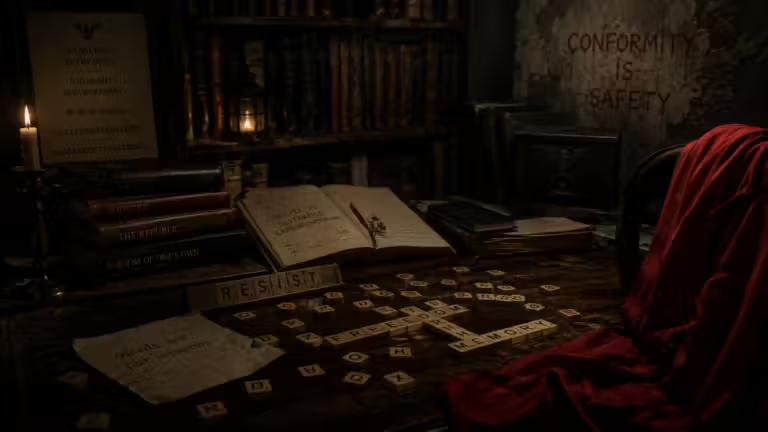
In The Handmaid’s Tale, the Commander’s study appears to offer Offred a forbidden refuge: books, Scrabble, private speech and a temporary escape from the rituals of Gilead. Yet the room is not truly liberating. It is another theatre of power, where male privilege disguises itself as kindness and where forbidden language becomes both a pleasure and a trap.
The Commander’s study is one of the most ambiguous spaces in Margaret Atwood’s novel. It is not as visibly violent as the Wall, nor as openly coercive as the Ceremony. At first, it even seems intimate, almost civilised. Offred is invited to play Scrabble, read forbidden words and sit in a room filled with objects that women are no longer allowed to possess.
That apparent comfort is exactly what makes the scene dangerous. The study does not abolish Gilead’s hierarchy. It personalises it. The Commander breaks his own rules, but he does so from a position of safety. Offred enters the room as a guest, a secret, a risk and a possession. The encounter therefore shows how authoritarian power can become seductive without becoming less coercive.

What is the Commander’s study in The Handmaid’s Tale?
The Commander’s study is his private room inside the household. It contains books, writing materials, objects of memory and the quiet privileges denied to women in Gilead. For Offred, entering the study means crossing into a forbidden male space where language has not been stripped away.
The room matters because Gilead has banned women from reading and writing. Words are not neutral in this society. They carry memory, interpretation, desire and dissent. When the Commander invites Offred into his study, he gives her access to forbidden language, but only under his control.
The study therefore functions as a controlled exception. Offred can read and play games there, but she cannot claim the room, own the books or speak freely outside its boundaries. The Commander lends her fragments of freedom while reminding her that he owns the conditions of that freedom.
A private room built on public inequality
The study is a male sanctuary
The study belongs to the Commander because Gilead allows elite men to keep private spaces of thought, memory and leisure. This privilege is political. Men like the Commander may read, store books, play with language and access the past. Women like Offred must live in rooms stripped of danger, identity and intellectual freedom.
Atwood uses the room to expose one of Gilead’s deepest hypocrisies. The regime claims to create moral order, but its leaders keep private exceptions for themselves. The study is not merely a room. It is evidence that the rules do not apply equally to those who make them.
This inequality gives the scene its tension. Offred’s visits are thrilling because they break the law, but the Commander is the one who can afford to break it. Her risk is existential. His risk is recreational, or at least far less exposed. That imbalance shapes every word exchanged between them.
Offred enters, but she does not belong
Offred’s presence in the study is illicit, but not empowering in any simple sense. She has been invited, not liberated. The invitation flatters her because it suggests trust, secrecy and special status. However, that special status remains dependent on the Commander’s desire.
This is why the room creates an unstable form of agency. Offred can speak more freely than usual, play Scrabble and enjoy the forbidden texture of words. Yet she must also please, interpret and manage the Commander. Her freedom in the room is real enough to matter, but limited enough to remain dangerous.
The study therefore reveals a cruel logic of Gilead. Even apparent privilege can become another form of control. Offred receives access to language, but access is mediated through a man who benefits from the system that silences her.

Scrabble: forbidden language as pleasure
A board game becomes subversive
Scrabble seems harmless in the old world. In Gilead, it becomes illicit. The game depends on spelling, reading, memory, chance, strategy and pleasure in words. All of these are dangerous in a society that denies women access to language.
Atwood makes Scrabble almost sensual. The tiles have texture. The letters are handled, arranged and tasted mentally. Offred’s pleasure in the game shows how deprivation changes ordinary objects. A board game becomes contraband because words themselves have become forbidden.
This transformation is central to the novel’s politics. Gilead fears language because language lets people compare, remember, joke, desire and refuse. Scrabble restores, for a moment, the playful instability of words. It gives Offred access to meanings that the regime cannot fully police while she is forming them in her mind.
Words become bodily
In the study, language is not abstract. Offred experiences words physically. She sees letters, touches tiles, chooses combinations and feels the pleasure of verbal play. This bodily relation to language matters because Gilead has separated women from both words and bodily autonomy.
The Scrabble scenes reunite these two forbidden territories. Offred’s mind works through letters, while her body responds to the risk and intimacy of the room. Reading becomes a kind of appetite. Spelling becomes a kind of touch.
This does not make the scene innocent. The pleasure of words is entangled with the Commander’s control. He gives Offred access to language as one might offer a treat. The game is subversive, but it is also patronising. That contradiction makes it brilliant.
Forbidden reading and the politics of literacy
The Commander’s study reminds us that literacy is power. In Gilead, women are forbidden to read because reading creates independent interpretation. A woman who reads can encounter voices outside the regime, remember alternative meanings and question official language.
This is why the room’s books matter so much. They represent knowledge, memory and forbidden interiority. The Commander’s ability to keep them reveals his status. Offred’s inability to possess them reveals hers.
The Penguin Random House reading guide highlights a central contradiction of the novel: Gilead’s rulers invoke biblical authority while keeping the Bible under lock and key. That question applies directly to the study. Texts are sacred when controlled by men, but dangerous when read by women. ([penguinrandomhouse.com](https://www.penguinrandomhouse.com/books/557793/the-handmaids-tale-movie-tie-in-by-margaret-atwood/9780525435006/readers-guide/))
The Commander’s kindness as a form of power
He offers favours, not freedom
The Commander’s behaviour can appear kind. He offers Offred games, conversation, magazines and small comforts. He treats her as more than a reproductive instrument, at least compared with the public rules of Gilead. Yet his kindness is inseparable from power.
He does not challenge the system that enslaves her. He creates a private exception for himself. This distinction is crucial. The Commander wants the pleasures of intimacy without surrendering the privileges of domination. He wants Offred to be grateful for crumbs from a feast he helped steal.
His favours therefore become a softer version of control. He does not need to threaten Offred directly in every scene because the structure already threatens her. His politeness rests on the violence of the system behind him.
The Commander wants recognition
The Commander does not only want sexual access or secret entertainment. He wants to be seen as humane. He wants Offred to recognise him as an individual, perhaps even as a lonely man trapped by his own system. This desire for recognition is one of his most revealing weaknesses.
However, his loneliness does not cancel his authority. Atwood refuses that sentimental escape. A powerful man can feel isolated and still remain powerful. The Commander’s need for companionship does not make Offred safe; it makes her useful in a new way.
This is why the study scenes feel so uncomfortable. The Commander’s vulnerability is real, but it is also exploitative. He asks Offred to comfort him within a system that has made her comfort irrelevant.
A false intimacy
The study creates intimacy without equality. Offred and the Commander sit together, talk privately and share forbidden experiences. Yet their relationship cannot become mutual because one of them controls the terms of encounter. The door may close, but Gilead remains inside the room.
This false intimacy is one of Atwood’s sharpest insights into power. Domination does not always appear as distance. Sometimes it appears as closeness. The Commander brings Offred nearer, but he does not release her from hierarchy. He turns secrecy into another possession.
The request for a kiss crystallises this dynamic. The Commander wants not only obedience but the performance of feeling. He wants Offred to act as if the relationship has meaning beyond coercion. That demand reveals the emotional vanity of power.

The study and the Ceremony: two rooms of control
The Commander’s study should be read alongside the Ceremony. The Ceremony is official, ritualised and reproductive. The study is private, secret and playful. Yet both spaces place Offred in relation to the Commander’s desires.
In the Ceremony, Offred’s body is used according to state ritual. In the study, her mind, attention and emotional responsiveness are used according to private male desire. The form of control changes, but the hierarchy remains. The Commander wants access to her body in one room and to her subjectivity in another.
This parallel deepens the novel’s critique of Gilead. The regime does not only exploit women through formal institutions. It also creates intimate arrangements in which men can seek comfort, novelty and self-forgiveness from the women they dominate.
Old magazines and the return of the past
The Commander also gives Offred access to old magazines. These objects belong to the pre-Gilead world of consumer culture, fashion, beauty, desire and female-targeted advertising. Under ordinary circumstances, such magazines might seem shallow or disposable. In Gilead, they become forbidden relics.
Atwood’s irony is superb here. The old world was not perfect. It objectified women, sold fantasies and trivialised desire. Yet compared with Gilead, even its flawed abundance becomes a lost field of choice. Offred can recognise both truths at once.
The magazines therefore complicate nostalgia. Atwood does not ask us to idealise the past. She asks us to notice what happens when imperfect freedoms are replaced by systematic captivity. The old magazines are trash and treasure at the same time.
Offred’s ambiguous agency
She calculates, performs and survives
Offred is not passive in the study. She watches the Commander, studies his moods, chooses her responses and learns how much she can risk. Her agency is tactical rather than free. She survives by reading power carefully.
This makes the study scenes psychologically rich. Offred enjoys aspects of the visits, but she also understands the danger. She feels curiosity, pleasure, disgust, fear and strategic interest. Atwood allows all these reactions to coexist because coercive situations rarely produce clean emotions.
Offred’s agency therefore exists inside constraint. She cannot control the game, the room or the Commander’s authority. Yet she can interpret, delay, flatter, remember and use the situation to gain information. In Gilead, such small manoeuvres matter.
Complicity is not the same as consent
Offred’s visits to the study raise uncomfortable questions. She goes back. She plays. She accepts the magazines. She manages the Commander’s attention. However, none of this should be mistaken for real consent, because the larger structure remains coercive.
The distinction matters. Consent requires the possibility of refusal without punishment or catastrophic risk. Offred does not have that possibility. She can make choices, but all her choices are shaped by danger.
This is one reason Atwood’s novel remains powerful. It understands the grey zones of survival. Offred is neither a pure victim nor a free agent. She is a captive person trying to create room for herself inside a system designed to remove room.
The study as a trap of specialness
The Commander makes Offred feel exceptional. He singles her out, invites her into a forbidden space and shares secrets with her. This specialness is seductive because Gilead has made the Handmaids interchangeable. To be chosen can feel like becoming visible again.
Yet specialness is also a trap. The Commander’s attention isolates Offred from Serena Joy, from other women and from any stable moral position. It gives her something to lose. It also makes her more vulnerable to punishment if discovered.
The study therefore offers a counterfeit version of individuality. Offred is treated as unique, but only because the Commander desires a private diversion. Her personhood is acknowledged just enough to be used.
Serena Joy and the danger of discovery
Serena Joy is not present in the study scenes in the same way she is present during the Ceremony, but her absence is charged. The secrecy of the visits depends on her exclusion. If she discovers them, Offred would be exposed to serious danger.
This triangle matters because Gilead has already forced Serena and Offred into rivalry. The study intensifies that rivalry by adding emotional and symbolic betrayal. The Commander breaks rules for pleasure, but women are likely to bear the consequences.
Once again, Atwood shows how patriarchal systems redirect male misconduct into female conflict. Serena may resent Offred, but the structure that creates the resentment belongs to Gilead and to the Commander’s privilege within it.
“Better never means better for everyone”
The Commander’s conversations with Offred reveal the ideology of the ruling class. His famous observation that “better never means better for everyone” exposes the logic of Gilead’s elites. They know their order benefits some people by sacrificing others.
This admission is chilling because it removes any illusion of innocence. The Commander is not merely confused or trapped. He understands that Gilead’s improvements are selective. He accepts inequality as the price of order, and the price is paid by women like Offred.
The study is the perfect setting for this statement. It is comfortable, private and protected. From such a room, suffering can be discussed as theory. Offred, however, lives the cost of that theory in her body, name and daily fear.
The Commander as reader of his own system
The Commander is not ignorant. He reads Gilead better than most because he helped make or maintain it. He understands its compromises, its attractions and its victims. However, understanding does not lead him to repentance. It leads him to private exceptions.
This makes him more disturbing than a simple fanatic. Fanatics can be dismissed as blind. The Commander sees enough to know better, but not enough to surrender power. His intelligence becomes part of his moral failure.
The study reveals that failure with painful clarity. He surrounds himself with books and language, yet he participates in a regime that denies those things to women. He treats words as pleasure while women experience their absence as captivity.
Why the Commander’s study matters in The Handmaid’s Tale
The Commander’s study matters because it shows the softer face of Gilead’s violence. The Wall terrifies, the Ceremony violates and the study seduces. All three spaces belong to the same system. Together, they reveal that power can punish, ritualise and charm.
The room also develops Offred’s complex form of resistance. She does not simply reject the study. She uses it, enjoys parts of it, fears it and interprets it. Her narration keeps the reader aware of both the pleasure and the trap.
Most importantly, the study proves that language remains dangerous in Gilead. A game of Scrabble can become an act of rebellion because the regime has made words illegal for women. Atwood’s point is sharp: when power bans reading, every letter becomes political.
Key literary devices in the Commander’s study scenes
| Device | Example in the study scenes | Effect |
|---|---|---|
| Symbolism | The study contains books, games and forbidden objects. | It represents male privilege and controlled access to language. |
| Irony | Scrabble, an ordinary game, becomes illegal pleasure. | Atwood shows how repression politicises everyday things. |
| Spatial contrast | The study contrasts with Offred’s bare room and the Ceremony bedroom. | Different rooms reveal different forms of power. |
| Motif of forbidden reading | Offred handles letters, words and magazines. | Language becomes sensual, illicit and politically charged. |
| Ambiguity | The Commander appears kind while remaining an oppressor. | The scene complicates simple moral categories. |
| False intimacy | Private meetings create closeness without equality. | Power disguises itself as companionship. |
| Focalisation | The scene is filtered through Offred’s cautious perception. | The reader experiences pleasure, danger and calculation together. |
| Foreshadowing | The study prepares later risks, including Serena’s anger and Jezebel’s. | The private game opens into deeper forms of danger. |
Possible essay thesis
In The Handmaid’s Tale, the Commander’s study functions as a seductive but coercive space where forbidden language, male privilege and false intimacy converge. Through Scrabble, books, private conversation and Offred’s cautious narration, Margaret Atwood shows that Gilead’s power does not operate only through public violence and ritual. It also works through favours, secrecy and the controlled distribution of pleasure.
Essay plan: how to analyse the Commander’s study
I. A forbidden male space
You can first analyse the study as a space of privilege. It contains books, private speech and intellectual freedom, all denied to women under Gilead. Offred’s entry into the room exposes the inequality on which the regime is built.
II. Scrabble and the politics of language
You can then focus on Scrabble and forbidden reading. The game turns language into pleasure and resistance, but it also shows that Offred’s access to words depends on the Commander’s permission.
III. False intimacy and ambiguous agency
Finally, you can examine the relationship between Offred and the Commander. The study creates secrecy and apparent closeness, but not equality. Offred gains small tactical advantages while remaining trapped inside coercive power.
Continue the analysis of The Handmaid’s Tale
- The Handmaid’s Tale by Margaret Atwood: Gilead, power and resistance
- The Handmaid’s Tale: incipit analysis
- The Handmaid’s Tale: Chapter 2 analysis
- The Handmaid’s Tale: Chapter 5 analysis
- The Handmaid’s Tale: the Ceremony analysis
- The Handmaid’s Tale: the Wall analysis
- Nolite te Bastardes Carborundorum: meaning and analysis
- The Handmaid’s Tale: Chapter 25 analysis
- The Handmaid’s Tale: Chapter 41 analysis
FAQ: the Commander’s study in The Handmaid’s Tale
Why is the Commander’s study important in The Handmaid’s Tale?
The Commander’s study is important because it reveals a softer but still coercive form of power. It gives Offred access to forbidden language and private conversation, but only under the Commander’s control.
Why do Offred and the Commander play Scrabble?
They play Scrabble because the Commander wants secret companionship and Offred wants access to forbidden words. In Gilead, the game becomes illicit because women are not allowed to read or write.
What does Scrabble symbolise in The Handmaid’s Tale?
Scrabble symbolises forbidden language, intellectual pleasure and the political power of words. It also shows that Offred’s access to language depends on male permission, which makes the scene both liberating and humiliating.
Is the Commander kind to Offred?
The Commander can appear kind, but his kindness is compromised by power. He offers favours without challenging the system that enslaves Offred. His private generosity depends on public inequality.
How does Offred resist in the Commander’s study?
Offred resists by observing, interpreting, remembering and using the situation tactically. She cannot control the room, but her narration exposes the Commander’s privilege and preserves her own judgement.
Sources and further reading
- Margaret Atwood, The Handmaid’s Tale, McClelland & Stewart, 1985.
- SkyMinds — The Handmaid’s Tale: Gilead, power and resistance
- Margaret Atwood’s official website — The Handmaid’s Tale
- Penguin Random House — The Handmaid’s Tale reading guide
- The Booker Prizes — The Handmaid’s Tale
- The Booker Prizes — reading guide to The Handmaid’s Tale
