
Romanticism transformed European art, literature, music and thought from the late eighteenth century onwards. Rather than following one fixed doctrine, Romantic writers and artists explored imagination, emotion, individual freedom, nature, history and the sublime in response to political revolution, industrialisation and Enlightenment rationalism.
What is Romanticism?
Romanticism was an artistic, literary and intellectual movement that developed in Europe during the late eighteenth century. It reached its greatest influence during the first half of the nineteenth century, although its chronology differs according to each country and artistic discipline.
It is often described as a reaction against the Enlightenment, rationalism and neoclassical order. That definition is useful, but incomplete. Many Romantic writers inherited Enlightenment ideals of liberty, criticism and human progress. What they challenged was the belief that reason alone could explain human existence.
Romanticism gave greater importance to imagination, emotion, intuition and individual experience. It also rediscovered nature, folklore, medieval history, national traditions and supernatural narratives.
The movement did not simply replace reason with feeling. Instead, it asked what rational systems had neglected: memory, desire, terror, spiritual experience, creativity and the relationship between humanity and the natural world.
Romanticism does not mean romantic love
Today, the adjective romantic often describes love, courtship or sentimentality. Literary and artistic Romanticism has a much broader meaning.
A Romantic work may explore love, but it may also concern revolution, childhood, death, imagination, political oppression, ruined civilisations or an individual confronting immense natural forces.
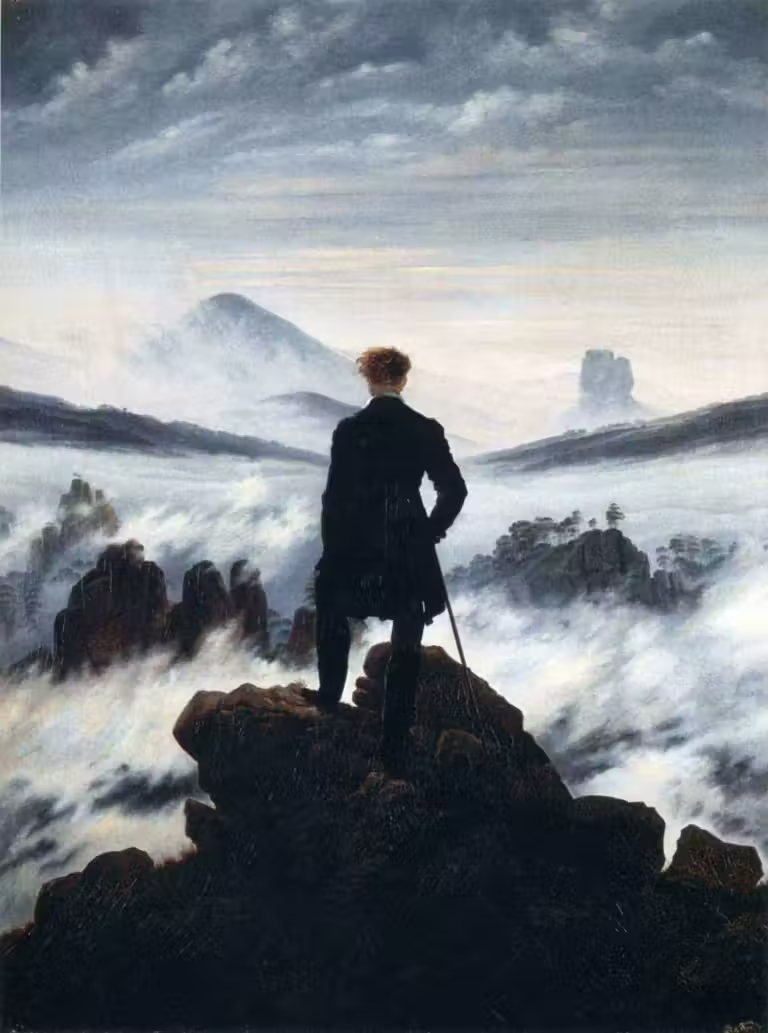
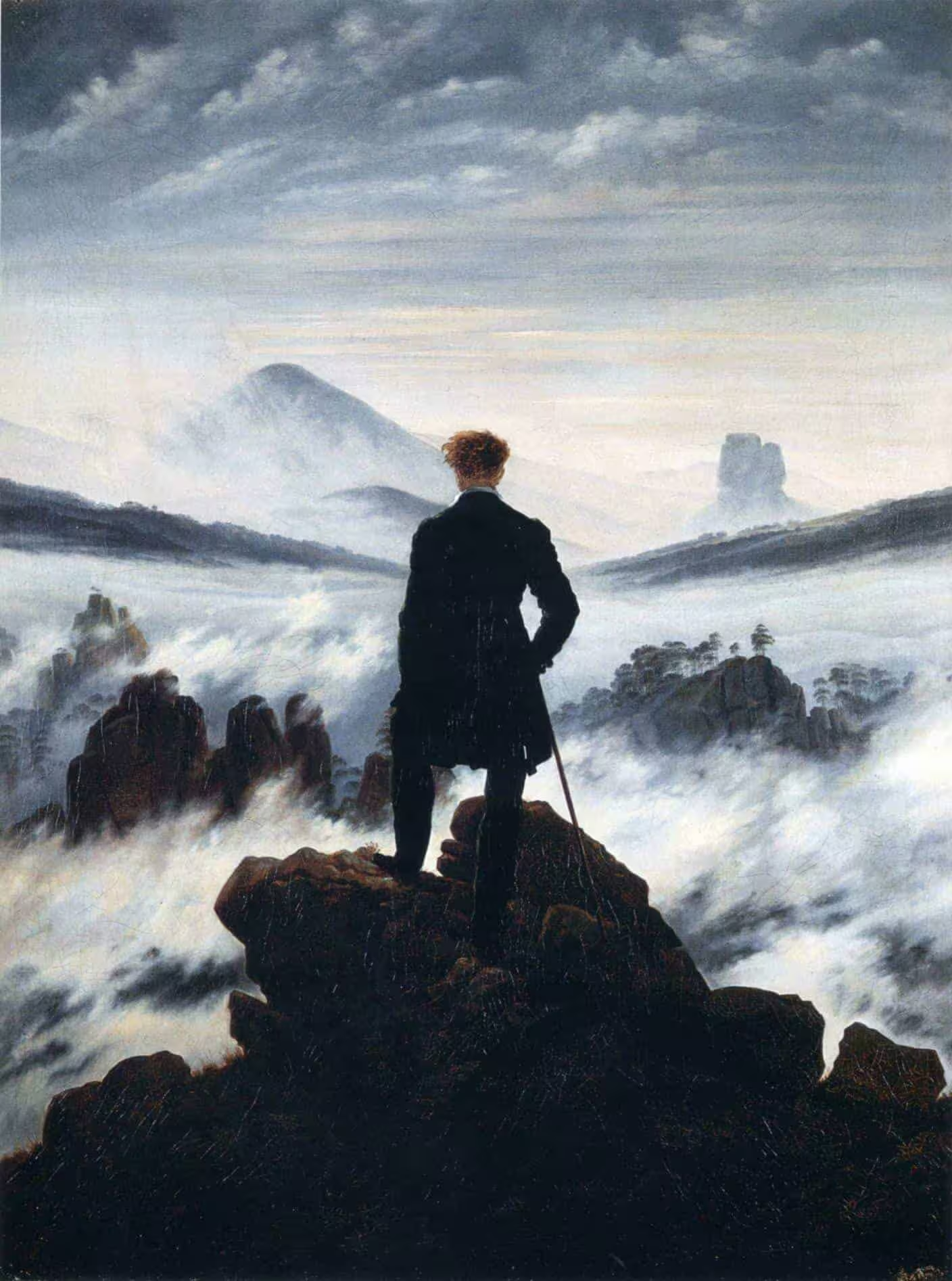
Caspar David Friedrich’s solitary wanderer, William Blake’s prophetic visions and Percy Bysshe Shelley’s revolutionary wind are all Romantic. None can be reduced to a conventional love story.

When did Romanticism begin?
Romanticism has no single beginning or ending. It emerged gradually through interconnected movements in Germany, Britain, France and other European countries.
German Sturm und Drang, usually translated as “Storm and Stress”, developed during the 1760s and 1770s. Writers such as Johann Wolfgang von Goethe and Friedrich Schiller rejected rigid conventions and emphasised intense emotion, rebellion and individual genius.
In Britain, the publication of William Wordsworth and Samuel Taylor Coleridge’s Lyrical Ballads in 1798 is frequently used as a practical starting point for English Romanticism. However, William Blake had already developed a highly original visionary poetry before that date.
In France, François-René de Chateaubriand and Germaine de Staël helped introduce Romantic thought during the early nineteenth century. Victor Hugo, Eugène Delacroix and Hector Berlioz later became major figures in French Romantic literature, painting and music.
Consequently, Romanticism should be understood as an international network of related movements rather than a single school governed by one manifesto.
The historical context of Romanticism
Romanticism developed during a period of exceptional political, technological and social change. Revolutions challenged traditional authority. Industrialisation transformed landscapes and labour. Expanding cities altered everyday life. Meanwhile, new ideas about nationhood changed European politics.
The American and French Revolutions
The American Revolution and the French Revolution inspired many European intellectuals. They appeared to demonstrate that inherited institutions could be overthrown and that societies could be reorganised around liberty and political representation.
The French Revolution initially generated considerable enthusiasm among British writers. Wordsworth, Coleridge and Blake all responded to its promise of human emancipation.
However, the Reign of Terror, the wars against revolutionary France and Napoleon’s rise complicated this enthusiasm. Some writers became disillusioned. Others retained their radical principles while criticising revolutionary violence.
The relationship between Romanticism and revolution is therefore complex. Romantic writers could be republican or conservative, nationalist or cosmopolitan, religious or sceptical. What they shared was an awareness that history was changing rapidly.
Political repression in Britain
The British government feared that revolutionary ideas might spread from France. William Pitt the Younger’s administration responded with surveillance, prosecutions and restrictive legislation.
Habeas corpus was suspended in 1794. The Treasonable Practices Act and Seditious Meetings Act followed in 1795. These measures restricted political organisation and public debate during a period of war and domestic unrest.
This political pressure influenced Romantic writing. Writers often expressed radical arguments through mythology, symbolism, historical settings or visionary poetry instead of direct political declarations.
Industrialisation and urban growth
The Industrial Revolution changed production, transport, labour and the physical environment. Factories expanded. Towns grew quickly. New machinery increased productivity while exposing many workers to dangerous and insecure conditions.
Romantic writers did not simply reject technology. Nevertheless, they frequently criticised forms of industrial and economic development that reduced human beings to units of labour.
William Blake’s image of the “dark Satanic Mills” remains one of the period’s most famous responses to industrial modernity. His poetry contrasts spiritual and creative freedom with systems of exploitation, conformity and control.
Enclosure and the transformation of rural life
Enclosure converted many common or collectively used lands into legally defined private property. Although enclosure had existed for centuries, parliamentary enclosure accelerated during the eighteenth and early nineteenth centuries.
Supporters argued that larger, consolidated farms would improve agricultural efficiency. However, many rural workers lost access to grazing, fuel and other resources that had supported village life.
These changes contributed to rural displacement and migration towards expanding towns. Romantic interest in country life must therefore be read against the disappearance of traditional communities and landscapes.
The main characteristics of Romanticism
Romanticism was diverse, but several recurring concerns connect its writers, painters and thinkers.
- the creative power of imagination;
- emotion, intuition and subjective experience;
- the individual and the exceptional personality;
- nature as a living, spiritual or overwhelming force;
- the sublime and experiences of terror or awe;
- political liberty and resistance to oppression;
- childhood, innocence and memory;
- folklore, legends and national traditions;
- the medieval past, ruins and the supernatural;
- the artist as visionary, rebel or outsider.
Not every Romantic work includes all these features. Nevertheless, they form a useful framework for recognising the movement.

Nature in Romantic literature and art
Nature is one of Romanticism’s central subjects. However, Romantic nature is not merely decorative scenery. It can educate, console, terrify, inspire or expose the limits of human power.
For Wordsworth, encounters with landscapes shape consciousness and memory. Nature can restore the individual after the pressures of social and urban life. It also connects personal experience with something larger than the isolated self.
Coleridge often presents nature as more mysterious. His landscapes contain supernatural, symbolic and psychological dimensions. In The Rime of the Ancient Mariner, the natural world becomes both victim and judge after the Mariner kills the albatross.
Romantic nature can therefore appear harmonious, but it can also remain indifferent or destructive. Mountains, oceans and storms remind human beings that they do not control the world they inhabit.
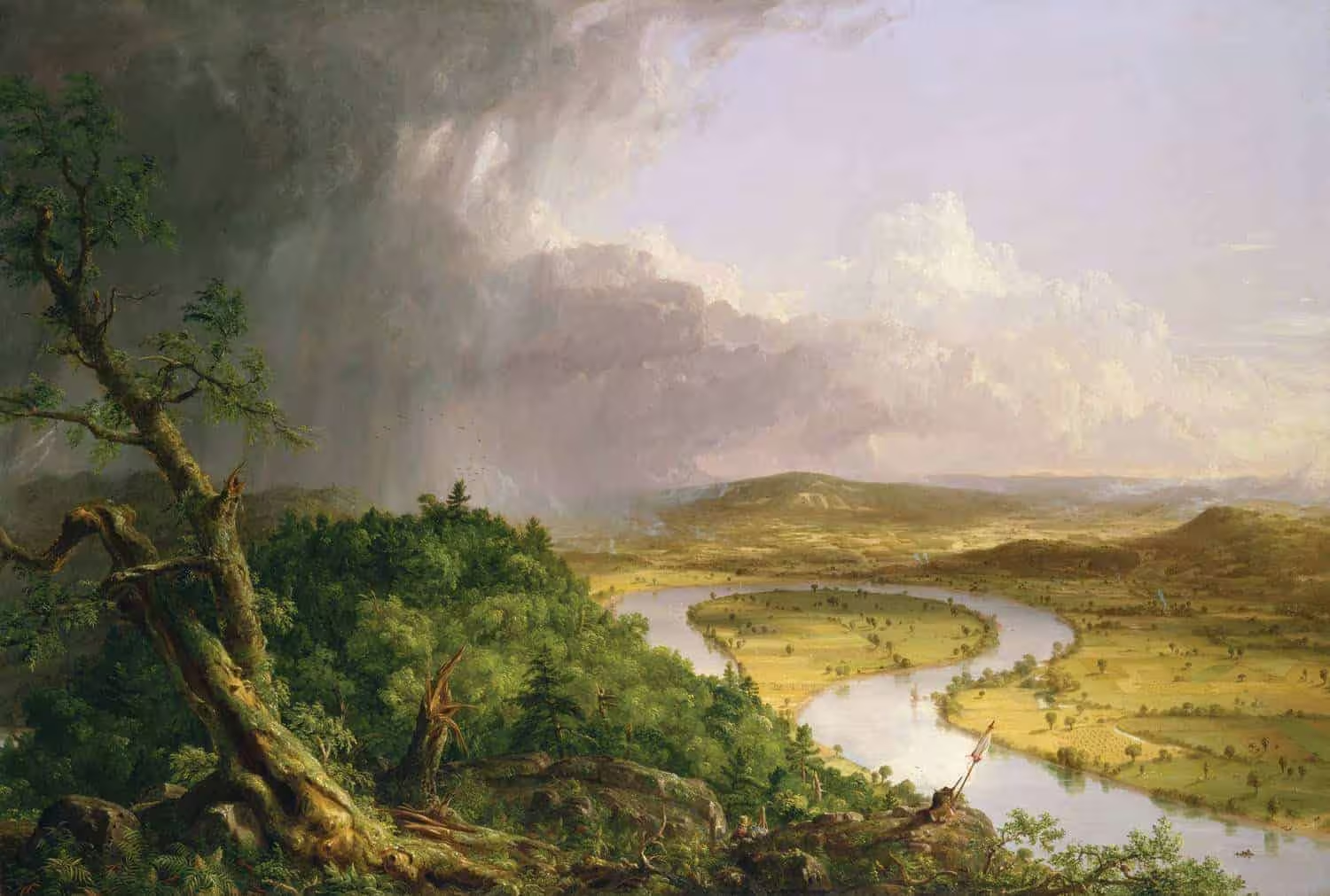
Thomas Cole’s The Oxbow stages this tension visually. The left side appears wild, dark and stormy. The right side presents cultivated fields and human settlement. The painting does not simply oppose good civilisation to bad wilderness. Instead, it asks how these two worlds can coexist.
The beautiful and the sublime
Romantic aesthetics distinguishes between the beautiful and the sublime. Beauty is commonly associated with harmony, proportion, delicacy and pleasure. The sublime emerges from vastness, obscurity, power and potential danger.
A peaceful garden may seem beautiful. A violent ocean or immense mountain range may produce the sublime. The observer experiences attraction and fear at the same time.
Edmund Burke had developed an influential account of the sublime before Romanticism reached its height. Romantic writers and painters expanded this interest by presenting human beings confronted with forces that exceed their understanding.
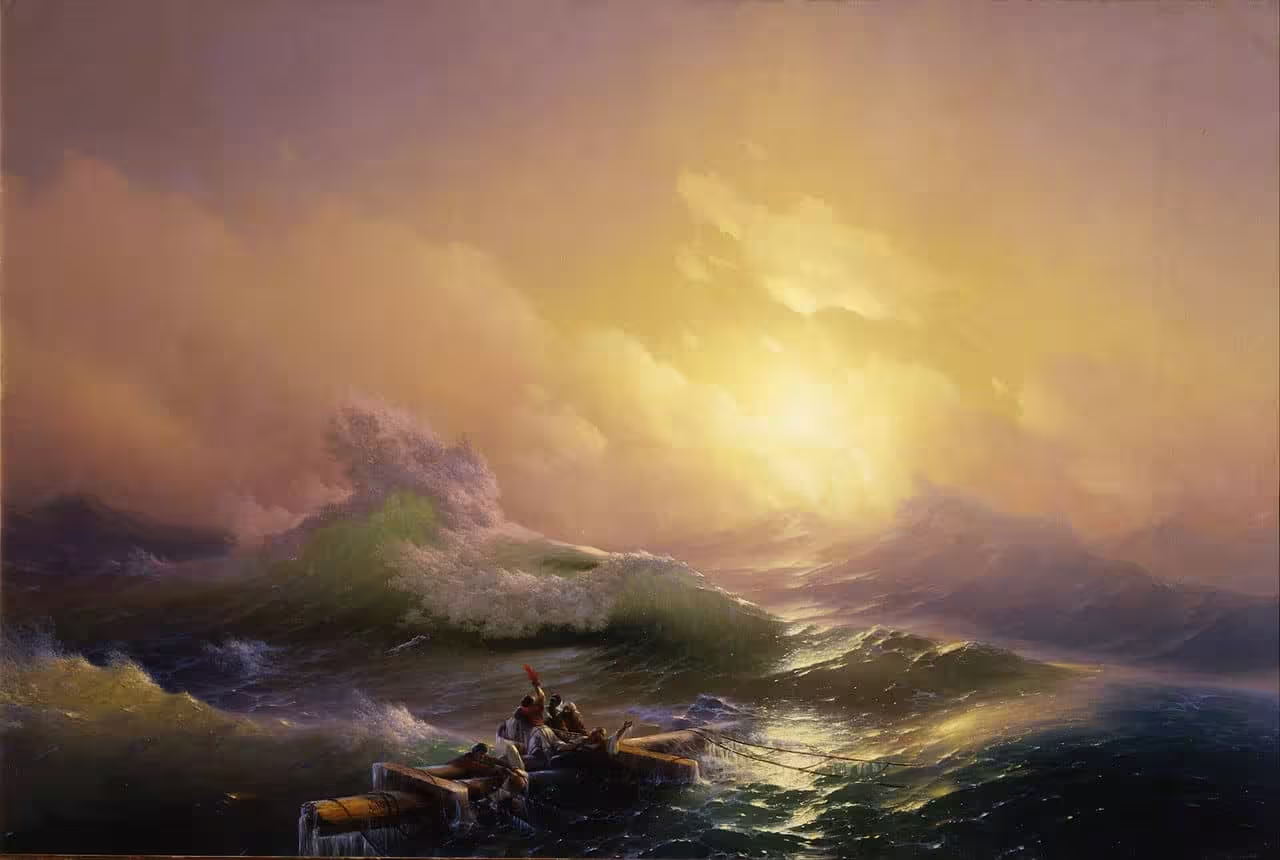
Ivan Aivazovsky’s The Ninth Wave demonstrates this Romantic combination of beauty and terror. Golden light illuminates an immense and dangerous sea. The survivors appear fragile, yet the painting also suggests endurance and hope.
The same aesthetics helps connect Romanticism with the Gothic and the fantastic. Both traditions use obscurity, terror and uncertainty, although Gothic literature usually gives greater importance to confinement, transgression and the return of a threatening past.
Emotion, passion and individual experience
Romanticism gives new authority to personal experience. Feeling is not treated merely as an obstacle to reason. It becomes a way of understanding the self and the world.
Romantic poetry frequently adopts the first person. The speaker describes an encounter, memory, vision or emotional crisis. However, this focus on the self does not always produce simple autobiography. The individual experience often opens onto political, philosophical or spiritual questions.
I am certain of nothing but of the holiness of the Heart’s affections and the truth of Imagination.
John Keats, letter to Benjamin Bailey, 22 November 1817
For Keats, imagination and emotional apprehension can reveal truths that abstract reasoning cannot reach alone. His statement captures the Romantic elevation of inward experience without suggesting that every feeling must be accepted uncritically.
Romantic emotions are also dynamic. Love may approach grief. Hope may turn into despair. Exaltation may collapse into melancholy. The Romantic self rarely remains stable.

Imagination as a creative power
Neoclassical theories often described art through imitation, proportion and established models. Romantic aesthetics placed much greater emphasis on creation.
The artist does not merely copy an external world. Imagination transforms perception and creates relationships between otherwise separate elements. The work of art becomes an organised whole with its own internal unity.
Samuel Taylor Coleridge developed an influential distinction between imagination and fancy in Biographia Literaria.
For Coleridge, primary imagination makes ordinary perception possible. Secondary imagination performs a conscious creative act: it dissolves and transforms its materials in order to recreate and unify them.
Fancy performs a more mechanical operation. It combines existing images through memory and association, but it does not transform them at the deepest level.
This theory makes the Romantic artist more than a skilled imitator. The artist becomes an active creator whose imagination reorganises reality.
The Romantic artist as visionary and rebel
Romantic culture often represents the artist as an exceptional figure. The poet or painter may appear as a prophet, exile, rebel or misunderstood genius.
William Blake developed his own mythology through illuminated books that combined poetry and visual art. Lord Byron cultivated the image of the defiant outsider. Percy Bysshe Shelley imagined poets as agents capable of transforming political consciousness.
This elevation of artistic genius carries risks. The creator may become isolated, arrogant or destructive. Romantic literature repeatedly compares human creativity with divine creation and the myth of Prometheus.
Mary Shelley’s Frankenstein examines this danger directly. Victor Frankenstein possesses immense ambition, but he refuses responsibility for the being he creates. The novel turns artistic and scientific creation into an ethical problem.
The two generations of British Romantic poets
Literary history often divides the major British Romantic poets into two generations. This classification is convenient, although it can oversimplify their differences.
The first generation
- William Blake;
- William Wordsworth;
- Samuel Taylor Coleridge.
Blake combined radical politics, religious vision and personal mythology. He criticised institutional religion, economic exploitation and the suppression of human creativity.
Wordsworth sought poetry in ordinary experience, rural life, memory and the relationship between mind and nature. His language aimed to move away from excessively artificial poetic diction.
Coleridge explored imagination, philosophy, religion and the supernatural. His poetry frequently combines conversational language with symbolic or visionary experience.
Wordsworth and Coleridge became more politically conservative with age. Nevertheless, describing their later work as simply reactionary obscures the complexity of their intellectual development.
The second generation
- Lord Byron;
- Percy Bysshe Shelley;
- John Keats.
The second generation came of age after the revolutionary wars had reshaped Europe. Byron and Shelley lived for long periods outside Britain. Both challenged political, religious and social authority.
Shelley’s The Mask of Anarchy responds to the Peterloo Massacre of 1819. His Prometheus Unbound reworks Greek mythology into a drama of liberation from political and divine tyranny.
Keats concentrated less directly on contemporary politics, although his poetry still explores authority, class, mortality and artistic freedom. His major odes examine beauty, time, desire and the limits of human experience.
This distinction receives fuller treatment in the companion article on English Romanticism from 1798 to 1832.
Ordinary life and poetic language
Wordsworth’s poetry challenged the assumption that serious literature required elevated subjects and elaborate diction. He argued that poetry could represent ordinary people and use language connected with everyday speech.
In the preface to Lyrical Ballads, Wordsworth describes his aim of selecting language “really used by men”. His poems often focus on children, solitary rural figures and people ignored by conventional literary culture.
This apparent simplicity should not be confused with a lack of artistic construction. Wordsworth carefully reshapes ordinary language through metre, repetition and meditation.
Coleridge’s contribution to Lyrical Ballads pursued a complementary aim. While Wordsworth gave imaginative significance to ordinary life, Coleridge made supernatural events psychologically credible.
The Rime of the Ancient Mariner combines the ballad tradition, maritime superstition, Christian symbolism and psychological guilt. Its supernatural world remains emotionally persuasive because the Mariner’s crime and isolation possess recognisable human meaning.
History, folklore and national identity
Romanticism rediscovered medieval literature, folk songs, legends, mythology and regional languages. This interest challenged the assumption that classical Greece and Rome provided the only legitimate artistic models.
Writers collected traditional tales and songs. Philologists studied vernacular languages. Artists represented ruins, historical conflicts and national landscapes.
These activities contributed to modern cultural nationalism. A community could imagine itself through a shared language, landscape, history and body of legends.
However, Romantic nationalism had contradictory consequences. It could support liberation from imperial rule, but it could also exclude minorities or invent an artificially unified national past.
Walter Scott and the historical novel
Walter Scott played a decisive role in the development of the historical novel. Works such as Waverley and Ivanhoe place fictional characters within periods of political and cultural conflict.
Scott’s protagonists often stand between opposing communities or historical forces. Their personal choices allow readers to experience history as a conflict between different values rather than as a simple sequence of events.
The historical novel became one of Romanticism’s most influential literary forms. It later shaped writers across Europe and the Americas.
Medievalism, the Gothic and the supernatural
The Romantic fascination with medieval culture helped stimulate the Gothic revival. Castles, monasteries, ruins and ancient manuscripts offered alternatives to classical order and modern industrial society.
Yet Romantic medievalism did not always reconstruct the Middle Ages accurately. Writers frequently transformed the period into an imaginative space for exploring faith, violence, national origins, sexuality and supernatural experience.
Gothic and Romantic works therefore overlap without becoming identical. Romanticism is the broader movement. Gothic fiction concentrates more specifically on fear, transgression, persecution, secrecy and threatening forms of the past.
Mary Shelley’s Frankenstein demonstrates this overlap. It is simultaneously a Gothic novel, a philosophical narrative and a Romantic critique of isolated ambition.
Romanticism, the Gothic and Todorov’s fantastic
Romanticism created a particularly favourable environment for Gothic literature and the fantastic. Its interest in dreams, imagination, folklore, the supernatural and unstable states of consciousness challenged the idea that reality could be explained through reason alone.
However, Romanticism, the Gothic and the fantastic are not interchangeable categories. Romanticism is a broad artistic and intellectual movement. The Gothic is a literary and aesthetic mode centred on fear, transgression, secrecy, persecution and the return of a threatening past.
The fantastic describes a more precise narrative effect. In Introduction à la littérature fantastique, Tzvetan Todorov defines it through hesitation. The reader and, often, a character cannot decide whether an apparently impossible event has a rational explanation or reveals a supernatural reality.
Todorov distinguishes the fantastic from two neighbouring modes:
- the uncanny, when strange events ultimately receive a natural, psychological or rational explanation;
- the marvellous, when supernatural events are accepted as real within the fictional world;
- the fantastic, which exists while uncertainty between those explanations remains unresolved.
Romantic literature frequently creates this hesitation through dreams, visions, doubles, haunted spaces and unreliable perception. Coleridge’s supernatural poetry, Hoffmann’s tales and later works such as Henry James’s The Turn of the Screw all explore the instability between external supernatural events and disturbed consciousness.
Todorov’s model therefore helps clarify one important legacy of Romanticism. Romantic writers did not merely introduce ghosts and supernatural events. They also made uncertainty itself into a literary experience.
This distinction is examined more fully in The Gothic and the Fantastic.
Aesthetic dimension
See Todorov’s Théories du Symbole (1977). Romanticism emphasises imagination (as opposed to the 18th century).
Before, art was imitation and mimesis (cf. Aristotle). There was a process of selection of things that were worth representing and a correction of nature according to the image of beauty you had in mind (harmony in parts and whole).
On the other hand, with romanticism, art is creation; it’s an autonomous whole. It does not imitate nature but recreates it. It is not a mirror but a different reality. This parallel world is based on the necessary artistic relations between the different organic parts.
Thus, it is useless; there is no purpose except for recreating reality. It is gratuitous and autonomous, unlike before, when it was made to instruct and entertain with a moral quality. There is no morality in art for the romantics.
Like nature, a work of art is an organic totality in form and meaning. The faculty it creates is imagination. Coleridge defined fancy and imagination in The Biographia Literaria, one of his main critical studies.
Imagination is an artistic and secondary imagination. It’s the principle of unity in a work of art and assimilates into a unifying vision. Primary imagination is the basis of perception and a God-like quality:
The IMAGINATION then, I consider either as primary, or secondary.
The primary IMAGINATION I hold to be the living Power and prime Agent of all human Perception, and as a repetition in the finite mind of the eternal act of creation in the infinite I AM.
The secondary Imagination I consider as an echo of the former, co-existing with the conscious will, yet still as identical with the primary in the kind of its agency, and differing only in degree, and in the mode of operation. It dissolves, diffuses, dissipates, in order to recreate; or where this process is rendered impossible, yet still at all events it struggles to idealise and unify. It is essentially vital, even as all objects (as objects) are essentially fixed and dead.
Fancy is associational logic; you do not create but associate ideas :
FANCY, on the contrary, has no other counters to play with, but fixities and definites. The Fancy is indeed no other than a mode of Memory emancipated from the order of time and space; while it is blended with, and modified by that empirical phenomenon of the will, which we express by the word CHOICE. But equally with the ordinary memory the Fancy must receive all its materials ready made from the law of association.
In Coleridge’s Kubla Khan (1816), there’s a contrast between microcosm and macrocosm: the union of contraries makes a synthetic whole thanks to symbols, polysemy and allegories.
In Herman Melville’s Moby Dick (1851), the white whale is an albino, and there is an opposition between nature and man (Captain Ahab), showing the irreducible forces of nature.
The image of the artist can take several forms. He can be like a God, a creator, but it comes with strings attached, such as the problem of transgression or curse.
If you are like a God, you’re likely to get punished for your hubris or your disobedience to the cosmic laws, just like Prometheus. The artist can also adopt the image of the « poète maudit ».
Romanticism in painting
Romantic painting favoured movement, atmosphere, dramatic light and emotional intensity. Painters explored shipwrecks, revolutions, distant landscapes, historical disasters and encounters between individuals and overwhelming natural forces.
Unlike neoclassical painting, Romantic art did not always organise the world into stable, balanced forms. Colour, movement and atmosphere could take precedence over precise outlines.
Caspar David Friedrich and the solitary observer
Caspar David Friedrich frequently places small human figures within vast landscapes. These figures often turn their backs towards the viewer, inviting us to share their act of contemplation.
In Wanderer above the Sea of Fog, the central figure appears dominant because he stands above the landscape. Yet the mountains and mist also limit his vision. The painting can therefore suggest mastery, uncertainty or spiritual confrontation.
J. M. W. Turner and the forces of modernity
Joseph Mallord William Turner used light, colour and atmospheric effects to dissolve stable forms. His paintings frequently represent storms, fires, seas and modern machines.
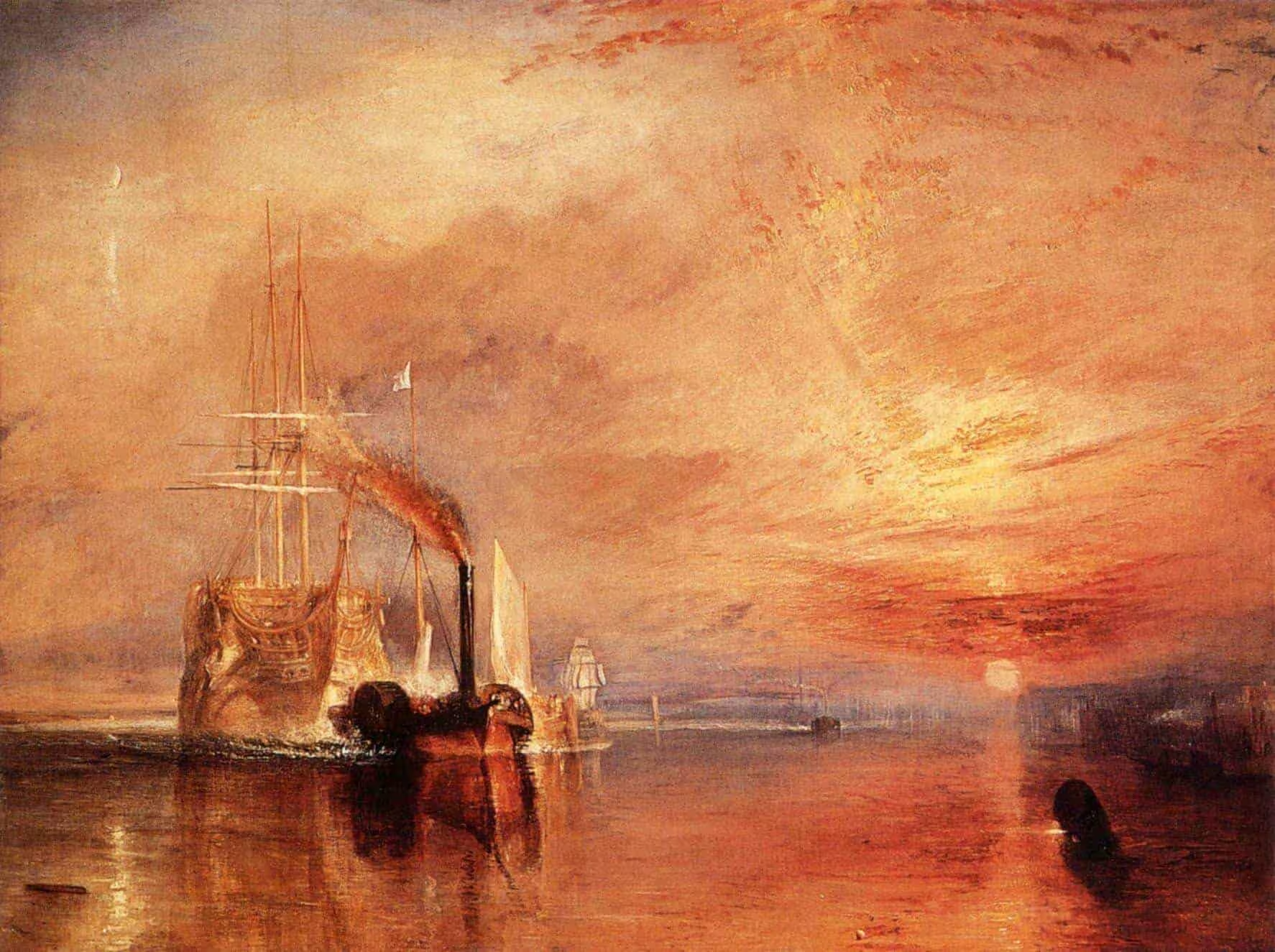
In The Fighting Temeraire, a small steam tug pulls an old warship towards its final berth. The painting contrasts the heroic past of sailing vessels with the industrial future represented by steam power.
The work is nostalgic, but not simply anti-modern. The spectacular sunset gives emotional grandeur to a historical transition that cannot be reversed.
Eugène Delacroix and revolutionary energy
Eugène Delacroix brought movement, colour and political drama to French Romantic painting. His figures rarely appear calm or perfectly ordered. Bodies, fabrics, smoke and gestures create a sense of immediate action.
Liberty Leading the People transforms the July Revolution of 1830 into a symbolic image. Liberty appears simultaneously as an allegorical figure and a participant in the fighting.
The painting unites idealism with physical violence. It celebrates political action while showing the bodies left behind by revolution.
Romantic exoticism and its limits
Romantic writers and painters often sought subjects beyond familiar European settings. The Mediterranean, the Middle East, North Africa and Asia became sources of colour, legend and imagined freedom.
This interest sometimes challenged cultural isolation and expanded artistic horizons. However, it also produced stereotypes. Artists could reduce complex societies to a few supposedly exotic signs.
Modern readers should therefore distinguish between genuine intercultural curiosity and Orientalism. Exotic settings often tell us as much about European fantasies and imperial power as they do about the cultures represented.
Women and Romanticism
Traditional accounts of Romanticism concentrated on a small group of male poets. Women were nevertheless central to the movement as novelists, poets, translators, political thinkers and critics.
Mary Wollstonecraft connected individual liberty with women’s education and political rights. Germaine de Staël helped circulate German Romantic ideas in France. Charlotte Smith influenced Romantic nature poetry and the revival of the sonnet.
Mary Shelley transformed Gothic and Romantic concerns through Frankenstein. Her novel examines creation, responsibility, education, isolation and the social production of monstrosity.
Writers such as Felicia Hemans, Letitia Elizabeth Landon and Anna Laetitia Barbauld also reached large contemporary audiences. Their relative absence from older literary histories reflects later canon formation rather than their insignificance during the period.
Romantic contradictions
Romanticism is often organised through contrasts:
- reason and emotion;
- civilisation and nature;
- beauty and terror;
- freedom and oppression;
- individual identity and collective tradition;
- hope and melancholy;
- creation and destruction;
- the visible world and the supernatural.
These oppositions should not be treated as simple choices. Romantic works often show that each term depends upon the other.
Nature can liberate and destroy. Passion can inspire resistance and cause self-destruction. Imagination can reveal truth and generate delusion. The individual can challenge tyranny while becoming isolated from society.
This unresolved tension gives Romantic art much of its energy.
From Romanticism to Victorian literature
Romanticism did not end suddenly when Queen Victoria came to the throne. Its themes continued through nineteenth-century literature.
Charlotte Brontë’s Jane Eyre and Emily Brontë’s Wuthering Heights inherit Romantic interests in passion, landscape, social rebellion and Gothic mystery. However, both novels belong to the Victorian period and address its specific institutions and moral conflicts.
American writers also transformed Romanticism. Ralph Waldo Emerson and Henry David Thoreau developed Transcendentalism. Edgar Allan Poe explored the divided self and psychological terror. Herman Melville’s Moby-Dick confronts human ambition with an irreducible natural world.
Later in the nineteenth century, Realism and Naturalism reacted against Romantic idealisation. Yet these movements retained Romanticism’s interest in individuality, history and the social consequences of modernity.
How to analyse a Romantic work
Begin with the work itself rather than searching for a fixed list of Romantic symbols. Then connect its formal choices with its historical and philosophical concerns.
- Identify the central experience. Does the work present memory, rebellion, contemplation, grief, terror or creative vision?
- Examine the representation of nature. Is nature comforting, spiritual, indifferent, cultivated or sublime?
- Study the individual. Does the central figure appear free, isolated, rebellious or overwhelmed?
- Analyse imagination. Does the work reproduce reality or transform it?
- Look for contrasts. Consider reason and emotion, beauty and terror, past and present, freedom and authority.
- Consider the historical context. How do revolution, industrialisation, enclosure or nationalism shape the work?
- Study the form. Analyse diction, rhythm, colour, composition, perspective or narrative voice.
- Avoid reducing Romanticism to sentiment. Explain the intellectual, political and aesthetic questions behind the emotions.
A convincing analysis should show how the work creates its meaning. Merely identifying mountains, ruins or strong feelings is not enough.
Conclusion
Romanticism changed how artists and writers understood nature, imagination and the individual. It opposed rigid artistic conventions, but it did not establish a single replacement doctrine.
Instead, Romanticism embraced contradiction. It celebrated liberty while fearing social fragmentation. It idealised nature while representing its destructive power. It elevated creative genius while exposing the dangers of isolation and ambition.
Its influence extends far beyond the early nineteenth century. Modern ideas of artistic originality, personal authenticity, national culture and spiritual encounters with nature still carry a strong Romantic inheritance.
Frequently asked questions
What is Romanticism in simple terms?
Romanticism was an international artistic and intellectual movement that emphasised imagination, emotion, individual experience, freedom and nature. It developed partly in response to rationalism, political revolution and industrialisation.
When was the Romantic period?
Romanticism developed during the late eighteenth century and remained highly influential throughout the first half of the nineteenth century. Its precise dates vary between countries and artistic disciplines.
What are the main themes of Romanticism?
Its central themes include imagination, emotion, nature, individual freedom, the sublime, political revolution, childhood, folklore, history, supernatural experience and the exceptional artist.
Why was nature important to Romantic writers?
Nature offered an alternative to industrial and urban life. It could restore the individual, stimulate imagination, express spiritual unity or expose humanity’s weakness before immense natural forces.
Who were the main British Romantic poets?
The six poets most commonly associated with British Romanticism are William Blake, William Wordsworth, Samuel Taylor Coleridge, Lord Byron, Percy Bysshe Shelley and John Keats.
How does Romanticism differ from the Enlightenment?
The Enlightenment generally emphasised reason, universal principles and systematic knowledge. Romanticism gave greater importance to imagination, emotion, subjective experience, cultural difference and aspects of reality that reason could not fully explain.
What is the difference between Romanticism and the Gothic?
Romanticism is a broad artistic and intellectual movement. The Gothic is a related literary and aesthetic mode centred on fear, secrecy, transgression, threatening settings and the return of the past.
