
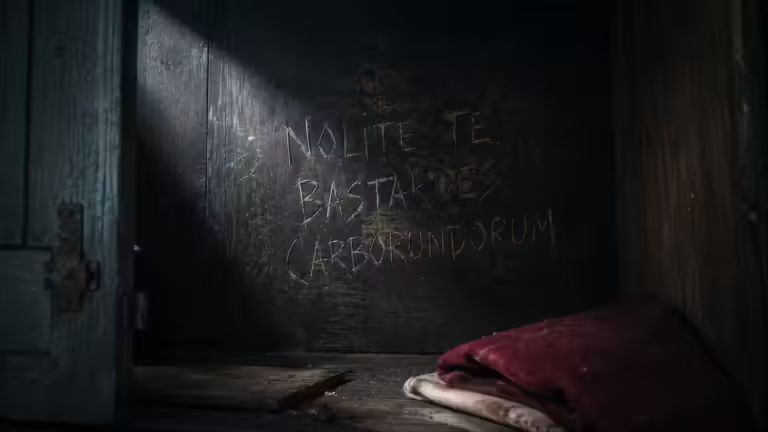
“Nolite te Bastardes Carborundorum” is one of the most memorable phrases in The Handmaid’s Tale. It is not real Latin, but mock Latin: a private joke that becomes a secret message of survival. Scratched inside Offred’s room by the previous Handmaid, the phrase creates a hidden bond between women and turns language into a small but powerful act of resistance.
In Margaret Atwood’s The Handmaid’s Tale, words are dangerous. Women are forbidden to read, language is controlled by the state, and official slogans replace private thought. Against this background, the strange phrase “Nolite te Bastardes Carborundorum” becomes far more than a joke. It becomes a trace of another woman’s voice.
The phrase is usually translated as “Don’t let the bastards grind you down”. Strictly speaking, that translation is playful rather than accurate, because the sentence is not proper Latin. However, its emotional meaning is clear. It tells Offred to endure, to refuse inward collapse and to remember that someone before her also resisted Gilead’s attempt to erase the self.

What does “Nolite te Bastardes Carborundorum” mean?
“Nolite te Bastardes Carborundorum” roughly means “Don’t let the bastards grind you down”. The phrase is mock Latin, not grammatical Latin. It looks scholarly and ancient, but it is deliberately fake, comic and rebellious.
This matters because the phrase works on several levels at once. On the surface, it sounds like a mysterious inscription. Once explained, it becomes a joke. Yet inside Gilead, even a joke can become dangerous. Humour creates distance from authority, and distance is one of the first conditions of resistance.
The phrase is especially powerful because it combines suffering and defiance. “Grind you down” suggests pressure, erosion and long-term exhaustion. Gilead does not only try to destroy people through spectacular punishment. It also wears them down through repetition, fear, isolation and routine. The message tells Offred not to let that slow destruction win.
Is “Nolite te Bastardes Carborundorum” real Latin?
No. “Nolite te Bastardes Carborundorum” is not real Latin. It is mock Latin: a deliberately fake Latin-like phrase. “Nolite” is a real Latin form meaning “do not”, but the rest of the phrase mixes invented forms and Latin-sounding English. “Carborundorum” is not classical Latin; carborundum is an abrasive industrial material, which explains the joke about being “ground down”.
That fake quality is not a weakness. It is the point. The phrase sounds like an old scholarly motto, but it is really a schoolboy joke. Vanity Fair’s account of the phrase notes that Atwood herself described it as a joke from her Latin classes, and classicist Michael Fontaine explains that the phrase only looks Latin because of its endings and shape. :contentReference[oaicite:1]{index=1}
In the novel, this false Latin becomes dramatically useful. Gilead presents itself through solemn language, biblical authority and official formulas. “Nolite te Bastardes Carborundorum” answers that seriousness with irreverence. It refuses to let power sound majestic. It laughs, quietly, from inside a cupboard.

Where does the phrase appear in The Handmaid’s Tale?
Offred discovers the phrase scratched inside her room, left by the previous Handmaid who lived there before her. The location is crucial. It is hidden, private and almost invisible. In a world where women cannot read freely, even a tiny inscription becomes an illicit text.
The message also transforms Offred’s room. Until then, the room feels controlled by Gilead: stripped of dangerous objects, arranged for surveillance and designed to prevent escape. The hidden phrase changes the room’s meaning. It proves that another woman once inhabited the same space, thought privately and left a trace behind.
That trace gives Offred something Gilead tries to deny: continuity. She is not alone. She belongs to a secret line of women who have suffered, watched, understood and resisted. The previous Handmaid cannot speak directly, but her scratched message still reaches Offred.
A hidden message from one Handmaid to another
The previous Handmaid becomes a ghostly ally
The previous Handmaid is absent from the room, but the message makes her present. She becomes a ghostly ally, not through direct speech, but through writing. Gilead can remove her body, erase her name and replace her with another Handmaid. Yet it cannot fully erase the mark she left behind.
This is why the phrase is emotionally charged. Offred does not simply find a motto. She finds evidence of another consciousness. The previous Handmaid had enough irony, anger and courage to write something forbidden. That discovery gives Offred a model of inner survival.
Atwood often gives political force to small objects: a match, a scrap of writing, a mirror, a flower, a phrase. Here, the scratched words become a form of secret inheritance. The previous Handmaid leaves Offred no weapon, no map and no rescue plan. She leaves language. In Gilead, that is already contraband.
The message creates female solidarity
Gilead tries to isolate women from one another. Handmaids walk in pairs, but each may report the other. Wives resent Handmaids. Aunts train women to police other women. The system works by preventing solidarity and replacing it with suspicion.
“Nolite te Bastardes Carborundorum” quietly resists that isolation. It connects two women who never meet. The previous Handmaid writes for an unknown future reader, and Offred becomes that reader. Their relationship exists outside official channels, outside law and outside speech.
This bond is fragile, but it matters. It proves that Gilead has not completely controlled transmission between women. A hidden message survives where public language has been captured. The cupboard becomes an underground archive.

Language as resistance in Gilead
Gilead controls language
Gilead’s power depends heavily on language. It renames women, rewrites social roles, controls greetings and gives violence respectable names. Executions become Salvagings. Sexual violence becomes the Ceremony. Reproductive slavery becomes sacred service.
This linguistic control matters because people often understand reality through available words. If the state controls names, it controls interpretation. If it controls interpretation, it can make violence appear lawful, holy or inevitable.
The pseudo-Latin phrase disrupts that system. It is unofficial, comic, obscene by implication and impossible to absorb into Gilead’s solemn vocabulary. It belongs to another register entirely. That makes it dangerous in miniature.
Mock Latin mocks authority
Latin traditionally carries associations of education, church, law and authority. Gilead itself relies on biblical and archaic language to appear legitimate. The phrase “Nolite te Bastardes Carborundorum” borrows that aura, then turns it into a joke.
This mockery is crucial. The phrase looks dignified, but its meaning is blunt and rebellious. It uses the costume of learned authority against authority itself. In that sense, the phrase behaves like Offred’s narration: outwardly controlled, inwardly subversive.
The comedy does not make the phrase shallow. Quite the opposite. Under repression, humour can preserve sanity. A joke says that the regime has not become the whole world. It creates a small mental space where power can be laughed at, and that laugh can keep a person alive.
Why the phrase matters to Offred
It gives her a private motto
Before Offred understands the phrase, it already affects her. Its mystery gives it power. She does not know exactly what it means, but she knows it was written by someone like her. That is enough to make it precious.
Once she learns the meaning, the phrase becomes a private motto. It tells her not to be worn away by humiliation, fear and repetition. It does not promise victory. It does not offer escape. Instead, it offers endurance, which is exactly what Offred needs.
This modest scale is important. Atwood does not present resistance only as heroic action. Often, resistance begins as the refusal to collapse inwardly. The message tells Offred to remain a self, even when Gilead treats her as a function.
It helps Offred survive the Commander’s house
The Commander’s house is designed to absorb Offred. Her room, clothes, meals, shopping walks and monthly rituals all define her through Gilead’s needs. The hidden phrase gives her a counter-definition. It reminds her that the house has contained rebellion before.
This matters because the phrase changes Offred’s relationship to space. Her room is no longer only a prison. It is also a place where another woman left a sign of refusal. The house still belongs to the Commander, but the hidden message belongs to the Handmaids.
The phrase therefore becomes a secret architecture inside the official one. Gilead has built walls, rooms and rules. The previous Handmaid has built a hidden line of communication. Offred lives between those two structures.

The Commander and the meaning of the phrase
The Commander later explains the phrase to Offred. This moment is uncomfortable because he understands the joke, but not its full emotional weight for her. For him, it belongs to schoolboy humour, nostalgia and private amusement. For Offred, it is a message from the dead or disappeared.
The Commander’s explanation also exposes his privilege. He can treat language as play because he still has access to books, Latin, Scrabble and forbidden knowledge. Offred has been deprived of reading and writing. What is a joke to him becomes survival material for her.
This difference is central to their relationship. The Commander enjoys breaking rules when it flatters him. He invites Offred into small forbidden games, but he remains protected by power. Offred, by contrast, risks punishment for the same contact with language. The phrase reveals how unequal transgression can be.
Writing, reading and forbidden knowledge
In Gilead, women’s literacy is treated as a threat. They are not supposed to read signs, books or ordinary printed language. This makes the phrase doubly forbidden: it is writing, and it is rebellious writing. Its very existence violates Gilead’s control over female knowledge.
The phrase also shows that reading is more than information. Reading can create intimacy across time. Offred reads a message written by someone she will never meet, and that act changes her inner life. Literacy becomes a relationship.
This explains why authoritarian systems fear reading. Reading allows people to encounter voices outside official control. It permits memory, irony, disagreement and secret companionship. “Nolite te Bastardes Carborundorum” contains all of these in a few scratched words.
The closet as a private archive
The location of the phrase matters almost as much as the phrase itself. It is hidden inside a closet or cupboard, a small enclosed space associated with concealment, secrecy and domestic order. Gilead tries to make the room visible and controlled, but the closet contains something the regime missed.
This hidden space becomes a private archive. It stores forbidden writing, previous suffering and female continuity. It also reminds the reader that official spaces often contain unofficial histories. Power never sees everything, however much it pretends to.
The closet also reverses the logic of surveillance. Gilead watches Offred, but Offred discovers something Gilead failed to watch. The hidden inscription becomes a blind spot in the regime’s control. Small, yes. But small things matter in this novel.
Humour under oppression
The phrase is funny, but the humour is dark. It does not deny suffering. It answers suffering with insolence. That is why the phrase has such force. It refuses the tragic dignity that Gilead tries to impose on its victims.
Gilead wants solemnity. It wants ritual, scripture, uniforms and submission. A schoolboy joke scratched in bad Latin punctures that atmosphere. It says, in effect, that the regime may be terrifying, but it is not sacred. It can be mocked.
This mockery does not overthrow Gilead. However, it prevents Gilead from becoming absolute inside Offred’s mind. Humour keeps judgement alive, and judgement is one of Offred’s most important forms of resistance.
From private joke to feminist rallying cry
Outside the novel, “Nolite te Bastardes Carborundorum” has become one of the best-known phrases associated with The Handmaid’s Tale. It often circulates as a feminist slogan, usually translated as “Don’t let the bastards grind you down”. Its popularity increased again with the television adaptation and wider public protests using Handmaid imagery. Vanity Fair describes it as a mock-Latin phrase that took on life as a rallying cry beyond the book. :contentReference[oaicite:2]{index=2}
This afterlife is interesting because the phrase was never proper Latin and never a formal political slogan inside the novel. Its power comes from its imperfection. It is handmade, hidden and a little ridiculous. That makes it more human than official language.
The phrase survives because it names a common experience: being slowly worn down by power, contempt or fear, and refusing to disappear. Atwood’s dystopia is specific to Gilead, but this small motto travels easily because many readers recognise the feeling.
A phrase that links resistance and survival
The phrase does not tell Offred to conquer Gilead. It tells her not to be ground down. That distinction is crucial. Atwood’s novel understands that survival under tyranny often begins before open rebellion. It begins with endurance, memory, irony and the refusal to accept the regime’s definition of the self.
This kind of resistance is not glamorous, but it is real. Offred survives through observation, private jokes, memory, desire and storytelling. “Nolite te Bastardes Carborundorum” belongs to that same quiet arsenal. It is not a weapon in the obvious sense. It is a sentence that helps her continue.
The message also becomes stronger because of its origin. It is not spoken by a leader, prophet or hero. It comes from another Handmaid, someone vulnerable and replaceable in Gilead’s eyes. That makes it more intimate and more democratic. Resistance begins in the margin, scratched where only the next woman might find it.
Why the phrase matters in The Handmaid’s Tale
“Nolite te Bastardes Carborundorum” matters because it brings together several of the novel’s deepest concerns: forbidden reading, female solidarity, humour, memory and survival. It proves that language can resist erasure, even when reduced to a hidden scratch in a room controlled by the state.
The phrase also exposes the limits of Gilead’s power. The regime can rename Offred, control her body, restrict her movements and forbid her to read. Yet it cannot entirely control the meanings she discovers, remembers and passes on through narration.
Most importantly, the phrase shows that resistance does not always begin with a dramatic act. Sometimes it begins with a joke, a mark, a memory or a sentence addressed to someone unknown. In Atwood’s world, that is enough to keep a human voice alive.
Key literary devices around the phrase
| Device | Example | Effect |
|---|---|---|
| Mock Latin | “Nolite te Bastardes Carborundorum” sounds Latin but is not proper Latin. | It mocks authority while borrowing its scholarly appearance. |
| Symbolism | The hidden phrase stands for survival and private resistance. | Language becomes a weapon against erasure. |
| Irony | A ridiculous phrase becomes emotionally serious. | Atwood turns humour into moral strength. |
| Motif of forbidden writing | The message is scratched in Offred’s room. | Writing becomes dangerous because Gilead fears female literacy. |
| Female solidarity | The previous Handmaid leaves a message for a future Handmaid. | The phrase creates a hidden bond across time. |
| Metonymy | The scratched inscription stands for the previous Handmaid’s whole presence. | A small mark preserves a lost woman’s voice. |
| Humour | The phrase is a schoolboy joke adapted to dystopian survival. | Comedy punctures Gilead’s solemn authority. |
| Intertextuality | The phrase imitates Latin mottoes and learned tags. | It uses the style of authority against authoritarianism. |
Possible essay thesis
In The Handmaid’s Tale, “Nolite te Bastardes Carborundorum” transforms mock Latin into a serious instrument of resistance. Through forbidden writing, humour, female solidarity and linguistic irony, Margaret Atwood shows that language can preserve identity under oppression. The phrase does not free Offred from Gilead, but it helps her survive by connecting her to another woman’s hidden act of defiance.
Essay plan: how to analyse “Nolite te Bastardes Carborundorum”
I. A forbidden message in a controlled space
You can first analyse where the phrase appears. It is hidden inside Offred’s room, a space designed by Gilead to control the Handmaid. The inscription turns that controlled space into a secret archive of resistance.
II. Mock Latin as linguistic rebellion
You can then focus on the phrase itself. It sounds like Latin, but it is fake. This mockery matters because Gilead depends on solemn, official and biblical language. The phrase answers that authority with humour and irreverence.
III. Female solidarity and survival
Finally, you can examine the emotional impact on Offred. The previous Handmaid’s message creates a hidden bond between women and gives Offred a private motto. It helps her resist being worn down by Gilead’s daily violence.
Continue the analysis of The Handmaid’s Tale
- The Handmaid’s Tale by Margaret Atwood: Gilead, power and resistance
- The Handmaid’s Tale: incipit analysis
- The Handmaid’s Tale: Chapter 2 analysis
- The Handmaid’s Tale: Chapter 5 analysis
- The Handmaid’s Tale: the Ceremony analysis
- The Handmaid’s Tale: the Wall analysis
- The Handmaid’s Tale: Chapter 25 analysis
- The Handmaid’s Tale: Chapter 41 analysis
FAQ: Nolite te Bastardes Carborundorum
What does “Nolite te Bastardes Carborundorum” mean?
“Nolite te Bastardes Carborundorum” roughly means “Don’t let the bastards grind you down”. It is a mock-Latin phrase rather than a grammatically correct Latin sentence.
Is “Nolite te Bastardes Carborundorum” real Latin?
No. The phrase is not real Latin. It uses some Latin-looking forms, but it is a joke phrase. Its power in the novel comes from its mixture of humour, mystery and defiance.
Who wrote “Nolite te Bastardes Carborundorum”?
The phrase was scratched inside Offred’s room by the previous Handmaid. Offred never meets her, but the message creates a hidden bond between them.
Why is the phrase important in The Handmaid’s Tale?
The phrase is important because it gives Offred a private motto of endurance. It also symbolises forbidden writing, female solidarity, humour under oppression and resistance to Gilead’s control of language.
Why does Gilead fear writing and reading?
Gilead fears writing and reading because literacy allows people to encounter voices outside official control. Reading can preserve memory, create solidarity and challenge the regime’s version of truth.
Sources and further reading
- Margaret Atwood, The Handmaid’s Tale, McClelland & Stewart, 1985.
- SkyMinds — The Handmaid’s Tale: Gilead, power and resistance
- Margaret Atwood’s official website — The Handmaid’s Tale
- Penguin Random House — The Handmaid’s Tale by Margaret Atwood
- The Booker Prizes — The Handmaid’s Tale
- The Booker Prizes — reading guide to The Handmaid’s Tale
- Vanity Fair — the history of “Nolite te Bastardes Carborundorum”
