
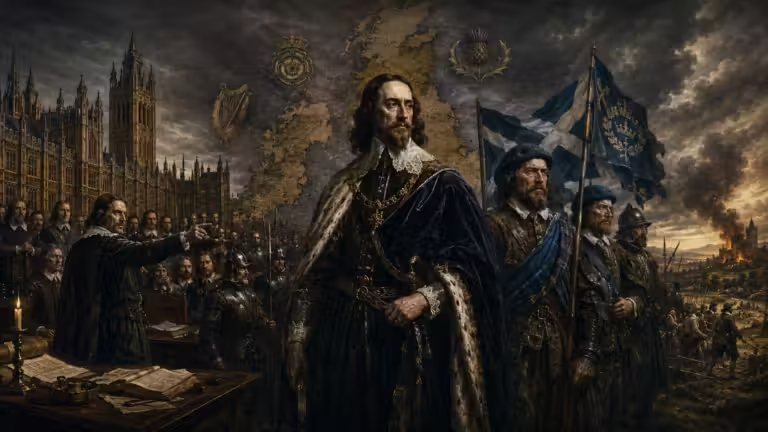
The Stuart crisis was not merely a quarrel between an English king and an English Parliament. James VI and I, followed by Charles I, ruled England, Scotland and Ireland as three distinct kingdoms with different churches, laws and political institutions. Attempts to impose greater religious and political uniformity destabilised this composite monarchy and produced the interconnected Wars of the Three Kingdoms.
The Stuart crisis followed a century of religious division and territorial expansion. The English Crown had strengthened its authority within the British Isles, but ruling several kingdoms proved far harder than conquering or planting territory.

Why call them the Wars of the Three Kingdoms?
The expression “English Civil War” usually describes the conflicts fought between Royalists and Parliamentarians from 1642. However, that name can conceal the wider crisis that connected England, Scotland and Ireland. Armies, political alliances and religious disputes repeatedly crossed the borders between the three Stuart kingdoms.
Scottish resistance to Charles I began before open war in England. Rebellion in Ireland then intensified English fears about Catholicism and raised the question of who should control the army. Scottish, Irish and English forces later intervened in one another’s conflicts, often forming alliances that changed as the wars developed.
Historians therefore increasingly refer to the Wars of the Three Kingdoms. The term presents the conflicts as a connected struggle over monarchy, religion, government and sovereignty rather than as an exclusively English constitutional revolution.
The three kingdoms did not yet form the United Kingdom or even the Kingdom of Great Britain. They shared a monarch after 1603, but retained separate parliaments, laws and established churches. This combination of one ruler and several political systems made the Stuart monarchy powerful in appearance but structurally fragile.
The Union of the Crowns in 1603
Elizabeth I died without children in March 1603. James VI of Scotland inherited the English and Irish crowns and became James I of England. For the first time, one monarch ruled all three kingdoms of England, Scotland and Ireland.
This dynastic event is known as the Union of the Crowns. However, it did not create a united British state. England and Scotland remained independent kingdoms with separate parliaments, legal systems and churches, while Ireland possessed its own Parliament under extensive English influence.
James promoted the idea of Great Britain and sometimes styled himself King of Great Britain. Nevertheless, neither the English nor Scottish Parliament accepted a complete political union. Many English politicians feared the financial and constitutional consequences, while Scots worried that their smaller kingdom would become subordinate to England.
The new monarchy was therefore composite rather than unitary. James had to negotiate separately with political and religious institutions in each kingdom. A policy acceptable in England might provoke opposition in Scotland or Ireland, while events in one kingdom could destabilise the others.

James I, divine right and parliamentary government
James believed that monarchy possessed divine authority. Kings received their office from God and could not be treated as ordinary public officials appointed by their subjects. However, James did not simply claim that monarchs could rule without law or tradition.
In practice, his theory placed the Crown above direct political accountability. Parliament could advise the king, grant taxation and pass legislation, but James resisted claims that the Commons possessed powers independent of royal recognition. Members of Parliament increasingly defended their privileges as established rights rather than temporary concessions.
The resulting conflict concerned both political principle and practical government. The Crown needed Parliament to approve extraordinary taxation, particularly during war. The Commons often used requests for money to demand answers to grievances concerning religion, royal ministers, monopolies and foreign policy.
James inherited considerable royal debt and maintained an expensive court. He raised money through customs duties, the sale of honours and commercial monopolies. These policies created resentment, but disagreement did not yet make civil war inevitable.
Religious tensions under James I
Religious division remained one of the monarchy’s greatest difficulties. The Church of England combined Protestant doctrine with bishops, liturgy and a close relationship between Church and Crown. Some Puritans wanted further reform, while Catholics hoped that James would relax the penalties imposed under Elizabeth I.
The Hampton Court Conference of 1604 considered several Puritan grievances but preserved the episcopal structure of the Church. Its most enduring result was the translation later known as the King James Bible, published in 1611. The new Bible strengthened vernacular Protestant culture without satisfying those who wanted Presbyterian or congregational reform.
The Gunpowder Plot and anti-Catholic fear
In November 1605, a group of English Catholics attempted to destroy the king and Parliament by placing gunpowder beneath the House of Lords. The authorities discovered the conspiracy before the opening of Parliament and arrested Guy Fawkes beside the explosives.
The plot was organised by a small group and did not represent English Catholics as a whole. Nevertheless, it reinforced the association between Catholicism, treason and foreign influence. Governments and Protestant polemicists repeatedly revived this fear during later political crises.
Scotland’s Presbyterian Kirk
Scotland presented a different religious problem. The Scottish Reformation had produced a Calvinist Kirk in which ministers and elders exercised authority through representative assemblies. Many Scottish Protestants rejected bishops because they regarded episcopacy as unscriptural and politically dangerous.
James gradually restored bishops to positions of influence in Scotland. He viewed episcopal government as a source of order and an instrument of royal authority. However, many ministers and nobles continued to defend the independence of the Kirk from direct royal control.
James understood Scottish politics better than his son later would. He advanced ecclesiastical changes cautiously and often relied on negotiation. The tensions remained unresolved, but they did not erupt into open rebellion during his reign.
Ireland, plantation and confessional division
English power expanded dramatically in Ireland after the end of the Nine Years’ War in 1603. The Flight of the Earls in 1607 allowed the Crown to confiscate extensive lands in Ulster. English and Scottish Protestant settlers then occupied plantations organised under royal authority.
Most of the Irish population remained Catholic, while the established Church of Ireland was Protestant. Political loyalty, land ownership and religious identity consequently became closely connected. Catholics included both Gaelic Irish families and descendants of medieval Anglo-Norman settlers commonly known as the Old English.
The Crown hoped that plantation, English law and Protestant institutions would stabilise Ireland. Instead, land confiscation and religious exclusion created grievances that would later contribute to rebellion. Ireland became the kingdom in which Stuart state-building produced the deepest combination of colonial, political and confessional conflict.

Charles I inherits the three kingdoms
Charles I succeeded James in 1625. He shared his father’s belief in sacred monarchy but possessed less political flexibility. His reserve, insistence on ceremony and reluctance to explain his intentions encouraged distrust among opponents.
Charles also married Henrietta Maria, the Catholic daughter of Henry IV of France. The marriage did not make Charles a Catholic, but her private chapel, Catholic household and influence at court increased Protestant suspicion. Critics feared that the king’s religious policies might eventually return England to Rome.
War, finance and the Duke of Buckingham
Charles inherited unsuccessful wars against Spain and later fought France. His favourite and principal minister, George Villiers, Duke of Buckingham, directed costly expeditions that ended in failure. Parliament repeatedly criticised Buckingham’s leadership and resisted granting the king sufficient long-term revenue.
Charles attempted to finance his policies without normal parliamentary approval. The Forced Loan of 1626–1627 required wealthy subjects to lend money to the Crown. Several men who refused were imprisoned without a conventional trial.
The dispute raised a constitutional question that went beyond the amount of money demanded. Could the king impose financial obligations and detain opponents through royal prerogative, or did inherited law protect subjects against such actions?
The Petition of Right of 1628
Charles summoned Parliament again in 1628 because he needed further funds. Before granting taxation, the Commons and Lords presented the Petition of Right. The document restated limits on the Crown’s power and appealed to existing law rather than declaring a new democratic constitution.
The petition condemned taxation without parliamentary consent, imprisonment without a stated legal cause, the billeting of soldiers in private homes and the use of martial law during peacetime. Charles eventually accepted it, although disagreement continued over whether his acceptance fully restricted the royal prerogative.
The Petition of Right later became a major landmark in British constitutional history. However, it did not solve the immediate conflict. Charles continued to collect customs duties that Parliament had not granted permanently, while MPs denounced changes in the Church of England.
In March 1629, members physically prevented Speaker John Finch from ending a Commons sitting on the king’s instructions. They passed resolutions against unauthorised taxation and religious innovation before Charles dissolved Parliament. He would not summon another English Parliament for eleven years.

The Personal Rule, 1629–1640
The period during which Charles governed England without Parliament became known as the Personal Rule. Later critics called it the “Eleven Years’ Tyranny”, although the king continued to work through courts, royal councils, judges and local officeholders rather than ruling alone.
Charles initially achieved a degree of financial stability and avoided expensive continental wars. Many subjects accepted royal government as long as taxation remained limited and public order continued. Opposition grew when the Crown expanded old fiscal devices and pursued controversial religious reforms.
Ship Money and government without Parliament
Ship Money traditionally required coastal communities to provide ships or funds during emergencies. Charles extended the levy across England and collected it during peacetime. The measure produced useful revenue but appeared to create a permanent national tax without parliamentary consent.
John Hampden refused to pay a small assessment and challenged the levy in court. In 1637, a majority of judges ruled for the Crown, but the narrow decision gave the campaign against Ship Money national prominence. Resistance increased as confidence in the legality of the tax declined.
The government also revived forest fines, imposed penalties for failing to accept knighthood and sold monopolies. Individually, many of these devices possessed historical precedents. Collectively, they appeared to opponents as an attempt to make parliamentary taxation unnecessary.
Laudian reform and the fear of Catholicism
William Laud became Archbishop of Canterbury in 1633 and supported greater uniformity within the Church of England. He promoted ceremonial worship, the authority of bishops and stricter regulation of parish churches and clergy. Communion tables were moved to the eastern end of churches and enclosed by rails.
Laud and Charles considered these changes compatible with Protestantism and orderly worship. However, many Puritans associated altars, vestments, images and sacramental ceremony with Catholicism. They feared that the government intended to reverse the achievements of the Reformation.
Church courts punished outspoken critics. William Prynne, Henry Burton and John Bastwick received severe sentences for attacking the bishops. Their punishment converted religious disagreement into a broader argument about censorship, arbitrary justice and the political power of the episcopacy.
Scotland breaks the Personal Rule
Charles’s government might have continued without an English Parliament had the king not attempted to transform Scottish worship. He wanted greater uniformity across his kingdoms and supported a new Scottish prayer book influenced by Anglican liturgy.
When clergy first used the prayer book in Edinburgh in July 1637, opposition erupted. Protesters regarded the liturgy as an assault on the Reformed character and institutional independence of the Kirk. Resistance soon spread beyond individual congregations.
The National Covenant of 1638
Scottish opponents drew up the National Covenant in February 1638. Its supporters pledged to defend the Reformed religion and resist innovations imposed without the approval of the Kirk and Scottish political institutions. Copies circulated through parishes and attracted thousands of signatures.
The Covenanters did not initially reject monarchy. They claimed loyalty to Charles while denying that royal authority allowed him to alter the Church arbitrarily. This distinction between resistance to a policy and rebellion against a king became increasingly difficult to maintain.
The Glasgow General Assembly of 1638 rejected the prayer book and removed bishops from the Scottish Church. Charles considered these decisions unlawful and prepared to enforce his authority militarily. The religious dispute had now become a constitutional confrontation.
The Bishops’ Wars
The First Bishops’ War began in 1639 but ended without a decisive battle. Charles lacked money, reliable troops and an effective supply system. A temporary settlement failed because neither side trusted the other’s interpretation of its terms.
War resumed in 1640. The Covenanter army entered northern England and defeated royal forces at Newburn. Charles had to negotiate while paying the expenses of the Scottish army occupying parts of Northumberland and Durham.
The Scottish crisis destroyed the financial basis of Personal Rule. To fund the war, Charles had already summoned the Short Parliament in April 1640. When MPs demanded that grievances be addressed before voting money, he dissolved it after only three weeks.
Military defeat left him no alternative but to call Parliament again. The Long Parliament first assembled in November 1640. It would remain a central political institution throughout the revolution and civil wars.
The Long Parliament dismantles Personal Rule
Parliament’s initial objective was not to abolish monarchy. Many members wanted to remove unpopular ministers, prevent government without Parliament and protect the Protestant religion. Charles’s weakness allowed them to dismantle several instruments of Personal Rule.
Thomas Wentworth, Earl of Strafford, had governed Ireland for Charles and became a symbol of authoritarian government. His opponents accused him of intending to use an Irish army against the king’s English subjects. Parliament ultimately condemned him through an Act of Attainder, and he was executed in May 1641 after Charles approved the legislation.
Archbishop Laud was imprisoned, although he would not be executed until 1645. Parliament abolished the courts of Star Chamber and High Commission, which critics associated with arbitrary punishment and religious coercion. It also declared Ship Money unlawful.
The Triennial Act required regular parliaments, while another statute prevented the Long Parliament from being dissolved without its own consent. These measures substantially restricted royal freedom of action. However, they did not resolve who should control ministers, the Church or the armed forces.
The Irish Rebellion of 1641
Rebellion began in Ulster in October 1641. Some Catholic landowners originally intended to seize strategic positions and negotiate concessions from the Crown. The rising quickly widened into attacks on Protestant settlers and a broader conflict over land, religion and political authority.
Violence included killings, forced expulsions, imprisonment and the destruction of property. Protestant reprisals also killed Catholic civilians. Reports circulated through England and Scotland, where printed accounts sometimes combined genuine testimony with rumours and greatly exaggerated casualty figures.
The rebellion transformed the struggle between Charles and Parliament. Both agreed that an army should restore order, but neither trusted the other to control it. MPs feared that Charles might use troops raised for Ireland against his opponents in England.
Irish Catholic leaders established the Confederate Catholic Association in 1642, with its political centre at Kilkenny. The Confederates professed loyalty to the king while demanding religious toleration, political reform and the restoration of Catholic property. Their position illustrates why the wars cannot be reduced to a simple division between royalists and rebels.
The final breakdown of trust in England
During 1641, Parliament itself became increasingly divided. Some members believed that the reforms already enacted had protected the constitution. Others feared that Charles would reverse them as soon as he recovered sufficient authority.
The Grand Remonstrance
John Pym and his allies drafted the Grand Remonstrance, a long catalogue of grievances against the king’s government. It condemned religious innovations, arbitrary taxation and the influence of allegedly corrupt or Catholic advisers.
The Commons approved it in November 1641 by a narrow majority. The closeness of the vote revealed a major political realignment. Many members who had opposed Personal Rule now feared that parliamentary leaders intended to control the king and transform the established Church too radically.
The future Royalist and Parliamentarian coalitions consequently emerged from former allies as well as longstanding enemies. The choice of sides depended on religion, local loyalties, constitutional principles, family connections and perceptions of immediate danger.
Charles I enters the House of Commons
Charles accused five leading members of the Commons and one peer of treason. On 4 January 1642, he entered the House of Commons with an armed escort and attempted to arrest the five MPs personally. They had already escaped.
Speaker William Lenthall refused to reveal their location and declared that he could act only as the servant of the House. The event represented an unprecedented violation of parliamentary privilege. Charles left London several days later after public demonstrations turned strongly against him.
The attempted arrest destroyed much of the remaining trust between Crown and Commons. Parliament increasingly acted as though the king’s advisers presented an immediate threat, while Charles believed that revolutionary politicians had usurped his lawful authority.
Who controlled the militia?
The Irish crisis made military control unavoidable. Parliament passed the Militia Ordinance in March 1642 and appointed commanders without royal assent. Because the king did not approve it, the measure was an ordinance rather than a conventional Act of Parliament.
Charles responded by issuing Commissions of Array that called local forces to royal service. Each side now claimed constitutional legitimacy and accused the other of preparing unlawful violence. Negotiation continued, but both camps began acquiring weapons, money and supporters.
In June, Parliament presented the Nineteen Propositions, which would have placed control of ministers, the militia and important aspects of church government under parliamentary influence. Charles rejected terms that he believed would reduce monarchy to a ceremonial institution.
On 22 August 1642, Charles raised his royal standard at Nottingham. This symbolic action marked the formal beginning of war between the king and Parliament in England. Yet armed conflict had already begun in Scotland and Ireland.
Who fought in the Wars of the Three Kingdoms?
The wars did not divide the population into two simple ideological camps. Royalists could defend traditional law and Parliament while believing that armed resistance to the monarch was illegitimate. Parliamentarians could oppose Charles without supporting democracy or religious toleration.
Scottish Covenanters defended Presbyterian government and the constitutional authority of the Scottish Kirk and Parliament. Irish Confederates sought Catholic rights, political security and protection or restoration of land. Both groups could negotiate with Charles while simultaneously opposing elements of royal policy.
Local conditions also mattered. Towns, counties, noble families and religious communities made decisions according to regional rivalries and immediate military pressures. Neutrality became difficult as both sides demanded taxation, soldiers, horses, food and accommodation.
Royalists
Royalists supported Charles I and defended the monarchy, the established social hierarchy and, in England, an episcopal Church. Their opponents later called them Cavaliers. However, Royalism included committed Protestants, constitutional conservatives, Catholics and people motivated primarily by personal or regional loyalty.
Parliamentarians
Parliamentarians claimed that they fought to defend Parliament, Protestant religion and the laws of the kingdom against corrupt advisers. They were later associated with the name Roundheads. Their coalition contained moderate Anglicans, Presbyterians, Puritans and increasingly independent religious groups.
Covenanters
The Covenanters controlled Scotland after the National Covenant and Bishops’ Wars. They wanted a Presbyterian religious settlement and initially hoped to preserve monarchy under constitutional and ecclesiastical limitations. Their intervention would prove decisive during the First English Civil War.
Irish Confederates
The Confederates governed much of Ireland from 1642. They combined Gaelic Irish and Old English Catholic interests, although those groups did not always share the same priorities. Some favoured an agreement with Charles, while others demanded stronger guarantees for Catholicism and land restoration.
Interlocking wars and changing alliances
The first major battle between Charles and the English Parliament took place at Edgehill in October 1642. Neither side secured a decisive victory. The war then developed through regional campaigns, sieges and competition for strategically important towns.
Parliament sought military assistance from the Scottish Covenanters. Through the Solemn League and Covenant of 1643, Parliament promised to reform religion in England and Ireland according to a broadly Reformed model. A Scottish army entered England in 1644 and helped Parliament defeat Royalist forces at Marston Moor.
The alliance did not mean that Scottish Presbyterians and English Parliamentarians shared identical objectives. Many English Independents rejected a compulsory national Presbyterian Church. Those disagreements became increasingly important after the defeat of the king.
In Scotland, the Royalist commander James Graham, Marquess of Montrose, fought the Covenanter government with Highland forces and soldiers from Confederate Ireland. His campaigns demonstrated how the conflicts crossed national and religious boundaries. Royalism in Scotland differed significantly from Royalism in southern England.
Charles also negotiated with the Irish Confederates, hoping that an agreement would release troops for service elsewhere. Yet concessions to Irish Catholics threatened to alienate Protestant supporters in England and Scotland. Every attempted settlement in one kingdom carried political consequences in the other two.
From the First Civil War to the execution of Charles I
Parliament reorganised its forces through the New Model Army in 1645. The army defeated the main Royalist field force at Naseby in June and captured evidence of Charles’s negotiations with Irish Catholics and foreign powers. Royalist resistance continued, but the king could no longer win the First Civil War militarily.
Charles surrendered to the Scottish army in 1646. He then attempted to exploit divisions between the Scots, the English Parliament and the New Model Army. He negotiated with several parties while avoiding a permanent religious or constitutional settlement.
A Second Civil War broke out in 1648 after Royalist risings and a Scottish invasion undertaken on the king’s behalf. The New Model Army defeated its opponents and concluded that Charles could not be trusted. Army leaders removed moderate MPs through Pride’s Purge in December.
The remaining Rump Parliament created a special court to try the king. Charles rejected its authority, arguing that no earthly court could judge a lawful monarch. He was convicted of treason and executed outside the Banqueting House in Whitehall on 30 January 1649.
The execution was revolutionary, but it did not conclude the Wars of the Three Kingdoms. England abolished monarchy and declared a Commonwealth, while the Scottish and Irish conflicts continued. Scotland recognised Charles II, and Irish Royalist and Confederate forces remained in the field.
The wars continue in Ireland and Scotland
In 1649, an English parliamentary army commanded by Oliver Cromwell invaded Ireland. The campaign included the notorious storming of Drogheda and Wexford, followed by further military operations, land confiscation and population displacement. Resistance continued after Cromwell returned to England.
The Scottish Covenanter government proclaimed Charles II but required him to accept Presbyterian conditions. Cromwell invaded Scotland in 1650 and defeated the Scottish army at Dunbar. Charles II then entered England but suffered defeat at Worcester in September 1651.
Worcester conventionally marks the end of the principal Wars of the Three Kingdoms. England, Scotland and Ireland came under the authority of the republican regime backed by the army. However, military occupation and resistance continued, particularly in Ireland.
The next article in this series examines the military revolution, the Commonwealth and Oliver Cromwell’s Protectorate in greater detail.
Religion at the centre of the Stuart crisis
Religion did not merely provide language for political and economic disputes. Contemporaries believed that correct worship determined the spiritual survival of individuals and entire kingdoms. Changes to liturgy or church government therefore appeared capable of bringing divine punishment.
Charles and Laud considered uniform worship essential to order. Scottish Covenanters viewed royal interference as a violation of Christ’s authority over the Kirk. Puritans feared a Catholic conspiracy, while Irish Catholics sought relief from a state that restricted their worship and political influence.
These convictions made compromise difficult. A solution acceptable to English Anglicans could threaten Scottish Presbyterians. Concessions to Irish Catholics might appear as betrayal to English and Scottish Protestants.
The wars consequently generated greater religious diversity as well as renewed coercion. The collapse of censorship and episcopal control allowed Baptists, Independents, Seekers and other movements to publish and organise. Yet most political groups still expected some form of national religious settlement.
Was the conflict a democratic revolution?
The struggle weakened traditional monarchy and encouraged unprecedented political debate. Parliament claimed the right to resist the king, the New Model Army became a political actor and radical groups proposed extensive reforms. The trial of an anointed monarch challenged assumptions that had structured European politics for centuries.
However, Parliament did not initially fight for modern democracy. Most MPs defended a political system led by property owners and social elites. They disagreed with Charles over the distribution and lawful exercise of authority rather than advocating universal political equality.
More radical ideas emerged during the wars. The Levellers demanded broader male suffrage, equality before the law, regular parliaments and religious toleration. Their proposals influenced the Putney Debates of 1647 but were resisted by senior army officers and property owners.
The revolution therefore opened political possibilities that its principal leaders had not originally intended. It expanded public argument about sovereignty and consent while also producing military government, censorship and religious persecution.
The human cost of the wars
The conflicts affected civilians as well as soldiers. Armies requisitioned food, occupied homes, damaged crops and spread disease. Sieges disrupted urban life, while local economies suffered from taxation and interrupted trade.
Women managed estates, defended households, petitioned authorities, carried intelligence and sometimes participated directly in military defence. They also faced displacement, widowhood and economic insecurity. Printed petitions allowed some women to intervene publicly in religious and political debates.
Ireland suffered particularly severe destruction through rebellion, massacre, conquest, famine, disease and confiscation. Scotland experienced invasion and military occupation, while parts of England and Wales endured prolonged campaigns. No kingdom escaped the effects of a war created by their political interdependence.
The constitutional legacy of the Stuart crisis
The wars demonstrated that the monarch could not govern all three kingdoms by imposing one religious and political model. They also showed that Parliament could challenge royal government, raise armies and create institutions without the king’s approval.
Nevertheless, parliamentary victory did not immediately establish parliamentary sovereignty. The army purged and dissolved parliaments, while the Commonwealth struggled to construct a stable constitutional settlement. England would restore the monarchy in 1660.
The central disputes remained unresolved after the Restoration. Who controlled taxation, the armed forces, ministers and religion? Could a monarch suspend laws or govern without regular parliaments? These questions returned during the reigns of Charles II and James II.
The Glorious Revolution of 1688 cannot therefore be understood as an isolated or entirely peaceful event. It emerged from memories of civil war, fears of Catholic monarchy and decades of failed attempts to balance royal authority with parliamentary government.
The Stuart crisis and the Atlantic world
The conflicts also affected English expansion overseas. Religious disputes had already encouraged Puritan migration to New England during the 1630s. The fall of royal authority then weakened metropolitan control and allowed some colonies greater political freedom.
Colonies did not respond uniformly. Some supported Parliament, while others retained Royalist sympathies. Barbados, Virginia and several Caribbean settlements became entangled in the conflict, demonstrating that the English Atlantic world formed part of the wider Stuart crisis.
The Commonwealth later attempted to restore imperial control through military force and commercial regulation. The Navigation Act of 1651 connected the republican regime to a more assertive maritime policy. These developments would help transform English expansion into a regulated Atlantic empire.
The political language generated by the wars also travelled across the Atlantic. Arguments concerning covenant, consent, taxation, representation and resistance would later influence colonial debates. However, colonial societies applied these ideas selectively while excluding Indigenous peoples, enslaved Africans and many European settlers from political power.
- The Reformation in the British Isles: Causes and Legacy
- English Expansionism: From the British Isles to the Atlantic Empire
- The Glorious Revolution of 1688
- Puritanism and Expansionism in Early America
- The Act of Union of 1707
Frequently asked questions about the Stuart crisis
What were the Wars of the Three Kingdoms?
The Wars of the Three Kingdoms were interconnected conflicts fought across England, Scotland and Ireland between the late 1630s and 1651. They involved disputes over monarchy, parliamentary authority, religion, land and the government of the three Stuart kingdoms.
Why is “English Civil War” an incomplete name?
The term focuses on the war between Charles I and the English Parliament. Scottish resistance began earlier, while the Irish Rebellion and armies moving between the kingdoms directly affected the English conflict. “Wars of the Three Kingdoms” reflects this wider context.
Why did Charles I rule without Parliament?
Charles dissolved Parliament in 1629 after repeated conflicts over taxation, religion and royal authority. He governed England without another Parliament until 1640, raising revenue through measures including Ship Money, monopolies and revived feudal fines.
How did Scotland cause the end of Personal Rule?
Scottish resistance to Charles’s prayer book produced the National Covenant and Bishops’ Wars. Charles needed money to fight the Covenanters, forcing him to recall the English Parliament. His military defeat in 1640 made continued government without Parliament impossible.
Why was the Irish Rebellion of 1641 so important?
The rebellion created an urgent need for an army but intensified distrust between Charles and Parliament. Each side feared that the other would use military forces to seize political power. Reports of violence also strengthened English and Scottish fears of Catholic conspiracy.
Did Parliament fight for democracy?
Most Parliamentarians initially fought to defend established laws, Parliament and Protestant religion rather than modern democracy. More radical groups such as the Levellers later demanded broader political participation, but Parliament and senior army leaders rejected many of their proposals.
Sources and further reading
- UK Parliament: key dates from 1603 to 1640
- UK Parliament: key dates from 1640 to 1660
- UK Parliament: the Petition of Right
- UK Parliament: Charles I and the Petition of Right
- The National Archives: Charles I
- The National Archives: taxation before 1689
- National Museums Scotland: Charles I and the Scottish Kirk
- National Museums Scotland: the Covenanters and National Covenant
- UK Parliament: the breakdown of 1641–1642
- UK Parliament: Charles I and the Five Members
- UK Parliament: civil war in Ireland
- UK Parliament: revolution and civil war across the three kingdoms
- The National Archives: women and the English Civil Wars
- History Ireland: the Irish Confederate War
The collapse of royal government opened a more radical phase of revolution. The next article examines the New Model Army, the execution of Charles I, the Commonwealth and Oliver Cromwell’s rule across England, Scotland and Ireland.
