
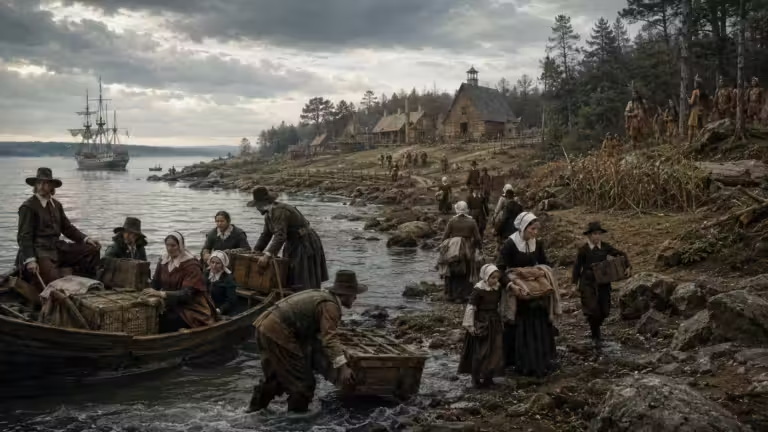
The Great Migration carried thousands of English Puritans to New England during the 1630s. They did not simply flee persecution in search of individual religious freedom. Instead, they intended to establish disciplined Protestant communities governed through covenant, scripture and collective responsibility. Their settlements encouraged literacy, local government and political participation among selected colonists, while also enforcing conformity and expanding across Indigenous homelands.
The Puritan migration formed part of the wider religious and constitutional history of the British Atlantic. The previous article examined how the Glorious Revolution protected a Protestant political order while leaving the position of religious minorities unresolved.

What was Puritanism?
Puritanism emerged from the English Reformation during the late sixteenth century. Puritans accepted the Protestant break with Rome but believed that the Church of England still preserved too many Catholic ceremonies, institutions and assumptions.
They objected to practices such as elaborate vestments, ceremonial worship and the authority of bishops. They instead emphasised scripture, preaching, moral discipline and the direct examination of personal faith.
Puritanism was not one organised denomination. The term covered ministers, theologians, lay believers and political reformers who disagreed about church government, worship and the limits of obedience to the established Church.
Most Puritans remained members of the Church of England and sought to reform it from within. Others concluded that no true Christian congregation could remain inside an institution they considered corrupt. These more radical believers became known as Separatists.
Puritans, Separatists and Pilgrims
The terms Puritan and Pilgrim are related but not interchangeable. The Pilgrims who established Plymouth Colony belonged to the broader Reformed movement, but they were Separatists who had formally withdrawn from the Church of England.
By contrast, most of the migrants who founded Massachusetts Bay from 1630 did not initially describe themselves as Separatists. They hoped that their New England churches would provide an example capable of inspiring further reform within England.
This distinction shaped their colonial institutions. Plymouth developed from a relatively small Separatist congregation, whereas Massachusetts Bay became a much larger project supported by a chartered company, influential ministers and members of the English gentry.
Neither group migrated merely because it wanted to practise any religion freely. Both sought the freedom to construct and defend communities based on their own understanding of true Christianity.

Why were English Puritans dissatisfied?
Elizabeth I’s religious settlement had established a Protestant national Church under royal authority. However, bishops, a formal liturgy and many traditional ceremonies survived. Puritans believed that the English Reformation had stopped before completing its work.
James I rejected demands for Presbyterian government at the Hampton Court Conference of 1604. He approved several limited reforms and authorised the biblical translation published in 1611, but he preserved bishops and the Book of Common Prayer.
Puritans also faced restrictions on unauthorised preaching and worship. Separatist congregations could encounter surveillance, fines and imprisonment because leaving the established Church challenged both religious and political authority.
The pressure intensified after Charles I became king in 1625. Charles and Archbishop William Laud promoted ceremonial uniformity and punished prominent critics. Puritans increasingly interpreted Laudian worship as evidence that the Crown intended to reverse the Protestant Reformation.
Charles dissolved Parliament in 1629 and began eleven years of government without another English Parliament. Political exclusion, religious anxiety and economic uncertainty persuaded some Puritan families that reform within England had become impossible.
The Separatists in the Dutch Republic
One English Separatist community left England for the Dutch Republic during the early seventeenth century. Its members eventually settled in Leiden, where they enjoyed greater freedom of worship than English law permitted.
Life in the Netherlands nevertheless presented difficulties. Many migrants worked in demanding trades, while community leaders worried that their children would adopt Dutch language and customs. They also feared that renewed European war might threaten their security.
The congregation therefore considered establishing a colony where it could preserve its religious identity and govern its communal life. Its members negotiated with English investors and secured permission connected to the Virginia Company’s colonial territory.
Only part of the Leiden congregation joined the voyage. Other passengers travelled for commercial, family or personal reasons and did not necessarily share the Separatists’ religious programme. William Bradford later distinguished the religious congregation from these other passengers, whom he called Strangers.
The Mayflower and the founding of Plymouth
The Mayflower sailed from England in September 1620 carrying just over one hundred passengers. Its intended destination lay within the Virginia Company’s territory, but storms and navigational difficulties brought the ship to Cape Cod.
The passengers had arrived north of the area covered by their original patent. Some reportedly argued that no lawful government would control them once they landed. The colony therefore needed an agreement capable of maintaining order until it obtained clearer legal authority.
The Mayflower Compact
Forty-one adult male passengers signed the Mayflower Compact in November 1620. They agreed to create a “civil Body Politick” and to obey laws enacted for the general good of the colony.
The document adapted the language of religious covenant to an immediate political problem. It established a basis for collective government among the settlers without rejecting the authority of King James I.
The Compact did not create modern democracy. Women, servants, children and Indigenous inhabitants took no part in its formation. Nor did it establish universal suffrage, religious equality or independence from England.
Its later constitutional reputation became much greater than its original purpose. American political writers eventually treated it as an early expression of government by consent, although its signatories primarily intended to prevent disorder within a vulnerable settlement.
Plymouth was built within Wampanoag homelands
The colonists did not enter an empty wilderness. The region formed part of the homelands of the Wampanoag and neighbouring Indigenous peoples, whose communities maintained political alliances, agricultural systems and territorial claims.
Epidemics introduced through earlier European contact had devastated coastal populations before the arrival of the Mayflower. The Patuxet village where the English established Plymouth had suffered particularly severe population loss.
The surviving colonists endured disease, hunger and exposure during their first winter. Approximately half of the passengers died. Their settlement survived through their own labour, supplies from the ship and crucial knowledge obtained from Indigenous people.
Tisquantum, commonly known as Squanto, had been kidnapped by an Englishman and transported across the Atlantic years earlier. After returning to New England, he acted as an interpreter and intermediary between Plymouth and the Wampanoag.
Ousamequin, called Massasoit by the English, negotiated an alliance with Plymouth in 1621. The agreement served Wampanoag strategic interests as well as English survival, particularly within a regional balance of power transformed by epidemics.
The relationship should not be reduced to a simple story of friendship. Both sides pursued political security, and neither could predict the demographic and territorial growth that later transformed the balance between them.

From Plymouth to Massachusetts Bay
Plymouth remained small and financially fragile. A much larger colonial enterprise developed after investors established the Massachusetts Bay Company and received a royal charter from Charles I in 1629.
The company possessed unusually broad powers to govern its territory. Its leaders transferred the charter and administrative centre to New England rather than leaving the company’s governing board in London.
This decision allowed the colonists to exercise substantial political autonomy. The company’s commercial organisation became the foundation of a colonial government led by a governor, assistants and General Court.
Massachusetts Bay was therefore both a religious project and a chartered corporation. Spiritual ambition, investment, land acquisition and political organisation developed together rather than as separate motives.
The Winthrop Fleet of 1630
John Winthrop led a fleet of eleven ships towards New England in 1630. Approximately seven hundred passengers travelled during this first major movement, while thousands more followed during the decade.
The settlers established or expanded communities around Salem, Boston, Charlestown, Dorchester, Roxbury and Watertown. They brought livestock, tools, household goods, servants and capital intended for permanent settlement.
Winthrop belonged to the English gentry and had experience as a lawyer and estate owner. He served repeatedly as governor but did not possess permanent personal authority. Colonial freemen elected governors and magistrates at regular intervals.
The early colony nevertheless experienced severe hardship. Disease, inadequate housing, food shortages and unfamiliar environmental conditions caused deaths and encouraged some settlers to return to England.
What was the Great Migration?
The term Great Migration usually describes the movement of roughly 20,000 English settlers to New England between 1630 and 1640. Massachusetts Bay received the largest share, although migrants also established communities in Connecticut, Rhode Island, New Hampshire and what became Maine.
This migration formed only one part of a much larger movement out of England. Other English migrants travelled to Ireland, the Caribbean, the Dutch Republic and the Chesapeake colonies.
New England’s migrants differed demographically from many settlers who travelled to Virginia or the Caribbean. They frequently arrived in family groups containing parents, children and servants, which created a more balanced population.
Many belonged to the middling ranks of English society. They included artisans, farmers, merchants, ministers and property owners. New England offered no immediate equivalent to Virginia tobacco or Caribbean sugar, so the region attracted fewer migrants seeking rapid wealth through a single export crop.
Religious motivation remained central, but migrants also sought land, community stability and economic independence. Their decisions combined conviction with the practical calculations of families planning permanent relocation.
Why did the Great Migration end?
The flow of Puritan migrants declined sharply after 1640. Charles I summoned the Long Parliament that year, and Puritan political influence increased dramatically within England.
The English Civil War then created new possibilities for religious and political reform at home. Puritans who might previously have emigrated could instead participate in the parliamentary cause.
Some New England settlers returned to England to preach, fight or pursue political careers. The Atlantic movement was therefore not entirely one-directional. Families, ministers, merchants and political ideas continued to circulate between England and the colonies.
The end of large-scale migration left Massachusetts with an established settler population capable of growing through natural increase. Its expanding towns would continue to seek new farmland long after the political reasons for migration had changed.
A Model of Christian Charity
John Winthrop expressed the colony’s social and religious ideals in the sermon commonly known as A Model of Christian Charity. He described the community as a “city upon a hill” watched by the world.
The phrase is now often used to celebrate American exceptionalism. Winthrop’s original argument was more demanding and less triumphant. Visibility meant that failure would expose the settlers’ hypocrisy and bring dishonour upon their religious mission.
Winthrop did not imagine a society without hierarchy. He assumed that inequalities of wealth and status would continue. The covenant instead required richer and poorer colonists to recognise mutual obligations within an interdependent Christian community.
Charity, discipline and collective obedience would demonstrate the truth of the settlers’ faith. Individual ambition had to remain subordinate to the spiritual survival of the community.
Later political rhetoric often retained the idea of exemplary mission while weakening Winthrop’s warnings about covenantal failure. For the longer ideological journey from Puritan providence to American exceptionalism, see Puritanism and Expansionism in Early America.
Covenant theology and social order
A covenant was a binding relationship governed by promises and obligations. Puritans used covenant language to understand salvation, church membership, marriage, civil society and the destiny of entire communities.
Individual congregations consisted of believers who entered a church covenant. Ideally, members could describe an experience of conversion and demonstrate conduct consistent with divine grace.
Puritans also believed that God judged communities collectively. Drought, epidemic, military defeat or political conflict could therefore be interpreted as punishment for shared sin.
This worldview encouraged public fasts, thanksgiving days, disciplinary hearings and communal self-examination. Political and environmental events acquired religious meaning because they appeared to reveal divine approval or anger.
Covenant ideas could support political participation because rulers remained responsible for fulfilling communal obligations. However, the same ideas could justify coercion against people considered threats to the colony’s relationship with God.
Was Massachusetts Bay a theocracy?
Massachusetts Bay is frequently described as a theocracy, but the term requires qualification. Ministers did not normally hold civil office simply because they were clergy, and churches did not directly administer every part of government.
Civil magistrates enacted laws, collected taxes and judged offences. The General Court operated through institutions derived from the company charter rather than through a formal council of ministers.
Nevertheless, Puritan theology strongly shaped law and political legitimacy. Religious offences could receive civil penalties, while ministers advised magistrates and influenced public opinion through sermons.
During much of the early colonial period, only adult male church members admitted as freemen could vote in colony-wide elections. This requirement excluded most inhabitants, including women, servants, non-members and Indigenous people.
Massachusetts Bay therefore combined civil government with an established religious order. It was neither a modern secular democracy nor a state directly governed by priests.
Town government and political participation
Puritan settlement encouraged the formation of compact towns rather than widely dispersed plantations. Congregations, houses, common land and meeting houses created visible local communities.
Town meetings allowed qualified male inhabitants to discuss roads, fences, grazing, taxation, schools and the distribution of land. Local officeholders exercised practical authority over everyday colonial life.
These institutions encouraged habits of election, petition and public argument. Officeholders did not inherit their positions permanently, and colonial leaders could face criticism or electoral defeat.
However, political participation remained socially restricted. Town government did not recognise universal equality, while wealthier families and established church members possessed disproportionate influence.
New England self-government therefore contributed to later political traditions without functioning as an early version of modern American democracy.
Literacy, education and scripture
Puritan worship placed preaching and scriptural interpretation at the centre of religious life. Believers needed sufficient literacy to read the Bible, study catechisms and examine printed sermons.
Massachusetts required towns of a certain size to support education. The legislation later nicknamed the Old Deluder Satan Act of 1647 linked schooling to the defence of religious knowledge against ignorance and error.
Harvard College was founded in 1636, only a few years after the establishment of Massachusetts Bay. Its early purpose included educating ministers capable of sustaining learned Protestant churches.
Education served religious and civic goals, but access remained unequal. Boys generally received more extensive formal instruction than girls, while social class and location affected educational opportunity.
Even so, New England developed a vigorous culture of reading, sermon publication, diaries, conversion narratives and historical writing. These literary practices shaped later American religious and intellectual traditions.
Family, gender and household authority
The household formed a central unit of Puritan social organisation. Parents and masters were expected to supervise prayer, education, labour and moral behaviour within their families.
Marriage was treated as a civil contract and religious vocation rather than a sacrament administered exclusively by the Church. Colonial courts regulated inheritance, marital disputes and sexual conduct.
Women exercised economic and spiritual influence within households and congregations. They managed farms and businesses, participated in religious discussions and often outnumbered men among full church members.
However, women could not vote in colonial elections or hold ordinary public office. Married women’s legal and economic identities were constrained by English assumptions about male household authority.
The controversy surrounding Anne Hutchinson demonstrated these limits. Her opponents objected to her theology, political alliances and willingness to exercise public religious authority beyond the roles they considered appropriate for a woman.
Roger Williams and liberty of conscience
Roger Williams arrived in Massachusetts Bay in 1631 and quickly challenged several assumptions held by its leaders. He argued that civil magistrates should govern secular conduct rather than enforce religious belief.
Williams rejected compulsory worship and state-supported religious conformity. Faith produced through punishment or political advantage could not constitute genuine belief.
He also criticised colonial claims to territory based solely on English royal charters. In his view, the Crown could not legitimately give away land already possessed by Indigenous nations.
Massachusetts authorities considered these arguments dangerous to both the Church and the legal foundations of the colony. They ordered his banishment in 1635.
Williams fled during the winter and received assistance from Narragansett people. He established Providence in 1636 on land obtained through negotiation with Narragansett leaders.
Providence and the settlements that later formed Rhode Island developed an unusually broad commitment to liberty of conscience. Williams did not merely request toleration for his own denomination; he argued that civil peace did not require religious uniformity.
Anne Hutchinson and the Antinomian Controversy
Anne Hutchinson arrived in Boston with her family in 1634. She hosted meetings in her home where women and men discussed sermons, conversion and the meaning of divine grace.
Hutchinson criticised several ministers for placing too much emphasis on visible moral conduct. She distinguished a covenant of grace from what she regarded as a misleading covenant of works.
Her opponents accused her of antinomianism, the belief that recipients of saving grace were no longer bound by moral law. Hutchinson disputed parts of this representation, but the theological controversy became inseparable from colonial politics.
Governor Henry Vane and several Boston supporters defended her, while John Winthrop and most ministers believed her teachings threatened ecclesiastical and social order. The controversy affected elections and divided influential families.
The General Court tried Hutchinson in 1637 and ordered her banishment. A church proceeding later excommunicated her. She and several followers helped establish Portsmouth on Aquidneck Island in 1638.
Her treatment reflected theological conflict, political rivalry and gendered limits on public authority. Massachusetts leaders did not punish every woman who discussed religion, but Hutchinson’s prominence made her challenge unusually threatening.
Quakers and the limits of Puritan toleration
Quaker missionaries began arriving in New England during the 1650s. Their rejection of formal clergy, oaths, social hierarchy and conventional worship directly challenged Puritan institutions.
Massachusetts responded through censorship, fines, imprisonment, physical punishment and banishment. Quakers who repeatedly returned after expulsion risked execution.
Four Quakers were executed in Boston between 1659 and 1661. The best known was Mary Dyer, who had previously supported Anne Hutchinson and lived in Rhode Island.
Puritan leaders claimed that persistent Quaker defiance threatened public order and the colony’s religious covenant. Critics argued that the executions exposed the contradiction between escaping religious coercion and reproducing it in New England.
Royal intervention eventually forced Massachusetts to end the executions. The episode strengthened Rhode Island’s contrasting reputation as a refuge for dissenters.
Puritan freedom was not universal religious freedom
The Puritans sought freedom from institutions they considered corrupt. Most did not conclude that every religious belief deserved equal protection.
They associated religious truth with the survival of the community. Error could therefore appear dangerous in the same way as sedition, fraud or public violence.
This position was not unique to Puritans. Anglican, Catholic and Reformed governments across seventeenth-century Europe commonly treated religious uniformity as a foundation of political stability.
Roger Williams’s broader theory of liberty of conscience was exceptional partly because it rejected this widespread assumption. Rhode Island did not eliminate every form of inequality, but it demonstrated that religious diversity did not necessarily destroy civil government.
New England was not an empty wilderness
Puritan writers frequently described New England as a wilderness. Biblically, wilderness could represent danger, temptation, testing and the possibility of spiritual renewal.
The word also concealed Indigenous occupation. Wampanoag, Massachusett, Narragansett, Pequot, Mohegan, Nipmuc and other peoples governed territories, cultivated fields and maintained regional trade and diplomacy.
Epidemics had killed large numbers before and during English settlement. Colonists sometimes interpreted abandoned villages or reduced populations as evidence that Providence had prepared the land for them.
This interpretation converted demographic catastrophe into religious justification. Disease did not erase Indigenous sovereignty, memory or continuing use of the land.
English settlement gradually increased pressure on hunting territories, fishing sites and agricultural land. Fences, livestock and permanent towns transformed environments shared among several Indigenous communities.
Land deeds and conflicting ideas of ownership
Colonists frequently recorded land transfers through written deeds. English officials treated these documents as permanent and exclusive transfers of ownership recognised by colonial courts.
Indigenous participants did not always understand agreements in the same way. Political leaders could authorise shared use, alliance or settlement without intending to surrender every form of territorial authority permanently.
Translation, coercion, debt and unequal legal institutions further complicated transactions. Colonial courts judged disputes through English assumptions that increasingly favoured settlers.
Roger Williams insisted that valid settlement required purchase from Indigenous owners. Yet even negotiated purchases operated within a colonial system whose growing population steadily shifted military and economic power towards the English.
The Pequot War
Conflict intensified in the Connecticut River Valley during the 1630s. English settlers, Dutch traders and Indigenous nations competed over trade, alliances and territorial control.
The Pequot occupied a powerful position in southern New England. Their rivals included the Mohegan and Narragansett, whose leaders made strategic alliances with English colonists.
A cycle of killings and reprisals developed into open war in 1636. Massachusetts Bay, Plymouth and Connecticut forces fought the Pequot with Indigenous allies who pursued their own regional objectives.
The Mystic massacre
In May 1637, English and allied Indigenous forces attacked a fortified Pequot settlement near the Mystic River. English commanders set fire to the enclosure and killed hundreds of inhabitants attempting to escape.
Many victims were women, children and older people rather than warriors engaged in open battle. Some Narragansett allies reportedly expressed horror at the English method of warfare.
English forces pursued survivors after the massacre. Colonial authorities enslaved some captives locally, distributed others among Indigenous allies and transported several people to Atlantic colonies.
The Treaty of Hartford of 1638 attempted to destroy the Pequot as an independent political identity. Survivors nevertheless preserved their communities and later re-established recognised territories.
The war opened additional land to English settlement and altered the regional balance of power. It also demonstrated how colonial expansion could combine religious rhetoric, commercial rivalry, Indigenous alliances and organised violence.
Slavery in Puritan New England
New England did not develop plantation slavery on the scale found in Barbados or Virginia during the same period. Nevertheless, unfree labour existed within Puritan colonies from their early decades.
Households employed indentured servants whose labour was controlled for a fixed term. Colonial warfare also produced Indigenous captives who were distributed as servants or sold into Atlantic slavery.
Massachusetts merchants participated in wider commercial networks involving enslaved Africans. Enslaved people lived and worked in Boston and other New England communities during the seventeenth century.
The legal status of slavery developed gradually through court decisions, legislation and commercial practice. Puritan religion did not prevent colonists from participating in racial and Indigenous enslavement.
This history complicates accounts that define New England solely through free family labour. Household settlement and commercial slavery developed within the same regional economy.
Missionaries and praying towns
Puritan ministers believed that they had a duty to spread Christianity among Indigenous peoples. Missionary work expanded during the 1640s under figures including John Eliot.
Eliot learned an Algonquian language and helped translate religious texts. A complete Bible in the Massachusett language appeared in 1663, becoming the first full Bible printed in North America.
Missionaries established settlements commonly called praying towns. Indigenous converts were encouraged to adopt Christian worship alongside English legal, agricultural and domestic practices.
Conversion could reflect genuine religious commitment, diplomatic strategy or the search for protection within a changing colonial world. Indigenous Christians did not simply abandon every element of their previous identities.
Missionary activity nevertheless operated alongside territorial expansion. English authorities often treated cultural transformation as evidence that Indigenous communities should accept colonial supervision.
The New England Confederation
Massachusetts Bay, Plymouth, Connecticut and New Haven formed the United Colonies of New England in 1643. The alliance is commonly known as the New England Confederation.
The colonies wanted to coordinate defence, diplomacy and the return of fugitives. They faced perceived threats from Dutch New Netherland, French colonies and Indigenous resistance.
Each member retained its own government, while commissioners met to consider matters of common concern. Massachusetts dominated because of its larger population and resources.
The Confederation did not create an independent New England state. Its members continued to claim authority through English charters and maintained strong cultural, economic and political connections across the Atlantic.
However, the alliance demonstrated the colonies’ ability to cooperate without constant direction from London. That experience contributed to New England’s strong tradition of regional self-government.
Puritan New England and the English Civil War
The English Civil War confirmed many Puritan criticisms of Charles I and Archbishop Laud. New England colonists generally sympathised with Parliament, although the colonies did not speak with complete political unity.
Migration to New England declined because reformers could now pursue change within England. Some ministers and settlers returned across the Atlantic and participated in parliamentary or military government.
Massachusetts also benefited from reduced imperial supervision. The Crown lacked the capacity to enforce plans for tighter control while fighting wars in England, Scotland and Ireland.
The colonies therefore developed institutions and territorial ambitions during a period of metropolitan crisis. English revolution created greater colonial autonomy without formally ending the settlers’ allegiance to England.
After the Restoration of Charles II, the Crown renewed efforts to supervise New England. Disputes over charters, trade, religious policy and imperial authority would eventually threaten Massachusetts Bay’s political independence.
Did Puritanism create American democracy?
Puritan institutions encouraged elections, representative assemblies, petitions, local meetings and written covenants. These practices contributed to traditions later associated with American self-government.
However, Puritans did not generally support democracy as universal political equality. Voting remained restricted, magistrates defended social hierarchy and religious dissent could receive civil punishment.
The political importance of the covenant also had two sides. It could make rulers accountable to communal obligations, but it could also define outsiders as threats to a chosen people.
Modern democratic institutions did not emerge from Puritanism alone. English constitutional law, colonial assemblies, religious dissent, Enlightenment philosophy, imperial conflict and the American Revolution all contributed.
Puritan New England supplied important practices and political vocabulary. It did not provide a complete or consistently democratic model.
The contradictions of Puritan liberty
Puritan settlers crossed the Atlantic partly because English institutions constrained their religious ambitions. Once in power, they created laws designed to preserve their own orthodoxy.
Their communities promoted education, covenantal responsibility and participation among selected members. They also banished dissenters, executed returning Quakers and excluded most inhabitants from colonial government.
Puritans imagined New England as a place where a reformed people might demonstrate Christian order. Yet their settlements expanded through epidemics, unequal land transfers, warfare and the subordination of Indigenous sovereignty.
These contradictions did not make Puritan ideals meaningless. They reveal how demands for freedom can remain narrow when a community defines liberty as the protection of its own mission rather than an equal right possessed by everyone.
From religious migration to an Atlantic empire
The Great Migration created a durable English population in New England. Family settlement, natural population growth and town formation gave the region a different demographic structure from plantation colonies dependent on continuous labour migration.
New England remained integrated into Atlantic commerce. Its merchants traded fish, timber, livestock and provisions with England, the Caribbean, Atlantic islands and other continental colonies.
Colonial self-government therefore existed within a larger imperial system. English authorities expected colonial trade to support metropolitan shipping, customs revenue and strategic power.
New England merchants and assemblies did not always accept those restrictions. Their resistance would become increasingly important after Parliament strengthened the Navigation Acts and attempted to regulate the expanding British Atlantic economy.
The next article examines mercantilism, chartered companies, shipping regulation, slavery and the economic structure that connected Britain, Africa, the Caribbean and mainland North America.
- The Reformation in the British Isles
- English Expansionism
- The Stuart Crisis and the Wars of the Three Kingdoms
- The Glorious Revolution of 1688
- Puritanism and Expansionism in Early America
- The American Colonies: Religion and Politics
Frequently asked questions about Puritanism and the Great Migration
Were the Pilgrims and Puritans the same?
The Pilgrims belonged to the wider Puritan movement, but they were Separatists who had left the Church of England. Most migrants to Massachusetts Bay wanted to reform the English Church rather than formally separate from it.
What was the Great Migration?
The Great Migration was the movement of roughly 20,000 English settlers to New England between 1630 and 1640. Many travelled in families and established permanent communities in Massachusetts, Connecticut, Rhode Island and neighbouring territories.
Why did the Puritans leave England?
They opposed religious policies that preserved bishops, formal liturgy and ceremonies they considered insufficiently Protestant. Under Charles I and Archbishop Laud, political exclusion and the enforcement of religious uniformity convinced many that reform within England had become impossible.
What did the Mayflower Compact establish?
The Compact created a civil political community whose male signatories promised to obey laws enacted for the colony’s general good. It preserved loyalty to the English king and did not establish universal democracy or religious freedom.
What did John Winthrop mean by a city upon a hill?
Winthrop meant that the Puritan colony would be closely watched as an experiment in covenantal Christianity. Success could provide an example, but disobedience would expose the settlers to public shame and divine punishment.
Was Massachusetts Bay a theocracy?
Religion strongly shaped its law and political legitimacy, but ministers did not directly govern every civil institution. Magistrates and the General Court exercised political authority, while church membership restricted participation in colony-wide elections.
Did the Puritans believe in religious freedom?
Most wanted freedom to establish and protect their own form of Protestantism. They did not generally support equal freedom for beliefs they considered dangerous. Massachusetts banished dissenters and executed four returning Quakers.
Why was Roger Williams banished?
Williams argued that civil government should not enforce religion and that English royal charters could not erase Indigenous ownership. Massachusetts leaders considered these positions dangerous to both religious order and the colony’s territorial legitimacy.
Why was Anne Hutchinson banished?
Hutchinson challenged influential ministers through her teachings about grace and organised religious meetings that attracted a substantial following. Her trial combined theology, political rivalry and opposition to a woman exercising prominent public religious authority.
Did Puritans settle empty land?
No. New England was governed and used by Indigenous nations including the Wampanoag, Massachusett, Narragansett, Pequot and Mohegan. Epidemics caused catastrophic population loss but did not eliminate Indigenous sovereignty or territorial claims.
Sources and further reading
- National Park Service: The Puritans
- Library of Congress: Puritan New England resource guide
- Library of Congress: the Mayflower Compact
- Commonwealth Museum: the Great Migration
- American Ancestors: New England’s Great Migration
- American Ancestors: Great Migration Study Project
- Library of Congress: religious persecution in colonial America
- National Park Service: Roger Williams and liberty of conscience
- National Park Service: Anne Hutchinson
- National Park Service: colonial Rhode Island timeline
- National Museum of the American Indian: Wampanoag and colonial timeline
- National Park Service: slavery and law in seventeenth-century Massachusetts
- National Park Service: Massachusetts and the early slave trade
- National Park Service: Jamestown and Plymouth
Puritan settlement created self-governing communities, but those communities remained embedded in English commerce and imperial authority. The next article examines mercantilism, the Navigation Acts and the Atlantic system that connected colonial production, maritime power and enslaved labour.
