
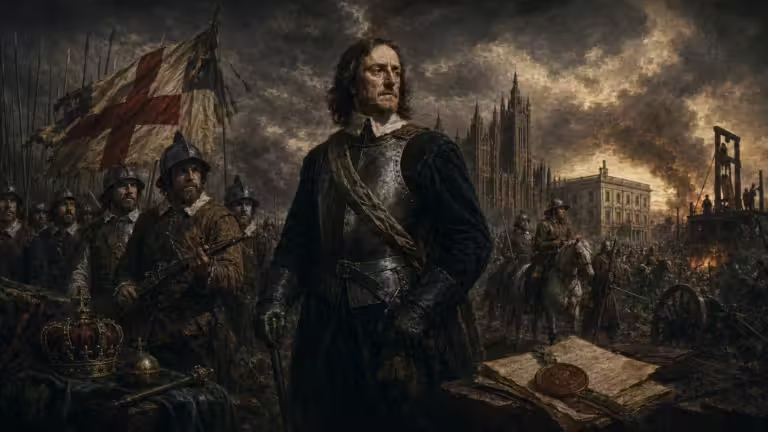
Parliament’s victory in the English Civil War destroyed the political order that its leaders had originally claimed to defend. The New Model Army defeated Charles I, challenged Parliament and helped bring the king to trial. England then abolished monarchy and the House of Lords, established a Commonwealth and eventually placed Oliver Cromwell at the head of a written constitutional regime.
The war emerged from a crisis that affected three kingdoms rather than England alone. Scottish resistance, the Irish Rebellion and the conflict between Charles I and Parliament had already transformed the Stuart monarchy before the first major English battle.

From political breakdown to civil war
Charles I raised his royal standard at Nottingham on 22 August 1642. The ceremony conventionally marks the beginning of open war between the king and Parliament in England. However, neither side entered the conflict with a complete political programme or a professional national army.
Royalists claimed that they defended lawful monarchy against subjects who had exceeded Parliament’s constitutional authority. Parliamentarians argued that they protected Protestant religion, parliamentary privilege and the laws of the kingdom from corrupt royal advisers. Both sides therefore presented themselves as defenders of the traditional constitution.
The population did not divide neatly into two ideological camps. Families, towns and counties often contained supporters of both causes. Personal loyalty, religion, local rivalries, economic interests and the presence of nearby troops all influenced the choice of allegiance.
Many people tried to remain neutral. Yet armies required horses, food, weapons, accommodation and taxes. As military mobilisation expanded, neutrality became increasingly difficult to maintain.
The opposing forces in 1642
The Royalists
Charles drew substantial support from northern and western England, Wales and sections of the aristocracy and rural gentry. Oxford became the Royalist capital after the king failed to recover London. Royalist forces included local infantry, cavalry regiments and experienced officers who had served in European wars.
Prince Rupert of the Rhine, Charles’s nephew, became the most famous Royalist cavalry commander. His aggressive charges often broke opposing formations. However, Royalist cavalry sometimes pursued fleeing enemies instead of returning to support the infantry.
The Parliamentarians
Parliament controlled London, the navy, several major ports and much of southern and eastern England. These advantages gave it access to customs revenue, financial institutions, workshops and a larger population. London also supplied volunteers, political organisation and a strategic defensive position.
The Earl of Essex initially commanded Parliament’s principal field army. Other regional forces operated under commanders including William Waller, the Earl of Manchester and Ferdinando Fairfax. Their independence later created serious problems of coordination.
The terms “Cavaliers” and “Roundheads” became familiar labels for Royalists and Parliamentarians. Contemporary speakers often used both names as insults. Neither term accurately describes the political, social or religious diversity within each coalition.

The First English Civil War, 1642–1646
Edgehill and the road to London
The first major battle took place at Edgehill on 23 October 1642. Royalist cavalry drove sections of Parliament’s horse from the field, while the infantry struggle remained indecisive. Neither army achieved the decisive victory that its leaders expected.
Charles advanced towards London after the battle. Parliament assembled defensive forces at Turnham Green in November, supported by large numbers of armed Londoners. Confronted by a strong defensive position, the king withdrew rather than risk a direct assault on the capital.
The failure to capture London proved strategically important. Parliament retained its financial and administrative centre, while Charles established his headquarters at Oxford. The war then developed through regional campaigns, sieges and raids rather than one uninterrupted national front.
A war fought locally
Local military associations organised taxation and defence. Parliament’s Eastern Association linked several comparatively wealthy counties, while Royalist commanders built networks in the Midlands, the north and the west. Regional resources often determined whether armies could remain in the field.
Both sides occupied fortified houses, medieval castles and walled towns. Sieges frequently caused more destruction than open battles. Civilians endured requisitioning, damaged crops, interrupted markets and outbreaks of disease.
Women managed businesses and estates while male relatives served in armies or lived in exile. They carried messages, organised supplies, defended houses and petitioned political authorities. Nevertheless, widows, refugees and soldiers’ families often faced acute financial insecurity.
Parliament turns to Scotland
By 1643, Royalist successes placed Parliament under severe pressure. Parliamentary leaders sought military support from the Scottish Covenanters. The resulting Solemn League and Covenant joined the two sides in an alliance against Charles.
Parliament agreed to pursue religious reform in England and Ireland, while Scotland sent an army south. The wording did not guarantee that England would adopt the Scottish Presbyterian system without modification. This ambiguity later exposed major disagreements between the allies.
The Scottish intervention changed the military balance in northern England. A combined Scottish and Parliamentarian army defeated Royalist forces at Marston Moor on 2 July 1644. The victory weakened Royalist control of the north and enhanced Cromwell’s reputation as a cavalry commander.
Why Parliament created the New Model Army
Parliament still lacked a unified military command after Marston Moor. Regional armies sometimes refused to operate beyond their own associations, while commanders disagreed over strategy. Critics accused senior officers of pursuing the war without enough determination to defeat the king.
Oliver Cromwell attacked the Earl of Manchester’s leadership and argued that Parliament needed soldiers committed to victory. Political tension also divided Presbyterians, who favoured a negotiated settlement, from Independents who accepted greater religious diversity and a more forceful military strategy.
The Self-Denying Ordinance
Parliament reorganised its forces in early 1645. The Self-Denying Ordinance required members of the Commons and Lords to give up military commands. Its supporters hoped to remove political rivalries from the army and replace inconsistent regional leadership.
Parliament repeatedly extended Cromwell’s military commission, so he became the most important exception to the principle. His success in the field and support within the army made him increasingly difficult to replace. He served as lieutenant-general of cavalry rather than commander-in-chief.
A national and professional army
The New Model Army formally came into existence in 1645. Sir Thomas Fairfax became commander-in-chief, Philip Skippon commanded the infantry and Cromwell led the cavalry. Parliament intended the force to operate throughout the kingdom rather than remain tied to one region.
Regular pay, standardised organisation and central command distinguished the new army from many earlier forces. In practice, payment frequently arrived late and discipline remained imperfect. Nevertheless, the army developed a strong collective identity and a reputation for coordinated battlefield action.
Religious commitment also shaped its culture. Soldiers attended sermons, read political and religious pamphlets and interpreted military victories as signs of divine providence. Promotion depended more heavily on ability and commitment than in many traditional armies, although social hierarchy did not disappear.
Naseby and Parliament’s military victory
The New Model Army confronted the principal Royalist army at Naseby on 14 June 1645. Prince Rupert’s cavalry initially drove back Parliament’s left wing. Cromwell’s horse defeated the Royalist cavalry opposite them and returned to attack the royal infantry.
Fairfax’s army destroyed or captured much of Charles’s main field force. Parliamentarian soldiers also seized the king’s correspondence. Parliament published selected letters to portray Charles as willing to seek military assistance from Irish Catholics and foreign powers.
Naseby did not end every Royalist campaign, but it made a final royal military victory unlikely. Parliament captured Bristol in September 1645, while Royalist garrisons surrendered throughout the following year. Oxford capitulated in June 1646.
Charles had already left Oxford and surrendered to the Scottish army at Newark in May. He expected to exploit disagreements between Scotland and the English Parliament. Instead, his captivity opened a new struggle over the political settlement.
Why victory failed to bring peace
Parliament’s coalition had agreed on the need to defeat the king but not on the form of post-war government. Presbyterians wanted a national Presbyterian Church and a negotiated restoration of royal authority under clear limitations. Independents resisted compulsory Presbyterian uniformity and defended wider freedom for Protestant congregations.
The Scottish army transferred Charles to the English parliamentary commissioners in January 1647 after reaching a financial settlement over military arrears. The Scots did not simply deliver him for execution. At that stage, nearly every major faction still expected monarchy to survive.
Parliament planned to disband much of the New Model Army while sending selected regiments to Ireland. However, soldiers had not received months of pay, and Parliament offered inadequate guarantees against prosecution for acts committed during the war. Many soldiers also feared that a Presbyterian settlement would suppress their congregations.
Regiments elected representatives known as Agitators or Agents to present their grievances. The army began acting as a political institution with its own councils, declarations and constitutional proposals. It no longer accepted that Parliament alone represented the nation’s interests.

The Levellers and the Putney Debates
The breakdown of censorship during the 1640s produced an extraordinary expansion of printed debate. Pamphlets discussed religious liberty, taxation, legal reform and the origins of political authority. Groups outside the traditional governing elite could now address a national audience.
Who were the Levellers?
The Levellers emerged from networks surrounding writers and organisers such as John Lilburne, Richard Overton and William Walwyn. Their opponents gave them a name suggesting that they wanted to level property and social distinctions. Leveller leaders rejected that description.
They defended equality before the law, regular parliaments, greater religious toleration and a substantial extension of male political participation. Their proposals did not amount to universal suffrage in the modern sense. Different Leveller texts retained exclusions based on dependence, service or receipt of poor relief.
The movement also opposed arbitrary imprisonment, compulsory tithes and legal privileges that protected the wealthy. Levellers grounded political legitimacy in the consent of the people rather than the inherited authority of kings or institutions.
The Agreement of the People
Army radicals circulated a constitutional programme called the Agreement of the People in October 1647. It proposed more equal electoral districts, frequent parliaments and protected rights that elected representatives could not remove. The document attempted to place government on an explicit foundation of popular consent.
Representatives of army officers and ordinary soldiers debated these proposals at Putney. Colonel Thomas Rainsborough argued for a broad political right among free Englishmen. Henry Ireton, Cromwell’s son-in-law, warned that men without a permanent economic interest might overturn property and established order.
Cromwell did not reject every demand for reform, but he prioritised military unity and a workable settlement. Senior officers resisted a constitution that they believed could destabilise property and government. Renewed political uncertainty and the king’s escape brought the debates to an end.
Charles I and the Second Civil War
Charles escaped from army custody in November 1647 and reached the Isle of Wight. He continued negotiating separately with Parliament, the army and the Scots. His strategy depended on offering different concessions to competing factions without committing permanently to any of them.
Through an agreement known as the Engagement, Charles promised to introduce Presbyterianism in England for a trial period. In return, a Scottish force invaded England on his behalf in 1648. Royalist uprisings also occurred in England and Wales.
The New Model Army defeated the risings and crushed the Scottish Engager army around Preston in August. Many officers concluded that Charles had deliberately caused further bloodshed after military defeat. They increasingly described him as a “man of blood” whom God had condemned.
Pride’s Purge and the Rump Parliament
A majority in the Commons still favoured further negotiations with Charles. Army leaders believed that such a settlement would betray their victories and endanger the political and religious cause. The conflict between the army and Parliament now became open.
On 6 December 1648, troops commanded by Colonel Thomas Pride prevented selected MPs from entering the House of Commons. They arrested some members and excluded many others. This intervention, known as Pride’s Purge, was the first military purge of an English Parliament.
The reduced assembly became known as the Rump Parliament. Its authority rested on a House of Commons from which the army had forcibly removed political opponents. That contradiction would undermine the republican regime from its beginning.
The trial and execution of Charles I
The Rump created a High Court of Justice to try Charles for treason. The House of Lords rejected the proposal, while judges and many MPs refused to participate. The Commons therefore claimed that the people, represented by their elected members, constituted the original source of lawful authority.
The trial opened in Westminster Hall on 20 January 1649. Prosecutors accused Charles of using public power for personal interest and waging war against Parliament and the people. The charge treated an anointed monarch as a public official accountable to the nation.
Charles refused to enter a plea because he denied the court’s jurisdiction. He repeatedly demanded to know which lawful authority allowed subjects to judge their king. His refusal prevented a conventional examination of witnesses but did not stop the proceedings.
The court convicted Charles on 27 January. Only 57 commissioners ultimately signed the death warrant, reflecting the controversy surrounding the decision. The king was beheaded outside the Banqueting House in Whitehall on 30 January 1649.
The regicide shocked European monarchies and divided Parliament’s own supporters. Some regarded it as a necessary act of justice against a ruler who had broken the law. Others saw it as an unlawful execution imposed by a minority backed by military force.
The creation of the Commonwealth
The Commons abolished the monarchy and declared the House of Lords unnecessary and dangerous. On 19 May 1649, Parliament formally established England as a “Commonwealth and Free State”. Executive authority passed to a Council of State appointed by Parliament.
The term Commonwealth has two related meanings. Strictly, it describes the republican governments of 1649–1653 and 1659–1660. The broader term Interregnum covers the entire period between the execution of Charles I and the Restoration of Charles II in 1660, including Cromwell’s Protectorate.
The new regime did not create a representative democracy. The Rump consisted of the surviving fragment of a Parliament elected in 1640. It faced no new national election and depended on the army for security.
Nevertheless, the Commonwealth represented a profound constitutional rupture. Government no longer operated in the king’s name, and legislation did not require royal assent. England had become a republic governed by a single parliamentary chamber.
The Commonwealth invades Ireland
The new republic faced immediate military threats in Ireland. Irish Confederate Catholics, English Royalists and other groups had formed a loose alliance that recognised Charles II after his father’s execution. Royalist-controlled ports could also provide bases for intervention from continental Europe.
Parliament therefore sent a large army under Cromwell’s command. He landed near Dublin in August 1649. The campaign aimed to defeat Royalist and Confederate resistance, secure land for Parliament’s creditors and soldiers, and impose the authority of the Commonwealth.
Drogheda
Cromwell’s army reached Drogheda in September 1649. The garrison rejected his demand for surrender, and Parliamentarian artillery breached the walls. After entering the town on 11 September, Cromwell’s soldiers killed most of the defending troops and an uncertain number of civilians.
Cromwell defended the killings as lawful punishment after resistance to a storm and as divine judgement on those connected with the rebellion. Even within the brutal conventions of seventeenth-century siege warfare, the scale and deliberate character of the slaughter made Drogheda notorious.
Wexford
The army attacked Wexford the following month. Negotiations were under way when Parliamentarian troops entered after the collapse or betrayal of part of the defence. Soldiers killed defenders and civilians, while many people drowned attempting to escape across the River Slaney.
Cromwell did not necessarily plan every event that followed the army’s entry. However, he commanded the invading force, accepted the outcome and interpreted the destruction as providential. Drogheda and Wexford remain central to his historical reputation in Ireland.
The wider conquest
Cromwell captured several towns before confronting strong resistance at Clonmel in May 1650. The defenders inflicted severe casualties on his assault force and withdrew before negotiating the town’s surrender. Cromwell left Ireland soon afterwards to prepare for war against Scotland.
Henry Ireton, Charles Fleetwood, Edmund Ludlow and other commanders continued the conquest. Sieges, famine, disease and guerrilla warfare devastated the population. Organised resistance largely collapsed by 1653, although insecurity persisted.
Confiscation and settlement
The Act for the Settlement of Ireland of 1652 classified landowners according to their alleged participation in rebellion or support for Royalism. The government confiscated extensive Catholic-owned estates and transferred land to soldiers, financial creditors and Protestant interests.
The popular phrase “To Hell or Connacht” gives an oversimplified account of the settlement. The regime did not physically remove every Catholic landholder to western Ireland. Nevertheless, forced transplantation, dispossession and legal restrictions radically altered the ownership and political control of Irish land.
Cromwell did not personally design or administer every stage of the settlement. Parliament, army officers, subsequent commanders and colonial investors all carried responsibility. Yet his invasion enabled the conquest and made his name a lasting symbol of English violence in Ireland.
The war against Scotland
Scotland’s Covenanter government condemned the execution of Charles I and proclaimed his son Charles II. Scottish leaders required the young king to accept the Covenants and Presbyterian government. His recognition created an immediate threat to the English Commonwealth.
Cromwell invaded Scotland in July 1650. The Scottish army under David Leslie avoided a major engagement while restricting Parliamentarian access to supplies. Cromwell’s position became increasingly dangerous near Dunbar.
Dunbar and Worcester
Leslie’s army left its defensive position and moved towards the English force. Cromwell attacked at dawn on 3 September 1650 and won a decisive victory at Dunbar. Parliamentarian troops captured thousands of Scottish soldiers, many of whom died through wounds, disease or imprisonment.
Charles II was crowned at Scone on 1 January 1651. He later led an army south into England, hoping to attract Royalist support. Cromwell overtook and defeated it at Worcester on 3 September 1651.
Charles escaped after weeks in hiding and eventually reached continental Europe. Worcester ended the principal military phase of the Wars of the Three Kingdoms. England, Scotland and Ireland now stood under the authority of the Commonwealth and its army.
An imposed republican union
The Commonwealth incorporated Scotland into a political union governed from Westminster. Representatives from Scotland and Ireland later sat in Protectorate parliaments alongside English and Welsh members. This was the first Westminster assembly designed to represent the entire archipelago.
The union did not rest on free negotiation between equal national parliaments. Military conquest and occupation made it possible. Scotland lost its independent Parliament during the Interregnum, although its legal and religious institutions retained distinctive features.
Radical politics after the regicide
The destruction of monarchy encouraged groups that wanted the revolution to continue. Levellers demanded constitutional reform and opposed the political dominance of officers and grandees. Army leaders instead prioritised unity, property and the survival of the regime.
Leveller-inspired mutinies broke out among sections of the army in 1649. Fairfax and Cromwell suppressed them, most notably at Burford. The movement continued through pamphlets and petitions but lost its ability to direct military pressure against the government.
The Diggers
A smaller movement associated with Gerrard Winstanley became known as the Diggers or True Levellers. Its members cultivated common land at St George’s Hill in Surrey during 1649. They argued that private control of land produced poverty and domination.
Local landowners and officials used legal pressure, harassment and physical violence to break up the settlements. The Commonwealth did not endorse the Diggers’ economic programme. Political revolution had not removed the power of property-owning elites.
Religious movements
The disappearance of episcopal control allowed Baptists, Independents and other Protestant congregations to expand. The early Quaker movement emerged during the 1650s through the preaching of George Fox and others. Its rejection of social deference, formal clergy and conventional worship alarmed magistrates.
Fifth Monarchists expected Christ’s kingdom to replace earthly governments. Some initially supported the republican revolution but later condemned Cromwell’s rule as insufficiently godly. Religious pluralism therefore generated both support for and opposition to the regime.
Why the Rump Parliament failed
The Rump achieved important military and administrative successes. It financed armies, developed the navy and secured diplomatic recognition. It also began discussing legal and electoral reforms.
However, critics accused its members of protecting their offices, delaying elections and avoiding fundamental reform. The Rump had never received a fresh electoral mandate. Its slow proceedings frustrated army officers who expected a godly and decisive transformation.
The relationship deteriorated as Parliament considered mechanisms for replacing itself. Cromwell believed that members intended to perpetuate their power through a settlement that excluded trustworthy reformers. On 20 April 1653, he entered the Commons with soldiers and dissolved the Rump by force.
The action repeated the central contradiction of the revolution. Cromwell claimed to defend liberty and representative government, yet used military power to remove a Parliament that no longer served his objectives. No agreed constitutional authority existed above the competing institutions.
The Nominated Assembly
Army leaders rejected an immediate conventional election. Instead, officers and Independent congregations nominated members for a new assembly that first met in July 1653. Its official title was the Nominated Assembly, although opponents called it Barebone’s Parliament after one of its members, Praise-God Barebone.
The assembly included experienced politicians, lawyers, merchants, landowners and committed religious reformers. It considered changes to marriage law, taxation, courts, tithes and the relief of debtors. Members disagreed sharply over how quickly and extensively they should reform society.
Moderates feared that radical proposals would undermine property, the legal profession and the established ministry. In December, a group of members surrendered the assembly’s powers back to Cromwell. The republican experiment now moved towards a written constitution headed by one executive ruler.
The Instrument of Government and the Protectorate
The Instrument of Government came into force in December 1653. It created a Lord Protector, a Council of State and regularly elected parliaments. The document was one of England’s first comprehensive experiments with a written national constitution.
Cromwell became Lord Protector on 16 December. The office was not formally hereditary, and the constitution limited the Protector through the Council and Parliament. However, Cromwell also commanded the army and possessed considerable influence over the state’s institutions.
The constitution redistributed parliamentary representation and included members for Scotland and Ireland. It required parliaments to meet at regular intervals and protected a limited degree of Protestant religious liberty. Yet it excluded Catholicism and episcopal Anglicanism from full toleration.
The arrangement attempted to balance several sources of authority: the people represented in Parliament, the executive leadership of the Protector and Council, and the military power that had created the regime. These elements never settled into a stable relationship.
Cromwell and the Protectorate parliaments
The First Protectorate Parliament met in September 1654. Many members challenged the Instrument of Government and attempted to revise the Protector’s constitutional position. Cromwell required MPs to recognise several fundamental principles before they could continue sitting.
Disputes over religion, the army and constitutional authority prevented productive cooperation. Cromwell dissolved the Parliament in January 1655 as soon as he believed the constitutional minimum period had expired. Government again depended heavily on the Council and military administration.
The rule of the Major-Generals
A failed Royalist rising led by John Penruddock in 1655 reinforced fears of conspiracy. The government divided England and Wales into military districts supervised by Major-Generals. They coordinated security, collected intelligence and pursued moral reform.
The Major-Generals enforced laws against drunkenness, gambling, disorderly alehouses and some forms of popular entertainment. They also imposed a ten per cent tax known as the Decimation Tax on former Royalists. Local reactions varied according to the officer and region.
The system combined efficient intelligence gathering with intrusive military government. Civilian elites resented officers who interfered with local administration and social customs. Parliament later rejected legislation intended to preserve the Decimation Tax.
Did Cromwell cancel Christmas?
The familiar claim that Oliver Cromwell personally banned Christmas oversimplifies the chronology. Parliament had already ordered regular fast days and acted against traditional religious festivals before Cromwell became Lord Protector. An ordinance of 1647 abolished Christmas, Easter and Whitsun as official feast days.
Puritan reformers objected to ceremonies without clear biblical authority and to customs involving drinking, gambling and disorder. They wanted Christmas Day treated as an ordinary working day or a time of religious reflection rather than public festivity.
The Protectorate continued enforcing aspects of this programme, especially under the Major-Generals. However, celebration persisted in homes and communities, sometimes provoking disturbances. The controversy reveals a wider conflict over whether government could impose a godly moral culture.
Religious toleration and its limits
Cromwell supported broader liberty for many Protestant groups than a restored Anglican or Presbyterian establishment would have allowed. Independent congregations, Baptists and several other communities could worship with varying degrees of protection. Cromwell often distinguished sincere religious error from conduct that threatened public order.
This toleration remained selective. The government restricted Anglican worship and excluded Catholics from the constitutional promise of liberty. Catholic priests faced severe penalties in Ireland, while Quakers and other radicals still suffered imprisonment.
The return of a Jewish community
Jews had been formally expelled from England under Edward I in 1290. In the 1650s, the Amsterdam rabbi Menasseh ben Israel petitioned Cromwell for their readmission. Cromwell supported the proposal for religious, economic and prophetic reasons.
The Whitehall Conference of 1655 reached no formal statutory settlement. Nevertheless, Cromwell’s government allowed an openly practising Jewish community to establish itself in London from 1656. This amounted to practical readmission without a parliamentary repeal of the medieval expulsion.
The decision represented a significant extension of religious diversity, but it did not provide full civil equality. Jewish residents still faced legal and political restrictions. Toleration under Cromwell remained pragmatic, incomplete and dependent on executive protection.
The Commonwealth and maritime expansion
The republican period also marked an important stage in the development of English commercial and naval power. The Rump Parliament passed the Navigation Ordinance of 1651 to challenge Dutch control of European carrying trade. It required many imports to arrive in English ships or vessels belonging to the country that produced the goods.
Commercial rivalry contributed to the First Anglo-Dutch War of 1652–1654. England’s navy achieved several major victories, although the conflict proved expensive. The Treaty of Westminster ended the war shortly after Cromwell established the Protectorate.
The Restoration government retained and expanded the Navigation Laws. Commercial policies created under the republic therefore became part of the later British imperial system. Political revolution did not interrupt England’s development as an Atlantic power.
The Western Design and Jamaica
Cromwell’s government launched the Western Design against the Spanish Caribbean in 1655. Its leaders hoped to weaken Catholic Spain, acquire profitable territory and expand Protestant power in the Americas. The expedition failed to capture Hispaniola.
The surviving force seized Jamaica instead. England retained the island, which later became a major centre of sugar production and racial slavery. The conquest connected Cromwell’s Protestant foreign policy with the expansion of plantation empire.
The Protectorate also allied with France against Spain. Anglo-French forces captured Dunkirk in 1658, giving England a strategic continental possession. Cromwellian foreign policy combined confessional rhetoric with commercial, naval and geopolitical calculation.
The Humble Petition and Advice
The Second Protectorate Parliament assembled in 1656 after the Council excluded numerous elected opponents. Civilian politicians wanted a more traditional and predictable constitutional settlement. Many regarded government through the Instrument and army officers as unstable.
In 1657, MPs presented the Humble Petition and Advice. It proposed a hereditary executive, regular taxation, a reformed second parliamentary chamber and clearer limits on military influence. The document also offered Cromwell the title of king.
Cromwell considered the proposal for several weeks. He eventually rejected the crown, partly because senior army officers and committed republicans opposed it. He accepted most of the remaining constitution and underwent a second installation ceremony that resembled a coronation.
The settlement created an “Other House” whose members Cromwell nominated. It functioned as a substitute for the abolished House of Lords. Opposition in the Commons and uncertainty over its legitimacy prevented the arrangement from creating lasting stability.
Was Cromwell a king in everything but name?
Cromwell occupied royal palaces, received ambassadors and exercised extensive executive authority. His second installation used ceremonial objects associated with monarchy, and the revised constitution allowed him to nominate a successor. These features encouraged comparisons with kingship.
However, important differences remained. Cromwell did not inherit the office through dynastic right, and formal constitutional documents defined his authority. He governed with a Council, summoned elected parliaments and lacked the sacred legitimacy claimed by the Stuarts.
He also dissolved parliaments, relied on military power and restricted elected opponents. Those actions allowed critics to portray him as a dictator who had replaced one form of personal rule with another. His defenders instead emphasised the difficulty of governing a country divided by war, religious conflict and Royalist conspiracy.
Neither interpretation fully resolves the contradiction. Cromwell defended representative government while repeatedly overriding representative institutions. He promoted religious liberty while excluding Catholics and suppressing opponents. He rejected hereditary monarchy while moving the Protectorate towards dynastic succession.
Cromwell’s death and the collapse of the Protectorate
Oliver Cromwell died on 3 September 1658. His son Richard succeeded him as Lord Protector under the arrangements established by the Humble Petition and Advice. Richard possessed neither his father’s military reputation nor an independent political base.
The army distrusted civilian politicians, while Parliament questioned the cost and political influence of the armed forces. Richard could not reconcile the competing institutions. He left office in May 1659, and the army recalled the Rump Parliament.
The following months brought repeated dissolutions, military interventions and failed attempts to revive republican government. General George Monck marched from Scotland and became the decisive political figure. The excluded members of the Long Parliament returned before arranging new elections.
The republican experiment ended because no faction could establish a broadly accepted constitutional settlement. The army had defeated the monarchy but could not agree on a stable relationship between military power, Parliament, religious liberty and executive government.
The human and political legacy of the Interregnum
The civil wars and conquests killed soldiers and civilians through battle, massacre, disease, famine and displacement. Ireland suffered especially severe population loss and land confiscation. England, Scotland and Wales also experienced taxation, occupation and economic disruption.
The revolution nevertheless transformed political debate. It made the accountability of rulers, popular consent, written constitutions and religious toleration subjects of sustained public argument. Levellers, Diggers and religious radicals articulated possibilities that went far beyond Parliament’s original cause.
The Commonwealth also demonstrated the limits of revolutionary change. Property-owning elites retained political power, women remained excluded from formal government and the army suppressed radical movements. The republic relied on conquest in Scotland and Ireland while presenting itself as a free state.
Later constitutional development did not follow a straight line from Cromwell to modern democracy. The monarchy, House of Lords and established Church all returned in 1660. However, restored kings could not erase the memory that Parliament had raised an army, tried a monarch and governed without the Crown.
From the Commonwealth to the Restoration
By early 1660, many political leaders believed that only a restored monarchy could end military instability. They did not necessarily seek an unconditional return to the government of Charles I. Questions concerning indemnity, property, religion and the army required negotiation.
Charles II issued the Declaration of Breda from exile. He promised a general pardon, respect for disputed property arrangements, payment of the army and a degree of religious accommodation, subject to parliamentary agreement. These assurances helped make restoration politically possible.
The next article examines how the restored monarchy dealt with the legacy of civil war and regicide. It also explains why the religious and constitutional problems that destroyed Charles I’s government returned under his sons.
- The Reformation in the British Isles
- English Expansionism
- The Stuart Crisis and the Wars of the Three Kingdoms
- The Glorious Revolution of 1688
- Puritanism and Expansionism in Early America
Frequently asked questions about the Civil War and Commonwealth
Who commanded the New Model Army?
Sir Thomas Fairfax served as commander-in-chief of the New Model Army. Philip Skippon commanded its infantry, while Oliver Cromwell became lieutenant-general of cavalry. Cromwell’s later political prominence sometimes obscures Fairfax’s formal command.
Why was the Battle of Naseby important?
Naseby destroyed much of Charles I’s principal field army in June 1645. Parliament also captured the king’s correspondence and used it to portray him as seeking assistance from Irish Catholics and foreign powers. The battle made final Royalist victory highly unlikely.
What did the Levellers want?
The Levellers demanded equality before the law, regular parliaments, broader male political participation and greater religious toleration. They based legitimate government on popular consent but did not consistently propose universal adult suffrage in the modern sense.
Why was Charles I executed?
Army leaders and the Rump Parliament concluded that Charles had caused renewed warfare after his first defeat and could not be trusted in a future settlement. A specially created court convicted him of treason for waging war against Parliament and the people.
What was the Commonwealth of England?
The Commonwealth was the republic created after the execution of Charles I and the abolition of monarchy and the House of Lords. The Rump Parliament governed from 1649 until Cromwell dissolved it in 1653. The Commonwealth briefly returned after the collapse of the Protectorate.
What was the difference between the Commonwealth and the Protectorate?
The Commonwealth initially placed authority in the Rump Parliament and Council of State. The Protectorate began in December 1653 under the Instrument of Government, which created Oliver Cromwell as Lord Protector alongside a Council and elected parliaments.
Did Cromwell personally ban Christmas?
No. Parliament had acted against Christmas and other traditional feast days before Cromwell became Lord Protector. His government continued parts of the Puritan programme, while the Major-Generals sometimes enforced restrictions on festivities and public entertainment.
Why is Cromwell remembered so differently in England and Ireland?
Some traditions associate Cromwell with parliamentary government, military ability and Protestant toleration. In Ireland, his name remains connected to the massacres at Drogheda and Wexford, military conquest, Catholic persecution, population displacement and extensive land confiscation.
Sources and further reading
- UK Parliament: The Civil War
- UK Parliament: key dates from 1640 to 1660
- UK Parliament: Presbyterians, Independents and the New Model Army
- UK Parliament: Pride’s Purge, the Rump and regicide
- UK Parliament: the trial of Charles I
- UK Parliament: the dissolution of the Rump Parliament
- UK Parliament: the Protectorate parliaments
- UK Parliament: the end of the Protectorate
- The National Archives: the Putney Debates
- The National Archives: women and the English Civil Wars
- The National Archives: Christmas and Cromwellian government
- The National Archives: Jewish expulsion and readmission
- UK Parliament: Civil War and Cromwellian Ireland
- History Ireland: the legacy of Cromwell’s conquest
- UK Parliament: revolution, Scotland and the Commonwealth
- UK Parliament: the Navigation Laws
The Restoration returned the Crown, the House of Lords and the Church of England, but it could not erase the revolution. The next article examines Charles II’s settlement, religious repression, the Exclusion Crisis and the renewed fear of Catholic monarchy under James II.
