

The Welfare State : an end to poverty and inequality ? photo

The Welfare State: an end to poverty and inequality ?

  1. The Poor Law Amendment Act (1834)
  2. Victorian philanthropy in 19th century England
  3. Electoral inequalities in Victorian England: the Road to Male Suffrage
  4. Ante Bellum, Inter Bella : Legislation and the Depression
  5. More electoral inequalities : the Road to Female Suffrage
  6. The Beveridge Report: a Revolution?
  7. The Welfare State: an end to poverty and inequality ?
  8. The Affluent Society : poverty rediscovered?
  9. Inequality and Race
  10. Inequality and Gender
  11. The Thatcher Years : the individual and society
  12. Inequalities in Britain today

According to Beveridge, two points of view are presented concerning the introduction of the Welfare State. The established view is that it was introduced in a climate of consensus: wartime hardships, the Evacuation, national solidarity and the acceptance of an increased role for the State in central planning led to a bipartisan approach to the need for durable change in social and health policies in Britain, as in other Western countries.

More recently, it has been pointed out that the War did not eliminate social differences or resentment, Evacuation did not lead to an ending of social prejudice, and the Conservatives and Labour Party did not agree on the way forward.

Nevertheless, Beveridge concludes that the War « was a major watershed in the history of school medical provision… It undoubtedly led to a determination to do something about the burden of poverty and ill health which had been revealed.

The Butler Education Act (1944)

Even before the Labour victory of 1945, Conservative Minister R. A. Butler introduced the 1944 English Education Act: since education had, like social security and health care, developed haphazardly, it was felt the situation before 1944 was complex, wasteful of ability and inequitable.

The 1944 Act laid the responsibility for education in England on the State and LEAs (Local Education Authorities), a national system, where locally administered Education became a free and universal social service. A Minister of Education was created.

Public education was to be organised in 3 stages: primary, secondary and further. In every area of the country schools should be sufficient in number, character and equipment « to afford all pupils opportunities for education offering such variety of instruction and training as may be desirable given their different ages, abilities and aptitudes ».

The private fee-paying sector was left intact. Education for all became compulsory from 5 to 15. Every parent had to ensure his child received a « suitable education » and every LEA had to make suitable provisions for this.

At age 11, children would take a test in English, Arithmetic and General Knowledge (11 plus): in the function of the results obtained at this examination, children would be sent either to Grammar School (for those with the highest marks) or Secondary Modern/Technical School for the rest.

This was known as the tripartite system but in reality, it was bipartite since very few LEAs set up Secondary Technical Schools. Comprehensive Schools were not proscribed, nor were they encouraged.

At age 16, the « brighter » pupils would take GCE O-Levels (General Certificate of Education Ordinary-Level) in several subjects, the others CSE examinations (Certificate of Secondary Education), introduced in 1963. At age 18, the « brightest » pupils would take GCE A-Levels (Advanced), which enabled pupils to apply for university.

The Labour victory of 1945 was followed by a heavy legislative programme. There were bills concerning Coal Nationalisation, Industrial Injuries, National Insurance, New Towns, Housing, Trade Union Law, the National Health Service… Much of the social planning for this legislation had been carried out during the war.

A common name for this battery of legislation concerning public health, social security, pensions and children’s allowances, better educational opportunities, and even a greater role for the State in the economy of the country (through nationalisations) is the Welfare State.
Lire The Welfare State: an end to poverty and inequality ?

The Beveridge Report : a revolution ? photo

The Beveridge Report: a Revolution?

  1. The Poor Law Amendment Act (1834)
  2. Victorian philanthropy in 19th century England
  3. Electoral inequalities in Victorian England: the Road to Male Suffrage
  4. Ante Bellum, Inter Bella : Legislation and the Depression
  5. More electoral inequalities : the Road to Female Suffrage
  6. The Beveridge Report: a Revolution?
  7. The Welfare State: an end to poverty and inequality ?
  8. The Affluent Society : poverty rediscovered?
  9. Inequality and Race
  10. Inequality and Gender
  11. The Thatcher Years : the individual and society
  12. Inequalities in Britain today

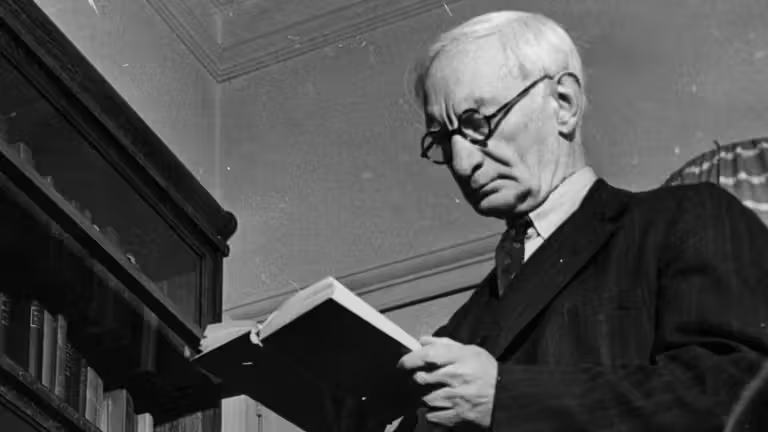
William Beveridge

William Beveridge was born in 1879 and he became a social worker in the East End of London in 1903. Later, he visited Germany to see for himself the system of social insurance introduced by Bismarck.

Beveridge became a journalist, writing mainly on social policy. He was noticed by Churchill (still a Liberal at that time) and in 1908, Beveridge became a civil servant at the Board of Trade.

Over the next three years, he worked on a national system of labour exchanges, which were introduced by the Liberal Government of Lloyd George. This measure only covered 2.75m men, one in six of the workforce.

Beveridge remained a civil servant for the duration of World War I and after the war, he became the Director of the London School of Economics (LSE). He continued academic work at the Universities of London and Oxford.

In June 1941, he was asked to chair an interdepartmental committee on reconstruction problems and on the coordination of existing schemes of social insurance.

At this time, the social security « system » was in a confused state: 7 Government departments were involved in providing various cash benefits to some people.

The terms of reference were:

To undertake, with special reference to the inter-relation of the schemes, a survey of the existing national schemes of social insurance and allied services, including workmen’s compensation, and to make recommendations. (Beveridge, Beveridge Report : Social Insurance and Allied Services, 1942)

Lire The Beveridge Report: a Revolution?

More electoral inequalities : the Road to Female Suffrage photo

More electoral inequalities : the Road to Female Suffrage

  1. The Poor Law Amendment Act (1834)
  2. Victorian philanthropy in 19th century England
  3. Electoral inequalities in Victorian England: the Road to Male Suffrage
  4. Ante Bellum, Inter Bella : Legislation and the Depression
  5. More electoral inequalities : the Road to Female Suffrage
  6. The Beveridge Report: a Revolution?
  7. The Welfare State: an end to poverty and inequality ?
  8. The Affluent Society : poverty rediscovered?
  9. Inequality and Race
  10. Inequality and Gender
  11. The Thatcher Years : the individual and society
  12. Inequalities in Britain today

Before the Industrial Revolution, men and women worked together as an economic unit, especially in rural communities. In well-off households, women would run the house.

The Industrial Revolution polarised women’s condition: the well-to-do withdrew from household management, leaving the way clear for the housekeeper. A woman was seen by the upper classes as an idealised creature, gentle, pure, and pious.

However, the ever more numerous working-class women would frequently work in factories. In 1851, 2.3m women and female children of working age out of 8m worked. Many women worked in service (1.2 million in 1881). Feminists disliked both these extremes.

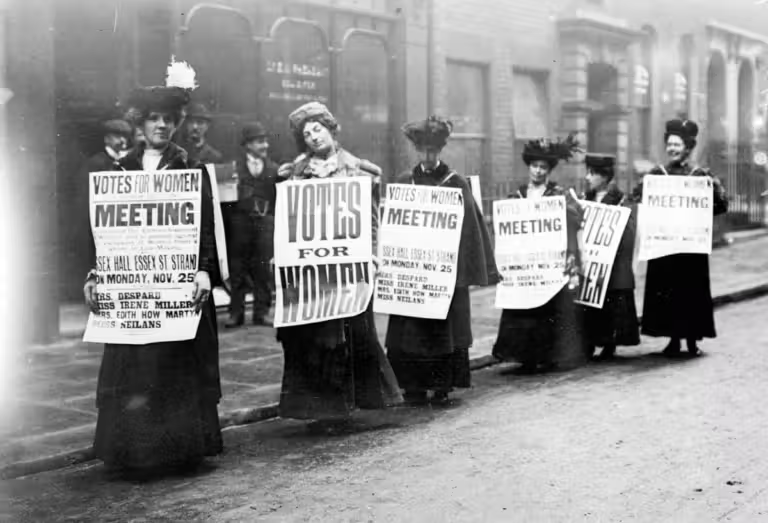
Arguments against the franchise for women: women were disqualified by their sex; the franchise was based on property qualification; women were thought to be too emotional; most women did not need the vote (they were surrounded by men who often would have it).

For the rest, if vagrant and very poor men did not have the vote, then their women did not deserve it either; the « idealized » woman was above the dirty affairs of Parliament; female suffrage might well pose a threat to men’s sexual domination of women.

Women’s rights were limited if non-existent throughout the 19th century. Reforms were finally obtained after the perseverance of female/feminist activists.

Lire More electoral inequalities : the Road to Female Suffrage