

Inequality and Gender photo

Inequality and Gender

  1. The Poor Law Amendment Act (1834)
  2. Victorian philanthropy in 19th century England
  3. Electoral inequalities in Victorian England: the Road to Male Suffrage
  4. Ante Bellum, Inter Bella : Legislation and the Depression
  5. More electoral inequalities : the Road to Female Suffrage
  6. The Beveridge Report: a Revolution?
  7. The Welfare State: an end to poverty and inequality ?
  8. The Affluent Society : poverty rediscovered?
  9. Inequality and Race
  10. Inequality and Gender
  11. The Thatcher Years : the individual and society
  12. Inequalities in Britain today

Inequalities between women of different social categories are nothing new. Despite the effects of the Welfare State, there remained several inequalities right into the 1960s.

In the field of abortion for example, some managed to find a compliant doctor and the money to pay for the abortion and there were those who either were unable to find the means of terminating an unwanted pregnancy or who resorted to back street butchery.

The Family Planning Act was passed in 1967 and was to have a great effect on women’s lives. Abortion became more easily available: in 1968, 22,000 abortions were carried out in public hospitals; in 1969, the number reached 31,000. The figure for single women continued to rise in the 1970s and 1980s: in 1971, 44,300; in 1990, 116,200. However, for married women, the figure actually fell slightly during the same period (1971, 41,500; 1990, 38,200).

Young mothers have always had difficulties in returning to work, especially if they were unable to find a willing child-minder. One reason is that until the 1990s, children usually did not go to school until the age of 5.

And child-minding was usually quite expensive as the local authorities only provided a limited number of places. This was not surprising as successive Government policies had encouraged women to remain at home to look after the children rather than to enter the workplace.

The number of births to unmarried mothers remained fairly stable from the beginning of the 20th century until the 1960s at approximately 4% of the total of births. From the 1960’s onwards, the percentage doubled. Then followed a period of relative stability (due probably to the effects of The Family Planning Act). Later, the percentages rose (luring the 1980’s and 1990’s.

Lire Inequality and Gender

Inequality and Race photo

Inequality and Race

  1. The Poor Law Amendment Act (1834)
  2. Victorian philanthropy in 19th century England
  3. Electoral inequalities in Victorian England: the Road to Male Suffrage
  4. Ante Bellum, Inter Bella : Legislation and the Depression
  5. More electoral inequalities : the Road to Female Suffrage
  6. The Beveridge Report: a Revolution?
  7. The Welfare State: an end to poverty and inequality ?
  8. The Affluent Society : poverty rediscovered?
  9. Inequality and Race
  10. Inequality and Gender
  11. The Thatcher Years : the individual and society
  12. Inequalities in Britain today

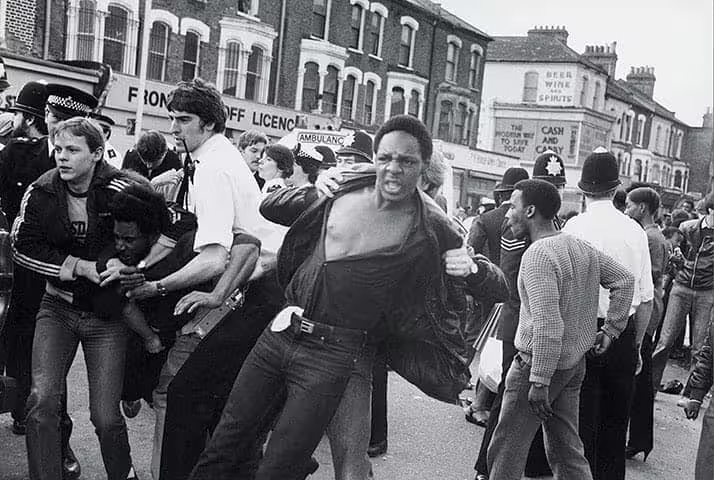
According to Seymour-Ure (in The Political Impact of Mass Media, 1974), the disturbances in Notting Hill in 1958 symbolised a turning point in British race relations.

Previously, immigration had been a relatively peripheral political issue; after 1958 it became one of the most important and the most sensitive.

In 1962, the Conservative Government passed the Commonwealth Immigration Act, introducing controls through a voucher system to limit the flow of West Indian and Indian sub-continent immigrants.

When the Labour Government came to power, instead of repealing the legislation, as they might have (cf. Race Relation Act, 1976 – Chapter 74) been expected to do (the Labour Party had opposed the introduction of the 1962 Act but the defeat of the Labour Shadow Foreign Secretary, Patrick Gordon-Walker at the 1964 General Election in the Midlands constituency of Smethwick, with a large percentage of « immigrants », was a sign that Labour had to tread softly on this issue), they in fact tightened by the Act in 1965 by limiting the number of vouchers still further.

In the mid-1960s, a growing number of Kenyan Asians were settling in Britain. The Labour Government then passed the 1968 Commonwealth Immigrants Act, stopping « coloured » immigration, though with a voucher scheme for Kenyan Asians.

Lire Inequality and Race

The Affluent Society : poverty rediscovered ? photo

The Affluent Society : poverty rediscovered?

  1. The Poor Law Amendment Act (1834)
  2. Victorian philanthropy in 19th century England
  3. Electoral inequalities in Victorian England: the Road to Male Suffrage
  4. Ante Bellum, Inter Bella : Legislation and the Depression
  5. More electoral inequalities : the Road to Female Suffrage
  6. The Beveridge Report: a Revolution?
  7. The Welfare State: an end to poverty and inequality ?
  8. The Affluent Society : poverty rediscovered?
  9. Inequality and Race
  10. Inequality and Gender
  11. The Thatcher Years : the individual and society
  12. Inequalities in Britain today

Post-war Britain is characterised by Butskellism, a hybrid word formed from part of the names of the Conservative (Butler) and Labour (Gaitskell) Chancellors of the Exchequer.

This socio-economic policy was a compromise between private and public responsibility for the individual and was seen to describe a consensus between right and left which was to last until 1975 (for the Conservatives) and 1979 (for the Labour Party).

The 50s and 60s were years of the acceptance by both sides in British politics of a Welfare State, which looked after the individual « from the cradle to the grave ».

Economic and social changes

Received wisdom indicates an increase in the standard of living for the majority of British people. The average male weekly wage for men in 1952 was £8 14s, the equivalent of £36 in 1976 when the same average weekly wage had reached £65.

This represented an increase in real terms of 80% in 24 years. Or there again, considering the percentage of homes owned by their residents, the figure in the same period jumped from 29% to 54%, an increase of 86%.

For the first time in their lives, many working-class and lower-middle-class people benefited considerably from the « affluent society ». They could borrow money at low rates of interest and buy new consumer goods and services. In 1951 there were 48 cars and 103 telephones for 1,000 people. In 1976, the figures were 103 and 392 respectively.

However, it must be remembered that economic growth was slower in Britain than in most other capitalist countries. This is often referred to as « relative » economic decline.

Lire The Affluent Society : poverty rediscovered?