
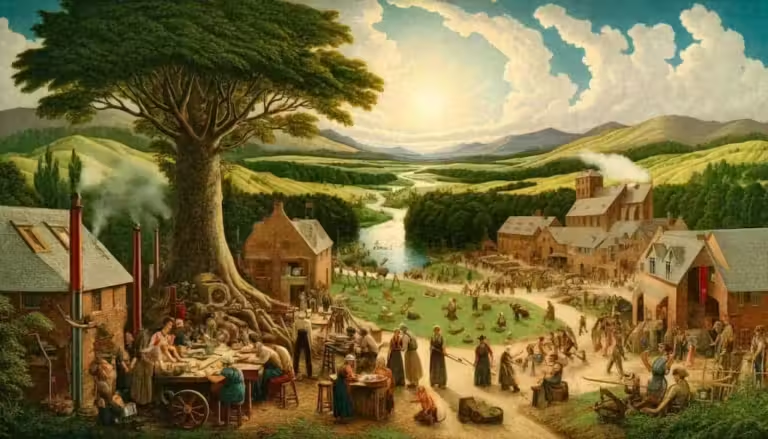
News from Nowhere presents socialism as an “epoch of rest”, but William Morris does not praise inactivity. Rest means freedom from coerced labour, competition and economic anxiety. Work survives, yet it becomes useful, creative and pleasurable.
William Morris gave his utopian romance a revealing subtitle: An Epoch of Rest. The phrase appears to promise stillness after the turmoil of industrial capitalism. However, the future society discovered by William Guest remains remarkably active.
People build houses, carve stone, grow food, study science, row boats and organise harvests. They do not escape work. Instead, they escape the social system that turns work into compulsion.
Rest therefore describes a political condition. It marks the end of exploitation, artificial scarcity and domination. It also allows Morris to reconnect labour with pleasure, art, nature and fellowship.

What does “An Epoch of Rest” mean?
News from Nowhere first appeared in the socialist newspaper Commonweal between January and October 1890. Morris published a revised English edition in 1891. Its complete title identifies the work as both a utopia and a romance.
The word epoch suggests a distinct historical period. Rest is not merely a private sensation. An entire civilisation has entered a new relationship with time, labour and social life.
The title also creates an immediate contrast with unrest. Morris wrote during an age of strikes, political agitation, industrial conflict and severe inequality. His utopia imagines what might follow that struggle.
Rest therefore means relief after a long historical ordeal. Capitalist competition has ended. Private property no longer determines human relations. Wage labour, commercial pressure and the state’s coercive institutions have disappeared.
Yet Morris does not imagine history simply stopping. People continue to change their surroundings and pursue their interests. Rest means freedom from mastery, not freedom from activity.
Sleep as a passage into another history
The novel begins after a heated discussion about the society that might emerge after a revolution. William Guest returns home frustrated, falls asleep and awakens beside a transformed River Thames.
Sleep allows him to cross a historical rupture without experiencing the intervening centuries. When he wakes, factories, smoke, traffic and commercial ugliness have vanished. London has become greener, quieter and less densely urbanised.
This device resembles Washington Irving’s Rip Van Winkle. Irving’s character sleeps through the American Revolution and awakens as a stranger within his own country. Guest likewise discovers that political change has made his familiar environment unrecognisable.
However, Morris gives the convention a more explicit political purpose. Guest does not merely miss a revolution. He enters a society shaped by its distant consequences.
The sleep motif also suggests symbolic death and rebirth. Guest temporarily leaves the nineteenth century, enters another order of existence and eventually returns. The future vision regenerates his political hope, although he cannot remain within it.

Rest as an answer to capitalist unrest
For Morris, capitalist society produces unrest because it organises life around competition. Workers compete for employment. Businesses compete for markets. Nations compete for resources and commercial power.
This system does not merely create poverty. It also damages the quality and purpose of work. Production responds to exchange value and profit, rather than genuine human need.
Consequently, people manufacture disposable or useless goods while enduring unhealthy conditions. Machinery may reduce effort during one task, yet the commercial system converts that saving into additional production elsewhere.
Morris attacks what we would now call productivism. Capitalism treats greater output as desirable, even when that output wastes resources and human lives. Cheapness becomes more important than durability, usefulness or beauty.
Nowhere reverses those priorities. Its inhabitants produce what they need. They value objects that remain useful and beautiful. As unnecessary production declines, work occupies less time and loses much of its coercive character.
From useless toil to pleasurable work
The distinction between work and rest initially appears simple. Work requires effort, while rest suspends it. Morris rejects that opposition.
“The reward of labour is life.”
William Morris, News from Nowhere, Chapter XV
In Nowhere, people work because creation carries its own reward. They no longer sell their time to survive. Nor does an employer control the pace, form or product of their labour.
This does not make every task effortlessly enjoyable. Some activities remain physically demanding. However, the community shares necessary work, removes avoidable drudgery and uses machinery for particularly unpleasant tasks.
Meanwhile, workers control their methods and rhythms. They can develop skill, exercise judgement and take pride in the result. Labour becomes closer to artistic creation than industrial obedience.
“work which is pleasure and pleasure which is work”
William Morris, News from Nowhere, Chapter XXXI
This formula expresses the heart of Morris’s social ideal. Capitalism separates labour from pleasure. It also separates manual work from intellectual and artistic activity. Nowhere attempts to reunite them.
A chair, house, bridge or piece of clothing can meet a practical need while expressing imagination. Art no longer exists as a luxury reserved for wealthy consumers. It becomes an ordinary dimension of everyday production.
Morris therefore does not demand the abolition of effort. He demands the abolition of alienated labour. Rest emerges when people control meaningful activity instead of enduring work imposed by economic necessity.

The “Obstinate Refusers” and the freedom to choose
Chapter XXVI, “The Obstinate Refusers”, illustrates this transformation particularly well. Its title can mislead readers who encounter it outside the novel.
The refusers are not idle. They decline to join a communal haymaking festival because they prefer working on a stone house. Their neighbours tease them, but nobody forces them to abandon their chosen task.
The episode shows that pleasure cannot be centrally prescribed. Different people enjoy different forms of work. One person may prefer seasonal agricultural labour, while another becomes absorbed in carving or construction.
Even leisure cannot become compulsory. A society that ordered everyone to enjoy the same festival would reproduce the regimentation it claimed to abolish.
Morris instead imagines voluntary coordination. People contribute because they understand communal needs and because useful activity interests them. Social pressure survives as humour and friendly criticism, but not as legal or economic punishment.
A pastoral and artistic form of repose
Rest also shapes the landscape. Guest travels from London towards the upper Thames through gardens, orchards, meadows and small communities. The journey gradually moves away from the industrial city and towards Morris’s idealised countryside.
This movement slows the narrative. Conversations, meals, rowing, bathing and descriptions of buildings replace dramatic action. The reader experiences time through seasons, journeys and shared activities rather than deadlines.
Chapter XXIX is explicitly titled “A Resting-Place on the Upper Thames”. Its landscape joins livelihood with beauty. Fields provide food, yet people also treat them as gardens intended for common pleasure.
Morris draws heavily upon medieval architecture and craft traditions. However, he does not propose a historically accurate return to the Middle Ages. His medievalism provides forms through which he can imagine a different future.
Old houses, decorated bridges and skilled craftsmanship oppose Victorian factories and utilitarian construction. Beauty becomes evidence that production serves human life rather than commercial calculation.
Nature also participates in this transformation. Cleaner rivers, abundant trees and productive gardens show that social liberation includes ecological repair. The end of commercial overproduction allows the environment to recover.

Is Morris’s epoch of rest too perfect?
Morris’s vision remains deliberately attractive, but it is not entirely flawless. Its beauty can conceal difficult political questions.
Nowhere has no central government, police force, prisons or formal legal system. Communities settle most matters through custom, discussion and reconciliation. That decentralisation distinguishes Morris from advocates of bureaucratic state socialism.
However, the novel gives limited attention to persistent ideological conflict. Most inhabitants broadly share the same values. Morris does not fully explain how the society would manage organised opposition, scarce resources or incompatible collective goals.
Nevertheless, Nowhere is not a world without disagreement. Characters differ over art, relationships, history and personal preferences. The “Obstinate Refusers” demonstrate that individuals can resist communal expectations.
Nor is it a world without violence or death. One episode describes a fatal confrontation caused by jealousy. The community cannot undo the tragedy, and no institution can guarantee complete moral perfection.
This episode matters because it prevents the novel from becoming a simple zero-defect society. Morris removes structural exploitation, but he does not eliminate desire, error, grief or emotional conflict.
The limits of Morris’s pastoral future
Morris’s future also depends upon an idealised rural economy. Large cities have contracted. Heavy industry has largely disappeared. Craft production, agriculture and small communities dominate social life.
This arrangement expresses a powerful critique of industrial urbanism. Yet it may underestimate the complexity of infrastructure, medicine, transport and large-scale production.
The novel also repeatedly associates social health with physical beauty. Guest encounters vigorous, attractive people living exceptionally long lives. This aesthetic harmony can make difference, disability and illness seem strangely absent.
Furthermore, Morris often transforms difficult agricultural labour into a communal festival. The vision reveals his desire to reconcile people with the land, but it sometimes romanticises physical work.
These weaknesses do not invalidate the novel. They reveal the risks built into every utopia. A writer must simplify social reality to make an alternative system visible.
News from Nowhere should therefore be read as a critical experiment, not as an administrative blueprint. Morris asks what labour, beauty and community might become once profit stops governing them.
Rest does not mean the end of history
Guest cannot remain in Nowhere. As the dream ends, he becomes increasingly conscious that he belongs to the unhappy past. The utopian society recedes just as he reaches its emotional centre.
This ending prevents the romance from offering passive consolation. Guest wakes in his own century, where exploitation and ugliness still exist. He must act without any guarantee that the imagined future will arrive.
The vision therefore turns rest into a political objective rather than an immediate escape. Its purpose is to strengthen action in the present.
Morris closes the novel by directing his protagonist towards a “new day of fellowship, and rest, and happiness”. Rest belongs to the future, but people must build it through present struggle.
The apparent paradox defines the novel. Humanity must labour to create a society freed from compulsory labour. It must pass through unrest before reaching an epoch of rest.
Continue exploring utopian literature
- Introduction to News from Nowhere: William Morris, socialism, medievalism and the Arts and Crafts movement.
- A Definition of Utopia in Literature: the history, conventions and political ambiguities of utopian writing.
Frequently asked questions
Does rest mean idleness in News from Nowhere?
No. Rest means freedom from forced, alienated and commercially driven labour. People remain active, but they choose useful work that develops skill, creativity and social relationships.
Is News from Nowhere a Marxist novel?
Morris drew heavily upon Marx’s critique of capitalism and class society. However, his decentralised, anti-parliamentary socialism also differs from state-centred and bureaucratic interpretations of Marxism.
Why does William Guest fall asleep?
Sleep allows Guest to cross a long period of historical change. It also frames the utopia as a dream that can inspire political hope without pretending to predict the future.
Is Nowhere a perfect society?
No. Nowhere has removed class exploitation and coercive institutions, but personal conflict, grief, violence and disagreement remain possible. Its rural simplicity also raises practical and political questions.
Sources and further reading
- William Morris, News from Nowhere; or, An Epoch of Rest, Project Gutenberg.
- William Morris, News from Nowhere, original Commonweal version, 1890.
- William Morris Society, William Morris education resource pack.
- Bonghee Oh, “Morris’s Idea of Utopia and Literature in News from Nowhere”, 2017.
- Laurence Davis, “Revolutionary Failure and Utopia: William Morris and the Paris Commune”, 2025.
