
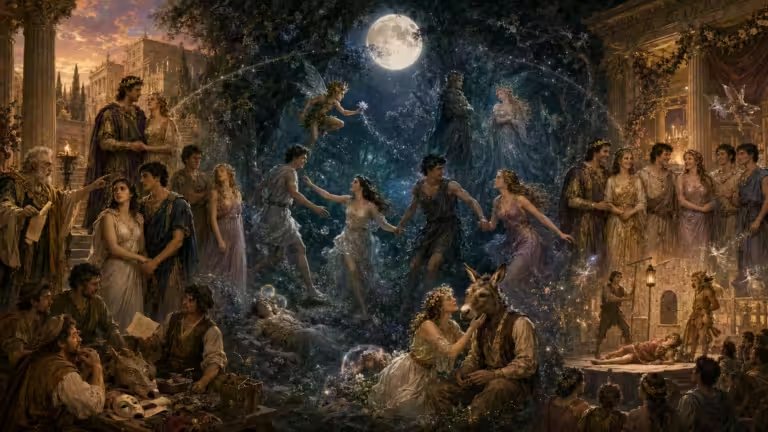
The structure of A Midsummer Night’s Dream brings together four dramatic worlds: the Athenian court, the young lovers, the mechanicals and the fairies. Shakespeare first presents these groups separately, sends them into the same forest, and then reunites them through marriage, performance and supernatural blessing.
Beneath the play’s apparent confusion lies an exceptionally controlled design. Its action moves from legal obstruction in Athens to emotional and magical disorder in the forest. It then returns to the city, where the events of the night are transformed into marriage, memory and theatre.
The conclusion does not merely restore the opening situation. Hermia escapes the marriage imposed by her father, Demetrius remains under the influence of magic, and the fairies enter the palace after the human characters retire. Shakespeare produces comic order, but he also preserves uncertainty.
Readers who need to review the events first can consult the complete act-by-act synopsis of A Midsummer Night’s Dream. This article focuses on how Shakespeare arranges those events into a coherent dramatic pattern.

The structure of A Midsummer Night’s Dream at a glance
The play contains five acts and nine scenes. However, its deeper structure depends less upon the conventional act divisions than upon changes of place, time, character grouping and dramatic control.
| Structural element | Beginning | Middle | Ending |
|---|---|---|---|
| Place | Athens | The forest outside Athens | Athens and the ducal palace |
| Time | Day and approaching evening | Night, sleep and dream | Dawn, wedding celebrations and night |
| Social condition | Law, hierarchy and obstruction | Misrule, transformation and confusion | Marriage, performance and qualified harmony |
| Lovers | Unequal romantic relationships | Magically rearranged desires | Two recognised couples |
| Fairies | Initially absent from Athens | Control much of the action | Enter and bless the palace |
| Mechanicals | Plan their production | Rehearse and encounter magic | Perform before the court |
| Theatre | A future wedding entertainment | Rehearsal and involuntary performance | Pyramus and Thisbe and Puck’s epilogue |
This pattern is often summarised as a movement from society into a “green world” and back. Yet Shakespeare complicates that model. Athens changes after the forest experience, while the fairies cross the apparent boundary and occupy the palace during the final scene.
The five-act dramatic architecture
Each act performs a distinct structural function. Shakespeare introduces separate plots, brings them into contact, intensifies their confusion, disentangles them and finally converts their experiences into public entertainment.
Act I: exposition and obstruction
Act I introduces the three human groups. The first scene presents Theseus and Hippolyta, Egeus and the four young lovers. The second scene introduces Bottom, Peter Quince and the other mechanicals.
The act establishes two events that organise the entire play: the forthcoming wedding and Hermia’s conflict with her father. Theseus’s marriage creates a deadline and a reason for celebration. Egeus’s demand creates the obstacle that sends Hermia and Lysander out of Athens.
The mechanicals respond to the same wedding from another social position. They plan to perform for Theseus and Hippolyta, although they do not yet meet the court. Their apparently independent subplot therefore remains connected to the principal action from the beginning.
Act I also establishes the movement towards the forest. Hermia and Lysander choose it as an escape from Athenian law, while the mechanicals select it as a private rehearsal space. Different characters enter the same location for unrelated reasons.
Act II: entry into the fairy world
Act II introduces Oberon, Titania, Puck and their attendants. The play’s fourth dramatic world therefore appears only after the human plots have been established. This delayed entrance changes the audience’s understanding of the forest.
The forest is not an empty refuge beyond Athenian authority. It possesses its own rulers, conflicts and hierarchies. Oberon and Titania’s quarrel has already disturbed the seasons before the young lovers arrive.
Act II also begins the convergence of the plots. Oberon witnesses Helena’s pursuit of Demetrius and decides to intervene. Puck’s inability to distinguish one Athenian man from another then connects the fairy conflict with the lovers’ story.
The love potion becomes the principal structural device. It allows Shakespeare to rearrange relationships rapidly without introducing disguise or long explanations. Sleep, sight and awakening control every transformation.
Act III: maximum confusion
Act III occupies the structural centre of the play. All four dramatic groups are now active in the forest, and plots that began separately collide. The lovers’ confusion, the fairy quarrel and the mechanicals’ rehearsal become parts of the same action.
In Scene 1, Puck discovers the mechanicals and gives Bottom a donkey’s head. Bottom’s singing awakens the enchanted Titania, linking the fairy and mechanical plots through an absurd romantic pairing.
Scene 2 creates the lovers’ comic crisis. Lysander and Demetrius both pursue Helena, Hermia is abandoned, the women quarrel and the men prepare to fight. The original imbalance has been completely reversed.
“Lord, what fools these mortals be!”
Puck, Act III, Scene 2
Puck’s comment establishes his position as both participant and spectator. He has helped create the confusion, yet he watches it like an amused theatre audience. His dramatic function therefore extends beyond that of a conventional servant.
The climax does not end with a decisive action. Instead, Puck uses fog, imitation and exhaustion to prevent violence. The act closes with all four lovers asleep, allowing the play to move from complication towards correction.
Act IV: awakening and recognition
Act IV reverses the transformations created during the night. Oberon releases Titania after obtaining the Indian boy, Puck restores Bottom’s human appearance, and Lysander’s affection returns to Hermia.
Dawn marks a transition from fairy control to human judgement. Theseus, Hippolyta and Egeus discover the lovers, whose imperfect memories make the previous acts resemble a shared dream.
Theseus resolves the opening conflict by overruling Egeus. Hermia may marry Lysander, while Helena will marry Demetrius. The authority that threatened Hermia in Act I now legitimises the relationship she chose.
Bottom also awakens without fully understanding his experience. His “rare vision” cannot be translated into ordinary language. The forest events therefore survive as memory, dream and potential art rather than as a rational account.
Scene 2 reunites Bottom with the mechanicals. Their subplot is now ready to re-enter the courtly frame. The four dramatic worlds have been disentangled, but the final act will bring them together again.
Act V: performance and comic postlude
Act V takes place after the weddings. The main romantic conflict has already been resolved, so the act functions less as a conventional climax than as a celebratory and interpretative postlude.
The mechanicals perform Pyramus and Thisbe before the three married couples. This embedded tragedy reflects the play that the audience has just watched. However, it replaces magical misunderstanding and comic survival with error, suicide and death.
The court comments throughout the performance, creating an audience inside the play. Shakespeare’s external spectators watch fictional spectators evaluating fictional actors. The comedy becomes openly concerned with its own theatrical construction.
The act continues after the mechanicals leave. Oberon, Titania, Puck and the fairies enter the palace and bless the marriages. The supernatural world therefore receives the final control of the stage.
Puck’s epilogue then addresses the real audience. He reframes the entire performance as a possible dream and makes applause part of the ending. The dramatic structure finally extends beyond the fictional story into the playhouse itself.

The four dramatic worlds
A Midsummer Night’s Dream does not contain four completely independent plots. Instead, it presents four social and imaginative worlds whose relationships gradually become visible. Each world possesses a distinctive tone, status and dramatic function.
The Athenian court
Theseus and Hippolyta frame the human action. Their wedding establishes the play’s calendar, creates the occasion for the mechanicals’ performance and provides the legal setting for Hermia’s conflict.
The court initially represents hierarchy, public authority and rational judgement. Theseus expects obedience from Hermia and appears confident that law can control desire. However, his own relationship with Hippolyta began through military conquest.
The court therefore represents order without necessarily representing justice or emotional harmony. Its authority must be modified before the young lovers can be integrated into the final celebration.
The young lovers
Hermia, Helena, Lysander and Demetrius form the principal romantic plot. Shakespeare gives them similar language, social status and emotional intensity. Their identities often seem less individual than relational.
The plot can therefore rearrange them almost like figures in a dance. Their declarations remain passionate even when the object of desire changes. This structural interchangeability supports the play’s sceptical examination of romantic certainty.
The lovers also connect the court with the forest. They leave Athens because its law obstructs them, but they cannot resolve their relationships without supernatural intervention. Their return allows the altered pairings to receive social recognition.
The mechanicals
Bottom and his companions belong to a lower social rank than the court and the lovers. They introduce occupational identities, prose dialogue, physical humour and practical concerns into a play otherwise dominated by rulers, noble lovers and supernatural beings.
Their social difference creates contrast rather than isolation. The mechanicals prepare a tribute for the duke, rehearse in the lovers’ forest and accidentally enter the fairy plot through Bottom’s transformation.
Bottom becomes the most important bridge between the dramatic worlds. He begins among the craftsmen, encounters Puck, becomes Titania’s beloved and finally performs before the court. No other character crosses so many social and ontological boundaries.
The fairies
Oberon, Titania and Puck introduce magic, folklore and a non-human perspective. Yet the fairy world mirrors the human world. It has rulers, servants, jealousy, conflict and struggles over possession.
The fairies possess greater power than the mortals, but they do not possess greater emotional wisdom. Oberon and Titania quarrel like an established human couple, while Puck mistakes Lysander for Demetrius despite his supernatural abilities.
The fairies also control the transition between dramatic phases. Their magic creates the central confusion, their antidotes prepare the resolution and their blessing completes the wedding night. Puck receives both the first substantial fairy description and the final speech.
How the four plots connect
Shakespeare avoids making the play feel like four unrelated stories by building several points of connection. A character, object or event repeatedly carries the action from one dramatic world into another.
| Connection | Plots joined | Structural result |
|---|---|---|
| The wedding of Theseus and Hippolyta | Court and mechanicals | Creates the occasion for Pyramus and Thisbe |
| Hermia’s forced marriage | Court and lovers | Sends the young lovers into the forest |
| Helena’s pursuit of Demetrius | Lovers and fairies | Prompts Oberon to intervene |
| The love potion | Fairies, lovers and Bottom | Produces both romantic confusion and parody |
| Bottom’s transformation | Mechanicals and fairies | Creates Titania’s enchanted love affair |
| Theseus’s hunting party | Court, lovers and forest | Returns the young people to public society |
| Pyramus and Thisbe | Mechanicals, court and lovers | Turns the preceding action into theatrical reflection |
| The fairy blessing | Fairies and court | Brings the forest world into the palace |
The strongest connections occur through Bottom and Puck. Puck moves between fairy intentions and mortal consequences. Bottom passes from the mechanicals’ rehearsal into Titania’s bower and then into the ducal performance.
The structure therefore depends upon crossings. Social classes, lovers, theatrical levels and even species meet in combinations that ordinary Athenian society would not permit.
Athens, the forest and Athens again
The most visible structural pattern is geographical. The first act takes place in Athens, the central action unfolds in the forest, and the final act returns to the court. This movement gives the comedy the broad shape of departure, transformation and reintegration.
Athens as law and social definition
Athens defines characters through fixed social relationships. Theseus is duke, Egeus is father, Hermia is daughter and the mechanicals are craftsmen. Authority moves downwards through this hierarchy.
The city also attempts to regulate marriage. Egeus treats Hermia as something he may dispose of, while Theseus initially supports his claim. Private desire conflicts with public law.
However, Athens should not be equated simply with reason. Egeus’s anger, Theseus’s impatience and Demetrius’s changing affections already reveal irrationality inside the supposedly rational city.
The forest as a transformative space
The forest weakens the identities assigned in Athens. Darkness prevents recognition, paths become uncertain and magic alters perception. Lovers lose one another, Bottom crosses the boundary between human and animal, and Titania abandons royal discrimination.
This freedom remains ambivalent. The forest shelters Hermia and Lysander from Athenian law, but it also exposes Hermia and Helena to abandonment, hostility and threatened violence. It enables transformation without guaranteeing safety.
Nor is the forest free from hierarchy. Oberon commands Puck, Titania commands her fairies, and both rulers struggle over the Indian boy. The forest replaces one system of authority with another rather than abolishing power.
The historical and folkloric meanings of this setting are explored further in the background to A Midsummer Night’s Dream.
The return to Athens
The return begins at dawn when Theseus discovers the sleeping lovers. The forest is still physically present, but the arrival of the duke restores public judgement and social language.
The characters do not return unchanged. Hermia can marry Lysander, Demetrius now desires Helena and Bottom carries an inexpressible memory of Titania. The forest has produced consequences that Athens must absorb.
The final setting is therefore a revised Athens. It contains more acceptable romantic pairings, a temporary meeting between social classes and the hidden presence of the fairies.
The limits of the town–forest–town pattern
The broad spatial pattern can suggest that Athens represents order while the forest represents disorder. Such a distinction helps explain the play, but it becomes misleading when treated as absolute.
Disorder exists before anyone reaches the forest. Hermia faces an unjust choice, Helena pursues a man who rejects her, and Oberon and Titania’s quarrel has disturbed the seasons. The forest reveals and exaggerates conflicts that already exist.
Order is also incomplete when the characters return. Demetrius remains enchanted, Egeus disappears without reconciliation and Titania has surrendered the Indian boy after magical humiliation. The marriages stop the action without answering every ethical question.
Most importantly, the forest does not remain outside the city. After the human celebrations, the fairies enter the palace, move through the sleeping household and bless its future children. The supernatural world becomes part of domestic order.
The structure therefore does not permanently separate reason from imagination. It ends by allowing dream, magic and uncertainty to inhabit the apparently rational world of marriage.

The lovers’ plot as a dance
The romantic structure resembles a dance in which characters repeatedly change partners. Shakespeare creates order, disrupts it and then establishes a new symmetrical arrangement.
| Stage | Hermia | Helena | Lysander | Demetrius |
|---|---|---|---|---|
| Opening arrangement | Loves Lysander | Loves Demetrius | Loves Hermia | Pursues Hermia |
| After Puck’s mistake | Loves Lysander | Loves Demetrius | Pursues Helena | Pursues Hermia |
| Maximum confusion | Rejected and isolated | Pursued by both men | Pursues Helena | Pursues Helena |
| Final arrangement | Paired with Lysander | Paired with Demetrius | Paired with Hermia | Paired with Helena |
The middle arrangement reverses the opening imbalance. Initially, two men desire Hermia and nobody returns Helena’s love. In Act III, two men desire Helena and nobody appears to love Hermia.
This symmetry turns emotional instability into visible dramatic form. The audience can follow the pattern even when the characters cannot understand it. Puck’s mistake produces disorder, but it remains an organised theatrical disorder.
The final pairings appear balanced because each person has one partner. Nevertheless, only Lysander’s enchantment is removed. The symmetry of the conclusion therefore conceals an unresolved difference between the couples.
Parallel couples and forms of love
The play’s structure depends upon several couples rather than one central romance. Each pairing presents love at a different stage or in a different form.
- Theseus and Hippolyta represent public marriage, political authority and a relationship shaped by conquest.
- Oberon and Titania represent an established marriage disrupted by jealousy and conflict over possession.
- Hermia and Lysander represent chosen love obstructed by paternal and political authority.
- Helena and Demetrius represent rejected love eventually satisfied through supernatural intervention.
- Titania and Bottom create a temporary parody of idealising desire.
- Pyramus and Thisbe represent the tragic outcome that the Athenian lovers avoid.
These couples create both parallels and contrasts. Theseus and Oberon are powerful male rulers, while Hippolyta and Titania are formidable women whose independence has been challenged. The lovers reproduce conflicts between desire and authority at a younger age.
Titania’s infatuation with Bottom exposes the irrationality present in every romantic plot. Her enchantment is visually extreme, but the lovers also idealise people whose qualities they barely examine.
The embedded story of Pyramus and Thisbe adds a tragic pair. Their deaths show what might occur when obstructed love, secrecy and mistaken evidence cannot be corrected in time.
Social hierarchy and structural contrast
Shakespeare arranges the characters across several social levels. The court contains rulers and aristocratic lovers. The mechanicals represent working trades, while the fairies possess a supernatural hierarchy that intersects with both.
The movement between these levels produces comedy and commentary. Bottom’s encounter with Titania temporarily places a weaver above a fairy queen, while the final performance brings craftsmen before aristocratic spectators.
High status does not guarantee wisdom. Theseus underestimates the lovers’ story, Oberon uses deception to defeat Titania and Egeus mistakes control for paternal duty. Conversely, Bottom’s foolishness coexists with courage, adaptability and imaginative experience.
The final celebration briefly gathers the social structure into one place. The mechanicals perform, the rulers watch and the fairies secretly bless everyone. Yet the groups do not become socially equal. Comedy creates contact rather than revolution.
Pyramus and Thisbe as a structural mirror
The mechanicals’ production is not an expendable comic interruption. It reflects, compresses and transforms the principal action. Shakespeare places a miniature tragedy inside his comedy so that the two forms interpret each other.
A tragic version of the lovers’ plot
Pyramus and Thisbe are young lovers separated by family opposition. They arrange a secret meeting outside the city, encounter a lion and misinterpret physical evidence. Their attempted escape ends in two deaths.
Hermia and Lysander also resist authority, flee the city and enter a dangerous wood. Their story avoids tragedy because magic remains reversible, violence is delayed and Theseus eventually changes the legal outcome.
The inset play therefore reveals the danger beneath the romantic comedy. Misunderstanding kills Pyramus and Thisbe, whereas Puck corrects the misunderstandings affecting the Athenian lovers before they become fatal.
A parody of theatrical representation
The mechanicals worry that spectators will mistake theatrical signs for reality. Consequently, they explain that the lion is not a lion, the wall is an actor and the moon is represented by a lantern.
Their explanations destroy the illusion they hope to protect. Instead of trusting the audience’s imagination, they make every theatrical convention visible. Their failure becomes a comic lesson in how theatre works.
Yet Shakespeare’s own production also relies upon visibly artificial conventions. A bare stage must become Athens, a forest, Titania’s bower and a palace. The mechanicals’ clumsiness makes the external audience more conscious of the imaginative cooperation required by every play.
An audience within the audience
Theseus, Hippolyta and the lovers watch and interrupt Pyramus and Thisbe. Their reactions create a second performance around the mechanicals’ play. Spectatorship itself becomes part of the drama.
The court’s comments also reveal character. Theseus often treats the actors more generously than Hippolyta does, while the young lovers use wit to display their restored social confidence.
Puck later places the real audience in a similar position. By asking for pardon and applause, he reminds viewers that their judgement determines whether Shakespeare’s own “dream” succeeds.
Metatheatre and frames within frames
Metatheatre describes drama that draws attention to its own status as performance. A Midsummer Night’s Dream uses several nested theatrical frames rather than limiting this device to the mechanicals’ production.
- The mechanicals cast and rehearse a play.
- Bottom unknowingly performs the role of Titania’s beloved.
- Puck imitates the voices of Lysander and Demetrius.
- The lovers awaken and narrate experiences they cannot verify.
- The court watches and judges Pyramus and Thisbe.
- Puck addresses Shakespeare’s audience directly.
Performance therefore shapes both plot and identity. Characters repeatedly adopt roles, follow scripts or mistake appearances for truth. The love potion itself behaves like an invisible director by assigning a new romantic part to anyone it affects.
The final epilogue encloses the entire comedy within another frame. Puck suggests that spectators may interpret the performance as a dream. The play becomes something imagined by its audience as much as something acted before them.
Time, night and dream structure
The opening announces that four days remain before Theseus’s wedding. However, the staged action soon compresses the decisive events into one night, followed by dawn and an apparently immediate wedding celebration.
This elastic chronology contributes to the dream effect. Calendar time matters less than the ritual movement from evening through darkness to morning. Night allows identities to dissolve, while dawn restores social recognition.
Sleep functions as a structural hinge. Titania must sleep before Oberon enchants her. Lysander and Demetrius receive the potion while asleep, and Puck gathers the lovers into sleep before correcting his mistake.
Awakening creates a new emotional or interpretative state. Enchanted characters wake in love, restored characters wake with altered memories, and Bottom wakes unable to separate experience from vision.
The dream structure allows incompatible events to coexist without complete explanation. A night can feel both brief and expansive, comic and threatening, real and imaginary. Puck’s epilogue preserves this temporal uncertainty rather than resolving it.
Structural oppositions
Shakespeare organises the play through recurring oppositions. However, the action repeatedly crosses or weakens each apparent boundary.
| Opposition | Initial distinction | How the play complicates it |
|---|---|---|
| Athens / forest | Law contrasts with natural freedom | The forest has rulers, while Athens contains irrational desire |
| Day / night | Visibility contrasts with confusion | Daylight does not reveal the full truth of the night |
| Reason / imagination | Theseus dismisses dreams and fairy stories | The audience has watched those apparently impossible events |
| Waking / dreaming | Waking appears more real | Dream experiences produce lasting consequences |
| Human / fairy | Mortals and immortals inhabit different worlds | They influence each other and finally share the palace |
| High / low society | Rulers contrast with craftsmen | Bottom enters Titania’s bower and performs before the court |
| Comedy / tragedy | The main play ends in marriage | Pyramus and Thisbe exposes the tragedy it narrowly avoids |
| Reality / theatre | The main story appears to contain a fictional performance | Puck reveals that the entire story is also a theatrical illusion |
The structural importance of these oppositions lies in their instability. The play does not simply choose Athens over the forest or reason over imagination. Instead, it makes each category dependent upon the other.
Repetition, doubling and reversal
Repeated actions help the audience navigate the complex plot. Characters pursue, reject, sleep, awaken and misrecognise one another in carefully varied sequences.
The two male lovers repeatedly exchange positions. Demetrius first rejects Helena, while Lysander loves Hermia. After the enchantments, both men use similar language to praise Helena and insult Hermia.
The two female characters also experience a reversal. Helena begins isolated and convinced of her inferiority. Hermia later occupies the same position when both men abandon her.
Oberon and Theseus form another structural doubling. Both are male rulers who intervene in relationships and expect obedience. However, Theseus resolves the human conflict publicly, while Oberon uses secrecy and magic.
Titania and Hippolyta similarly possess authority that male power attempts to contain. Titania resists Oberon until he manipulates her perception, while Hippolyta enters marriage after Theseus defeated her in battle.
These parallels prevent the subplots from remaining decorative. Each dramatic world offers another version of power, desire, conflict or reconciliation.
Language and structural rhythm
The play’s different groups often speak in different registers. The lovers favour lyrical verse and conventional romantic imagery. The mechanicals frequently use prose, malapropisms and awkward theatrical language.
Oberon and Titania speak in highly patterned poetry filled with natural imagery. Puck moves more freely between narrative, rhyme, song, impersonation and direct address. These shifts help the audience recognise changes of world and tone.
Scene alternation also creates rhythm. The play moves from rulers to craftsmen, fairies to lovers, romance to farce and danger to song. No single tone dominates for long.
This variation prevents the multiple plots from becoming monotonous. It also allows Shakespeare to place serious questions beside comic action without requiring one to cancel the other.
What is the climax of A Midsummer Night’s Dream?
Act III, Scene 2 forms the principal comic climax. All four lovers meet after the potion has rearranged their affections. Helena believes everyone is mocking her, Hermia attacks Helena verbally, and Lysander and Demetrius prepare to fight.
The scene brings the romantic plot closest to violence and complete social collapse. It also reveals Puck’s mistake to Oberon, making correction possible.
However, the play contains a second kind of climax in Act V. The performance of Pyramus and Thisbe gathers the human characters and transforms their dangerous experiences into comedy.
The first climax belongs to the plot, while the second belongs to theatrical interpretation. Shakespeare first resolves what happened, then asks how such events can be represented and understood.
Does the ending restore the beginning?
The ending restores public order, but it does not recreate the opening arrangement. Egeus wanted Hermia to marry Demetrius, yet Theseus permits her marriage to Lysander. Paternal authority has therefore been limited rather than reaffirmed.
The lovers also retain the consequences of magic. Demetrius remains in love with Helena because the potion was never removed. His final certainty is structurally useful but psychologically ambiguous.
Oberon and Titania reconcile, but Oberon has secured the Indian boy through deception. Their restored harmony rests upon Titania’s defeat and erased memory of her enchanted humiliation.
Finally, the fairies enter Athens rather than remaining in the forest. The city can no longer be separated completely from the dream world. The ending creates a new order that contains elements of the disorder it appears to overcome.
This qualified resolution helps explain why the play remains more complex than a simple romantic comedy. Read the accompanying analysis of why A Midsummer Night’s Dream is a comedy.
Why is the structure of the play important?
The structure allows Shakespeare to examine the same subjects through different social groups and dramatic forms. Courtly authority, romantic desire, marriage, imagination and performance appear repeatedly, but never in exactly the same form.
The play’s complexity also supports its central interest in unstable perception. Characters cannot always distinguish love from enchantment, waking from dreaming or nature from performance. The audience experiences a similar uncertainty while moving between dramatic worlds.
Nevertheless, the construction remains clear enough to guide spectators through the confusion. Spatial movement, repeated awakenings, partner reversals and parallel couples make the apparent chaos legible.
Shakespeare’s achievement lies in joining these disconnected materials without flattening their differences. The court, lovers, mechanicals and fairies retain distinctive identities, yet each becomes necessary to the final theatrical pattern.
The play therefore resembles its own description of imagination. It gives apparently unrelated figures “a local habitation and a name”, bringing classical Athens, English folklore, romantic comedy and amateur tragedy into one coherent dramatic dream.
Frequently asked questions
What is the basic structure of A Midsummer Night’s Dream?
The play moves from Athens into the forest and back to Athens. The city introduces legal and romantic conflicts, the forest transforms them through magic, and the return converts the new relationships into marriages and public celebration.
How many plots are there in A Midsummer Night’s Dream?
The play contains four interconnected dramatic worlds rather than four entirely separate plots. These involve the Athenian court, the young lovers, the mechanicals and the fairies. Their stories converge in the forest and during the final wedding celebrations.
What is the role of the forest in the structure?
The forest provides a transitional space beyond direct Athenian law. It allows identities, relationships and social hierarchies to change. However, it also contains danger, conflict and its own forms of authority.
What is the climax of A Midsummer Night’s Dream?
Act III, Scene 2 is the principal plot climax. Both men pursue Helena, Hermia is rejected and the lovers move towards violence. Puck and Oberon must intervene before the relationships can be restored.
Why is Pyramus and Thisbe structurally important?
The mechanicals’ play mirrors the story of Hermia and Lysander in tragic form. It also creates an audience within the play and examines theatrical illusion. Shakespeare turns the danger underlying the main plot into public comedy.
Why does Act V come after the marriages are settled?
Act V functions as a postlude rather than a conventional resolution. It allows the characters to watch Pyramus and Thisbe, brings the fairies into the palace and lets Puck reinterpret the entire play as a possible dream.
Does the play end where it began?
It returns geographically to Athens, but the social situation has changed. Hermia marries Lysander despite Egeus’s demand, Demetrius remains enchanted and the fairies enter the palace. The ending creates a revised order rather than restoring the original one.
How does the dream motif affect the structure?
Sleep and awakening mark the play’s major transformations. Characters receive enchantments while asleep and wake with new desires or uncertain memories. Puck’s epilogue finally invites the audience to treat the entire performance as a dream.
Continue studying A Midsummer Night’s Dream
Explore how Shakespeare transforms this complex structure into romantic comedy, magical confusion and theatrical celebration.
Sources and further reading
- Folger Shakespeare Library: complete text of A Midsummer Night’s Dream
- Catherine Belsey, “A Modern Perspective: A Midsummer Night’s Dream”
- Folger Shakespeare Library: critical bibliography and further reading
- Royal Shakespeare Company: scene-by-scene plot synopsis
- Royal Shakespeare Company: dramatic timeline
- Royal Shakespeare Company: setting and language analysis
- Shakespeare’s Globe: plot and characters
- Shakespeare’s Globe: the forest and theatrical space

i thanketh thee for this wonderful story. it doth have tremendous effect on me
Report a typoit doth indeed ! You’re very welcome.
Report a typoThank you! :D This really helped.
Report a typoCheers, I’m glad it helped :)
Report a typo