
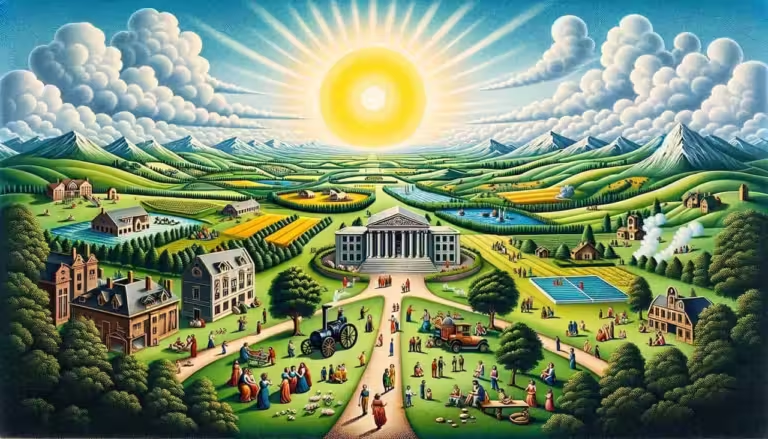
A literary utopia describes an imaginary society organised differently from the author’s world and presented as better in significant ways. It does not merely depict perfection. Instead, it tests ideas about power, property, work, freedom and happiness.
The word utopia now describes almost any ideal place, project or future. We speak of technological utopias, ecological utopias and even utopian business plans. However, the term began as the name of an imaginary island in a book published by Thomas More in 1516.
Since then, utopia has become a literary genre, a method of political criticism and a way of imagining alternatives to the present.
A utopian text does not need to offer a flawless world. In fact, its most interesting features often emerge from tension, contradiction and uncertainty. The apparently ideal society may conceal coercion. Meanwhile, customs that initially seem absurd may expose injustices that readers normally accept.

A concise definition of literary utopia
A literary utopia is a detailed representation of a society that does not exist and differs significantly from the writer’s own society. The text presents that imagined community as better in at least some important respects.
That definition requires several qualifications.
- The society must be imaginary, although it may use real locations.
- It normally describes social institutions, rather than one person’s private paradise.
- It establishes a comparison between the imagined society and the author’s world.
- It appears better according to a particular system of values, not necessarily according to every reader.
- It may contain disturbing institutions, contradictions or deliberate satire.
A utopia is therefore not simply a perfect place. It is a structured thought experiment about how people might live together differently.
The meaning of the word utopia
Thomas More coined the word utopia from Greek elements. The name creates a deliberate pun between two similar expressions:
- ou-topos: no place or nowhere;
- eu-topos: a good place.
Utopia is therefore both the good place and the place that does not exist. The apparent ideal contains impossibility within its name.
This ambiguity prevents a straightforward reading. More does not simply describe a perfect state and ask England to copy it. He creates an imaginary society whose customs challenge European assumptions while raising fresh moral and political problems.
The word later acquired several related meanings. It can refer to More’s fictional island, the literary genre inspired by his book, an ideal social project or the broader human desire for a better way of life.

A utopia does not have to be perfect
Modern usage often treats utopia as a synonym for perfection. Literary analysis requires a more precise definition.
Readers may disagree about whether an imagined society is desirable. A system that guarantees material equality might also restrict movement, privacy or personal choice. One character may praise social order, while another reader notices conformity.
Thomas More’s Utopians abolish private property and organise production for common use. However, they also practise slavery, regulate travel, supervise behaviour and impose strict social customs.
These contradictions do not disqualify the book as a utopia. They form part of its intellectual design. The text invites readers to compare competing values rather than admire an uncomplicated paradise.
A better definition therefore focuses on comparison. A utopian society appears preferable to the existing world in significant respects, even when it remains imperfect or troubling.
Utopia as a critical mirror
Utopian literature describes another society, but its real subject is usually the author’s own world.
The imaginary community acts as a critical mirror. By changing familiar institutions, the writer reveals that those institutions are neither natural nor inevitable.
A society without money invites readers to reconsider private property and exchange. A society without conventional marriage challenges assumptions about family. A society built around leisure questions the organisation of work.
The utopian method therefore relies upon estrangement. Readers temporarily leave their own customs behind and encounter a different social logic.
When they return mentally to the real world, ordinary institutions may appear newly strange. That change in perspective often matters more than the practicality of the proposed alternative.
Utopia is not necessarily set in the future
Many modern utopias describe future societies. However, future projection is not an essential feature of the genre.
Thomas More places Utopia on a distant island that supposedly exists at the same time as Renaissance Europe. The separation is geographical rather than temporal.
Early utopian travellers typically cross an ocean, enter an unknown country and discover unfamiliar institutions. Distance protects the imagined society from outside interference while making its existence seem just plausible enough.
Later writers increasingly moved utopia into the future. This change transformed the genre. A distant island might remain forever inaccessible, but a future society could appear as the result of historical development.
Louis-Sébastien Mercier’s The Year 2440, published in 1771, helped establish the future-oriented utopia. During the nineteenth century, industrialisation and theories of progress made temporal projection increasingly important.
Edward Bellamy’s Looking Backward and William Morris’s News from Nowhere both send a nineteenth-century protagonist into the future. However, they imagine radically different forms of socialism.
The typical structure of a literary utopia
Utopian narratives vary widely, but many follow a recognisable pattern.
1. Departure from the familiar world
A traveller leaves home by ship, dream, accident, underground passage or time displacement. This journey creates distance from ordinary society.
2. Arrival in an unknown society
The traveller enters a place organised according to unfamiliar rules. An island is common, but writers also use hidden valleys, underground civilisations, distant planets and future cities.
3. A guided tour
A local inhabitant explains the society’s institutions. The visitor asks the questions that readers might ask about government, property, education, work, family and religion.
4. Comparison with the real world
The guide and traveller compare the imaginary society with the visitor’s home. Satire often emerges from these conversations.
5. Return or exclusion
The traveller usually returns home, awakens or becomes unable to remain. The alternative society survives as a story, memory or political possibility.
This structure turns exposition into narrative. Instead of presenting a dry constitution, the writer allows readers to discover the social system alongside an outsider.

Common features of utopian societies
No single feature defines every utopia. Nevertheless, the genre repeatedly examines several areas of collective life.
Isolation
Many early utopias occupy islands or hidden territories. Isolation allows an alternative culture to develop without being absorbed by surrounding societies.
However, isolation can also conceal fear of difference. A supposedly harmonious society may maintain order only by controlling contact with outsiders.
Property and distribution
Utopian writers frequently reconsider private property. Some abolish money and individual ownership. Others preserve personal possessions while placing land or production under collective control.
The central question remains consistent: how should a society distribute resources without creating poverty, idleness or domination?
Work and leisure
Utopias often reduce working hours, distribute unpleasant tasks or transform labour into a creative activity. They ask whether work must remain compulsory, unequal or exhausting.
Thomas More limits the working day to six hours. Bellamy uses centralised industrial organisation. Morris instead makes useful work pleasurable and voluntary.
Education
Education usually supports the new social order. It may develop reason and talent, preserve equality or teach citizens to accept collective values.
This dual function creates tension. Education can liberate individuals, but it can also produce conformity.
Government and authority
Some utopias rely upon wise rulers, scientific experts or religious leaders. Others favour assemblies, local communities or voluntary cooperation.
The apparent absence of conflict should always invite scrutiny. Who makes decisions? What happens when someone refuses? Can citizens leave?
Family and gender
Writers regularly redesign marriage, childcare, domestic labour and sexual relationships. These changes reveal the period’s assumptions about gender and social reproduction.
A text may appear radical in one area while remaining conservative in another. Formal equality does not automatically remove patriarchal control.
Science, technology and nature
Some utopias trust science to eliminate scarcity, disease and physical labour. Others regard technological expansion as a threat to autonomy or the environment.
This opposition becomes especially important during the nineteenth century. Bellamy embraces industrial coordination, while Morris imagines a decentralised society that has abandoned unnecessary mass production.
The origins of utopian thought
Thomas More invented the word, but he did not invent the desire to imagine a better society.
Ancient myths described lost ages of abundance and harmony. Religious traditions imagined gardens, promised lands, heavenly cities and renewed worlds. Popular tales created lands where food appeared without labour and social hierarchies temporarily disappeared.
These traditions differ from literary utopia because divine intervention, magic or nostalgia often creates their ideal conditions. More’s society instead depends mainly upon human institutions, laws and customs.
Ideal-society narratives also exist beyond the European tradition. Tao Yuanming’s fifth-century Chinese account of the Peach Blossom Spring describes a secluded community living peacefully beyond the violence of recorded history.
We should therefore distinguish the specific genre created around More’s book from the broader, cross-cultural impulse to imagine alternative forms of collective life.
Plato’s Republic as a classical precursor
Plato wrote the Republic long before the word utopia existed. The dialogue investigates justice by constructing an ideal city in speech.
Its guardians share property, receive a controlled education and subordinate private interests to the city. Plato also grants women within the guardian class access to education and political responsibilities.
However, the Republic is not a narrative journey to a functioning alternative society. It remains a philosophical dialogue about justice, knowledge and political order.
It therefore acts as a major precursor rather than a literary utopia in the strict Morean sense.
Atlantis plays a different role in Plato’s Timaeus and Critias. It begins as a wealthy and powerful civilisation, but ambition and imperial expansion lead to its destruction. Atlantis is better understood as a warning about corruption than as Plato’s ideal commonwealth.
Thomas More’s Utopia
Thomas More published Utopia in Latin at Leuven in 1516. The first English translation, by Ralph Robinson, appeared in 1551.
The work contains two books. Book I stages a debate about political counsel and criticises European society. Its subjects include enclosure, poverty, theft, capital punishment, war and royal courts.
Book II describes the island of Utopia through the testimony of the traveller Raphael Hythloday.
The Utopians hold property in common, work limited hours and distribute goods according to need. They value education, tolerate several religions and treat gold as a material of little intrinsic worth.
Yet the society also restricts travel, maintains slavery, supervises private behaviour and places strong pressure upon citizens to conform.
More makes his own position deliberately difficult to identify. Raphael’s surname, Hythloday, can suggest a speaker of nonsense. The fictional Thomas More challenges some of Raphael’s claims. Meanwhile, the island’s institutions combine attractive reforms with obvious moral problems.
The book should therefore be read as an open intellectual puzzle, not a simple manifesto.
Renaissance and early modern utopias
More’s book established a narrative model that later writers adapted to changing political, religious and scientific concerns.
The Abbey of Thélème
In Rabelais’s Gargantua, the Abbey of Thélème rejects conventional monastic discipline. Its inhabitants follow the principle “Do what you will”.
Thélème celebrates freedom, education and personal cultivation. However, it remains an exclusive community populated by privileged and accomplished individuals.
Christianopolis
Johann Valentin Andreae’s Christianopolis, published in 1619, describes a disciplined Christian community built around common property, education, labour and scientific knowledge.
The City of the Sun
Tommaso Campanella’s The City of the Sun, published in Latin in 1623, combines communal ownership, universal education, astrology and rule by an intellectual and religious elite.
New Atlantis
Francis Bacon’s unfinished New Atlantis, published after his death in 1627, imagines the island of Bensalem. Its most influential institution is Salomon’s House, a research community devoted to organised scientific investigation.
These works share More’s use of an enclosed society, but they assign different roles to religion, science and political authority.
The nineteenth-century move towards the future
Industrialisation transformed utopian literature. Writers no longer imagined only remote islands. They projected the consequences of social and technological change into the future.
Edward Bulwer-Lytton’s The Coming Race depicts an advanced underground civilisation whose power appears both impressive and threatening.
Richard Jefferies’s After London imagines England after the collapse of industrial civilisation. Nature reclaims the landscape, but human society also returns to violence and feudal hierarchy.
W. H. Hudson’s A Crystal Age presents a pastoral future without money, conventional competition or modern industry. Its apparent harmony becomes increasingly restrictive for its Victorian protagonist.
Edward Bellamy’s Looking Backward, published in 1888, imagines a centralised industrial commonwealth in the year 2000. The state coordinates production through an “industrial army” and distributes goods through equal public credit.
William Morris rejected Bellamy’s emphasis on centralisation and industrial efficiency. His News from Nowhere replaces them with local cooperation, common ownership, ecological restoration and pleasurable work.
These works demonstrate that utopia is never politically neutral. Writers may agree that the present is unjust while disagreeing completely about technology, authority and progress.
What is the difference between utopia and dystopia?
A dystopia presents an imaginary society that appears substantially worse than the author’s world. It commonly develops existing political, technological or environmental tendencies until their dangers become impossible to ignore.
John Stuart Mill used the term dys-topians in Parliament in 1868. The word later became the standard label for oppressive or deeply undesirable imaginary societies.
Utopia and dystopia are not absolute opposites. Both forms construct another society to criticise the present. They often examine the same subjects:
- political authority;
- economic organisation;
- technology;
- education;
- surveillance;
- gender and reproduction;
- the relationship between individuals and the community.
The crucial difference lies in evaluation. A utopia foregrounds desirable alternatives, while a dystopia foregrounds suffering, domination or decline.
However, one character’s utopia can easily become another character’s dystopia. A perfectly ordered society may look peaceful from the centre and oppressive from its margins.
Dystopia and anti-utopia are not identical
The terms dystopia and anti-utopia often overlap, but they describe different critical movements.
A dystopia depicts a society that has become oppressive, dehumanising or disastrous. Its target may be authoritarianism, capitalism, environmental collapse, patriarchy, surveillance or technological control.
An anti-utopia attacks utopianism itself. It argues that attempts to impose an ideal social order tend to suppress difference, individual freedom and political disagreement.
A dystopian novel may still preserve utopian hope through resistance, memory or an alternative community. An anti-utopia is more suspicious of the entire desire to design a perfect society.
Many works combine both forms. The distinction remains useful, but it should not become a rigid classification.
Why can utopia become oppressive?
Every utopia depends upon a definition of the good life. Someone must decide what counts as happiness, justice, useful work and acceptable behaviour.
Problems arise when the imagined society treats one answer as universally valid. Diversity then appears as disorder, disagreement becomes ignorance and refusal becomes a threat.
The pursuit of harmony may therefore produce surveillance or coercion. A community can eliminate visible conflict by silencing people who do not share its values.
However, this danger does not make every utopian idea authoritarian. Open or critical utopias refuse final perfection. They preserve debate, uncertainty and the possibility of further change.
William Morris’s Nowhere, for example, contains no centralised state or fixed administrative blueprint. Ursula K. Le Guin later described an “ambiguous utopia” in The Dispossessed, where the alternative society remains incomplete and open to criticism.
The strongest utopian texts do not close political discussion. They create room for it.
How to analyse a utopian text
A useful analysis should move beyond listing attractive institutions. It should examine the relationship between the imaginary society, the narrative and the historical context.
What problem in the present does the text expose?
Identify the poverty, inequality, political repression, technological anxiety or environmental damage that motivates the alternative society.
Who defines the good society?
Examine the narrator, traveller and guide. Their opinions may differ, and none should automatically represent the author.
How are property and labour organised?
Ask who owns land, tools and resources. Determine whether people choose their work and how the society distributes unpleasant tasks.
What happens to disagreement?
A society’s treatment of dissent often reveals more than its official claims about freedom.
Who remains outside the ideal?
Consider foreigners, servants, enslaved people, dissidents, disabled people and anyone excluded from full citizenship.
How does the text use irony?
Names, narrative gaps and contradictions may undermine the guide’s confident explanations. An apparently serious proposal may contain satire.
Is the society complete or still changing?
A closed utopia presents its institutions as final. A critical utopia recognises that no social order can permanently resolve every conflict.
Why utopian literature still matters
Utopian literature interrupts political fatalism. It reminds readers that existing institutions were created by people and can therefore be changed by people.
This does not mean every imagined alternative is practical or desirable. Utopia remains valuable precisely because it permits experimentation without pretending to settle every question.
The genre asks readers to consider what society treats as unavoidable. Must employment determine access to basic needs? Must technology increase consumption? Must cities separate people from nature? Must equality require uniformity?
Utopia turns such questions into places, institutions and stories. It gives abstract political ideas a human scale.
Its purpose is not necessarily to predict the future. It makes the present available for criticism.
Continue the series on utopian literature
- News from Nowhere: William Morris, Context and Key Ideas examines the artistic, political and intellectual origins of Morris’s utopian romance.
- News from Nowhere: An Epoch of Rest explores Morris’s transformation of labour, leisure, art and socialist fellowship.
Frequently asked questions
What is a utopia in literature?
A literary utopia is a detailed description of an imaginary society presented as better than the author’s society in significant ways. It usually examines institutions such as government, property, work, education and family life.
Does utopia mean a perfect society?
Not necessarily. A utopia presents a desirable alternative according to particular values, but it may contain contradictions, restrictions or disturbing institutions. Readers may also disagree about whether the society is genuinely better.
Who invented the word utopia?
Thomas More coined the word for his 1516 book Utopia. The name plays upon Greek terms meaning “no place” and “good place”.
What is the difference between utopia and dystopia?
A utopia foregrounds an imaginary society that appears better than the present. A dystopia foregrounds a society that is oppressive, frightening or substantially worse. Both forms use imaginary worlds to criticise real social tendencies.
Are all utopias set in the future?
No. Early literary utopias usually existed in remote or unknown locations. Future-oriented utopias became especially prominent from the late eighteenth century onwards.
Why are utopias often islands?
An island creates physical and cultural separation from the known world. It allows the writer to imagine institutions developing without outside interference, while also raising questions about exclusion and control.
Sources and further reading
- Fátima Vieira, “The Concept of Utopia”, in The Cambridge Companion to Utopian Literature.
- Thomas More, Utopia, Project Gutenberg.
- Stanford Encyclopedia of Philosophy, Thomas More.
- Library of Congress, The Utopia of Sir Thomas More, Latin and first English translation.
- Encyclopaedia Britannica, Utopia by Thomas More.
- UK Parliament, John Stuart Mill’s parliamentary speeches from 1868.
- Roland Boer, “Abstract or Concrete Utopia? Concerning the Ideal Society in Chinese Philosophy and Culture”.

