
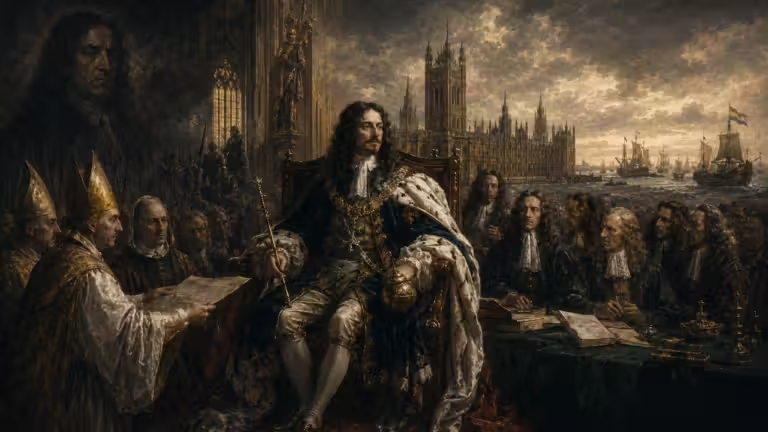
The Restoration of 1660 returned the monarchy, Parliament and the Church of England, but it did not restore the political world that had existed before the Civil War. Charles II governed within a society transformed by regicide, republican government, religious pluralism and military rule. The settlement survived for twenty-five years, yet conflicts over Catholicism, dissent, royal prerogative and the succession eventually prepared the overthrow of James II in 1688.
The Restoration followed eleven years of republican experiments. Before examining how monarchy returned, revisit the New Model Army, the execution of Charles I, the Commonwealth and Oliver Cromwell’s Protectorate.

Why was the monarchy restored in 1660?
Oliver Cromwell’s death in September 1658 exposed the fragility of the Protectorate. His son Richard inherited the office of Lord Protector but lacked military authority, political experience and a dependable group of supporters. He resigned in May 1659 after failing to reconcile Parliament with senior army officers.
The following months brought repeated constitutional breakdowns. The army recalled the Rump Parliament, expelled it and then restored it again. Competing officers and politicians claimed to defend the republican cause, but none could establish a government with broad legitimacy.
England had grown weary of military intervention, irregular taxation and constitutional uncertainty. Many former Parliamentarians concluded that monarchy offered the best prospect of stable civilian government. Their support did not mean that they had abandoned every principle defended during the Civil War.
General George Monck commanded the English army occupying Scotland. During the winter of 1659–1660, he marched south while presenting himself as a defender of lawful parliamentary government. His intentions remained deliberately uncertain until he had secured control of London and the army.
Monck allowed the MPs excluded during Pride’s Purge to return to the Long Parliament. That restored assembly dissolved itself and authorised elections for a new Parliament. Because no king existed to summon it, the resulting body became known as the Convention Parliament.
The Declaration of Breda
Charles Stuart had lived in exile since his defeat at Worcester in 1651. From the Dutch city of Breda, he issued a declaration on 4 April 1660 offering terms for his return. The document avoided resolving several divisive issues directly and instead left their final settlement to Parliament.
Charles promised a general pardon for offences committed during the conflicts, apart from exceptions determined by Parliament. He also offered liberty for “tender consciences”, payment of the army’s arrears and parliamentary consideration of disputed property.
The declaration reassured groups that feared revenge or dispossession. Former Parliamentarians hoped to retain property acquired during the Interregnum, while soldiers wanted their wages. Religious dissenters interpreted the language of conscience as a possible foundation for toleration.
However, the declaration was intentionally ambiguous. It did not define the limits of religious liberty or identify those who would be excluded from pardon. It also did not determine whether confiscated estates would return to their former owners.
The Convention Parliament accepted the declaration and invited Charles to return. He entered London on 29 May 1660, his thirtieth birthday. Crowds, decorations and public celebrations presented the Restoration as a national reconciliation after years of conflict.

What did the Restoration restore?
The monarchy, House of Lords and established Church returned. The Restoration also revived hereditary titles, royal ceremonies and many institutions abolished after 1649. New coronation regalia had to be created because the Commonwealth had destroyed or sold much of the previous collection.
Charles II’s reign was legally dated from his father’s execution on 30 January 1649 rather than from his return in 1660. This constitutional fiction implied that the republic and Protectorate had never possessed lawful authority. It strengthened the principle of hereditary monarchy while avoiding an admission that Parliament had created a new king.
Nevertheless, Charles did not simply recover every power exercised by his father. The courts associated with Personal Rule remained abolished, and the Crown could not easily revive Ship Money or other disputed fiscal measures. Parliament also retained the political importance it had acquired during the Civil War.
The Restoration therefore combined continuity with substantial change. England recovered a king, but that king inherited a state with a stronger Parliament, a larger fiscal system and a permanent military establishment. The central question concerned how these institutions would share power.
Pardon, punishment and the regicides
The Act of Indemnity and Oblivion of 1660 granted a broad pardon for acts committed during the wars and Interregnum. Without such protection, thousands of soldiers, officials and property owners could have faced prosecution. Political stability required the Crown to limit revenge.
The pardon did not extend fully to those associated with the trial and execution of Charles I. Parliament identified surviving regicides and other republican leaders for punishment. Several were executed, while others received imprisonment or escaped abroad.
The bodies of Oliver Cromwell, Henry Ireton and John Bradshaw were exhumed and subjected to symbolic posthumous execution. These acts displayed the restored monarchy’s rejection of regicide and republican government. However, the Crown did not attempt to punish every person who had served the Commonwealth.
The distinction between selective punishment and general pardon served a practical purpose. Charles could avenge his father and reaffirm royal authority without restarting the civil conflict. Even so, the fate of the regicides reminded political opponents that reconciliation had clear limits.
The Convention and Cavalier Parliaments
The Convention Parliament supervised the initial Restoration settlement. Its members included former Royalists and moderate Parliamentarians who largely agreed that monarchy should return. However, they disagreed over religion, property and the precise constitutional lessons of the Civil War.
Charles dissolved the Convention in December 1660. Elections produced a more strongly Royalist and Anglican assembly that first met in May 1661. Its opponents later called it the Cavalier Parliament.
The Cavalier Parliament remained in existence until 1679, making it one of the longest parliaments in English history. Its members strongly supported the monarchy and Church of England, particularly during its early sessions. Yet they did not abandon parliamentary privilege or accept unlimited royal government.
Restoration politics did not divide immediately into government and opposition parties. MPs formed shifting alliances around religion, foreign policy, taxation and court influence. The clearer labels Whig and Tory would emerge only during the Exclusion Crisis.
The financial settlement of the monarchy
Charles needed enough revenue to govern without constantly requesting emergency grants. Parliament assigned the Crown a substantial ordinary income drawn from customs, excise and traditional revenues. The settlement was intended to fund peacetime government throughout the king’s life.
In practice, revenue often fell below expectations while the expenses of court, administration, diplomacy and war increased. Charles therefore continued to rely on parliamentary subsidies, loans and financial arrangements with foreign powers.
This dependence constrained the Crown but did not give Parliament continuous control over government. Charles could dissolve Parliament, postpone sessions and seek income elsewhere. The political balance depended less on one formal constitutional rule than on the Crown’s changing financial needs.
The Restoration also preserved a small permanent army. The experience of military rule made standing forces politically suspect, but Charles retained regiments for royal security and overseas service. Under James II, the size and command of this army would become a central source of fear.
The Restoration of the Church of England
The Church of England recovered its bishops, ecclesiastical courts and parish organisation. The Restoration therefore reversed the Presbyterian and Independent experiments of the 1640s and 1650s. It did not, however, immediately determine whether moderate Puritans could remain within the national Church.
Some church leaders favoured a broad Protestant settlement that could include Presbyterians. Charles’s Declaration of Breda appeared to leave room for such accommodation. The Savoy Conference of 1661 brought Anglican and Presbyterian representatives together to discuss revisions to the liturgy.
The conference failed to produce a lasting compromise. Anglican leaders defended episcopal government and a revised Book of Common Prayer, while Presbyterian ministers sought further liturgical and ecclesiastical reform. The Cavalier Parliament then imposed a narrower settlement.
The Corporation Act of 1661
The Corporation Act restricted municipal office to people willing to meet Anglican religious tests. Officeholders had to reject the Solemn League and Covenant and demonstrate conformity through participation in Anglican communion.
The measure connected local political authority with religious allegiance. Protestant dissenters who rejected the established Church could no longer participate freely in the government of towns and boroughs. These exclusions also helped Royalist Anglicans regain control of local institutions.
The Act of Uniformity of 1662
The Act of Uniformity required clergy to use the revised Book of Common Prayer and conform to episcopal ordination and the doctrines of the Church of England. Ministers who refused the terms had to leave their benefices by St Bartholomew’s Day, 24 August 1662.
Approximately two thousand ministers lost or left their positions in what became known as the Great Ejection. This event separated a substantial Nonconformist ministry from the established Church and gave English dissent a more permanent institutional identity.
Presbyterians, Congregationalists, Baptists and other Protestants continued to worship outside the parish Church. Their congregations differed significantly in theology and organisation. What united them politically was exclusion from the restored Anglican establishment.
Conventicles and the Five Mile Act
The Conventicle Act of 1664 restricted religious meetings held outside the authorised Church. The Five Mile Act of 1665 prevented many ejected ministers from living near corporate towns or their former parishes unless they accepted a demanding oath.
These laws aimed to prevent dissenting congregations from becoming centres of political resistance. Memories of Puritan mobilisation and republican government made religious independence appear dangerous to many Restoration legislators.
Collectively, the Corporation Act, Act of Uniformity, Conventicle Acts and Five Mile Act became known as the Clarendon Code. The expression is retrospective and can misleadingly suggest one coherent programme designed entirely by Edward Hyde, Earl of Clarendon.
Clarendon was Charles II’s principal minister during the early Restoration, but Parliament, bishops and local elites also shaped the settlement. The laws nevertheless established a powerful connection between Anglican conformity, public office and political loyalty.
Religious dissent after the Great Ejection
Persecution did not eliminate Nonconformity. Ministers preached in private houses, barns and open spaces, while congregations developed their own networks of worship and support. Enforcement varied considerably between regions and according to local magistrates.
John Bunyan, a Baptist preacher and later author of The Pilgrim’s Progress, spent years in prison after refusing to abandon unauthorised preaching. Quakers also faced fines, imprisonment and violence because their meetings rejected Anglican worship and conventional social deference.
Nonconformists did not form a single political movement. Some Presbyterians sought eventual readmission to a broader national Church. Congregationalists and Baptists defended autonomous congregations, while Quakers developed a distinctive testimony against oaths and violence.
The experience of exclusion nevertheless gave these communities a shared interest in religious toleration. Their later relationship with James II would prove complicated: they welcomed relief from persecution but distrusted a Catholic king who claimed the power to suspend laws without Parliament.
The Restoration settlement in Scotland
Charles II was restored as king of Scotland as well as England and Ireland. However, the Scottish political and religious settlement followed its own path. The Crown dismantled the revolutionary authority established by the Covenanters and restored episcopal government.
Charles had accepted the Covenants before his Scottish coronation in 1651. After the Restoration, he rejected that commitment and asserted royal authority over the Church. Bishops returned, and hundreds of ministers with Covenanting sympathies lost their parishes.
Some ministers and worshippers attended illegal outdoor services known as conventicles. Government forces attempted to suppress these meetings, while field preachers defended the principle that Christ, rather than the monarch, governed the Church.
The Pentland Rising of 1666 and another Covenanter rebellion defeated at Bothwell Bridge in 1679 intensified repression. Executions, imprisonment, fines and transportation followed. The harshest period of persecution during the 1680s became known in Covenanting memory as the Killing Time.
Scottish resistance was therefore not simply an extension of English Nonconformity. It concerned the constitutional independence of the Kirk, the binding force of the Covenants and the Crown’s attempt to impose episcopal authority on a Presbyterian tradition.
Land, religion and power in Restoration Ireland
The return of Charles II created competing expectations in Ireland. Catholic Royalists hoped to recover land confiscated during the Cromwellian conquest. Protestant soldiers, settlers and financial creditors expected the Crown to confirm property they had acquired under the Commonwealth.
Charles could not satisfy both groups. The Irish Acts of Settlement and Explanation restored some former owners but largely protected the landholding structure created by conquest and confiscation. Much of the property transferred to Protestant interests therefore remained outside Catholic control.
The established Church of Ireland recovered its episcopal organisation and legal privileges. Most inhabitants remained Catholic, while Presbyterians formed an important community, particularly in Ulster. Political and economic power rested disproportionately with the Protestant landowning minority.
The Restoration did not yet create every institution later associated with the Protestant Ascendancy. However, it preserved the land settlement and confessional inequalities from which that ruling order developed.
James II’s later attempt to appoint Catholics to military, judicial and administrative offices would therefore transform Irish politics more dramatically than it did English politics. Protestant opponents feared the loss of property and power, while Catholics saw a possibility of reversing decades of exclusion.
A restored court and an unstable kingdom
The court of Charles II became associated with theatre, fashion, scientific interest and a reaction against Puritan moral regulation. Theatres reopened, and women appeared legally on the professional English stage for the first time. The Royal Society received a royal charter in 1662.
This cultural image gave the Restoration a reputation for pleasure and licence. However, court culture should not be confused with the everyday experience of the population. Most people remained connected to parish, family and local forms of religious and social discipline.
The restored monarchy also faced severe national emergencies. The Great Plague killed tens of thousands of Londoners in 1665, while the Great Fire destroyed much of the city in September 1666. Neither disaster caused the political crisis of 1688, but both tested government and intensified religious interpretations of public catastrophe.
Foreign war brought further humiliation. During the Second Anglo-Dutch War, a Dutch fleet entered the Medway in June 1667 and attacked English ships near the principal naval base at Chatham. The raid damaged the government’s reputation and contributed to Clarendon’s fall from power.
Charles II, France and the Treaty of Dover
After Clarendon’s fall, Charles governed through a shifting group of ministers often called the Cabal. The name came from the initials of five leading figures, although they did not form a modern cabinet or unified political party.
Charles sought greater freedom from parliamentary financial control. An alliance with Louis XIV of France offered subsidies and support against the Dutch Republic. The secret Treaty of Dover of 1670 contained commitments that Charles could not present openly to a strongly Protestant Parliament.
Among its secret provisions, Charles indicated that he would declare himself Catholic when circumstances permitted. The timing and seriousness of that commitment remain debated, but the agreement illustrates the gap between public foreign policy and private royal diplomacy.
England joined France in war against the Dutch Republic in 1672. The conflict proved unpopular and expensive, while Parliament increasingly suspected Catholic and French influence at court. Foreign policy, religion and royal finance became inseparable.
The Declaration of Indulgence and the Test Act
In March 1672, Charles issued a Declaration of Indulgence that suspended penalties against Protestant dissenters and Catholics. The policy offered genuine relief to persecuted communities. However, the king based it on a claimed royal power to suspend laws.
Parliament opposed the declaration because it believed the Crown could not set aside statutes unilaterally. Many Anglicans also feared that toleration for Protestant dissent merely provided political cover for the advancement of Catholicism.
Charles withdrew the declaration in 1673. Parliament then passed the Test Act, requiring holders of civil and military offices to receive Anglican communion and reject central Catholic teachings.
James, Duke of York and heir to the throne, resigned his position as Lord High Admiral rather than comply. His conversion to Catholicism was now publicly undeniable. The possibility of a future Catholic monarch became the central political issue of the next decade.
Why did Catholicism provoke such fear?
Anti-Catholicism in Restoration Britain drew on more than theological disagreement. Protestants remembered the Gunpowder Plot, the Irish Rebellion of 1641, continental religious wars and the persecutions associated with Mary I.
Louis XIV’s France also offered a contemporary model of powerful Catholic monarchy. English critics associated Catholicism with royal absolutism, standing armies and obedience to an external papal authority. These associations often simplified the beliefs and loyalties of actual Catholics.
English Catholics formed a small minority and did not constitute one organised political conspiracy. Many remained loyal to the Crown despite penal laws. Nevertheless, political propaganda repeatedly represented Catholic priests, courtiers and foreign diplomats as members of a coordinated threat.
The memory of civil war made such fears especially dangerous. Protestants who disagreed over episcopacy, toleration or royal power could temporarily unite against an imagined Catholic attempt to destroy both religion and Parliament.
The Popish Plot of 1678
In 1678, Titus Oates and Israel Tonge claimed to have discovered a Catholic conspiracy to murder Charles II and place James on the throne. Oates presented detailed allegations involving Jesuits, priests, courtiers and Queen Catherine’s household.
The supposed plot was fabricated. However, the mysterious death of the magistrate Sir Edmund Berry Godfrey appeared to confirm public suspicions. Parliament, judges, newspapers and crowds treated Oates as a credible witness before the inconsistencies in his testimony became undeniable.
Innocent Catholics were convicted and executed through testimony that would later collapse. Priests and laypeople faced arrest, while Parliament strengthened religious tests. The atmosphere rewarded accusation and made scepticism appear politically dangerous.
The crisis demonstrates how propaganda can transform existing prejudice into public panic. Oates did not create English anti-Catholicism, but he exploited fears already embedded in political culture.
The Exclusion Crisis, 1679–1681
The Popish Plot intensified demands to prevent James from inheriting the throne. Anthony Ashley Cooper, Earl of Shaftesbury, and his allies promoted legislation that would exclude the Catholic duke from the succession.
Supporters of exclusion argued that Catholic kingship endangered Protestant religion, Parliament and the law. They insisted that political necessity could override hereditary succession. Some promoted Charles’s Protestant but illegitimate son, the Duke of Monmouth, as a possible alternative.
Opponents feared that Parliament would acquire the power to choose monarchs and destabilise hereditary government. They defended James’s lawful succession while often remaining personally hostile to Catholicism.
Charles dissolved the long Cavalier Parliament in January 1679. Three subsequent parliaments considered exclusion between 1679 and 1681, but no Exclusion Bill became law. Charles used prorogation and dissolution to prevent his brother’s removal from the succession.
The emergence of Whigs and Tories
The Exclusion Crisis encouraged the formation of more organised political groupings. Supporters of exclusion became known as Whigs, while defenders of hereditary succession and the established Church became known as Tories.
Both names began as insults. “Whig” had associations with radical Scottish Presbyterians, while “Tory” referred to Irish Catholic outlaws. Their adoption reflected the increasingly hostile religious language of political debate.
The Whigs were not modern liberals, and the Tories were not yet the later Conservative Party. Both groupings contained landowners, aristocrats and defenders of limited political participation. They differed most sharply over succession, religious toleration and the danger posed by royal authority.
Even so, their organisation, election campaigns, printed propaganda and parliamentary cooperation marked an important stage in the development of party politics. Political allegiance increasingly extended beyond temporary disagreement over one bill.
The Habeas Corpus Act of 1679
Parliament passed the Habeas Corpus Act during the first Exclusion Parliament in 1679. The legislation strengthened procedures through which courts could examine whether the authorities had lawfully detained a prisoner.
The Act did not invent the writ of habeas corpus, whose history extended much further back. Nor did it create a universal right to immediate release. It made it harder for officials to evade judicial scrutiny through delay or by moving prisoners beyond the reach of English courts.
Its later constitutional importance has sometimes obscured its immediate political context. MPs feared that ministers could imprison opponents or remove them to distant jurisdictions. The Act sought to protect legal process within a period of intense partisan conflict.
Habeas corpus therefore became one element in the developing claim that executive authority remained subject to law. The principle would later appear alongside the Petition of Right and Bill of Rights in narratives of English constitutional liberty.
Charles II defeats the exclusion movement
Charles summoned the final Exclusion Parliament to Oxford in March 1681, away from the political pressure of London. When the Commons continued promoting exclusion, he dissolved Parliament after only a few days.
The king then governed without another Parliament for the remaining four years of his reign. Unlike his father during Personal Rule, Charles possessed a stronger political position, improved customs revenue and financial assistance from Louis XIV.
The Crown also challenged Whig control of municipal corporations. By attacking or renegotiating borough charters, the government placed local institutions in more dependable hands. These changes influenced juries, elections and the appointment of magistrates.
Whig organisation declined under prosecution and internal division. Shaftesbury fled to the Dutch Republic, where he died in 1683. The failure of exclusion allowed the Crown to present its opponents as republicans willing to revive the disorders of the Civil War.
The Rye House Plot
In 1683, the government uncovered plans among some opponents to organise an uprising and possibly attack Charles and James as they returned from Newmarket. The precise relationship between different conspirators and the alleged assassination scheme remains disputed.
The discovery allowed the Crown to intensify its campaign against leading Whigs. William Russell was executed for treason, while the republican writer Algernon Sidney was convicted partly through the use of an unpublished political manuscript as evidence.
The repression weakened organised opposition and strengthened Tory loyalty to monarchy. By the time Charles died in February 1685, James’s succession appeared secure despite his Catholicism.
James II’s peaceful accession
James II inherited the English and Irish crowns and became James VII of Scotland in February 1685. His accession did not immediately provoke a revolution. Many subjects accepted hereditary succession and feared a renewed attempt to exclude a lawful monarch.
James promised to defend the established government and Church of England. The Parliament elected in 1685 contained a strong Tory and Anglican majority. It granted him substantial revenue and initially supported the suppression of rebellion.
The king also possessed qualities that some contemporaries admired. He had administrative and naval experience, worked diligently and expressed his intentions more directly than his brother. However, he lacked Charles’s political flexibility and ability to retreat from an unsuccessful policy.
James believed that the monarchy possessed a legal power to dispense individuals from statutory restrictions. He intended to use that authority to appoint Catholics and eventually secure wider toleration. The methods he chose steadily destroyed his original support.
The Argyll and Monmouth rebellions
James faced two connected rebellions during the first months of his reign. Archibald Campbell, Earl of Argyll, landed in western Scotland and attempted to mobilise opponents of royal and episcopal government. His poorly coordinated rising collapsed, and he was executed in Edinburgh.
James Scott, Duke of Monmouth, landed at Lyme Regis in June 1685. As Charles II’s Protestant illegitimate son, he attracted support from West Country artisans, farmers and religious dissenters. He eventually declared himself king.
The rebellion lacked sufficient weapons, cavalry and support from the political elite. Royal forces defeated Monmouth’s army at Sedgemoor on 6 July 1685. Monmouth was captured and executed.
Special judicial commissions led by Judge George Jeffreys then tried hundreds of suspected rebels. The proceedings became known as the Bloody Assizes because of their severe sentences. Defendants were executed, imprisoned or transported into colonial servitude.
The rebellions initially strengthened James. They allowed him to present political opposition as treason and justified an expansion of the standing army. Yet that army soon became one of the principal reasons that former supporters turned against him.
James II and the standing army
James retained and enlarged the forces raised against Monmouth. He concentrated substantial numbers near London and appointed Catholic officers who could not satisfy the Test Act. Parliament objected to both the army’s size and the king’s use of dispensing power.
English political culture associated permanent armies with continental absolutism and domestic coercion. Memories of the Major-Generals and military interventions during the Interregnum added a specifically English fear of rule by soldiers.
James argued that experienced Catholic officers should not be excluded from service because of religion. His opponents feared that officers dependent on royal exemption would obey the king against Parliament, the Church and local government.
The dispute was therefore not merely about Catholic participation. It concerned whether the king could suspend the operation of laws for selected individuals and maintain a military force without sustained parliamentary approval.
The dispensing power
James arranged a legal test case involving the Catholic officer Sir Edward Hales. In Godden v Hales in 1686, judges upheld the Crown’s claimed authority to dispense individuals from statutory penalties.
The judgment gave James a legal mechanism for appointing Catholics to offices despite the Test Acts. However, critics argued that judges dependent on royal favour had allowed the executive to defeat Parliament’s legislation.
Dispensation for an individual differed formally from suspending an entire law. Yet repeated exemptions could make a statute practically ineffective. Opponents therefore believed that James had acquired a power to govern outside the parliamentary settlement.
The conflict revived one of the fundamental questions of the Stuart century: could royal prerogative override legislation when the monarch claimed that state necessity required it?
James II and the Church of England
James initially benefited from the Church of England’s teaching on hereditary monarchy and resistance. Anglican clergy had opposed exclusion and supported his lawful succession. Many still regarded rebellion against an anointed king as religiously unacceptable.
The relationship deteriorated when James attempted to weaken Anglican control of institutions. He created an Ecclesiastical Commission that exercised authority over clergy and universities. The body reminded critics of the High Commission abolished during the reign of Charles I.
The commission suspended Henry Compton, Bishop of London, after he failed to discipline a clergyman who had criticised Catholicism. The Crown also intervened at Magdalen College, Oxford, to impose a president willing to accept royal policy.
These actions convinced many Anglicans that James did not merely seek private freedom for Catholics. They believed he intended to transform the established Church through administrative coercion and control of education.
The Declarations of Indulgence
James issued a Declaration of Indulgence in 1687 and renewed it in 1688. It suspended penal laws affecting both Catholics and Protestant dissenters, allowing broader freedom of worship and access to public life.
The policy placed Nonconformists in a difficult position. Many welcomed relief from the Corporation, Test and penal laws. However, accepting liberty through royal suspension could strengthen a power later used against them or against Parliament.
Some dissenters cooperated with the king, while others aligned with Anglican opponents. James attempted to build a new political coalition of Catholics, Nonconformists and officials dependent on royal favour. He also questioned local officeholders about their willingness to support repeal of the Test Acts.
The campaign failed to create a dependable electoral majority. Catholics remained too few to sustain the government, while many dissenters distrusted the Crown. At the same time, James alienated the Anglican and Tory interests that had secured his succession.
The trial of the Seven Bishops
In 1688, James ordered clergy to read the renewed Declaration of Indulgence during church services. Seven bishops, including Archbishop William Sancroft, petitioned the king to withdraw the instruction.
The bishops argued that Parliament had not confirmed the royal suspending power. They presented their opposition respectfully and continued to profess loyalty to the monarch. James treated the petition as a seditious libel and ordered their prosecution.
The trial transformed Anglican resistance into a national political event. Crowds celebrated the bishops as defenders of law and religion. Their acquittal on 30 June 1688 produced public rejoicing and demonstrated the king’s growing isolation.
The case also destroyed James’s strongest ideological protection. Anglican teaching had discouraged resistance to hereditary monarchy, yet the king had now prosecuted bishops who had defended him during the Exclusion Crisis.
The birth of a Catholic heir
Before June 1688, many opponents expected James’s reign to end naturally without a Catholic succession. His adult daughters Mary and Anne were Protestant, and Mary was married to the Dutch Protestant prince William of Orange.
Queen Mary of Modena gave birth to a son, James Francis Edward Stuart, on 10 June 1688. The child displaced Mary and Anne in the line of succession and created the possibility of a continuing Catholic dynasty.
Opponents circulated the false claim that the child had been smuggled into the birth chamber in a warming pan. The rumour lacked credible evidence, but its popularity showed how completely political distrust had overwhelmed ordinary standards of proof.
The birth transformed the crisis. Political leaders who might have tolerated an ageing Catholic king now feared that James’s policies would continue under a Catholic son educated within the same religious and political system.
James II’s policies in Scotland
James ruled Scotland as James VII. He initially continued severe measures against militant Covenanters while seeking greater freedom for Catholics. As in England, he used royal authority to suspend or dispense with religious restrictions.
Scottish political institutions differed from their English equivalents, but the central problem remained similar. James promoted toleration through prerogative rather than through a durable agreement with representative institutions.
Some Presbyterians benefited from indulgence and could worship more openly. Nevertheless, many distrusted a settlement created by the same monarchy that had persecuted Covenanters and restored episcopacy.
When William invaded England, Scottish opposition would therefore combine Presbyterian resentment, Protestant fears and resistance to royal absolutism. The later Scottish Revolution Settlement would restore Presbyterian government rather than reproduce the English Anglican settlement.
James II’s transformation of Ireland
Ireland became central to James’s attempt to establish Catholic equality and royal authority. Richard Talbot, Earl of Tyrconnell, gained increasing control over the army and administration. Catholics entered offices from which Restoration arrangements had excluded them.
For Irish Catholics, these policies offered relief from a state built on conquest, confiscation and religious discrimination. They also raised hopes that the land settlement might be revised. James consequently retained far greater Catholic support in Ireland than in England or Scotland.
Irish Protestants interpreted the same changes as a threat to religion, property and political control. The replacement of Protestant officers and officials appeared to place the kingdom under a Catholic army loyal to the Crown.
The crisis of 1688 therefore produced different alignments across the three kingdoms. Many English and Scottish Protestants opposed James, while much of Catholic Ireland continued to recognise him. The resulting conflict would extend beyond the largely peaceful transfer of power in England.
The Invitation to William
William of Orange was Stadtholder of the Dutch Republic, a leading opponent of Louis XIV and the husband of James’s Protestant daughter Mary. He had strategic as well as religious reasons to intervene. Dutch security depended on building a European alliance against France.
English opponents maintained secret communication with William throughout the crisis. They needed military support but also wanted to avoid presenting his intervention as a simple foreign conquest.
On 30 June 1688, seven prominent Englishmen sent William a formal invitation. The signatories represented Whig and Tory, military and aristocratic interests. They assured him that much of the country would support an intervention if he brought sufficient force.
The invitation did not yet determine whether William would rule, govern as Mary’s consort or merely secure a free Parliament. Nor did it explain how James could be removed without violating hereditary monarchy.
Those constitutional questions would be answered only after William landed and James’s government collapsed. The invitation nevertheless marked the point at which domestic resistance became an organised plan for foreign military intervention.
Why did James II lose his supporters?
James did not fall simply because he was Catholic. England had accepted his accession despite knowing his religion. The political crisis developed because he combined Catholic advancement with a disputed interpretation of royal authority.
He maintained a standing army, appointed officers contrary to the Test Acts, influenced judges and local officeholders, intervened in universities and prosecuted Anglican bishops. Each measure weakened a different part of the coalition that had originally supported hereditary succession.
His policy of toleration also lacked a secure constitutional foundation. By suspending laws rather than negotiating their repeal through Parliament, James made religious liberty appear dependent on personal royal power.
The birth of his son then changed a temporary conflict into a potential dynastic transformation. Opponents no longer expected the Protestant Mary to reverse James’s policies after his death.
Finally, James underestimated the possibility that Whigs, Tories, Anglicans and dissenters might cooperate. Their reasons for opposition differed, but they increasingly agreed that William’s intervention offered the only practical route to a new settlement.
Was the Restoration settlement doomed to fail?
The Restoration survived for more than a generation and should not be treated merely as an unsuccessful prelude to 1688. Charles II preserved monarchy despite war, plague, financial crisis, religious division and an organised campaign to exclude his heir.
The settlement also created durable institutions. The monarchy, Lords and Commons continued after 1688, as did the Church of England and much of the Restoration legal order. Even the later revolutionary settlement claimed to restore law rather than create a completely new constitution.
However, the Restoration failed to resolve the place of religious minorities. Anglican exclusivity encouraged permanent Nonconformity, while Catholics remained associated with political danger. Attempts to offer toleration repeatedly became disputes over royal prerogative.
Nor did the settlement define a stable boundary between Crown and Parliament. Charles managed this ambiguity through political skill and retreat. James attempted to resolve it in favour of executive authority and thereby destroyed the compromise.
The Restoration’s constitutional legacy
The period between 1660 and 1688 contributed several important elements to later British political culture. Parliamentary opposition became more organised, while Whig and Tory identities provided durable languages of political allegiance.
The Habeas Corpus Act strengthened legal procedures against unlawful detention. At the same time, the charter campaign, political trials and punishment of dissenters demonstrated that constitutional protections remained uneven and vulnerable to partisan enforcement.
The religious settlement created a lasting division between the established Church and Protestant Nonconformity. Dissenters would gain limited freedom under the Toleration Act of 1689 but remain excluded from full political equality for well over a century.
Most importantly, the Restoration showed that hereditary monarchy could survive only through political cooperation. Charles II managed Parliament, Church and court through negotiation, patronage and strategic retreat. James II lost the throne when he treated concession as weakness and prerogative as a substitute for consent.
From Restoration to Revolution
By the summer of 1688, James remained king and commanded an army, administration and considerable resources. His opponents had not defeated him in Parliament or raised a successful domestic rebellion.
Nevertheless, the political foundations of his government had collapsed. Anglican bishops opposed him, Tory officeholders doubted him, Whigs organised against him and sections of the army communicated with William of Orange.
The coming revolution would not be entirely bloodless, nor would it affect England, Scotland and Ireland in the same way. It would involve a Dutch invasion, military desertion, popular unrest and prolonged warfare beyond England.
The next article examines how William landed, why James fled and how Parliament transformed a foreign intervention into a constitutional settlement through the Declaration and Bill of Rights.
- The Reformation in the British Isles
- English Expansionism
- The Stuart Crisis and the Wars of the Three Kingdoms
- The English Civil War and Cromwell’s Commonwealth
- The Glorious Revolution of 1688
- Puritanism and Expansionism in Early America
Frequently asked questions about the Restoration
Why was Charles II restored in 1660?
The Protectorate collapsed after Oliver Cromwell’s death, while the army and republican parliaments could not establish a stable government. Political elites increasingly viewed a negotiated restoration of monarchy as the best route back to civilian government and constitutional order.
What did the Declaration of Breda promise?
Charles II offered a broad pardon, liberty for tender consciences, payment of the army and parliamentary consideration of disputed property. The promises remained deliberately flexible because Parliament would determine their detailed implementation.
What was the Clarendon Code?
The Clarendon Code is the collective name given to Restoration laws that strengthened the Church of England and restricted Protestant dissent. They included the Corporation Act, Act of Uniformity, Conventicle Acts and Five Mile Act.
What was the Great Ejection of 1662?
Approximately two thousand ministers lost or left their positions after refusing the requirements of the Act of Uniformity. Their removal strengthened separate Presbyterian, Congregationalist, Baptist and other Nonconformist communities outside the established Church.
Was the Popish Plot real?
No. Titus Oates and Israel Tonge fabricated allegations of a Catholic conspiracy to murder Charles II. Public panic, political opportunism and unreliable trials nevertheless led to persecution and the execution of innocent Catholics.
What caused the Exclusion Crisis?
The crisis developed from attempts to prevent James, Duke of York, from succeeding because he was Catholic. Exclusion supporters feared Catholic absolutism, while opponents defended hereditary monarchy and warned that Parliament should not choose the sovereign.
How did Whigs and Tories originate?
Whigs emerged from the movement supporting James’s exclusion, while Tories defended hereditary succession and the established Church. Both names began as hostile political insults during the Exclusion Crisis of 1679–1681.
Why did James II lose the throne?
James alienated supporters by using royal dispensing power, appointing Catholic officers, maintaining a standing army, intervening in the Church and universities, and prosecuting the Seven Bishops. The birth of a Catholic son made his policies appear dynastic and permanent.
Did James II support religious toleration?
James issued declarations that relieved Catholics and Protestant dissenters from penal laws. However, he imposed toleration through a disputed royal power to suspend legislation rather than through parliamentary repeal, causing many potential beneficiaries to distrust his methods.
Sources and further reading
- The National Archives: Charles II and the Restoration
- The National Archives: Charles II video transcript
- The Royal Family: Charles II
- The Royal Family: the Interregnum and Restoration
- UK Parliament: religion and belief, 1604–1689
- UK Parliament: Act of Uniformity 1662
- National Museums Scotland: Covenanters after the Restoration
- History Ireland: Restoration Ireland and Dublin
- History Ireland: Richard Talbot and the Irish Restoration settlement
- UK Parliament: the origins of Whigs and Tories
- UK Parliament: Magna Carta, habeas corpus and Parliament
- The Royal Family: James II
- UK Parliament: overview of the Glorious Revolution
- The National Archives: the Glorious Revolution and James II
By June 1688, James II had alienated the political, military and religious interests that once defended his succession. The next article follows William of Orange’s invasion, James’s flight and the constitutional settlement embodied in the Bill of Rights.
