
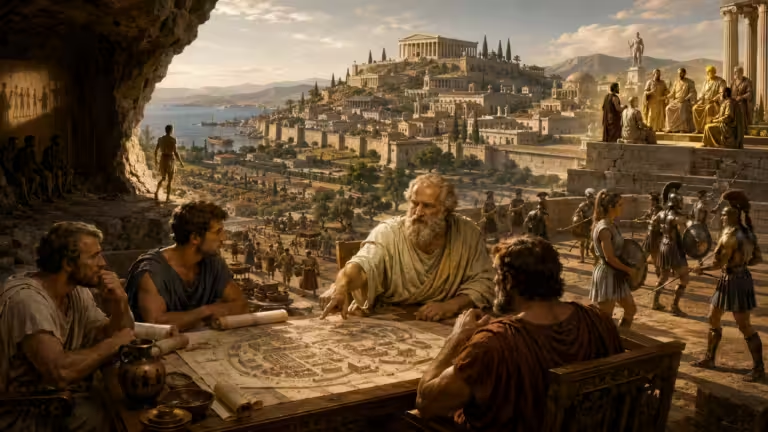
Plato’s Republic is one of the earliest and most influential attempts to imagine an ideal political community. Through the construction of Kallipolis, a city governed by philosopher-rulers, the dialogue examines justice, education, property, gender, political authority and the relationship between individual happiness and social order. However, Plato does not describe a fictional country discovered by a traveller. His ideal city remains a philosophical model built through argument. The Republic therefore provides a major foundation for utopian thought without becoming a literary utopia in the strict sense later established by Thomas More.

Why is Plato’s Republic associated with utopia?
Plato wrote The Republic during the fourth century BCE, almost two thousand years before Thomas More created the word utopia. Its original Greek title, Politeia, refers broadly to a constitution, political order or form of government rather than to a modern republic.
The dialogue begins with a question about justice. Socrates and his interlocutors want to determine what justice is and whether a just person lives more happily than an unjust one. Because justice seems difficult to observe within a single individual, Socrates proposes examining it on a larger scale by constructing a just city “in speech”.
This imaginary city gradually develops into Kallipolis, whose name means the beautiful or noble city. Its institutions regulate education, political power, military service, property, family life and artistic production. Each institution supports Plato’s conception of justice as harmony between distinct social functions.
Consequently, The Republic resembles later utopian works in several important ways. It rejects existing political arrangements, constructs an alternative social order and uses that model to expose weaknesses within contemporary society. Nevertheless, its purpose differs from that of a conventional literary utopia.
The historical crisis behind Plato’s ideal city
Plato did not develop his political philosophy in a stable or peaceful environment. Classical Athens experienced war, imperial defeat, oligarchic revolution, democratic restoration and intense political conflict during his lifetime.
The Peloponnesian War ended in 404 BCE with Athens defeated by Sparta. An oligarchic regime known as the Thirty then seized power and conducted a violent political purge. Although democracy soon returned, the restored democratic government later condemned Socrates to death in 399 BCE.
These events helped shape Plato’s distrust of existing political systems. Oligarchy had produced brutality, while democracy had executed the philosopher whom Plato regarded as exceptionally just. Political institutions seemed vulnerable to ambition, ignorance, faction and persuasive rhetoric.
The Republic responds to this crisis by asking a radical question: what would political life look like if knowledge and virtue governed the city instead of wealth, birth, popularity or force?

From the healthy city to the luxurious city
Socrates does not begin with kings, armies or elaborate laws. He starts with basic human needs. No individual can produce food, shelter, clothing and every other necessity alone, so people form communities and divide their labour.
This first settlement remains small and modest. Its inhabitants produce necessary goods, share simple meals and avoid excessive consumption. Socrates calls it the healthy city because its limited desires create little competition or conflict.
However, Glaucon dismisses this austere community as a “city of pigs”. He demands furniture, fine food, perfumes, entertainment and the other refinements associated with civilised life. Once these luxuries enter the city, citizens require additional workers, land and resources.
The luxurious city therefore creates rivalry and war. It must acquire territory, defend itself and establish a specialised military class. Plato’s political construction begins with economic cooperation, but expanding desire makes political control necessary.
This sequence introduces a recurring theme in utopian literature. A society must decide whether prosperity means satisfying more desires or limiting unnecessary ones. Later writers, including Thomas More and William Morris, would return to the same conflict between material abundance, simplicity and human happiness.
The three classes of Kallipolis
Kallipolis contains three main social groups. Plato assigns each group a specific function according to the abilities required for that role.
The producers
The largest class includes farmers, craftspeople, merchants and other workers who provide the city’s material goods. They may own property, establish households and participate in economic exchange.
However, the producers do not govern. Plato assumes that their lives primarily concern material needs and appetites. Political decisions therefore belong to citizens whose education has trained them to pursue the good of the entire city.
The auxiliaries
The auxiliaries defend Kallipolis and enforce the decisions of its rulers. They require courage, discipline and loyalty, but they must also distinguish genuine threats from the citizens whom they protect.
Socrates compares the ideal guardian to a well-trained dog. It remains gentle towards familiar people while responding fiercely to enemies. Education must therefore balance physical strength with intellectual and moral restraint.
The philosopher-rulers
The most accomplished guardians become rulers. They receive decades of education and undergo repeated tests of character. Only those who consistently place the common good above personal advantage qualify to govern.
Plato does not treat political leadership as a reward for ambition. Indeed, the best rulers do not particularly desire power. They govern because knowledge creates an obligation to serve others.

The city and the tripartite soul
The organisation of Kallipolis reflects Plato’s account of the human soul. Socrates divides the soul into three parts: reason, spirit and appetite.
Reason seeks truth and judges what benefits the whole person. Spirit produces courage, indignation, pride and the desire for recognition. Appetite includes hunger, sexual desire, material wants and other bodily impulses.
These parts correspond to the city’s three classes. The philosopher-rulers represent reason, the auxiliaries represent spirit and the producers represent appetite. Justice exists when each element performs its proper function without usurping another’s role.
For Plato, political justice and psychological justice therefore possess the same structure. A just person allows reason to guide spirited energy and regulate appetite. Similarly, a just city gives authority to those capable of rational knowledge.
This analogy explains why The Republic cannot be reduced to a constitutional proposal. Plato constructs the city partly to make the individual soul visible. Kallipolis is simultaneously a political community and a model of moral order.
Justice as specialisation and harmony
Modern discussions often associate justice with equality, rights or fair procedures. Plato instead defines justice through functional order. Each person should perform the task for which their nature and education have best prepared them.
This principle of specialisation first appears in the city’s economy. A farmer should concentrate on farming, while a builder should concentrate on construction. Divided labour allows each worker to develop expertise and produce better results.
Plato then extends the same principle to political authority. Producers should not rule merely because they possess wealth. Soldiers should not govern merely because they command force. Philosophers should rule because they understand justice and the common good.
However, this model makes political hierarchy appear natural and necessary. It grants individuals little freedom to define their own social roles. The city determines their appropriate function through education, testing and institutional classification.
Kallipolis therefore pursues harmony without embracing political equality. Every class contributes to the city, but the classes do not possess equal authority. Plato values unity and proper order more highly than individual choice.
Why must philosophers become rulers?
Plato’s most famous political claim appears in Book V. Cities will not escape injustice until philosophers become rulers or existing rulers genuinely pursue philosophy.
By philosophy, Plato does not mean abstract speculation detached from practical life. A true philosopher loves knowledge, resists deception and seeks stable truths beyond temporary opinion. Such a person can distinguish what merely appears beneficial from what genuinely serves the city.
Ordinary political competition rewards popularity, wealth, military success or rhetorical skill. None of these qualities guarantees wisdom. A persuasive politician may satisfy citizens’ desires while leading them towards disorder.
The philosopher-ruler instead studies the Form of the Good. This knowledge provides the ultimate standard by which laws, institutions and actions should be judged. Political power becomes legitimate only when guided by an understanding of what makes human life genuinely good.
This solution creates its own difficulty. Philosophers may understand truth, but knowledge does not automatically provide administrative skill or public consent. Moreover, a ruler who claims privileged access to the good may become impossible to challenge.
The allegory of the cave and political education
The allegory of the cave explains both philosophical education and political responsibility. Prisoners sit chained inside a cave and mistake shadows projected onto a wall for reality. Because they have never seen anything else, appearances define their entire world.
One prisoner escapes and gradually adjusts to the world outside. He first sees reflections, then physical objects and finally the sun. The ascent represents the difficult movement from opinion towards knowledge, while the sun symbolises the Form of the Good.
However, the liberated prisoner cannot remain outside. He must return to the cave and help govern those who still inhabit the world of appearances. Philosophical understanding creates a duty to re-enter political life.
The return also reveals the danger faced by philosophers. The other prisoners may mock someone whose eyes no longer adjust quickly to darkness. They may even attack anyone who attempts to release them.
The episode recalls the execution of Socrates. It also expresses Plato’s suspicion that citizens may resist truth when truth challenges familiar beliefs. Education must therefore transform the whole person rather than simply transmit information.
Education as the foundation of the ideal state
Kallipolis depends more upon education than upon written law. Plato wants to shape citizens whose habits, emotions and desires support justice before serious political conflict emerges.
Young guardians begin with physical training and what Plato broadly calls music. Music includes poetry, stories, rhythm and every cultural form capable of influencing character. Education must create courage without brutality and sensitivity without weakness.
Future rulers later study arithmetic, geometry, astronomy and harmonics. These disciplines train the mind to move beyond sensory appearances towards abstract relationships. Dialectic then teaches advanced students to question assumptions and reason towards first principles.
This programme lasts well into adulthood. Intellectual ability alone does not qualify someone to rule. Candidates must also demonstrate endurance, honesty and resistance to corruption throughout practical public service.
Plato’s emphasis on education strongly influenced later utopian writing. Imaginary societies frequently redesign schools because no alternative political order can survive unless citizens learn different values. Yet education can support emancipation or enforce conformity.
Poetry, censorship and the control of culture
Plato recognises literature as a powerful political force. Stories shape emotions long before children can evaluate their moral assumptions. Consequently, Kallipolis carefully regulates poetry, music and dramatic representation.
Traditional poets often depict gods behaving deceitfully, violently or irrationally. Plato fears that young guardians will imitate these examples. Stories should instead encourage courage, moderation, loyalty and respect for rational order.
Book X develops a broader criticism of imitation. A poet can represent courage, government or craftsmanship without possessing genuine knowledge of those subjects. Art may therefore appeal to emotion while distancing audiences from truth.
Plato’s solution imposes severe restrictions upon artistic freedom. Certain poetic forms and representations have no place within the ideal city. Kallipolis achieves moral consistency by narrowing the range of stories that citizens may hear.
This tension later becomes central to dystopian literature. A state may claim that controlling culture protects truth, morality or social harmony. However, the same power can prevent criticism and make official values impossible to question.
Communal property among the guardians
Plato does not abolish private property throughout Kallipolis. The producers continue to own possessions and maintain households. Communal arrangements apply primarily to the guardian classes.
Guardians must not accumulate land, money or luxurious private homes. They live together, eat common meals and receive what they need from the productive class. Plato wants to prevent political authority from becoming a route towards personal enrichment.
This arrangement separates economic power from political power. Rulers possess authority, but they cannot convert that authority into private wealth. Their austere lives should keep them focused upon the common good.
However, the system depends upon extraordinary discipline. It assumes that carefully educated guardians can suppress possessiveness and accept a life without private wealth. It also leaves producers supporting rulers who exercise political power over them.
Thomas More would later extend common property much more broadly across the island of Utopia. Nevertheless, Plato’s guardians provide an important model for the relationship between communal ownership, political unity and freedom from corruption.
The abolition of the private family
Plato also removes the conventional family from the guardian class. Guardians should not know which children are biologically their own. Children receive a communal upbringing, while adults regard the younger generation collectively.
This arrangement aims to eliminate conflicts between private loyalty and public duty. A ruler should not favour a child, sibling or household over the city. By weakening exclusive family bonds, Plato hopes to make the guardians resemble one extended political family.
The city also regulates reproduction. Officials arrange pairings while concealing their intervention behind apparently random selections. Their objective is to produce future guardians with desirable qualities and control the size of the ruling class.
These measures turn reproduction into a political institution. They sacrifice privacy, parental attachment and personal choice to collective unity. From a modern perspective, this coercive system represents one of the most disturbing aspects of Kallipolis.
Women as guardians and rulers
Plato makes a striking argument about women within the guardian class. If women possess the appropriate abilities, they should receive the same education and perform the same political or military functions as men.
Physical differences do not justify assigning every social responsibility according to sex. Plato compares the distinction to differences between bald and long-haired men: neither characteristic determines whether someone can practise medicine, govern or defend the city.
This proposal challenged many conventions of classical Athens, where women lacked formal political authority. In Kallipolis, a woman capable of philosophy may become a ruler, while a woman with the appropriate courage may serve as a guardian.
Nevertheless, Plato does not develop a modern theory of gender equality. He often assumes that men remain physically stronger on average. Moreover, the state controls women’s reproductive lives as rigorously as those of men.
His position therefore combines radical inclusion with authoritarian regulation. Women gain access to education and public responsibility, but individual autonomy remains subordinate to the city’s reproductive and political objectives.
The myth of the metals and political unity
Kallipolis requires citizens to accept its social organisation. Socrates therefore proposes a founding story commonly called the myth of the metals or the noble lie.
The story presents all citizens as children of the same earth. However, their souls contain different metals. Gold corresponds to rulers, silver to auxiliaries, while bronze or iron corresponds to producers.
The myth performs two political functions. Shared birth from the earth creates collective identity, while the metals explain social differentiation. Citizens should see their assigned roles as expressions of natural ability rather than products of arbitrary privilege.
Plato allows some mobility between classes because children may possess a different “metal” from their parents. In principle, education identifies ability rather than preserving hereditary rank.
Even so, the city stabilises itself through an official fiction. Political harmony depends partly upon citizens accepting a story designed by their rulers. This practice raises a lasting problem: can a just society legitimately use deception for the common good?
Plato’s criticism of democracy
Books VIII and IX compare Kallipolis with four declining political regimes: timocracy, oligarchy, democracy and tyranny. Each constitution corresponds to a particular type of soul and emerges from the corruption of the preceding system.
Timocracy values military honour. Oligarchy allows wealth to determine political power and divides the city between rich and poor. Democracy then arises when those excluded from power overthrow the oligarchs.
Plato associates democracy with freedom, diversity and the rejection of fixed authority. At first, this political variety appears attractive. Citizens can choose different ways of life rather than accepting one imposed hierarchy.
However, Plato believes democracy treats unequal forms of knowledge and character as though they deserved equal authority. Citizens become unwilling to accept discipline, while leaders compete by gratifying popular desires.
Excessive freedom eventually destroys the conditions that sustain freedom. Political disorder creates demand for a strong protector, who then becomes a tyrant. The democratic desire to escape all restraint therefore produces its apparent opposite.
This analysis exposes the anti-democratic dimension of Kallipolis. Plato does not want institutions to reflect citizens’ preferences. He wants knowledge of the good to govern preferences themselves.
Is Kallipolis intended to be achievable?
Socrates repeatedly acknowledges that Kallipolis may be difficult to establish. Its possibility depends upon the unlikely union of philosophy and political power. Existing societies rarely educate rulers to become philosophers or persuade philosophers to govern.
However, practical difficulty does not make the city useless. A model can reveal the principles of justice without providing an immediately achievable constitution. Kallipolis establishes a standard against which individuals and existing regimes can be judged.
Near the end of Book IX, Socrates suggests that the ideal city may exist as a pattern for someone who wishes to organise their own life. Whether the city exists anywhere on earth matters less than whether an individual can establish its order within the soul.
This passage supports an ethical interpretation of The Republic. Plato may not expect lawmakers to reproduce every institution literally. The city intensifies moral and political principles so that readers can understand their implications.
Nevertheless, the dialogue also discusses education, military organisation, property and government in considerable detail. The political model cannot be dismissed as a mere metaphor. Its ethical and institutional meanings remain deliberately interconnected.
Is Plato’s ideal state authoritarian?
Kallipolis pursues justice, but it grants citizens few protections against political authority. Philosopher-rulers control education, culture, reproduction and class assignment. The city limits property and family life among guardians while excluding producers from government.
Plato justifies this power through knowledge. The rulers understand the good and therefore govern for the benefit of the whole community. Political legitimacy rests upon expertise and virtue rather than consent.
Critics question whether anyone could possess such reliable political knowledge. If rulers misunderstand the good, citizens have no democratic mechanism for correcting them. Even genuinely well-intentioned authority may become oppressive when it cannot be challenged.
Yet Kallipolis differs from a conventional tyranny. Its rulers cannot acquire personal wealth, establish dynasties or pursue private luxury. Plato designs their education and communal lives precisely to remove common incentives for corruption.
The central problem is therefore not simple selfishness. It concerns paternalism: may wise rulers legitimately direct other people’s lives for their own good? The Republic offers one of the earliest and most uncompromising examinations of that question.
Why The Republic is not a literary utopia in the strict sense
The Republic clearly belongs to the intellectual history of utopianism. It builds an ideal social order from first principles, contrasts that order with existing societies and examines the institutions required to sustain it. Scholars therefore regularly describe Kallipolis as a utopian city.
However, Plato does not send a traveller to an unknown island or future civilisation. Readers do not encounter ordinary inhabitants living within Kallipolis. Nor do they explore its streets, homes and daily customs through narrative experience.
Instead, Socrates and his interlocutors construct the city through philosophical dialogue. Each institution emerges as part of an argument about justice. Kallipolis functions more like a political thought experiment than a fully dramatised imaginary world.
Thomas More later transformed this method. His Utopia combines political argument with travel narrative, fictional geography, reported customs and an ambiguous witness. The imaginary society becomes a place that readers can mentally visit.
Plato should therefore be regarded as a foundational precursor to literary utopia. He provides many of its major questions, but not yet its characteristic narrative form. This distinction also explains why The Republic belongs equally to ethics, political philosophy and the history of ideal societies.
Plato’s influence on later utopian literature
Later utopian writers repeatedly return to problems raised by The Republic. Who should govern? Can education eliminate conflict? Should rulers own property? Does private family life weaken collective loyalty? Can equality coexist with specialised social functions?
Thomas More adopts communal ownership more broadly while preserving elected institutions and household structures. Francis Bacon transfers authority towards a scientific institution. Edward Bellamy trusts centralised administration, whereas William Morris imagines voluntary cooperation without a governing elite.
Dystopian writers also inherit Plato’s concerns. State education, cultural censorship, controlled reproduction and the subordination of private life to collective order later appear as instruments of oppression in works by Yevgeny Zamyatin, Aldous Huxley, George Orwell and Margaret Atwood.
This does not mean that Plato directly advocates every later form of authoritarianism. Rather, The Republic identifies a permanent tension within political imagination. The desire to create a harmonious society can encourage both admirable reform and coercive control.
The first utopia or an ideal state?
Plato’s Republic is both less and more than the first utopia. It is less because it lacks the fictional journey, geographical discovery and detailed social narration that later define literary utopia. It never asks readers to believe that Kallipolis exists as an unknown community somewhere beyond the familiar world.
However, it is more than a constitutional blueprint. The dialogue connects political institutions with education, psychology, ethics, knowledge and happiness. It asks not only how a city should govern, but what kind of people its institutions will create.
Kallipolis remains attractive because it removes wealth from political power, treats government as a responsibility and opens guardian education to qualified women. Yet it also suppresses political participation, regulates culture, controls reproduction and assigns social functions from above.
These contradictions make The Republic indispensable to the study of utopian literature. Plato does not provide a society that readers must accept or reject as a complete programme. He creates a model through which they can examine the costs of political harmony.
The dialogue therefore establishes the central question that every later utopia must confront: when a society defines the good life, how much freedom can it permit individuals to define the good for themselves?
Continue the series on utopian literature
- What Is a Utopia? Definition, Origins and Literary Features introduces the genre, its history and its recurring narrative conventions.
- Arcadia, Eden and the Golden Age: The Myths Behind Utopia will examine the paradisal traditions that preceded political and literary utopias.
- News from Nowhere: William Morris, Context and Key Ideas explores Morris’s artistic and socialist vision.
Frequently asked questions
Is Plato’s Republic the first utopia?
The Republic is one of the earliest systematic descriptions of an ideal political community. However, it is better understood as a philosophical precursor to literary utopia because Plato constructs the city through dialogue rather than through a fictional journey to an alternative society.
What is Kallipolis in Plato’s Republic?
Kallipolis is the ideal city that Socrates and his interlocutors construct in speech. It contains producers, military auxiliaries and philosopher-rulers. Its name can be translated as the beautiful, noble or excellent city.
Why does Plato want philosophers to rule?
Plato believes philosophers should rule because they seek knowledge of justice and the good rather than wealth, popularity or personal power. Their education should enable them to govern according to the interests of the whole city.
Does Plato abolish private property?
Plato abolishes significant private property only among the guardian classes. Producers may retain property and households. Guardians instead live communally so that wealth and family interests cannot corrupt their political responsibilities.
Can women become rulers in Plato’s ideal city?
Yes. Plato argues that qualified women within the guardian class should receive the same education and perform the same political or military functions as qualified men. However, the state still exercises extensive control over reproduction and family life.
Why is Plato critical of democracy?
Plato believes democracy values freedom without sufficiently distinguishing knowledge from opinion. He argues that political leaders may gain power by gratifying popular desires, while excessive resistance to authority can create disorder and eventually enable tyranny.
Sources and further reading
- Plato, Republic, Perseus Digital Library.
- Plato, The Republic, translated by Benjamin Jowett, Project Gutenberg.
- Stanford Encyclopedia of Philosophy, “Plato’s Ethics and Politics in The Republic”.
- Internet Encyclopedia of Philosophy, “Plato: The Republic”.
- Julia Annas, An Introduction to Plato’s Republic, Oxford University Press, 1981.
- C. D. C. Reeve, Philosopher-Kings: The Argument of Plato’s Republic, Princeton University Press, 1988.
- Malcolm Schofield, Plato: Political Philosophy, Oxford University Press, 2006.
