
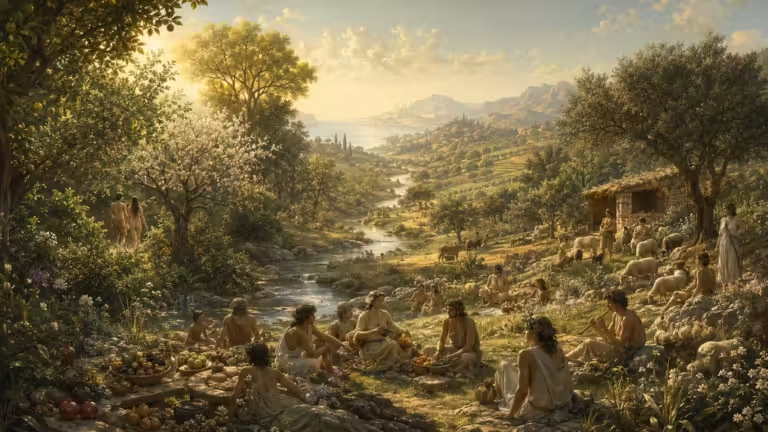
Long before philosophers and writers designed ideal political communities, myths imagined worlds free from hunger, conflict, exhausting labour and social corruption. The Greek Golden Age, the biblical Garden of Eden, pastoral Arcadia and the medieval Land of Cockaigne offered different visions of abundance, innocence and harmony. These places were not yet utopias in the strict literary sense. Their perfection came from nature, divine order or fantasy rather than laws and human institutions. Nevertheless, they supplied utopian literature with its most enduring landscapes, desires and contradictions.

What existed before literary utopia?
The word utopia did not exist before Thomas More published his book of that name in 1516. However, the desire to imagine a better form of life appeared much earlier. Ancient and medieval cultures repeatedly described places where human beings lived close to nature, enjoyed material abundance and escaped the burdens of ordinary history.
These imagined worlds took several forms. Some belonged to a distant past, while others occupied a sacred garden, a remote island, an idealised countryside or a comic land of unlimited food. They could express religious hope, social criticism, nostalgia or simple wish fulfilment.
They also answered different questions. The Golden Age asked whether humanity had declined from an earlier condition. Eden explained the loss of innocence and immortality. Arcadia imagined a simpler relationship between human life, poetry and nature. Cockaigne turned hunger and labour upside down through comic excess.
Literary utopia would later transform these inherited images. Instead of merely longing for a vanished paradise, writers began to ask how property, education, work, government and religion might be reorganised. Paradise became a political experiment.
Paradise and utopia are not the same thing
A paradise is usually given rather than constructed. Its abundance may come directly from the earth, the gods or a divine creator. Its inhabitants do not necessarily establish institutions because natural or sacred harmony has already solved the problems that political institutions normally address.
A utopia, by contrast, generally explains how a society works. It describes rules governing property, labour, education, family life, religion, justice or political authority. Even when the society occupies an isolated island, its organisation results from human decisions rather than spontaneous natural perfection.
The distinction is not absolute. Many utopias borrow paradisal imagery, while myths of paradise can contain assumptions about work, hierarchy and social order. However, the difference between divine gift and human design remains fundamental.
Paradise asks what perfect existence might feel like. Utopia asks what arrangements might produce a better society. The first inspires desire; the second turns desire into a social model.

The Golden Age: a world before labour and conflict
One of the oldest Western accounts of an ideal human condition appears in Hesiod’s Works and Days, composed around the late eighth or early seventh century BCE. Hesiod describes successive races or ages of humanity, beginning with a golden race that lived during the reign of Cronus.
The people of this first age lived without grief, painful labour or the physical decline associated with old age. The earth produced food abundantly without coercion, while human beings lived peacefully among plentiful flocks and crops. Death came gently, like sleep, rather than through disease or violence.
This vision contains several features that later utopian writers would inherit. Nature provides enough for everyone, so competition becomes unnecessary. Work no longer dominates human life, and material abundance removes a major cause of theft, inequality and war.
The Golden Age also exists without elaborate law. Human beings act justly because their desires remain moderate and the world satisfies their needs. Social harmony therefore arises before political institutions rather than through them.
Hesiod’s ages of humanity
Hesiod does not present the Golden Age in isolation. It begins a history of decline through several successive human races. The names and exact sequence vary in later traditions, but Hesiod describes the golden, silver, bronze, heroic and iron races.
The Golden Race
The golden race lives close to the gods in peace and abundance. Its members experience neither exhausting labour nor destructive competition. After death, they become benevolent spirits who watch over mortal life.
The Silver Race
The silver race remains immature for an unusually long time and fails to honour the gods properly. Zeus eventually destroys it. Greater physical development has not produced greater wisdom or justice.
The Bronze Race
The bronze race devotes itself to violence and war. Its members possess great strength but ultimately destroy one another. Technical and military power therefore accompany moral deterioration.
The Heroic Race
Hesiod interrupts the pattern of continuous decline with a race of heroes associated with the great legendary wars. Some receive a blessed existence on the Isles of the Blessed after death. This heroic age introduces the possibility that excellence can briefly reappear within a fallen history.
The Iron Race
Hesiod places himself within the iron race, whose members experience labour, anxiety, injustice and family conflict. Social bonds deteriorate, while dishonesty and force increasingly replace honour. The Golden Age becomes a standard by which the misery of the present can be judged.
This downward movement differs sharply from modern ideas of historical progress. Humanity does not gradually improve through knowledge and technology. Instead, civilisation appears as a long departure from an earlier condition of natural sufficiency.
Why the Golden Age is not yet a utopia
Hesiod does not explain how the golden race distributes resources, selects leaders or resolves political disagreements. It does not need an economic system because the earth produces spontaneously. Nor does it need a theory of government because conflict has not yet entered human life.
The Golden Age also belongs to an irrecoverable past. Hesiod does not offer a political programme capable of restoring it. His readers can compare their age with an earlier ideal, but they cannot simply reproduce the conditions created under Cronus.
This temporal distance gives the myth both power and limitation. It exposes present suffering by showing that human existence could be imagined differently. However, it locates perfection outside practical history.
Later utopian literature would preserve the Golden Age’s rejection of scarcity and oppressive labour. Yet it would attempt to achieve similar results through communal property, technological organisation, social discipline or voluntary cooperation.
Ovid and the Roman Golden Age
The Roman poet Ovid gave the myth one of its most influential literary forms in Book I of the Metamorphoses. His Golden Age existed before judges, punishments and written laws because people acted honestly without external coercion.
Human beings had not yet cut ships from trees to cross the seas. They did not build defensive walls or make weapons. The earth produced food without ploughing, while a permanent spring removed the hardship of seasonal agriculture.
Ovid’s account connects moral innocence with the absence of technology, territorial expansion and private possession. Navigation, mining and warfare emerge as signs of decline. Human beings become less secure as they attempt to control more of the world.
This association strongly influenced later pastoral and utopian writing. Simplicity could represent wisdom, while luxury and technical power could indicate corruption. However, later writers would disagree over whether technology caused human misery or offered a way to overcome it.
The Golden Age as a criticism of the present
The myth does more than describe a pleasant past. It creates a contrast through which writers can criticise existing society. If earlier human beings lived without war, extreme labour and private greed, then these conditions cannot be treated as unavoidable features of existence.
However, nostalgia can support opposing political conclusions. A writer may use the Golden Age to condemn inequality and imagine communal abundance. Another may use it to idealise obedience, rural simplicity or an allegedly stable social hierarchy.
The myth therefore does not contain a single political message. Its meaning depends upon what the writer identifies as the cause of decline. Luxury, private property, technology, empire, moral disobedience and political ambition can each become the moment when harmony disappears.
Utopian literature inherits this diagnostic function. Every ideal society implies an explanation of what has gone wrong elsewhere. To imagine perfection is also to identify the defects of the present.
Eden: paradise as a sacred garden
The Garden of Eden provides another foundational image of ideal existence. In Genesis, God plants a garden in Eden and places the first human within it. The garden contains trees that are beautiful and suitable for food, together with the tree of life and the tree of the knowledge of good and evil.
Eden combines abundance, beauty, intimacy and moral order. Human beings live within a world that has been prepared for them, while the garden supplies their needs. They experience no initial conflict with one another, nature or their creator.
Unlike the Golden Age, Eden belongs to a narrative of creation, command and transgression. Its harmony depends upon a relationship between human freedom and divine prohibition. The garden is plentiful, but it is not without limits.
The story therefore connects paradise with responsibility. Human beings do not create Eden, yet their conduct determines whether they can remain within it. Innocence requires trust and obedience rather than political organisation.
Was there work in the Garden of Eden?
Eden is often imagined as a place of complete idleness, but the Genesis narrative presents a more complex picture. The first human is placed in the garden “to till it and keep it”. Productive activity therefore exists before the expulsion.
The crucial distinction concerns the nature of labour. Work within Eden belongs to care, cultivation and participation in creation. It does not yet involve the painful struggle against resistant ground described after the transgression.
Following the expulsion, agriculture becomes associated with hardship, thorns, sweat and mortality. Labour does not begin after the fall, but it changes from meaningful stewardship into difficult necessity.
This distinction later becomes central to utopian thought. Many utopias do not abolish productive activity. Instead, they attempt to remove exploitation, monotony and excessive toil so that work can become useful, communal or pleasurable.
William Morris develops this idea explicitly in News from Nowhere: William Morris’s Epoch of Rest. His ideal society does not simply stop working. It transforms labour into skilled and satisfying activity.
Knowledge, freedom and the loss of Eden
The central prohibition in Eden concerns the tree of the knowledge of good and evil. The serpent persuades the woman that eating its fruit will open human eyes and make human beings like divine beings who know good and evil.
After the fruit is eaten, the first consequence is self-consciousness. The humans recognise their nakedness, hide themselves and attempt to shift responsibility. Knowledge does not immediately produce wisdom or liberation; it introduces shame, division and fear.
The humans are then expelled, and access to the tree of life is guarded. They have acquired knowledge but cannot combine that knowledge with immortality. Paradise becomes a lost place that human beings remember but cannot re-enter through ordinary effort.
This structure differs from the Greek myth of gradual decline. Eden turns loss into a moral and existential event. Human beings leave the garden because a boundary has been crossed, not because one metallic race has simply replaced another.
Eden as a model of separation
Eden also contributes an important spatial pattern to later utopian literature. The ideal place is enclosed, protected and separated from the ordinary world. It has a defined interior, a boundary and a guarded entrance.
Separation preserves perfection by preventing corruption from entering. However, it also makes paradise inaccessible. The same boundary that protects the garden excludes fallen humanity.
Later utopian islands reproduce this double function. Their distance allows an alternative society to develop without immediate interference. Yet isolation can also conceal coercion, prevent departure and limit encounters with difference.
The enclosed garden therefore becomes both an image of safety and a political warning. A perfectly ordered space may protect its inhabitants, but it must also decide who belongs inside and who remains outside.
Eden and the desire for restoration
Although Eden lies in the past, its cultural meaning is not limited to nostalgia. Jewish and Christian traditions repeatedly connect paradise with restoration, redemption and renewed closeness to the divine. The lost garden can therefore become a model for a future condition.
This movement from origin to restoration changes the direction of ideal imagination. Perfection no longer belongs exclusively to what humanity has lost. It may also represent what history, divine action or moral transformation could recover.
Secular utopian writing adapts this pattern. A damaged society may regain harmony through education, revolution, institutional reform or a new relationship with nature. The path back to paradise becomes a path forwards through history.
Yet the difference remains decisive. Religious restoration depends upon divine fulfilment, while political utopia asks what human beings can construct for themselves. The utopian project secularises part of the paradisal promise.
Arcadia: from a Greek region to a literary landscape
Arcadia was not originally an imaginary country. It was a mountainous region in the central Peloponnese, associated in ancient culture with pastoral life, remoteness and the god Pan. Literary tradition gradually transformed this real location into an idealised landscape of shepherds, music and natural simplicity.
The pastoral genre developed from Greek poetry about herdsmen and rural life, particularly the Idylls of Theocritus. Virgil reworked this tradition in his ten Eclogues, which established the Latin pastoral and made Arcadia an enduring imaginative setting for European literature.
Literary Arcadia is more beautiful and harmonious than ordinary agricultural life. Shepherds tend their flocks, rest beneath trees, compete in song and speak about love, poetry or loss. The countryside becomes a refuge from urban ambition, political violence and commercial pressure.
However, Arcadia is not simply a world of effortless happiness. Pastoral poetry often allows suffering to enter the ideal landscape. Unrequited love, death, displacement and political conflict remain present beneath the surface.
The pastoral retreat
Pastoral literature frequently creates a movement away from the city, court or centre of political power. The countryside offers slower rhythms, simpler customs and a closer relationship with the natural world.
This retreat does not necessarily reject civilisation permanently. Urban and educated writers often adopt the voices of shepherds while remaining conscious of sophisticated literary conventions. Simplicity becomes an artistic construction rather than a direct record of rural life.
The pastoral world allows writers to examine complex subjects at a distance. A dispute between shepherds can reflect political rivalry. The loss of a farm can evoke war or confiscation. A song contest can explore poetic authority and social recognition.
Arcadia therefore differs from a fully designed utopia. It does not usually present a complete constitution or economic system. Its political force comes from contrast: the imagined countryside reveals what urban, courtly or imperial life has sacrificed.
The locus amoenus: the pleasant place
Arcadian landscapes often employ a classical literary pattern known as the locus amoenus, or pleasant place. Its typical elements include shade, grass, trees, gentle water, birdsong and a moderate climate.
This environment offers shelter from danger and excessive heat. It creates a temporary zone in which characters can rest, converse, sing or fall in love. Nature seems to arrange itself around human pleasure.
The pleasant place later becomes an important component of utopian geography. Ideal societies frequently contain fertile gardens, clean rivers, public green spaces and harmonious architecture. Environmental beauty confirms the justice of the social order.
However, literary tradition also destabilises the locus amoenus. A seemingly safe garden can become the setting for danger, temptation or violence. The ideal landscape may conceal forces that its visual harmony cannot control.
Arcadia contains labour, art and loss
Unlike the Golden Age, Arcadia does not always eliminate work. Shepherds tend animals, travel through the landscape and participate in rural production. However, pastoral convention minimises the exhausting and repetitive dimensions of agricultural labour.
Work becomes compatible with leisure because it leaves time for music, conversation and contemplation. The shepherd represents a life in which useful activity has not destroyed artistic expression.
This balance later becomes important to William Morris. In News from Nowhere: William Morris, Context and Key Ideas, social transformation allows labour, beauty and everyday life to support one another.
Yet Arcadia remains vulnerable. Virgil’s pastoral poetry includes the effects of land confiscation and political upheaval alongside natural beauty. The supposedly timeless refuge cannot completely escape history.
Sannazaro and Renaissance Arcadia
Jacopo Sannazaro’s Arcadia, written during the late fifteenth century and published in an authorised edition in 1504, helped transmit pastoral conventions into Renaissance European literature. The work combines prose narrative with verse eclogues.
Its protagonist leaves Naples and enters a pastoral world populated by shepherds, poets and nymphs. The journey resembles a retreat from political and emotional difficulty, but Arcadia cannot permanently heal the losses carried into it.
Sannazaro’s influence helped make Arcadia a portable literary idea. It no longer referred only to one region of Greece. Any harmonious rural landscape could become “Arcadian” when literature transformed it into a space of simplicity, beauty and reflection.
English Renaissance writers developed this inheritance further. Philip Sidney’s Arcadia, Shakespearean pastoral comedy and later poetry use rural retreat to explore identity, authority, love and political disorder.
Why Arcadia is not a perfect society
Arcadia offers an attractive mode of life, but it rarely explains the social conditions that make such leisure possible. Shepherds sing and rest, yet the wider economy often remains invisible. Pastoral simplicity can depend upon labour that the text chooses not to show.
The genre may also idealise rural hierarchy. Landowners, servants and agricultural workers do not necessarily possess equal freedom. A beautiful landscape cannot by itself guarantee political justice.
Arcadia therefore provides utopian literature with an atmosphere rather than a complete programme. It supplies natural beauty, moderate desire, meaningful activity and distance from corrupt centres of power. It does not automatically explain how those goods should be distributed.
This limitation remains relevant to ecological and pastoral utopias. A society can appear sustainable and peaceful while concealing who performs unpleasant work, who owns the land and who has been excluded from the landscape.
The Isles of the Blessed and the geography of happiness
Ancient traditions also placed ideal existence on remote islands or at the distant edges of the known world. Hesiod associates certain heroes with the Isles of the Blessed, where they enjoy a peaceful and fertile existence under the rule of Cronus.
This geographical separation anticipates a defining convention of literary utopia. The better world exists somewhere beyond ordinary travel routes, protected by the sea and difficult to reach.
Remote islands solve a narrative problem. They allow writers to describe a society that has developed according to different assumptions while preserving a connection with the reader’s world. A traveller can cross the boundary, observe the alternative and return with a report.
However, the Isles of the Blessed remain rewards or supernatural destinations rather than political communities. Their inhabitants do not create happiness through legislation. Geography preserves the ideal condition that divine favour has granted.
Cockaigne: the medieval fantasy of unlimited abundance
The medieval Land of Cockaigne offers a very different kind of paradise. Instead of spiritual innocence or refined pastoral harmony, it imagines unlimited food, leisure, comfort and bodily pleasure.
An important Middle English version, The Land of Cokaygne, survives in a single manuscript known as British Library Harley MS 913. The poem probably originated in Ireland during the fourteenth century and combines fantasy with satire.
In Cockaigne, cooked food may present itself without human effort. Buildings contain edible materials, rivers provide luxurious drink and inhabitants escape ordinary scarcity. The landscape abolishes the practical relationship between work and consumption.
This fantasy speaks directly to societies in which hunger, seasonal shortages and physical labour shaped everyday life. Its excess is not random. It reverses conditions that many medieval people could not control.
Cockaigne as satire
Cockaigne is not simply a sincere proposal for a better society. Its absurd abundance often creates a comic world of inversion. Religious discipline, fasting, hierarchy and sexual restraint can all be overturned.
The Middle English poem describes a luxurious monastic community in ways that may satirise corruption and hypocrisy. The supposed spiritual institution becomes a centre of material indulgence.
The fantasy therefore directs criticism in more than one direction. It mocks institutions that preach restraint while enjoying privilege. It may also mock the crude human desire to define happiness entirely through food, idleness and sensual pleasure.
Cockaigne occupies an unstable position between dream and parody. Readers can enjoy its escape from scarcity while recognising that unlimited appetite does not necessarily create justice, meaning or social harmony.
How Cockaigne differs from utopia
Cockaigne solves scarcity through magic rather than economic organisation. Food arrives without agriculture, trade or distribution. Leisure exists because production has become unnecessary, not because work has been shared fairly or transformed technologically.
The land also lacks the moral seriousness of most formal utopias. Its purpose is carnivalesque release. It suspends ordinary rules long enough to expose the frustrations those rules create.
Nevertheless, Cockaigne anticipates a major utopian question: what would human beings do if survival no longer consumed most of their time? Later writers answer through education, art, public service, scientific inquiry or communal pleasure.
The medieval fantasy raises the question without providing a stable answer. Freedom from work may create culture and flourishing, or it may produce endless consumption. Utopian literature repeatedly negotiates between these possibilities.
Golden Age, Eden, Arcadia and Cockaigne compared
| Ideal world | Location in time or space | Source of abundance | Role of labour | Cause of imperfection |
|---|---|---|---|---|
| Golden Age | A lost primordial past | The earth produces spontaneously | Painful toil is absent | Historical and moral decline |
| Garden of Eden | A sacred garden at the beginning of human history | Divine creation and provision | Cultivation exists without oppressive hardship | Transgression and expulsion |
| Arcadia | An idealised pastoral landscape | Moderate needs and harmonious nature | Rural work coexists with leisure and art | Loss, political intrusion and hidden labour |
| Cockaigne | A remote comic land of plenty | Magical and excessive material abundance | Work becomes unnecessary | Appetite, absurdity and satirical inversion |
| Literary utopia | An invented island, country or future society | Social organisation, institutions or technology | Work is redistributed, reduced or transformed | Defective institutions and human choices |
The common features of paradisal myths
Despite their differences, these traditions share several recurring elements. Together, they establish the imaginative grammar that later utopian writers would adapt.
Abundance without destructive competition
Ideal worlds remove scarcity or reduce desire. When nature provides enough, human beings no longer need to fight over basic resources. Peace begins with material security.
Freedom from oppressive labour
The Golden Age and Cockaigne largely abolish toil, while Eden presents cultivation without postlapsarian hardship. Arcadia retains work but integrates it with rest, music and natural rhythm.
Separation from ordinary society
The garden, remote island and pastoral retreat all create distance. The ideal place survives because it lies outside the social conditions that produce corruption elsewhere.
Harmony between humanity and nature
Nature does not appear as an enemy that must be conquered. It nourishes human life, provides beauty and supports moderate forms of activity. Environmental harmony becomes evidence of moral harmony.
A criticism of the present
Every paradise creates an implicit comparison. Its peace exposes contemporary violence, its abundance exposes hunger and its leisure exposes exhausting labour. The ideal world becomes a mirror held against historical reality.
The political limits of paradise
Paradisal myths imagine desirable conditions without always explaining how those conditions could be maintained. They often remove the causes of conflict rather than establish institutions capable of managing conflict.
This difference matters because real societies contain disagreement, competing interests and unequal power. Abundance may reduce conflict, but it does not automatically settle questions of authority, freedom, responsibility or belonging.
Myths can also conceal labour. An Arcadian landscape appears effortless because difficult agricultural work remains outside the frame. Cockaigne erases production through magic. The Golden Age depends upon an earth that never refuses its fruits.
Literary utopia must confront these practical questions more directly. Who produces food? How many hours do people work? Who distributes resources? What happens when individuals reject the common rules?
Who is excluded from paradise?
An ideal place often defines itself through boundaries. Eden has a guarded entrance after the expulsion. The Isles of the Blessed admit exceptional heroes. Arcadian retreat may belong primarily to educated poets who imagine themselves as shepherds.
These boundaries reveal a central problem within ideal literature. A society may appear harmonious because it excludes those who would disturb its unity. The absence of visible conflict may indicate justice, but it may also indicate silence or removal.
Later utopian writers make this issue increasingly explicit. Foreigners, enslaved people, dissenters, criminals and those who resist communal expectations often occupy the margins of apparently perfect societies.
Paradise therefore cannot be evaluated only from within. Readers must also ask who cannot enter, who cannot remain and whose labour supports the beauty enjoyed by others.
From natural harmony to social organisation
The decisive development in utopian literature occurs when writers move from describing ideal conditions to explaining their causes. Happiness no longer depends entirely upon divine favour, spontaneous fertility or a vanished age.
Instead, political imagination begins to organise the good society. Property can be held communally. Citizens can receive a shared education. Work can be limited, rotated or assigned according to ability. Laws can discourage luxury and prevent private interests from controlling government.
Plato’s Republic: The First Utopia or an Ideal State? represents an essential stage in this transition. Plato does not merely describe abundance or innocence. He constructs a city whose education, hierarchy and government aim to produce justice.
However, Plato’s Kallipolis remains a philosophical model rather than a discovered imaginary country. Thomas More would later combine institutional design with the narrative conventions of travel, geography and cultural encounter.
From the lost past to the distant island
The Golden Age and Eden locate perfection near the beginning of human history. This structure encourages nostalgia because the ideal has already disappeared. Humanity looks backwards towards an origin it can no longer inhabit.
Island utopias change the relationship between perfection and time. The ideal society may already exist somewhere else, hidden beyond familiar geographical knowledge. It develops alongside the reader’s world rather than before it.
This spatial transformation creates political possibility. If another society already organises life differently, then present institutions cannot claim to be natural or inevitable. Human customs become comparable and therefore open to criticism.
The traveller provides the connection between the two worlds. By observing foreign customs and reporting them at home, the traveller turns an inaccessible paradise into an argument about political alternatives.
What Thomas More inherits from paradise
Thomas More’s Utopia inherits several features from earlier ideal traditions. Utopia is geographically separated, agriculturally productive and relatively free from extreme scarcity. Its inhabitants limit luxury, organise labour and subordinate private accumulation to collective stability.
However, More replaces spontaneous abundance with institutions. Utopians must work, distribute goods, educate citizens, regulate travel and organise political authority. Their society functions because human beings have deliberately arranged it.
This change also creates ambiguity. Once perfection depends upon rules, readers can question those rules. Communal order may reduce poverty while restricting privacy. Discipline may protect equality while limiting individual freedom.
Utopia therefore begins where paradise becomes political. It preserves the ancient desire for harmony but subjects that desire to institutional analysis.
Pastoral utopia after Thomas More
Paradisal and Arcadian imagery does not disappear after the invention of literary utopia. Later writers combine institutional thought with gardens, rivers, rural communities and fertile landscapes.
William Morris’s News from Nowhere offers a particularly important example. Its transformed England resembles an Arcadian landscape, but its beauty results from social revolution, the disappearance of private capital and a new understanding of useful work.
Morris does not simply return his characters to an untouched natural past. His society passes through industrial capitalism and political struggle before creating a less centralised civilisation. Arcadia becomes historical rather than merely nostalgic.
This combination allows pastoral utopia to become politically meaningful. The beautiful landscape no longer hides the social system. It expresses the society’s values and material organisation.
Can paradise become dystopian?
The promise of harmony can conceal a demand for conformity. A society that defines one perfect way of life may treat disagreement as corruption. Protecting the garden can become an excuse for controlling its inhabitants.
Paradisal language can also legitimise exclusion. Governments, colonies and intentional communities have sometimes imagined new territories as empty gardens awaiting cultivation. Such images can erase the people who already inhabit the land.
Dystopian literature frequently exposes the coercion hidden within official happiness. Citizens may receive material comfort while losing privacy, freedom, memory or political agency. The pleasant surface becomes part of the system’s power.
The myths behind utopia therefore contain a permanent tension. Harmony remains desirable, but any attempt to preserve it must answer who defines harmony and what happens to those who prefer another form of life.
Why these myths still matter
Eden, Arcadia, the Golden Age and Cockaigne continue to shape modern culture because they represent desires that political language cannot fully contain. They imagine safety, belonging, enough food, meaningful activity, environmental balance and relief from anxiety.
They also remind readers that the good society is not only a constitutional problem. People want beautiful surroundings, time for relationships, freedom from humiliating labour and a sense that their lives belong within a meaningful world.
Yet myths achieve harmony by simplifying reality. They remove scarcity, conflict or moral uncertainty through divine provision, natural abundance or imaginative convention. Political societies cannot rely upon those solutions.
Utopian literature begins by accepting the desire expressed by paradise while challenging its mechanisms. It asks how human beings might create abundance without magic, community without innocence and harmony without silencing freedom.
The myths behind utopia
The Golden Age contributes the dream of life without scarcity, war or oppressive toil. Eden contributes the enclosed garden, moral innocence, meaningful cultivation and the pain of irreversible loss. Arcadia contributes pastoral beauty, artistic leisure and an alternative to urban ambition. Cockaigne contributes the rebellious fantasy of bodily abundance and complete freedom from necessity.
None of these worlds constitutes a literary utopia in the strict sense. Their inhabitants do not collectively design political institutions capable of producing the conditions they enjoy. Perfection precedes politics or makes politics unnecessary.
Nevertheless, these myths establish the emotional and symbolic foundations of the genre. They provide its gardens, islands, fertile landscapes, communal meals and suspicion of luxury. Above all, they give utopia its conviction that present suffering is neither the only imaginable condition nor the final measure of human possibility.
Thomas More would convert that conviction into a fictional society governed by human choices. The lost paradise would become an island whose institutions could be described, debated and judged.
Continue the series on utopian literature
- What Is a Utopia? Definition, Origins and Literary Features introduces the genre and its principal conventions.
- Plato’s Republic: The First Utopia or an Ideal State? examines Kallipolis, philosopher-rulers and Plato’s model of justice.
- Thomas More’s Utopia: Meaning, Structure and Political Ambiguity will examine the book that gave the utopian genre its name.
- News from Nowhere: William Morris, Context and Key Ideas explores the transformation of pastoral longing into socialist utopia.
Frequently asked questions
What is the difference between paradise and utopia?
Paradise usually derives its perfection from divine provision, natural abundance or a primordial condition. Utopia normally explains how human institutions organise property, labour, education and government to create a better society.
What is the Golden Age in Greek mythology?
The Golden Age is the earliest and most harmonious human age described by Hesiod. People live peacefully without painful labour, severe old age or material scarcity because the earth provides abundant food spontaneously.
Is the Garden of Eden a utopia?
Eden is an important precursor to utopian imagination, but it is not a political utopia. God creates the garden and provides its abundance, while its harmony depends upon a sacred relationship rather than human laws or institutions.
Did Adam work before the fall?
Genesis places the first human in the garden to cultivate and preserve it. Work therefore exists before the fall, but it becomes painful and burdensome after the expulsion. Eden distinguishes meaningful activity from oppressive toil.
What does Arcadia represent in literature?
Arcadia represents an idealised pastoral landscape associated with simplicity, natural beauty, poetry and distance from political ambition. However, pastoral literature often allows grief, dispossession and historical conflict to disturb this apparent harmony.
What is the Land of Cockaigne?
Cockaigne is a medieval comic land of unlimited food, leisure and sensual pleasure. It reverses the conditions of hunger, physical labour and religious restraint, often combining wish fulfilment with social satire.
How did paradisal myths influence Thomas More?
Earlier myths supplied images of fertile land, limited desire, communal abundance and separation from ordinary society. More transformed these motifs by explaining how work, property, education, religion and political institutions operated on the island of Utopia.
Sources and further reading
- Hesiod, Works and Days, lines 109–201, Perseus Digital Library.
- Ovid, Metamorphoses, Book I: The Four Ages, Scaife Viewer.
- Genesis 2–3, New Revised Standard Version Updated Edition.
- Oxford Research Encyclopedia of Literature, “Pastoral”.
- Richard Jenkyns, “Virgil and Arcadia”, The Journal of Roman Studies, 1989.
- The Land of Cockaygne, University of Southampton.
- Harry Levin, The Myth of the Golden Age in the Renaissance, Indiana University Press, 1969.
- Frank E. Manuel and Fritzie P. Manuel, Utopian Thought in the Western World, Harvard University Press, 1979.
- Raymond Trousson, Voyages aux pays de nulle part: histoire littéraire de la pensée utopique, Éditions de l’Université de Bruxelles, 1999.
