
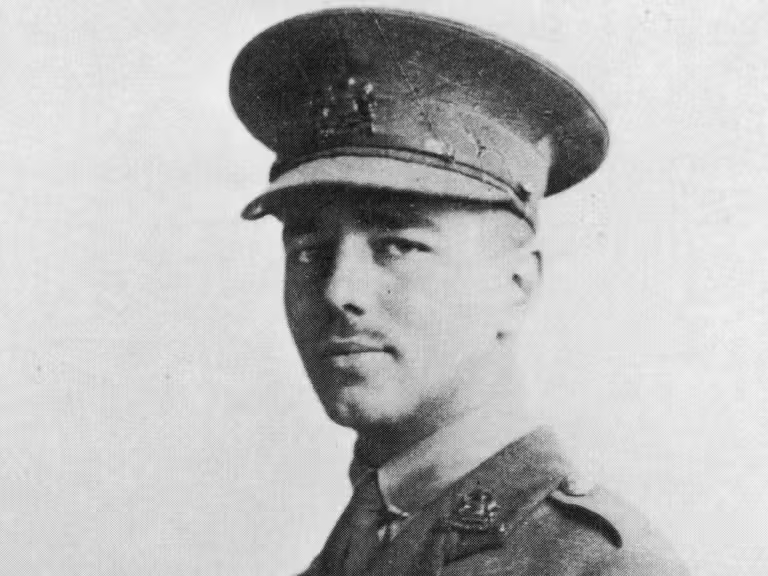
Wilfred Owen is one of the most important poets of the First World War. His poetry rejects patriotic illusion and gives voice to the suffering, fear, exhaustion and pity experienced by soldiers in modern industrial warfare.
Owen did not write about war from a safe distance. He served on the Western Front, suffered shell shock, met Siegfried Sassoon at Craiglockhart War Hospital, returned to active service, and was killed in France on 4 November 1918, one week before the Armistice.
His reputation rests on a small but extraordinary body of poetry. Most of his major poems were written between 1917 and 1918. Only a few were published during his lifetime, but his posthumous influence transformed the way readers think about war poetry.

Wilfred Owen: short biography
Wilfred Edward Salter Owen was born on 18 March 1893 in Oswestry, Shropshire. He grew up in a modest middle-class family and received his education in technical and local schools rather than at an elite university. Before the war, he worked as a teacher and spent time in France, where he taught English near Bordeaux.
Owen enlisted in 1915 and was commissioned into the Manchester Regiment. His experience at the front changed both his life and his poetry. In 1917, after traumatic experiences in combat, he was diagnosed with shell shock and sent to Craiglockhart War Hospital in Edinburgh.
Craiglockhart was decisive. There, Owen met Siegfried Sassoon, an established war poet and officer who encouraged him to sharpen his voice, confront the reality of war and move beyond imitation. Owen returned to the front in 1918. He was awarded the Military Cross, but he was killed shortly afterwards, on 4 November 1918.
The telegram announcing his death reached his family as bells were ringing for the Armistice. It is hard to imagine a more brutal symbol of the war’s timing, waste and irony.
Why Wilfred Owen matters
Owen matters because he changed the tone of English war poetry. Earlier patriotic verse often represented war through honour, sacrifice, courage and national duty. Owen does not completely reject courage, but he rejects the false glamour built around war.
His poems show the soldier’s body under pressure: gas, mud, fatigue, wounds, nightmares, fear, mutilation and psychological collapse. War is not presented as a noble adventure. It becomes a machine that damages both the living and the dead.
This is why Owen’s poetry remains central to any study of World War One literature. He gives readers not propaganda, but witness. Not clean heroism, but pity. Not ceremony, but trauma. Subtle? Not always. Necessary? Absolutely.

“My subject is War, and the pity of War”
Owen’s most famous statement comes from the preface he drafted for a collection of poems he did not live to publish. He writes that his subject is not glory, honour or heroic deeds, but war and the pity of war.
My subject is War, and the pity of War. The Poetry is in the pity.
This sentence is the key to Owen’s work. “Pity” does not mean sentimental weakness. It means moral attention. Owen asks the reader to look directly at suffering, without hiding behind patriotic slogans.
For Owen, poetry must not decorate war. It must expose what war does to human beings. That is why his best poems are both technically controlled and emotionally devastating.
The influence of Keats and Sassoon
Two major influences shaped Owen’s poetry: John Keats and Siegfried Sassoon. They pull his writing in different directions, and the tension between them gives Owen much of his power.
The Keatsian influence
Before becoming a major war poet, Owen admired the Romantic poets, especially Keats. From Keats, he inherited a sensitivity to sound, texture, colour, beauty and sensuous language.
This matters because Owen’s poems are not merely documentary reports from the trenches. They are carefully shaped works of art. Even when he writes about gas, wounds or terror, he pays close attention to rhythm, imagery and musicality.
The result is disturbing. Beauty does not soften horror. It often makes horror more intense, because the poem forces us to notice suffering with painful precision.
The Sassoon influence
Siegfried Sassoon gave Owen something different: directness, anger, irony and a sharper anti-war edge. At Craiglockhart, Sassoon encouraged Owen to confront the brutal truth of front-line experience and to distrust grand patriotic language.
Sassoon’s influence can be seen in Owen’s realism, his bitter contrasts and his attack on public myths about war. However, Owen goes beyond Sassoon. He adds a deeper pity, a more visionary imagination and a stronger sense of collective suffering.
In simple terms: Keats helps Owen make the poetry beautiful; Sassoon helps him make it truthful; the war makes it unbearable.

Owen’s main themes
Owen’s poems return to a small number of powerful themes. They form the emotional and intellectual centre of his work.
The pity of war
Pity is Owen’s central theme. His poems ask the reader to recognise soldiers not as abstract heroes, but as young men exposed to fear, pain, disfigurement, mental collapse and death.
This pity is not passive. It challenges patriotic rhetoric. It forces the reader to ask who benefits from heroic language when soldiers are the ones paying the price.
The lie of patriotic glory
Owen repeatedly attacks the language of glory. His most famous poem, Dulce et Decorum Est, directly challenges the old Latin phrase claiming that it is sweet and fitting to die for one’s country.
For Owen, this idea becomes “the old Lie”. The capital letter matters. It turns the phrase into a cultural myth, repeated by those who do not face the trenches themselves.
The soldier’s body
Owen’s poetry is intensely physical. Bodies cough, bleed, limp, drown, dream, decay and break. War is not an abstract conflict between nations. It is experienced through the body.
This physical detail gives the poems their force. The reader cannot remain comfortable. Owen makes war visible, audible and almost tactile. There is no clean distance.
Trauma and shell shock
Owen’s own experience of shell shock informs his writing. His poems often represent psychological damage through nightmares, haunting memories, distorted perception and emotional numbness.
War does not end when the guns stop. It continues inside the mind. This is one reason Owen remains so modern: he understands trauma as an afterlife of violence.
The failure of religion and ritual
Several Owen poems use religious imagery, but rarely in a simple comforting way. Traditional rituals often seem inadequate before mass death. Prayers, bells and funerals are replaced by rifles, shells and the noise of battle.
In Anthem for Doomed Youth, the title itself creates a bitter contrast. An anthem suggests ceremony and dignity. “Doomed youth” suggests young lives already condemned.
Key poems by Wilfred Owen
Owen’s major poems are short, concentrated and often devastating. These are the essential ones to know.
| Poem | Main focus | Why it matters |
|---|---|---|
| Dulce et Decorum Est | Gas attack, exhaustion, anti-war irony | Owen’s most famous attack on patriotic propaganda. |
| Anthem for Doomed Youth | Death, funeral ritual, lost youth | Contrasts religious ceremony with battlefield slaughter. |
| Disabled | Wounded veteran, lost masculinity, social neglect | Shows war’s consequences after the battlefield. |
| Exposure | Cold, waiting, fear, slow suffering | Represents war as endurance rather than heroic action. |
| Futility | Death, nature, failed consolation | Questions whether life and creation have meaning after war. |
| Strange Meeting | Afterlife, enemy encounter, shared suffering | Gives Owen’s pity a visionary and universal dimension. |
| Mental Cases | Psychological trauma | Confronts the mental destruction caused by war. |
Dulce et Decorum Est: attacking “the old Lie”
Dulce et Decorum Est is Owen’s most famous poem because it dismantles patriotic idealism with shocking physical detail. The poem begins with exhausted soldiers, not noble warriors. They are bent, coughing, lame, blind with fatigue and almost dehumanised by exhaustion.
The sudden gas attack changes the rhythm. Panic replaces marching. One soldier fails to fit his gas mask in time, and the speaker remembers him as if he were drowning. The nightmare returns in dreams, which suggests trauma rather than simple memory.
The poem ends by addressing those who repeat patriotic slogans to children. Owen does not simply describe suffering. He accuses the culture that turns suffering into recruitment language.
That is why the Latin ending matters. The classical phrase sounds noble until the poem places it beside a dying soldier. Owen does not argue politely with propaganda. He drags it into the mud and makes it look at what it has done.
Anthem for Doomed Youth: a funeral without ceremony
Anthem for Doomed Youth uses the structure of a sonnet to ask what kind of funeral soldiers receive on the battlefield. The answer is bleak: no proper bells, prayers or choirs. The sounds of war replace the sounds of mourning.
The poem contrasts religious ritual with mechanical violence. Rifles become prayers. Shells become bells. The battlefield becomes a grotesque church where young men are killed in large numbers, without individual dignity.
Yet the poem is not cold. Its second half turns towards private mourning: candles, pallor, flowers and patient minds. Public ceremony fails, but personal grief remains.
Disabled: the wounded soldier after the war
Disabled focuses on a young veteran who has lost his limbs and now sits isolated from ordinary life. The poem moves between past and present, contrasting youthful confidence with physical loss and social abandonment.
Owen shows how recruitment propaganda turns youth, sport, masculinity and vanity into tools of war. The soldier once joined partly for glory, uniforms and admiration. Now, he is pitied, ignored and dependent on institutions.
The poem is especially powerful because the war’s violence continues after combat. The soldier survives, but survival does not restore him. Owen makes us see the long aftermath of injury.
Strange Meeting: pity beyond enemy lines
Strange Meeting is one of Owen’s most visionary poems. The speaker descends into a dreamlike underworld and meets an enemy soldier whom he has killed. Instead of hatred, the poem offers recognition.
The enemy is not a monster. He is another victim of the same war. This encounter expands Owen’s pity beyond national boundaries. The poem suggests that war destroys not only bodies, but also the truths and possibilities that human beings might have shared.
The poem’s famous power lies in that reversal. The enemy becomes a mirror. The battlefield produces not victory, but mutual loss.
Owen’s style and poetic technique
Owen’s poetry is powerful because its technique serves its moral vision. He does not simply tell readers that war is terrible. He makes poetic form register shock, dislocation and pain.
- Pararhyme: Owen often uses half-rhyme or slant rhyme, creating unease instead of neat closure.
- Alliteration and assonance: repeated sounds create musicality, violence or pressure.
- Irony: heroic language is placed beside grotesque reality.
- Religious imagery: rituals of worship and mourning are transformed by war.
- Graphic imagery: physical detail prevents romantic distance.
- Direct address: the reader is sometimes implicated or accused.
- Dream structure: memory, nightmare and hallucination blur together.
Pararhyme is especially important. It refuses the satisfying harmony of full rhyme. Words nearly match, but not quite. That “not quite” suits Owen’s world: broken, unstable, unresolved.
Wilfred Owen and Siegfried Sassoon at Craiglockhart
The meeting between Owen and Sassoon at Craiglockhart War Hospital is one of the key moments in the history of World War One poetry. Sassoon was already known for his angry, satirical poems against the war. Owen was younger and still finding his mature voice.
Sassoon helped Owen revise poems and encouraged him to write with greater realism. The encounter did not create Owen’s talent, but it accelerated his development. Craiglockhart gave him a literary mentor, a medical context and a space in which trauma could become poetry.
This meeting is also central to Pat Barker’s novel Regeneration, which revisits Craiglockhart, shell shock, psychiatric treatment and the relationship between historical figures such as Owen, Sassoon and W. H. R. Rivers.
Related reading on SkyMinds: Introduction to Regeneration by Pat Barker and First dialogue between Rivers and Sassoon in Regeneration.
Wilfred Owen and World War One poetry
Owen belongs to a wider generation of World War One poets, but his position is distinctive. Rupert Brooke is often associated with early idealism and patriotic sacrifice. Siegfried Sassoon is associated with satire, anger and protest. Edward Thomas brings a quieter, more reflective poetic voice. Owen combines pity, technical control, horror and moral accusation.
That combination explains why he has become one of the central poets of the war. His poetry does not merely document trench experience. It changes the moral vocabulary through which war can be imagined.
Related reading on SkyMinds: World War One poetry: a problematic issue, War Poet: Rupert Brooke and War Poet: Edward Thomas.
Chronology of Wilfred Owen
| Date | Event |
|---|---|
| 1893 | Wilfred Owen is born in Oswestry, Shropshire. |
| 1913 | Owen goes to France and works as an English teacher. |
| 1915 | He enlists in the British Army. |
| 1917 | After traumatic front-line experience, he is sent to Craiglockhart War Hospital. |
| 1917 | He meets Siegfried Sassoon, who encourages his poetic development. |
| 1917–1918 | Owen writes many of his most important poems. |
| 1918 | He returns to active service and is later awarded the Military Cross. |
| 4 November 1918 | Owen is killed in France, one week before the Armistice. |
| 1920 | A posthumous edition of his poems helps establish his reputation. |
How to analyse a Wilfred Owen poem
When analysing Owen, do not stop at “war is horrible”. That is true, but too general. You need to show how the poem creates that meaning through language, form and contrast.
- Identify the situation: gas attack, funeral, memory, trauma, waiting, injury or dream vision.
- Look at the speaker: witness, survivor, mourner, accuser or visionary figure.
- Track contrasts: glory versus mud, ceremony versus slaughter, youth versus death, propaganda versus reality.
- Analyse sound: rhyme, pararhyme, alliteration, rhythm and harsh consonants.
- Study imagery: bodies, wounds, machines, religion, dreams, darkness, animal comparisons.
- Connect form and meaning: ask why the poem uses sonnet form, fragmentation, direct address or a dream structure.
- End with Owen’s moral purpose: pity, accusation, witness or anti-propaganda.
A strong essay on Owen should connect technique to ethics. The poem’s form is not decorative. It is part of its protest.
Quick revision table
| Question | Short answer |
|---|---|
| Who was Wilfred Owen? | An English soldier-poet of the First World War, born in 1893 and killed in 1918. |
| Why is Owen important? | He transformed war poetry by exposing suffering, trauma and the false glamour of patriotic rhetoric. |
| What is “the pity of war”? | Owen’s central idea: poetry should reveal the human suffering caused by war. |
| Who influenced Owen? | Keats influenced his lyricism and sound; Sassoon influenced his realism, irony and anger. |
| What is Owen’s most famous poem? | Dulce et Decorum Est, an attack on patriotic propaganda. |
| What is pararhyme? | A partial rhyme that creates tension and unease, often used by Owen. |
| Where did Owen meet Sassoon? | At Craiglockhart War Hospital in Edinburgh. |
| When did Owen die? | On 4 November 1918, one week before the Armistice. |
FAQ: Wilfred Owen
Is it Wilfred Owen or Wilfried Owen?
The correct name is Wilfred Owen. “Wilfried Owen” is a spelling mistake. His full name was Wilfred Edward Salter Owen.
What is Wilfred Owen famous for?
Wilfred Owen is famous for his First World War poetry, especially poems that expose trench warfare, gas attacks, shell shock, physical suffering and the false glamour of patriotic propaganda.
What are Wilfred Owen’s most famous poems?
His best-known poems include Dulce et Decorum Est, Anthem for Doomed Youth, Disabled, Exposure, Futility, Strange Meeting and Mental Cases.
How did Siegfried Sassoon influence Wilfred Owen?
Sassoon encouraged Owen to write more directly about the realities of war. His influence helped Owen develop sharper irony, stronger realism and a more openly anti-war poetic voice.
What does “the pity of war” mean?
The phrase means that Owen’s poetry focuses on the suffering caused by war, rather than on glory, honour or patriotic heroism. For Owen, the emotional and moral force of poetry lies in pity.
Was Wilfred Owen anti-war?
Owen’s poetry strongly attacks the romantic and patriotic myths used to justify war. He does not deny courage, but he exposes the physical and psychological destruction hidden behind public language about honour and glory.
When was Wilfred Owen killed?
Wilfred Owen was killed in action on 4 November 1918, during the crossing of the Sambre–Oise Canal, one week before the Armistice.
Conclusion
Wilfred Owen’s poetry remains central because it refuses to let war hide behind noble language. His poems confront the reader with bodies, wounds, gas, fear, trauma and grief. They replace heroic myth with pity.
Owen’s greatness lies in the fusion of technical skill and moral urgency. He learned from Keats the power of sound and beauty. He learned from Sassoon the force of realism and irony. Then he transformed his own experience of war into poetry that still feels painfully alive.
He died at twenty-five, before he could shape his own literary legacy. Yet the poems he left behind changed the language of war. That is the terrible irony of Owen’s career: a short life, a small body of work, and an influence that still refuses to fade.
