
The Historical Notes at the end of The Handmaid’s Tale radically change the meaning of Offred’s story. Her intimate testimony is reframed as an academic document discussed centuries later at a symposium on Gilead. Through Professor Pieixoto’s detached tone, archival language and final question, Margaret Atwood exposes how women’s voices can survive history and still be distorted by the institutions that preserve them.
The Historical Notes are not a simple appendix. They are the novel’s second ending. After Offred’s unresolved departure in the black van, the reader is suddenly moved to a future academic conference where her story has become an object of study. The shift is jarring, funny, chilling and deeply political.
This final section forces us to reread everything. Offred’s voice has survived, which means Gilead did not fully erase her. Yet her testimony is now handled by scholars, classified through archives and interpreted by a male academic whose jokes and assumptions partly repeat the very attitudes the novel has criticised. The future is freer than Gilead, but it is not innocent.
What are the Historical Notes in The Handmaid’s Tale?
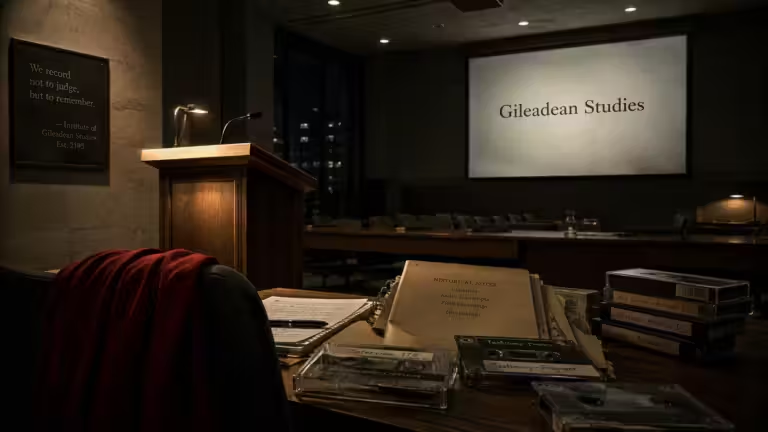
The Historical Notes are the final section of The Handmaid’s Tale. They take the form of a partial transcript from an academic symposium on Gilead Studies, held long after the fall of the regime. Instead of continuing Offred’s first-person narration, the novel shifts to a scholarly lecture about the origin, authenticity and interpretation of her recorded testimony.
The main speaker is Professor James Darcy Pieixoto, who presents Offred’s narrative as a historical document. He explains how the tapes were discovered, how they were arranged and why scholars cannot easily identify Offred, the Commander or Nick with absolute certainty. The section therefore gives the reader more historical distance, but less emotional certainty.
This frame matters because it changes the status of the novel. What we have read is not presented as a polished written memoir. It is a reconstructed oral testimony, edited from recorded fragments. Atwood therefore turns the act of reading into an act of listening to a damaged archive.