
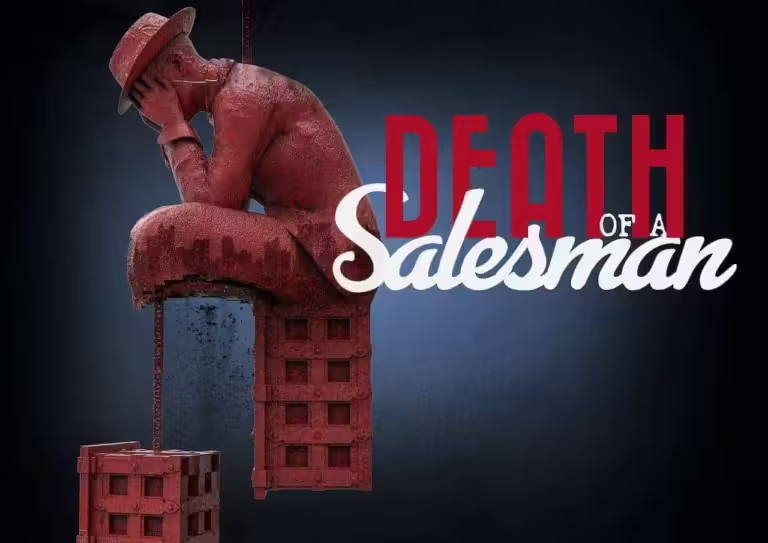
Death of a Salesman is both a social drama and a modern tragedy. Arthur Miller exposes the economic system that makes Willy Loman disposable, yet he also gives Willy agency, responsibility and a desperate struggle for dignity. Social forces create the pressure, while Willy’s choices transform that pressure into tragedy.

Is Death of a Salesman a tragedy or a social drama?
Critics have long debated whether Arthur Miller’s Death of a Salesman should be classified as a tragedy or a social drama. The social interpretation appears immediately convincing: Willy Loman is an ageing travelling salesman discarded by his employer when he can no longer produce sufficient profit. His family struggles with debt, insecure employment and the promises of the American Dream.
However, Miller does more than document social injustice. He presents Willy’s final day as a struggle over identity, dignity, responsibility and the meaning of a human life. The two interpretations are therefore not mutually exclusive: Death of a Salesman is best understood as a modern social tragedy.
Its subject is social because Willy’s crisis develops within a competitive economic system. Its form and emotional effect are tragic because Willy actively defends a mistaken vision of himself until that struggle destroys him.
| Social drama | Modern tragedy |
|---|---|
| Examines work, money, class and economic insecurity | Examines dignity, identity, responsibility and irreversible loss |
| Shows how institutions shape individual lives | Shows how an individual responds to those pressures |
| Encourages criticism of society | Produces pity, fear and tragic recognition |
| Presents Willy as an exploited worker | Presents Willy as an active but mistaken protagonist |
| Locates the crisis in post-war American capitalism | Gives the crisis broader human significance |
Why did critics question the play’s tragic status?
Classical tragedy is commonly associated with kings, princes and exceptional figures. Oedipus rules Thebes, while Shakespeare’s tragic protagonists often possess political or military power. Willy Loman possesses no such status: he is an ordinary salesman living in a modest Brooklyn house, and his employer can dismiss him without altering the course of history.
Some critics have therefore argued that Willy lacks the grandeur required of a tragic hero. His ambitions appear limited, his values are frequently shallow and his death changes neither society nor the economic system that defeated him. Furthermore, Willy often seems less like a heroic rebel than a confused victim, since his memories interrupt reality, his judgements contradict one another and his plans repeatedly fail.
If society determines everything, Willy appears to possess no genuine freedom. Without choice, responsibility or meaningful resistance, his death might seem merely pathetic rather than tragic. Miller confronts this objection directly in his 1949 essay Tragedy and the Common Man, where he argues that tragic dignity does not depend upon social rank but upon the intensity with which a person defends a threatened sense of self.

Arthur Miller’s theory of modern tragedy
Miller published Tragedy and the Common Man shortly after the Broadway opening of Death of a Salesman. The essay explains why an ordinary person can become the protagonist of a tragedy. For Miller, the tragic figure struggles to secure a rightful place within the world and resists whatever threatens his dignity.
This struggle must be serious and complete. Miller describes the tragic protagonist as claiming his full value as a person and pursuing that claim without reservation. Willy’s social position is therefore not a disqualification; instead, his ordinariness makes the play’s tragic claim more democratic.
Willy represents people whose identities depend upon work, income and social recognition. His tragedy asks whether an ordinary person retains dignity once the market has declared him useless.
Tragedy assumes that human action matters
Miller’s conception of tragedy rests upon the belief that human action remains meaningful. The tragic protagonist may fail, but the struggle itself reveals that another path was possible. This distinguishes tragedy from complete fatalism.
If Willy were merely a machine crushed by capitalism, his decisions would possess little moral or dramatic importance. Instead, the play repeatedly gives him alternatives: he can accept Charley’s job, listen to Biff, recognise Linda’s love or reconsider his definition of success. Willy refuses these alternatives, and that refusal prevents him from becoming only a passive victim.
How does Death of a Salesman function as social drama?
The play offers a precise criticism of modern economic and social life. Willy’s private crisis cannot be separated from the system in which he works. However, Miller avoids turning the play into a political lecture, since social criticism emerges through conversations, domestic objects, employment relationships and disappointed expectations.
The disposable worker
Willy has spent decades travelling throughout New England, and he believes that long service should create loyalty between employee and employer. Howard Wagner understands their relationship differently. Willy’s value depends upon his present productivity, not upon his past sacrifices.
Once Willy can no longer travel effectively or generate sufficient sales, Howard dismisses him. The business recognises neither gratitude nor emotional obligation. Willy’s complaint that a person cannot simply be discarded like a piece of fruit expresses the play’s social accusation: a system based entirely upon utility eventually treats people as disposable goods.
Howard is not a melodramatic villain
The dismissal scene gains power because Howard is not presented as a theatrical monster. He does not devise a cruel plan to destroy Willy. Instead, he appears distracted, impatient and absorbed by his new recording machine, while regarding Willy’s crisis as an inconvenient management problem.
This ordinariness makes the scene more disturbing. The economic system does not require personal hatred; it produces cruelty through routine decisions and emotional indifference. Howard also speaks proudly about his children while refusing to hear Willy’s appeal, enjoying the security of family life while helping to destabilise Willy’s family.
Debt and the illusion of ownership
The Loman household is dominated by payments for the house, refrigerator, car and repeated repairs. These possessions promise comfort and independence, yet they frequently create anxiety instead. Appliances deteriorate, cars lose value and the mortgage consumes decades of labour.
Linda finally announces that the house is “free and clear” after Willy’s death. The phrase exposes the central irony: the family owns the property only when the person who struggled to purchase it is gone.
The American Dream as social ideology
Willy does not merely desire money. He believes in a particular formula for success according to which attractiveness, confidence and popularity naturally produce wealth. A man who is “well liked” should prosper.
The play systematically challenges this belief. Bernard succeeds through study and discipline, while Charley prospers without theatrical charm. Biff possesses confidence and physical appeal but cannot construct a stable career.
The American Dream becomes dangerous when Willy treats it as a moral law. Professional failure then signifies personal worthlessness. Society does not simply deny Willy financial success; it provides the values through which he interprets that denial as proof that his life has failed.
Is Willy Loman a tragic hero?
Willy does not conform perfectly to the classical model of the tragic hero. Nevertheless, several features give him genuine tragic stature. He struggles for dignity, makes consequential choices and pursues his objectives with a determination that becomes both admirable and destructive.
He struggles for dignity
Willy’s deepest fear is not poverty alone but insignificance. He needs to believe that his work mattered, that his sons admire him and that other people will remember him. His imagined funeral becomes proof that he possessed social value.
This desire is tragically recognisable because most people need more than material survival. They also need respect, connection and evidence that their lives have meaning. Willy’s error lies in seeking those needs through popularity, commercial success and financial sacrifice.
He makes consequential choices
Willy’s environment limits him, but it does not eliminate choice. Throughout the play, he repeatedly chooses to preserve his self-image rather than confront painful reality.
- He refuses Charley’s offer of employment.
- He continues to exaggerate his professional reputation.
- He imposes his definition of success upon Biff and Happy.
- He refuses to accept Biff’s ordinary ambitions.
- He converts Biff’s love into another fantasy of financial success.
- He chooses suicide as the final proof of his value.
These choices make Willy morally responsible without making him solely responsible. His tragedy develops through the interaction between personal error and social pressure.
His strengths and weaknesses are inseparable
Willy’s persistence appears both admirable and destructive. He refuses to accept humiliation, but he also refuses necessary help. His love for Biff motivates his final sacrifice, yet that love remains entangled with ambition.
Likewise, his imagination gives him hope but prevents him from recognising reality. A tragic characteristic is not necessarily an isolated vice: the same quality may sustain a protagonist and contribute to his downfall.
Willy’s hamartia: error rather than fatal flaw
Discussions of tragedy often translate the Greek term hamartia as “fatal flaw”, but that expression can be misleading. Hamartia more accurately describes an error, frailty or mistaken course of action. A tragic protagonist does not necessarily fall because of one defective personality trait.
Willy’s hamartia is therefore not simply pride. It is his persistent misjudgement of human value. He believes that personality matters more than knowledge, appearance more than discipline and public admiration more than private love.
Most importantly, he confuses economic value with human dignity. He assumes that his family can only love him if he provides visible success. This error shapes his professional life, his parenting and his final decision.
When Biff cries in his arms, Willy finally receives proof that his son loves him. Yet he interprets this love through the same mistaken values and decides that insurance money will allow Biff to become successful. The emotional discovery is genuine, but the interpretation remains false.

Does the play contain a tragic reversal?
In classical theory, peripeteia describes a reversal that changes the protagonist’s situation. Death of a Salesman does not begin with Willy at the height of prosperity, since his professional and psychological decline is already advanced when he returns home.
Consequently, the play contains no single movement from greatness to ruin. Instead, Act Two presents a sequence of failed hopes that gradually removes every possible route of escape.
- Howard refuses Willy’s request for a local position and dismisses him.
- Willy must ask Charley for money after rejecting his job offer.
- Biff discovers that Bill Oliver barely remembers him.
- The family dinner ends in confusion and abandonment.
- The Boston memory exposes the betrayal beneath Willy and Biff’s conflict.
- Biff’s declaration of love becomes the basis for Willy’s suicidal plan.
Each reversal destroys another possible rescue. Yet the final reversal is deeply ironic: Biff’s love should counter Willy’s belief that affection depends upon success, but Willy uses that love to justify his death.
Does Willy achieve anagnorisis?
Anagnorisis refers to recognition: the movement from ignorance towards knowledge. Willy appears to approach several moments of recognition. Bernard asks what happened after Biff visited Boston, Charley exposes the weakness of Willy’s business philosophy, and Biff finally confronts the family’s lies.
Nevertheless, Willy never develops complete self-knowledge. He recognises that Biff loves him, but he does not recognise that this love exists independently of achievement. He still believes that money will redeem both father and son.
Willy’s recognition is therefore partial. He discovers an emotional truth but interprets it through an unchanged ideology.
Biff inherits the recognition Willy cannot complete
Biff undergoes the clearest movement towards self-knowledge. After the failed meeting with Bill Oliver, he recognises that he exaggerated his former position and admits his pattern of theft, drifting and self-deception.
During the final confrontation, Biff rejects the fantasy that he is destined for extraordinary success. He accepts his limitations without treating them as proof of worthlessness. The play thus divides the traditional tragic function between two characters: Willy undergoes the catastrophe, while Biff achieves the fuller recognition.
This division prevents the ending from becoming entirely hopeless. Willy dies within the illusion, but Biff may escape it.
The tragedy of consciousness
The main tragic conflict occurs inside Willy’s consciousness. Past and present coexist because Willy can no longer keep memory, fantasy and immediate reality separate. The audience does not simply observe events that happened years earlier; it experiences the past as Willy experiences it, selective, emotionally charged and constantly revised.
His memories initially offer refuge because they restore a time when Biff appeared destined for success and Willy still believed in his professional future. However, those memories gradually reveal what Willy wants to suppress. The idealised past contains theft, academic failure, adultery and betrayal.
The past therefore becomes both shelter and accusation. For a detailed study of this dramatic technique, read Death of a Salesman: the structure of a memory play.
Social forces as the modern equivalent of fate
In Greek tragedy, protagonists may confront divine laws, inherited curses or political obligations. Modern tragedy often replaces those forces with economic and social structures. Willy confronts no visible god; instead, he faces a market that measures human beings through productivity, youth and commercial performance.
However, capitalism does not function as fate in a strictly mechanical sense. Charley and Bernard live within the same society but adopt different values and habits. The social system creates powerful pressures, but characters still interpret and respond to them differently.
Willy’s tragedy arises because he internalises the system’s values. The external force becomes an internal voice. Howard does not need to follow Willy home because Willy continues the work of judgement himself, measuring his career, his sons and even his death according to commercial value.
This internalisation gives the play greater complexity than a simple opposition between an innocent worker and an evil employer.
Is Willy’s suicide a sacrifice?
Willy imagines his suicide as a practical and heroic act. He believes that the life-insurance payment will give Biff the financial opportunity he never provided while alive. His death therefore resembles a sacrifice, since Willy offers his life for his son’s future.
Yet the sacrifice remains tragically mistaken. There is no certainty that the insurer will pay after a suicide, and Biff has already rejected the commercial future that Willy wants to purchase for him. Most importantly, Willy turns himself into a commodity and concludes that his dead body possesses greater economic value than his living presence.
The act intended to defeat the market therefore completes its logic. Willy sells the only product he believes he has left: his life. His suicide is simultaneously loving, proud, desperate and deluded, which gives it tragic complexity without making it successful or unequivocally noble.
Does the play produce catharsis?
Aristotle associates tragedy with the emotions of pity and fear and with the difficult concept of catharsis. Death of a Salesman clearly invites pity because Willy is exhausted, frightened and increasingly unable to distinguish hope from reality.
The play also produces fear because Willy’s values are not uniquely his own. His desire for success, recognition and security belongs to the society around him. The audience may therefore recognise part of itself in him.
The fear does not come from encountering a wholly alien figure. It comes from seeing familiar ambitions carried to a destructive extreme. However, the emotional resolution remains unsettled because Willy’s death does not restore justice, reform the workplace or reunite the family.
The Requiem offers several competing interpretations rather than one authoritative lesson. The audience must decide which account comes closest to the truth.
The Requiem: tragedy and social criticism remain unresolved
The Requiem tests every possible interpretation of Willy’s death. Rather than providing a single moral conclusion, it gives each survivor a distinct understanding of his life.
Charley defends the salesman
Charley explains that a salesman depends upon dreams, promises and personal confidence. His speech gives Willy’s profession a tragic vulnerability. Unlike a craftsman, a salesman may possess nothing tangible to demonstrate his worth, and once people stop smiling back, his professional identity collapses.
Biff identifies the wrong dream
Biff believes that Willy never understood who he truly was. Willy enjoyed building, repairing and working with his hands, yet he pursued an ideal of commercial success. Biff’s judgement shifts the tragedy away from simple economic failure: Willy did not merely fail to achieve his dream; he chose a dream unsuited to his nature.
Happy preserves the illusion
Happy responds by promising to prove that Willy’s dream was valid. He interprets repetition as loyalty. Consequently, the social ideology that destroyed Willy survives his death and may reproduce the tragedy in the next generation.
Linda exposes the human loss
Linda cannot understand why Willy died just as the final house payment was completed. Her grief strips the debate of abstraction. Whatever critical label the audience chooses, a husband and father is absent, and neither the economic system nor the insurance payment can answer that loss.
Why the play is more than social protest
A conventional protest drama might identify a clear oppressor, expose an injustice and direct the audience towards reform. Death of a Salesman resists that simplicity because responsibility remains distributed across institutions, relationships and individual decisions.
- Howard behaves callously, but he did not create Willy’s entire philosophy.
- The economic system exploits Willy, but Willy transmits its values to his sons.
- Biff suffers from Willy’s expectations, but he also makes destructive choices.
- Linda recognises Willy’s suffering, but she cannot dismantle his illusions.
- Charley offers an alternative, but Willy refuses it.
The play condemns a system without pretending that changing one employer would solve every human problem. Social injustice matters, but it operates through beliefs that characters adopt, reproduce and sometimes resist.
Why the play is more than a private tragedy
Conversely, Willy’s downfall cannot be reduced to psychology or family conflict. His ideas about masculinity, fatherhood and personal worth come from a wider culture. His mental world contains advertising language, commercial myths and stories of sudden wealth.
Even the family’s most intimate conflicts concern employment, income and status. Biff’s relationship with Willy cannot be separated from Willy’s demand that his son become professionally successful. The private tragedy therefore reveals a social structure, as Miller uses one household to examine the promises and exclusions of American life.
This connection between the domestic and the social also shapes the representation of family in Death of a Salesman.
The strongest interpretation: a modern social tragedy
The most convincing interpretation does not force the play to choose between tragedy and social drama. The social conditions explain the form that Willy’s struggle takes. He lives in a society that associates masculinity with income, personality with marketability and dignity with professional success.
The tragic form then examines how Willy responds to those conditions. He clings to a false identity, rejects alternatives and sacrifices himself for the values that diminished him.
- The social analysis prevents the tragedy from becoming merely personal.
- The tragic form prevents the social analysis from becoming mechanical propaganda.
- Willy’s responsibility prevents him from becoming a passive statistic.
- Social pressure prevents his downfall from becoming a purely private failure.
Miller’s achievement lies in this balance. Willy is neither entirely free nor entirely determined, neither heroic in the classical sense nor merely pathetic. He is an ordinary man whose struggle becomes tragic because he places his entire identity at stake.
How to write an essay on tragedy and social drama
A strong essay should avoid arguing that the play is exclusively one genre or the other. Instead, examine how the social and tragic dimensions interact throughout the play.
- Establish the social context. Analyse employment, age, debt, consumer culture and the American Dream.
- Examine Willy’s agency. Identify the alternatives he rejects and the decisions he makes.
- Define his hamartia carefully. Present it as a persistent error about human value rather than a simple personality defect.
- Study the incomplete recognition. Willy discovers Biff’s love but fails to understand its implications.
- Analyse the suicide as a paradox. It is intended as a loving sacrifice but reproduces the commercial logic that destroyed Willy.
- Use the Requiem as evidence. Its conflicting voices prevent a simple moral conclusion.
- Conclude with synthesis. Social pressure gives the tragedy its historical form, while Willy’s choices give it moral significance.
Conclusion
Death of a Salesman is not weakened by its combination of tragedy and social drama. That combination defines its originality. Arthur Miller exposes a society that discards ageing workers and encourages people to measure themselves through money, status and popularity.
Yet Willy remains more than a social victim. He participates in the values that oppress him, imposes them upon his family and repeatedly rejects possible alternatives. His downfall becomes tragic because his legitimate desire for dignity is inseparable from a destructive misunderstanding of dignity.
Willy discovers that Biff loves him, but he cannot imagine love without economic proof. He therefore dies to finance the success that Biff no longer wants. The play’s final judgement remains divided among the survivors: Charley sees the vulnerability of the dreamer, Biff identifies the wrong dream, Happy preserves it and Linda mourns the person lost beneath the argument.
Death of a Salesman is therefore best described as a modern social tragedy: a drama in which society shapes the catastrophe, but human choices give that catastrophe its tragic meaning.
Frequently asked questions
Is Death of a Salesman a tragedy?
Yes. The play adapts tragedy to the experience of an ordinary modern protagonist. Willy struggles to defend his dignity, makes consequential choices and suffers an irreversible downfall that produces pity and fear.
Why is Death of a Salesman also a social drama?
The play examines employment, debt, consumer culture, ageing and the American Dream. Willy’s private collapse develops within an economic system that values him according to his productivity.
What is Willy Loman’s tragic error?
Willy persistently confuses economic success, popularity and human worth. This error shapes his career, his relationship with his sons and his belief that suicide will give his life value.
Does Willy achieve recognition before his death?
Willy achieves only partial recognition. He understands that Biff loves him, but he cannot accept that this love exists independently of professional achievement and financial success.
Why can an ordinary salesman be a tragic hero?
Arthur Miller argues that tragic stature comes from the intensity of a person’s struggle for dignity rather than from social rank. Willy’s ordinary status makes the tragedy relevant to modern democratic society.
What is the best description of the play’s genre?
Death of a Salesman is best described as a modern social tragedy. Its social context creates the pressure, while Willy’s choices and mistaken beliefs give his downfall tragic significance.
Sources and further reading
- Arthur Miller: works and official Death of a Salesman resources
- Arthur Miller, Tragedy and the Common Man, first published in The New York Times, 27 February 1949.
- Aristotle on tragedy: hamartia, catharsis, recognition and reversal
- Matthew C. Roudané, “Death of a Salesman and the poetics of Arthur Miller”
- Tahar Bayouli and Imed Sammali, “Tragedy and social drama in Arthur Miller’s Death of a Salesman”
- Arthur Miller, Death of a Salesman. Page numbers vary between editions, so verify quotations against the edition used in class.
