Zack Hemsey est un compositeur et musicien américain qui a produit pas mal de musiques pour des films et bande-annonces. L’une de ses musiques, « Mind Heist » a notamment été utilisée pour le trailer d’Inception.
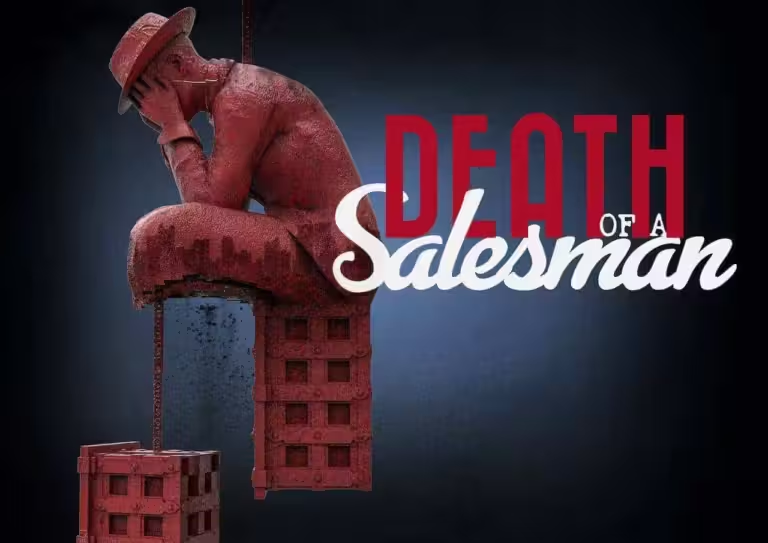
Death of a Salesman is both a social drama and a modern tragedy. Arthur Miller exposes the economic system that makes Willy Loman disposable, yet he also gives Willy agency, responsibility and a desperate struggle for dignity. Social forces create the pressure, while Willy’s choices transform that pressure into tragedy.
Is Death of a Salesman a tragedy or a social drama?
Critics have long debated whether Arthur Miller’s Death of a Salesman should be classified as a tragedy or a social drama. The social interpretation appears immediately convincing: Willy Loman is an ageing travelling salesman discarded by his employer when he can no longer produce sufficient profit. His family struggles with debt, insecure employment and the promises of the American Dream.
However, Miller does more than document social injustice. He presents Willy’s final day as a struggle over identity, dignity, responsibility and the meaning of a human life. The two interpretations are therefore not mutually exclusive: Death of a Salesman is best understood as a modern social tragedy.
Its subject is social because Willy’s crisis develops within a competitive economic system. Its form and emotional effect are tragic because Willy actively defends a mistaken vision of himself until that struggle destroys him.
Social drama
Modern tragedy
Examines work, money, class and economic insecurity
Examines dignity, identity, responsibility and irreversible loss
Shows how institutions shape individual lives
Shows how an individual responds to those pressures
Encourages criticism of society
Produces pity, fear and tragic recognition
Presents Willy as an exploited worker
Presents Willy as an active but mistaken protagonist
Locates the crisis in post-war American capitalism
Arthur Miller structures Death of a Salesman around the interaction of present action, memory and imagination. Willy Loman’s past does not appear as a sequence of conventional flashbacks. It remains active within his present consciousness, shaping what the audience sees, hears and understands.
Why is the structure of Death of a Salesman unusual?
Death of a Salesman combines a simple chronological plot with a much more complex psychological structure. The present-day action covers approximately the final twenty-four hours of Willy Loman’s life, followed by the Requiem after his funeral. Within that narrow period, however, the play moves through several decades of memory, fantasy and imagined conversation.
Arthur Miller does not separate these different periods into conventional scenes. Instead, the present and the past occupy the stage together. A word, object, sound or emotional pressure can transform the theatrical space and bring an earlier moment into immediate dramatic existence.
Miller described this method as a “mobile concurrency of past and present”. The expression emphasises simultaneity rather than retrospection. Willy does not calmly look back upon a completed past; he continues to live inside it.
Structural level
Function
Examples
External plot
Shows the final day of Willy’s life in chronological order
Willy returns home, visits Howard and Charley, meets his sons and dies
Memory scenes
Reconstruct significant episodes from Willy’s past
The young Biff, Ben’s visits and the Boston hotel
Double exposure
Places past and present on stage at the same time
Willy speaks to Charley and Ben within the same sequence
Imagined conversations
Dramatises Willy’s internal arguments
Willy consults the dead Ben about his suicide plan
Requiem
Moves outside Willy’s consciousness after his death