
A Midsummer Night's Dream : synopsis photo

A Midsummer Night’s Dream: Complete Act-by-Act Synopsis

  1. A Midsummer Night’s Dream: Introduction and Context
  2. Background of A Midsummer Night’s Dream: Myth, Folklore and Festivity
  3. Structure in A Midsummer Night’s Dream: Plots and Patterns
  4. Why Is A Midsummer Night’s Dream a Comedy?
  5. A Midsummer Night’s Dream: Complete Act-by-Act Synopsis

In A Midsummer Night’s Dream, four young Athenians enter an enchanted forest where fairy magic transforms their affections. Meanwhile, Oberon humiliates Titania by making her fall in love with Bottom, an amateur actor carrying a donkey’s head. After a night of confusion, Puck restores the lovers, three couples marry, and the mechanicals perform their unintentionally comic tragedy.

William Shakespeare combines several stories within this comedy. The court of Athens represents law and social order. The forest releases imagination, desire and disorder. The mechanicals add theatrical comedy, while Oberon, Titania and Puck control the supernatural world.

This act-by-act synopsis explains how these separate groups enter the forest, collide during the night and return to Athens. For broader context, begin with the introduction to A Midsummer Night’s Dream.

A Midsummer Night’s Dream: short summary

Hermia loves Lysander, but her father orders her to marry Demetrius. Hermia and Lysander flee into the forest. Demetrius follows them, pursued by Helena, who remains desperately in love with him.

In the same forest, the fairy king Oberon quarrels with Titania over a young Indian boy. Oberon asks Puck to use a magical flower on Titania and Demetrius. However, Puck mistakes Lysander for Demetrius. Both young men eventually pursue Helena, leaving Hermia rejected and confused.

Puck also gives Bottom the head of a donkey. Titania wakes under Oberon’s spell and immediately falls in love with him. Once Oberon has secured the Indian boy, he removes Titania’s enchantment. Puck restores Lysander’s love for Hermia, while Demetrius continues to love Helena.

Theseus discovers the four lovers and allows both couples to marry. Bottom rejoins the mechanicals, who perform Pyramus and Thisbe during the wedding celebrations. Finally, the fairies bless the palace and Puck invites the audience to remember the performance as a dream.

Lire A Midsummer Night’s Dream: Complete Act-by-Act Synopsis

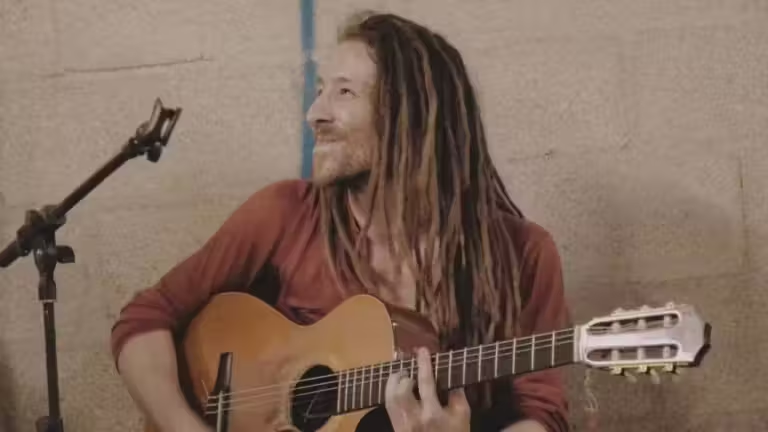
Vanupié featuring Lidiop - Rockadown (Châtelet-Les-Halles session) photo

Vanupié featuring Lidiop – Rockadown (Châtelet-Les-Halles session)

Voici Vanupié et Lidiop qui jouent le morceau Rockadown dans les couloirs du métro parisien à la station de métro Châtelet-Les-Halles :

De superbes voix et une musique totalement planantes. Admirez aussi le regard empli d’amour entre les deux musiciens, c’est absolument fascinant.

Vanupié, né en 1980 à Annecy, est un auteur-compositeur-interprète, chanteur et musicien de reggae-soul français.

Dans une autre vie, Vanupié a travaillé pour une grande agence de publicité avant de tout plaquer pour se consacrer à sa musique.

L’idée de départ était d’accumuler les concerts et d’en assurer la promotion par la distribution de flyers. Il se fait connaître grâce à ses prestations dans le métro parisien.

Vanupié aurait pu arrêter l’expérience il y a bien longtemps. Depuis ses débuts, il a rempli La Cigale, joué au Bataclan, assuré la première partie d’UB40, The Wailers, SOJA, Tryo ou encore Alpha Bondy, fait Solidays et tourne à une moyenne de 100 concerts par an.

Rockadown est issue de l’album Janus (2017).

Utiliser un NAS Synology comme disque Time Machine sous MacOS photo 11

Utiliser un NAS Synology comme disque Time Machine sous MacOS

Time Machine permet de sauvegarder automatiquement un Mac, puis de restaurer des fichiers, des dossiers, des réglages ou une machine complète en cas de problème.

La méthode la plus classique consiste à brancher un disque USB ou Thunderbolt au Mac. C’est simple, fiable, et souvent très rapide. Mais si vous avez déjà un NAS Synology, vous pouvez aussi l’utiliser comme destination Time Machine.

L’intérêt est évident : les sauvegardes se lancent automatiquement sur le réseau, sans brancher de disque externe. Le Mac voit le NAS comme un disque de sauvegarde, et Time Machine s’occupe du reste.

La configuration propre consiste à créer un dossier partagé dédié, un utilisateur dédié, un quota pour éviter que Time Machine ne mange tout l’espace du NAS, puis à activer la diffusion Time Machine via SMB dans DSM.

Lire Utiliser un NAS Synology comme disque Time Machine sous MacOS