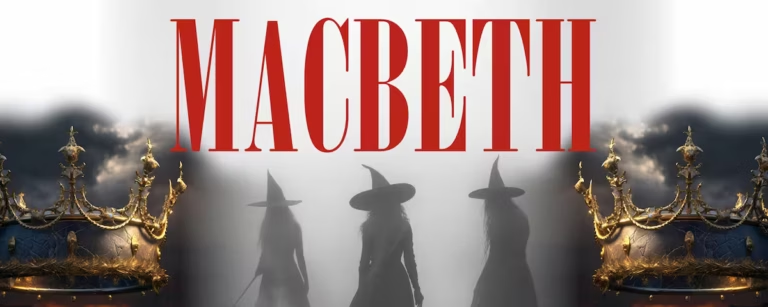
Trois sorcières ombrageuses portant des chapeaux pointus se tiennent sous le grand texte rouge "MACBETH", flanqué de couronnes dorées ornementées, tandis que des nuages sombres évoquent la tension de la scène et laissent entrevoir la violence imminente dans cette atmosphère dramatique et mystique.

The Dramatic Quality in Macbeth: Violence, Prophecy and Stage Tension

Macbeth is not only a tragedy about ambition. It is also one of Shakespeare’s most theatrical plays. Its dramatic quality comes from the way Shakespeare turns prophecy, violence, guilt, political disorder and stage movement into visible tension.

The play rarely lets the audience rest. From the opening thunder to the final battle, Macbeth moves through shocks, reversals, entrances, exits, apparitions, murders and sudden changes of rhythm. In other words, Shakespeare does not merely tell the story of Macbeth’s fall. He stages it as a progressive collapse of moral, political and psychological order.

Lire The Dramatic Quality in Macbeth: Violence, Prophecy and Stage Tension

Political questions in "Macbeth" photo

Political Questions in Macbeth: Kingship, Tyranny and Legitimacy

Macbeth is not only a tragedy of ambition. It is also a deeply political play about kingship, legitimacy, tyranny, treason, rebellion and the collapse of order. Shakespeare shows what happens when private ambition attacks public authority.

Political questions are typical of Renaissance drama, especially because monarchy was associated with inheritance, providence and divine right. In this vision of the world, the king is not merely a political leader. He is part of a sacred order. Therefore, to murder a rightful monarch is not simply to commit a crime. It is to wound the entire structure of society.

At the beginning of the play, Scotland has a legitimate king. By the middle, it has a usurper. By the end, it needs political restoration. The movement of the play is therefore political as well as psychological: Macbeth’s inner corruption becomes a national disaster.

This is why the political questions in Macbeth matter so much. Shakespeare does not simply ask whether Macbeth wants power. He asks what power becomes when it loses legitimacy, morality and public trust.

Lire Political Questions in Macbeth: Kingship, Tyranny and Legitimacy

Introduction to "Macbeth" photo

Introduction to Macbeth: Plot, Characters, Themes and Tragedy

Macbeth is one of Shakespeare’s darkest and most concentrated tragedies. It tells the story of a brave Scottish soldier who hears a prophecy, murders his king, seizes the crown, and gradually destroys himself through fear, guilt and tyranny.

The play is short, violent and psychologically intense. Shakespeare does not simply show a bad man doing evil. He shows a noble man becoming evil while knowing exactly what he is doing. That is why Macbeth remains so powerful: the tragedy lies in Macbeth’s awareness.

At its centre, the play asks a brutal question: what happens when ambition oversteps moral limits?

Lire Introduction to Macbeth: Plot, Characters, Themes and Tragedy