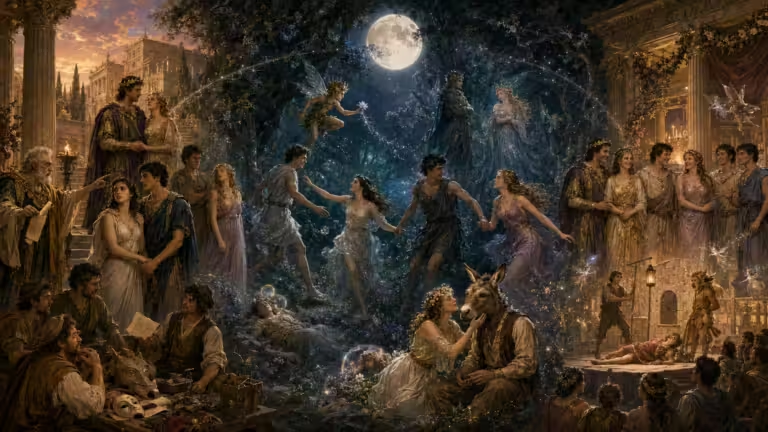
The structure of A Midsummer Night’s Dream brings together four dramatic worlds: the Athenian court, the young lovers, the mechanicals and the fairies. Shakespeare first presents these groups separately, sends them into the same forest, and then reunites them through marriage, performance and supernatural blessing.
Beneath the play’s apparent confusion lies an exceptionally controlled design. Its action moves from legal obstruction in Athens to emotional and magical disorder in the forest. It then returns to the city, where the events of the night are transformed into marriage, memory and theatre.
The conclusion does not merely restore the opening situation. Hermia escapes the marriage imposed by her father, Demetrius remains under the influence of magic, and the fairies enter the palace after the human characters retire. Shakespeare produces comic order, but he also preserves uncertainty.
Readers who need to review the events first can consult the complete act-by-act synopsis of A Midsummer Night’s Dream. This article focuses on how Shakespeare arranges those events into a coherent dramatic pattern.
The structure of A Midsummer Night’s Dream at a glance
The play contains five acts and nine scenes. However, its deeper structure depends less upon the conventional act divisions than upon changes of place, time, character grouping and dramatic control.
| Structural element | Beginning | Middle | Ending |
|---|---|---|---|
| Place | Athens | The forest outside Athens | Athens and the ducal palace |
| Time | Day and approaching evening | Night, sleep and dream | Dawn, wedding celebrations and night |
| Social condition | Law, hierarchy and obstruction | Misrule, transformation and confusion | Marriage, performance and qualified harmony |
| Lovers | Unequal romantic relationships | Magically rearranged desires | Two recognised couples |
| Fairies | Initially absent from Athens | Control much of the action | Enter and bless the palace |
| Mechanicals | Plan their production | Rehearse and encounter magic | Perform before the court |
| Theatre | A future wedding entertainment | Rehearsal and involuntary performance | Pyramus and Thisbe and Puck’s epilogue |
This pattern is often summarised as a movement from society into a “green world” and back. Yet Shakespeare complicates that model. Athens changes after the forest experience, while the fairies cross the apparent boundary and occupy the palace during the final scene.