Turin Brakes
Turin Brakes are an English band, comprising original duo of Olly Knights and Gale Paridjanian, and long-term collaborators Rob Allum and Eddie Myer. They had a UK top 5 hit in 2003 with their song « Painkiller (Summer Rain) ».
The band was started by long-time friends Knights and Paridjanian. The two met at a young age and spent much of their childhood together, both receiving guitars as Christmas presents at the age of 10.
Although they split after Knights went to film school and Paridjanian attempted to form a band in Toronto, Ontario, Canada, they soon reunited and collaborated on what would later become their first EP, The Door, which was eventually released through Anvil Records in 1999 as a limited vinyl release. This led to the band attracting the attention of larger record labels.
Source Records would eventually release two more EPs, The State of Things EP and Fight or Flight, prompting NME to proclaim « Turin Brakes inhabit a space which is entirely their own, fully formed and brutally emotive… give them the devotion they deserve. »
Source reissued the song « The Door » before releasing their first album, The Optimist LP, in 2001. The album, which was released in the United States by Astralwerks, was greeted with critical praise, spawned several modestly successful UK singles, « Underdog (Save Me) » (reaching no. 39 in the UK Singles Charts), Mind Over Money (reaching no. 31) and « Emergency 72 », and received a nomination for the Mercury Music Prize.
In August 2001, the album was certified Gold by the British Phonographic Industry. A planned tour of the United States opening for the Stereophonics and Matthew Jay, was cancelled due to the September 11 terrorist attacks. Still, the band played at over 80 venues in Europe and the United States that year.
Turin Brakes have often been compared to many of the new acoustic movement bands spawned in the late 1990s such as Elbow, Starsailor, and the Norwegian band Kings of Convenience, whose 2001 album entitled Quiet Is the New Loud is a helpful indicator of the band’s first album.
With each record, Turin Brakes try to change their sound. While the first album features a lot of acoustic guitar, Ether Song featured more electric guitar and was, in total, a lot darker. The third album, Jackinabox, can be seen as a combination of the first two albums, with some funk influences.
While Dark on Fire featured a bigger sound produced by Ethan Johns, 2010’s Outbursts can be seen as a return to the sound of The Optimist LP. Turin Brakes formerly performed live as a five-piece outfit to achieve a full band sound, and were joined on stage (and often also in the studio) by Rob Allum (drums), Phil Marten (keyboards) and Eddie Myer (bass).
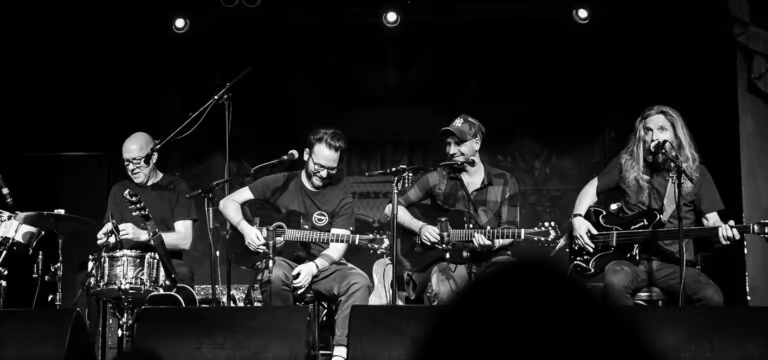
Following Marten’s departure, they now perform as a four-piece band, with Gale’s guitar playing being more prominent and more richly contributing to the live sound.
On 6 September 2012, all four Turin Brakes members played at a « Spirit of Talk Talk » evening at 229 Great Portland Street where they joined some former members of Talk Talk to play a few hits including It’s My Life, with the band then playing a set of their own afterwards.
Before playing the song « Painkiller » Gale announced to the audience that although it wouldn’t be obvious to most people the song was heavily influenced by Talk Talk and by the work they did with producer Phill Brown in the Kent countryside some years ago.
Turin Brakes guitar tabs