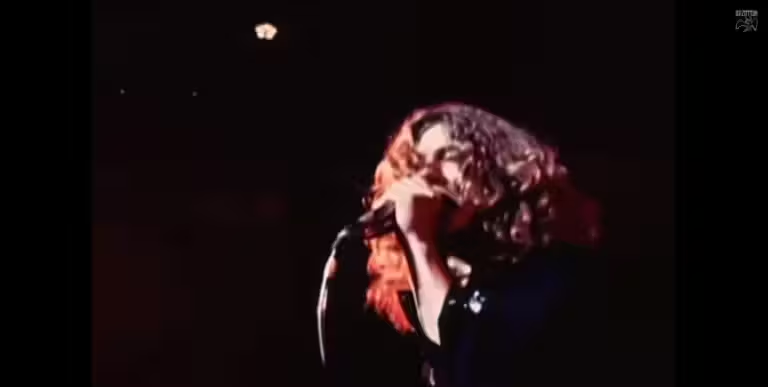

Si, de temps à autre, il vous arrive de laisser votre femme/copine/mère (rayez les mentions inutiles) conduire votre voiture et que votre réaction pendant tout le trajet se résume à ceci :
… alors vous n’êtes pas seul !
Anyone ?
Si, de temps à autre, il vous arrive de laisser votre femme/copine/mère (rayez les mentions inutiles) conduire votre voiture et que votre réaction pendant tout le trajet se résume à ceci :
… alors vous n’êtes pas seul !
Anyone ?
Un petit peu de steampunk dans ce clip pour la chanson Eye of the Storm de Lovett :
Cela me permet de parler un peu du mouvement steampunk, qui est au départ un genre littéraire dont l’intitulé a été forgé par allusion au cyberpunk par l’auteur K. W. Jeter à titre de boutade.
Pour cette raison, il est parfois plus approprié de parler de « rétrofuturisme » pour désigner le mouvement.
L’expression steampunk, (“punk à vapeur” littéralement) est un terme inventé pour qualifier un genre de littérature né à la fin du XXe siècle, dont l’action se déroule dans l’atmosphère de la société industrielle du XIXe siècle.
Le terme fait référence à l’utilisation massive des machines à vapeur au début de la révolution industrielle puis à l’époque victorienne.
Aujourd’hui le steampunk est considéré comme un esthétisme pouvant intéresser à la fois des œuvres littéraire fantastique, de fantasy, d’anticipation et certains sous-genres de la science-fiction.
My several years in the word game have learnt me several rules:
A writer must not shift your point of view.
A writer should not alienate half his readers by using gender-specific language.
Also, always avoid annoying alliteration.
Always pick on the correct idiom.
Analogies in writing are like feathers on a snake.
And don’t start a sentence with a conjunction.
Avoid clichés like the plague – they’re old hat.
Avoid trendy locutions that sound flaky.
Be careful to use the rite homonym.
Be more-or-less specific.
Contractions aren’t necessary, and shouldn’t be used.
DO NOT use all caps for emphasis.
Do not use hyperbole; not one in a million can do it effectively.
“Do not use unattributed quotations.”
Don’t be redundant; don’t use more words than necessary; it’s highly superfluous.
Don’t indulge in sesquipedalian lexicological constructions.
Don’t never use no double negatives – that’s a no-no!
Don’t overuse exclamation marks!!!!!
Don’t repeat yourself, or recapitulate what you have said before.
Eliminate quotations. As Ralph Waldo Emerson said, “I hate quotations. Tell me what you know.”
Eschew ampersands & abbreviations, etc.
Eschew obfuscation.
Everyone should be careful to use a singular pronoun with singular nouns in their writing.
Exaggeration is a million times worse than understatement.
Foreign words and phrases are no longer de rigueur; French is so passé.
Go around the barn at high noon to avoid colloquialisms.
If any word is improper at the end of a sentence, a linking verb is.
Indubitably, you should employ the vernacular.
It behoves thee to be abstentious of archaic expressions.
Never use a big word when a diminutive alternative would suffice.
No sentence fragments.
One should never generalise.
One-word sentences? Eliminate. Always!
Parenthetical remarks (however relevant) are unnecessary.
Parenthetical words however must be enclosed in commas.
Place pronouns as close as possible, especially in long sentences of ten or more words, to their antecedents.
Placing a comma between subject and predicate, is not correct.
Prepositions are not words to end a sentence with.
Proofread carefully to see if you any words out.
Puns are for children, not groan adults.
Remember to never split an infinitive.
Subject and verb always has to agree.
Take the bull by the hand and avoid mixing metaphors.
The passive voice is to be avoided.
Understatement is always absolutely the most fantastic and best way to promote earth-shattering ideas.
Use an apostrophe in it’s proper place, but omit it when its not needed.
Use words correctly, irregardless of how others use them.
Using euphemisms is ill-advised; they should be consigned to the sanitary landfill.
Who needs rhetorical questions?
Writing carefully, dangling participles must be avoided.
— Written by Frank L. Visco and originally published in the June 1986 issue of Writers’ Digest.